
The tinfoil shook because my hands shook, and I couldn't hold the lighter steady enough to chase the little brown line without scorching it into nothing. A piece of it blackened and curled and turned into a taste at the back of my throat, burned plastic and powdered sugar. I held the smoke until my chest ached, because that was the only prayer I had left. It didn't hit. Or it hit the way a screen door hits when you slam it. You feel something, technically.
I set the foil down on the carpet next to a Diet Coke can that had been there since before Mara left. The carpet was that colour apartments get when nobody has lived in them properly for years, not grey, not brown, something in between that you can't name and don't want to. The building was condemned. I knew this because of the sign on the front door and because the water had been off for two weeks. I'd been pissing in a bucket near the window. The window didn't have glass anymore. Someone had taken it or it had fallen out. I never asked.
I couldn't remember the last thing I ate that wasn't a gas station pastry. When I tried to think about it my mind slid off the question like oil. Mara would have known. Mara kept track of things like that, meals and appointments and which bills were three months late versus four. Then she stopped keeping track and then she stopped being here, and the only evidence she'd existed at all was a hair tie on the bathroom doorknob and the dent in the mattress where she used to sleep facing away from me.
The warehouse job lasted eleven weeks. My manager, a guy named Phil with a moustache that looked drawn on with marker, called me into the office on a Tuesday and told me I was done. He didn't say why. He didn't need to. I'd been nodding off behind the forklift and everyone knew it, and the fact they'd let it go eleven weeks was more kindness than I had coming. Phil had a photo of a golden retriever on his desk. I stared at it while he talked because looking at his face seemed harder than it should have been. He said something about a final cheque. I said something back. I don't remember what.
That was three weeks ago. Or four. Time had stopped being something I measured and started being something that happened to me, like weather.
My mother used to tell a story about her brother Rafael, and I never knew if it was a warning or a ghost story or just something she had to say out loud to keep it from rotting inside her. She told it the same way every time, sitting at the kitchen table with her coffee going cold, her fingers working the beads of the rosary she kept in her apron pocket. I was maybe seven the first time. I didn't understand half of it. I understood all of it.
Rafael showed up at my grandparents' house in Juárez on a Thursday evening in the summer of 1974. I know it was Thursday because my mother always said Thursday like it mattered, like the day of the week was a detail God was keeping notes on. He came through the front door without knocking, wearing a white shirt that looked expensive, carrying a leather suitcase that hung off his arm heavier than a suitcase should. My grandmother was making tortillas. The kitchen smelled like cumin and lard and the sharp char of one left too long on the comal. That smell. I can't separate it from what came after. Every time I smell cumin I see my uncle's mouth bleeding and smiling at the same time and I feel my mother's hand pulling me behind her skirt.
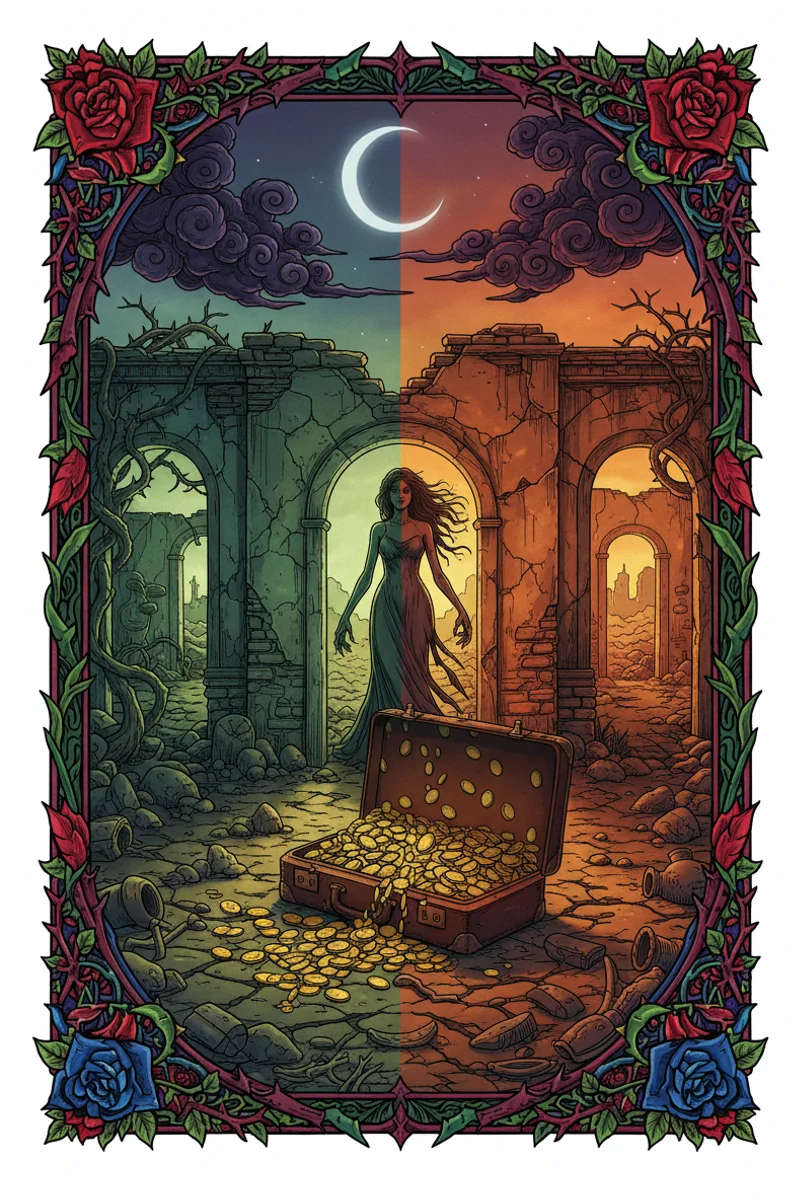
He opened the suitcase on the kitchen table without a word and gold coins spilled out onto the linoleum. Not a few. Dozens. They scattered and rolled and some of them spun like tops before going flat. Banknotes too, currencies I wouldn't be able to name for another twenty years. My grandmother screamed. Not a surprised scream. A knowing one, like she'd been waiting for this exact thing and had already done her grieving over it.
My grandfather hit Rafael across the mouth. Then my grandmother came at him with the wooden spoon, the big one she used for the beans, and she hit him again and again, crying, saying things in Spanish I was too young to understand and old enough to feel. She crossed herself. She said La Virgen de Guadalupe's name the way you'd call for someone standing just outside the room. My grandfather grabbed the suitcase and threw it and more coins went everywhere and my mother pulled me behind her and I could feel her heartbeat through the fabric of her dress.
Rafael stood there and took it. Bleeding from his lip, bleeding from a cut above his eye where the spoon had caught him, and smiling. That was the part that got me every time she told it. He was smiling. Not cruel, not crazy. A tired smile. The smile of someone who'd been carrying something so heavy for so long that a beating felt like a place to set it down.
They threw him out. My grandmother wouldn't let anyone touch the coins for three days. She made my grandfather sweep them into a pile with a broom, and she burned sage over them, and then he drove them to the river and threw them in. My mother said she watched from the kitchen window as her brother walked down the street with the empty suitcase, not looking back.
That was the last time anyone in the family saw Rafael Serna.
My mother told me never to look for him. She said it the way you'd say don't touch the stove, not angry, just certain of the burn. "He sold something that wasn't his to sell." I asked her what. She shook her head and crossed herself and that was the end of that conversation.
I thought about Rafael sometimes when I was high. I thought about him the way you think about a wreck on the highway. Slowing down to look even though you know better. Even though you know what you'll see.
The county lockup smelled like bleach and urine and the particular sadness of fluorescent lights at three in the morning. They'd picked me up outside a 7-Eleven on Alameda. Pipe in my jacket pocket, baggie with enough residue to make the officer's night. The cop who cuffed me had hands like baseball mitts and he was gentle about it, which was worse than rough. Rough I could have gotten angry at. Gentle just made me feel like something being handled carefully. Like evidence.
They gave me a phone call. I picked up the receiver and stared at the numbers and my mother's was the only one I knew by heart and I put the phone back down. I told myself it was pride. That wasn't it. Behind me the booking officer was reciting my charges to somebody, and the thought of those words travelling down a phone line into her kitchen, where she'd be standing with her coffee and her rosary, was something I physically could not make happen. I'd rather disappear. Which, as it turned out, was more or less what happened.
I spent the night on a plastic bench next to a guy picked up for public intoxication who talked in his sleep about someone named Darla. The withdrawal was starting. My skin felt like it was on inside out. Every few minutes a cramp moved through my stomach like a fist opening and closing. I lay on my side and watched the ceiling and waited for morning.
Morning came and a guard told me someone had posted my bail.
I didn't know anyone who would post my bail. I didn't know anyone who had bail money. I said as much and the guard shrugged like it wasn't his problem, which it wasn't, and walked me through processing. They gave me back my jacket and my wallet, which had eleven dollars in it, and the laces for my shoes. I signed something. The signature didn't look like mine.
Outside the front door of the jail a black SUV sat idling at the kerb. A man I'd never seen before leaned against the passenger side, short, well dressed, wearing sunglasses at dawn. He said my name. Not a question.
I should have walked away. That's what people say after, right? I should have walked away. But I was twenty-eight years old with eleven dollars and a body starting to eat itself from the inside out, and the only person who loved me was someone I couldn't call. The man opened the back door. I got in.
He handed me a bottle of water and a white pill and said it would help with the sickness. I took it because I would have taken anything. Within minutes the cramps smoothed out and the sweating stopped, and then I was watching the El Paso skyline shrink in the rear window, and then I wasn't watching anything at all.
I woke up on clean sheets. White plaster ceiling, exposed wooden beams, a fan turning slow, the air cool. My body felt wrong in a way that took me a long time to identify. It didn't hurt. Nothing hurt. The withdrawal wasn't suppressed or managed, it was gone, like someone had reached in and pulled the sickness out by the root. I lay there in the absence of pain and for maybe three seconds it was the most beautiful thing I had ever experienced. Cool tile under my bare feet when I swung my legs over the edge of the bed. Clean. Medical clean, the kind that means somebody is paying attention to surfaces.
Then the wrongness registered. Not in my body. In the air, in the light, in the quality of the silence. The bedroom was large and well furnished and smelled faintly of cedar and leather polish. Out the window, flat dry country, scrubland running to low brown hills. No road. No power lines. The sky was too big.
There were no insects. I stood at the window a full minute listening to nothing. No birds. No dogs. Not even wind. The biological silence of a place everything alive has agreed to leave.
"You slept fourteen hours."
I spun around. The man in the doorway wasn't what I expected. Seventies, maybe. Tanned, broad through the shoulders, a full head of white hair. He looked healthy. Better than healthy. He looked like someone who played tennis three times a week and drank expensive wine and had never missed a meal he didn't want to miss. Linen shirt, cotton trousers, leather sandals. He looked like retirement. Like a magazine advertisement for retirement.
His eyes were what stopped me.
Everything else about him was maintained, preserved, kept in working order like a car that gets washed and waxed every week. But his eyes were the eyes of a dog beaten so long it had stopped flinching. Not sad, exactly. Past sad. Somewhere on the far side of sad where the word quits meaning anything.
"Do you know who I am?" he said.
I did. I don't know how. Something in the shape of his face, something my mother's kitchen had encoded in me decades ago.
"Rafael," I said.
He nodded, came into the room, sat on the edge of an armchair across from the bed. His movements were careful, deliberate. Not old man careful. Prisoner careful. The kind of careful you learn when certain parts of a room turn out to be safer than others.
"I paid your bail," he said. "I've been watching a while. Not personally. I have people who watch."
"Why."
He didn't answer that yet. "Are you hungry?" he said instead, and I realised I was starving in a way I hadn't been in months, actual hunger where the nausea used to sit. He took me down a hallway with tile floors and whitewashed walls to a kitchen where a plate was already waiting. Rice and beans and grilled chicken and fresh tortillas. I sat and ate and he watched me eat and neither of us spoke. A clock hung on the wall, the old kind with a pendulum, and its ticking was the only sound in the house.
He took me to the study after. There was a gold coin on the desk and I picked it up without thinking. It was warm. Not room temperature. Warm like someone had been holding it in a fist. Heavier than it had any business being. I set it down and rubbed my fingers together and they smelled like struck matches, a faint yellow residue on my thumb, sulphuric, wrong.
"Sit down, Marco."
I sat. He sat across from me. Between us on the desk, next to the coin, lay a brick of brown powder wrapped in cellophane. I knew what it was the way you know your own name. My hand moved. I watched it move. It got about six inches off my thigh before I caught it with my other hand and held it there, and my uncle watched this happen with an expression I couldn't read.
"That's part of it," he said. "If you want."
"Part of what."
He leaned back and rubbed his face with both hands. When he took them away he looked ten years older, like the face he'd been wearing was something he had to hold in place by effort.
"I made a deal," he said. "Fifty years ago. With a woman. Her name is Verlette Quinn."
He said it the way you'd name a street you drive every day. No drama, no weight. A fact, ordinary and terrible.
"During the day she's beautiful. The most beautiful woman you've ever seen. She takes care of the house. Cooks sometimes. Sits in the garden. You could love her during the day if you let yourself, and I let myself, the first couple of years, because it was easier than not."
He stopped. He looked at the wall behind me.
"At night she's something else. Something old. She comes to the bedroom and she isn't the woman from the daytime anymore, she's the thing that's been wearing the woman. And she uses you. Every night. For fifty years."
He said it like he was reading off a bus schedule. Flat. Bored, nearly. The monotone of a man who's run the words through his head so many times they've lost their edges, and my stomach turned worse than any monster description could have managed. I've heard junkies describe overdoses with more feeling than he used on fifty years of whatever had been done to him.
"I can't leave," he said. "I've tried. I can't die on my own. Tried that too. She won't let me. The deal was my lifetime and she decides when that ends."
"Why am I here."
"Because she'll accept a replacement. She told me. Years ago she told me."
Something cold moved through my chest, and it wasn't fear. It was recognition. Like a key turning.
"I can't," I said.
"I know." He let that sit. Then: "She knows you're here. She accepted you when you walked through the door. You leave, she goes after your mother."
He said my mother's name. Elena. He said it quietly, not looking at me, and afterward his jaw worked like he was chewing something that wouldn't go down.
"You're full of shit," I said, but my voice came out thin. The voice of someone who already believes.
"The ranch is yours. The money. The accounts. Everything. And that." He nodded at the brick. "As much as you want. Forever."
I opened my mouth. Nothing came. We sat in the quiet and the clock ticked in the hallway and the sun dropped lower until the light through the window turned the colour of bruised fruit.
He stood up. Slowly. He reached behind his back and when his hand came around it held a revolver, a snub-nosed thing, old and well oiled.
"Don't."
"I can't do another night. I can't." His voice cracked for the first and only time. He was looking at me and his eyes were asking something he never said and never would.
I reached for his arm half a second too late. The sound was shorter than I expected, a hard pop, a textbook dropping flat on concrete. Something wet and warm hit my forearm. Body temperature. Like spilled soup. He folded onto the floor without drama, mechanically, a thing switching off.
The silence after was worse than the sound. The clock ticked in the hallway. The sulphur on my fingers mixed with something copper and new. I looked at the warmth on my arm and couldn't connect it to the man on the floor and couldn't disconnect it either.
Then, under the ticking, from somewhere down the long tile hallway, footsteps. A woman's footsteps. Slow. Patient. Coming closer in a house where nothing outside had made a sound for miles in any direction.
I looked at the door. I looked at the brick on the desk. I looked at my uncle on the floor, his body perfect, maintained, kept beautiful for something that owned him.
The footsteps got