
The ring fit like it was made for my finger. That's the part that should have told me something.
I was twenty four years old with ninety dollars in my wallet and a Dodge Dart that burned oil so bad you could track me across three states by the blue haze. I'd left Sarasota on a Tuesday because there was nothing keeping me there and I wanted to see every piece of this country before I turned thirty. I had a list in a spiral notebook. Grand Canyon. Yellowstone. Big Sur. The redwoods. I'd crossed off Big Sur two days before because I drove through it at night and couldn't see a damn thing but figured it still counted.
The redwoods were new. Redwood National Park had only been a park for two years and I read about it in a magazine at a laundromat in Eureka while my clothes went around. The photographs looked like another planet. Trees so big the cars parked next to them looked like toys. I tore the page out and used it as a bookmark.
I got there on a morning in October of 1970. Parked in a dirt lot with three other cars and walked in.
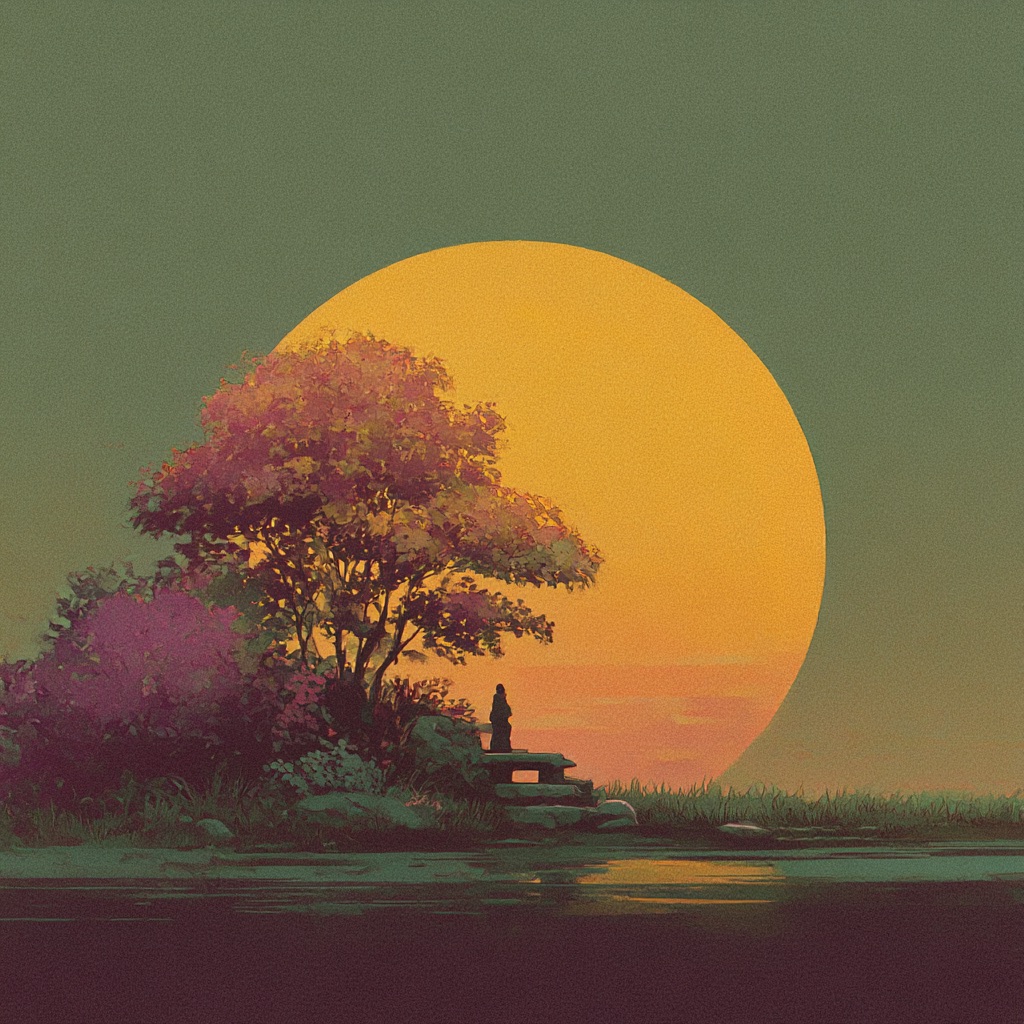
The fog was the first thing. Not fog like Florida fog, which is warm and sits on you like a wet towel. This was something else. It smelled like opening a cabinet in a house where somebody died and nobody found them for a while. Damp wood and fungus and something sweet underneath that you didn't want to think about too hard. The trees went up and the fog came down and somewhere in the middle they met and you couldn't tell where one ended and the other began. I walked for maybe an hour on a marked trail, then I walked off it, because the trail felt small and I hadn't come all the way from Florida to follow signs.
I know now that was the ring pulling me. Or I don't know that. I don't know anything for certain except what I found and what it did. But I think about that moment a lot. How my feet just turned left where there was no path and kept going. How the ferns came up waist high and soaking and I didn't care. How the trees got bigger the further I went, trunks wide enough to park the Dart inside, bark so thick and furrowed it looked like the skin of something that had been alive since before people were an idea.
I almost tripped on it. The chest. It was half buried in the duff, that's what they call the floor of the forest, all needles and decomposed bark and centuries of things falling and rotting and becoming soil. The corner of it was sticking up like a bone coming through skin. I kicked at it with my boot and felt solid wood underneath. Took me ten minutes to dig it out with my hands. My fingernails were black by the time I had it free.
It was small. The size of a cigar box, maybe a little bigger. Made from some wood I didn't recognise, dark and dense and smooth as glass where the dirt hadn't gotten into the grain. On the bottom somebody had carved a name. ELIAS WARRICK. The letters were precise, not scratched in but cut with something sharp and steady. Like whoever held the knife had all the time in the world to get it right.
The lid was stuck but not locked. I pried it open with my thumbnail and a smell came out that was concentrated forest. Not fresh forest. Old forest. Forest that had been sealed away and was now breathing for the first time in years or decades or longer.
Inside was a ring and a note.
The ring was wood too. Light coloured, a pale grain that caught what little light filtered down through the canopy. Plain. No carving, no markings. Just a circle of wood, smooth and thin, turned on a lathe by somebody with more skill than I'd ever seen.
The note was folded twice. The paper felt like cloth under my fingers, soft and fragile, and when I unfolded it the creases tore a little, small whispers of disintegration, like the thing had been holding itself together out of pure stubbornness and now that somebody was reading it, it could finally let go. The ink had faded to brown. Dried blood brown. The handwriting was cramped and slanted hard to the left.
It said, Love will find you whether you want it or not. It will find you and it will not let you go. Do not put this on. It does not come off, and it will keep you from feeling what they feel. You will carry it until you can't carry anything. I am sorry. I was not strong enough to destroy it and neither will you be.
I read it twice. Turned it over. Nothing on the back. I looked at the ring sitting in the chest on a little bed of moss gone dry and brown. Picked it up and held it between my thumb and forefinger. It weighed almost nothing.
Here's what I want to tell you. That I didn't know. That I was young and stupid and the note seemed like a joke, some hippie nonsense left in the woods by somebody who'd eaten the wrong mushrooms. And part of that is true. I was young and stupid. But I read that note and felt something in my chest I can only call recognition. Like somebody had described a room I was already standing in. Love will find you whether you want it or not. I'd had girlfriends in Sarasota. I'd had a girl named Kim who cried when I told her I was leaving and I felt nothing. No guilt, no relief, nothing at all. Like watching a stranger cry on a bus.
I put the ring on my left ring finger and it slid on smooth and warm.
That was fifty years ago. I have not been able to remove it since. Soap, butter, ice water, WD-40. Dental floss wound tight to squeeze the flesh down. Other things I'm not going to write down, because they involved blood. None of it worked. The ring sits on my finger like it grew there. Like it is my finger.
I left the redwoods that same day. Drove south with the chest on the passenger seat and the note folded back into it and the fog still clinging to my clothes. By the time I hit San Francisco the fog had burned off and the ring was just a ring on my finger and I told myself nothing had changed.
Things changed.
I drove to Reno and a woman at a gas station told me I had the most beautiful eyes she'd ever seen. My eyes are brown. Not interesting brown. Just brown. In Salt Lake City a waitress wrote her phone number on my receipt and drew a heart next to it. In Cheyenne a man followed me out of a bar and told me he loved me and started crying. I had spoken six words to him.
By the time I reached Nebraska I understood. The note wasn't hippie nonsense. The ring was a magnet and every person I met was iron filings.
I want to be clear about something. I am not a good looking man. I was not a good looking young man. I have a face like a shovel and ears that stick out and I've been told my smile looks like I'm about to do something illegal. The ring didn't change what I looked like. It changed what people saw when they looked at me. Whatever ache lived inside them, whatever gap, they looked at me and saw it closing. I could feel it happen. A shift in their eyes like a channel changing. One second I was a stranger and the next I was the most important person they'd ever met.
And I felt nothing back. Not a goddamn thing.
I drove. For years I drove. Montana. The Dakotas. Minnesota, where the cold hurt so bad I thought my wooden finger would crack and split. Down through Missouri, across to Tennessee, back west through Arkansas and Oklahoma. I still had the list in my spiral notebook but I stopped crossing things off because the places had stopped mattering. I'd stand at the rim of the Grand Canyon and look down into that mile of geology and feel exactly what I'd feel looking at a parking lot. By then the wandering had turned into plain running. I was getting away from all those eyes that saw something in me that wasn't there.
I ended up in Arizona because the Dart's transmission finally gave out on I-10 about forty miles east of Tucson. I walked to the nearest exit and there was a 24-hour diner with a neon sign that buzzed and flickered and said EAT in red letters. One of the letters might have been burnt out. I don't remember which.
It was 3 AM. The place smelled like grease and like coffee that had sat on the burner so long it had given up being coffee and become something else. A chemical. A punishment. The flat top hissed and spat behind the counter and the floor tiles were the colour of old teeth.
Delfina Reyes brought me eggs without me ordering them.
"You look like you need eggs," she said. She was maybe thirty, dark hair pulled back, a face that was pretty in a way she didn't seem to know about. Her name tag said DELFINA and I didn't ask about it because I didn't care. She set the plate down, the ceramic clinking on the Formica, and poured me coffee from a pot with a ring of black residue around the inside like a bathtub in a condemned building.
"I didn't order eggs."
"I know, honey. But you need them."
She topped off my coffee before I'd taken more than two sips. Then she told me about her cousin's divorce. I don't remember his name. She said he'd married a woman from Flagstaff who collected ceramic frogs and that should have been the first sign. I didn't respond. She told me about monsoon season, how last summer a wash flooded so fast it took out a mailbox and carried it a quarter mile down the road and they found it in somebody's yard with the mail still inside, just soaking wet.
She poured my coffee for the fourth time without being asked and I realised she was gone. I could see it. That channel change in her eyes. It had already happened, maybe the moment I walked in, maybe before the eggs. She was in love with me and nothing I could say would change that. I'd seen it dozens of times by then. Hundreds. But watching it happen to her while she talked about ceramic frogs and monsoon season and the stolen mailbox made me feel a nausea I hadn't felt in years. Like watching somebody step off a cliff and smile at you on the way down.
"You should stop talking to me," I said.
"Why's that, sweetheart?"
"Because I don't want you to."
She laughed. Actually laughed. Picked up my plate, scraped the leftover yolk into a bus tub, and came back with more coffee.
I stayed because the Dart was dead and I didn't have money for a transmission. She let me sleep in the back booth until morning and then she drove me to a mechanic she knew who let me pay in installments. Three weeks later the car was fixed and I was still there.
She asked me to marry her on a Sunday. I said no. She asked again on a Wednesday. I said no. She asked on a Friday and I said I don't love you and I never will and you're wasting your time and your life and if you had any sense you'd walk away from me and never look back.
She reached across the Formica table and squeezed my hand. "You always say the sweetest things when you're scared."
I couldn't breathe for a second. That's when I understood the full shape of it. The ring didn't just make them love me, it translated me. Indifference came through on their end as mystery. Cruelty came through as passion. When I told her plainly that I felt nothing, she heard the most romantic thing anybody had ever said to her. There was no escape through honesty because honesty itself had been rewritten.
We married at a courthouse in Tucson on a Tuesday afternoon. The clerk had a cold and kept sniffing. Delfina wore a yellow dress she'd bought at a thrift store and she cried when she signed the papers. I signed them too. Not because I loved her. Because I was tired. Tired of driving and tired of running and tired of saying no to somebody who couldn't hear no.
"I know, honey," she said when I told her again that I didn't love her, right there at the clerk's desk with the pen still in my hand. "I know."
We lived in a house she rented and then bought with her diner money and my mechanic's wages, because I'd started working at the shop that fixed the Dart. Decades went past. I'm going to say that again because I need you to understand how it felt. Decades went past. Like watching paint dry on a fence that runs to the horizon.
She hummed while she ironed my shirts. She didn't know any full songs, just fragments, and she'd loop the same eight bars of something over and over until the sound became part of the house like the hum of the refrigerator. She slept with her hand on my wrist. Every night, her warm palm against skin that was slowly becoming something other than skin. She read my silence as depth, my absence as private weather she was patient enough to wait out. She built a cathedral inside her head and I was the altar and every day she came and knelt and prayed and I sat there being made of wood.
Her drugstore perfume. Something floral. Something that tried too hard and knew it was trying too hard and tried anyway. It mixed with the coffee smell she brought home on her clothes and I could map the hours of her shift by how the balance shifted between flowers and burnt arabica.
I tried to be cruel enough to drive her away. Over eggs one morning, because it was always eggs with her, I told her I felt nothing. I told her that her voice was noise. I told her I'd married her because I was too tired to keep saying no. She listened to all of it. Set down her fork. Chewed the piece of toast she was eating and swallowed and took a sip of orange juice.
"You're having a hard day," she said. "I'll make dinner early."
In 1998 I took the chest out of the closet where I'd kept it for twenty eight years and drove to a motel outside of Phoenix. I told her I was visiting a friend. She packed me a sandwich and kissed my cheek and said drive safe. The motel room had a bible in the nightstand and a stain on the ceiling shaped like Texas.
I locked the bathroom door and sat on the edge of the tub with a hacksaw I'd bought at a hardware store. I pressed the blade against the ring on my finger and drew it back.
The sound. Not the wet grinding I expected, nothing like bone and flesh resisting metal. A dry, high pitched singing. A bow drawn across a cello string. I felt the vibration travel up my arm and settle behind my teeth. I pulled the blade again. Same sound. No blood. I looked down.
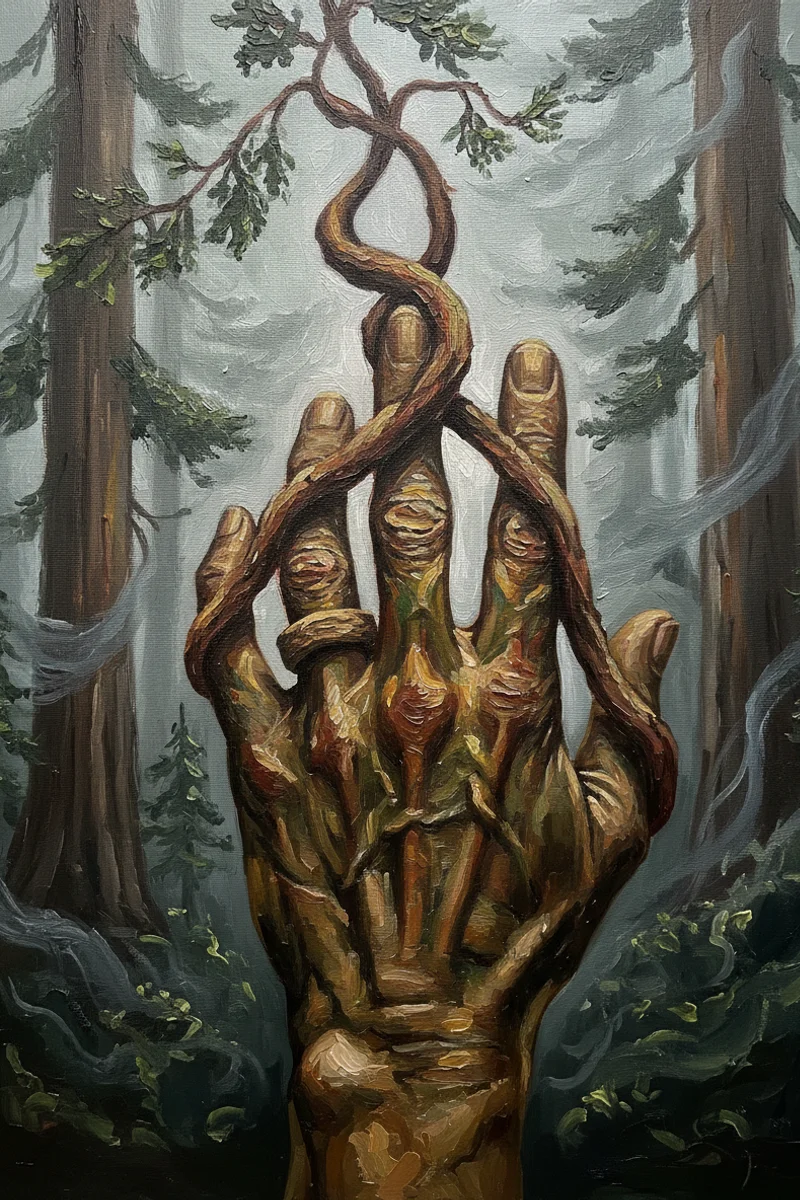
Grain. Pale, tight growth rings in a clean dry surface where my blood and bone should have been. Heartwood. I was looking at heartwood. The cut wasn't bleeding because there was nothing in me to bleed. I could count the rings. Tight ones packed close together near the centre, wider ones toward the outside, the growth pattern of a tree that started in shade and found light.
I stopped sawing. There was no pain. I stopped because I recognised it. The grain in my finger matched the grain of the ring. Matched the grain of the chest. Matched the trees I'd walked through that morning in 1970 when the fog smelled like a sealed cabinet and I put a circle of wood on my finger and became something other than a man.
I set the hacksaw on the rim of the tub and sat there a long time. The stain on the ceiling really did look like Texas. I could hear traffic on the highway through the thin walls. Somebody in the next room had their television on. A laugh track. Some sitcom. People laughing at things that weren't funny.
I drove home and she asked if I'd had a nice visit and I said yes and she said that's good honey and we ate the leftover casserole she'd made and she hummed her eight bars and I watched her hand on the table and thought about the wood inside me.
She died in 2019. Pancreatic cancer. Three months from diagnosis to funeral. She spent most of it apologising to me for leaving. I sat in the chair next to her hospital bed and held her hand and she told me she'd had a wonderful life and that I'd made her so happy and I said nothing, because what could I say. What could I possibly say.
The ring translated my silence too. She smiled at me like I'd said exactly the right thing.
The house is quiet now. Has been for five years. I'm seventy eight. My joints don't bend right anymore and it isn't arthritis. I know what it is. I can feel the grain when I press my thumbnail into the back of my hand, the ridges there under the skin, subtle and undeniable. I am becoming the chest. I am becoming the forest. Elias Warrick became whatever he became and I'm becoming it too.
I'm sitting at the kitchen table right now. Her table. She picked it out at a garage sale in 1986 and refinished it herself and there's still a spot on one corner where the stain is lighter because she got distracted by something on television and didn't put on enough coats. I've got the chest in front of me and the note from Elias Warrick, which is nearly powder now, barely holding its shape. And I've got a clean sheet of paper and a pen.
My handwriting is terrible. My finger joints won't cooperate. The letters come out crooked and stiff and I have to press hard to make the ink flow and I keep worrying I'm going to poke through the paper.
I'm writing a note for whoever finds it next. I'm telling them about the ring. About what it does. About what it costs. I'm trying to find the right words to warn somebody I'll never meet and I keep crossing things out and starting over because nothing sounds right. Nothing sounds big enough or desperate enough or honest enough.
What I want to write is that I'm lonely. That I've been lonely since 1970. That Delfina Reyes ironed my shirts and slept with her hand on my wrist and hummed the same eight bars for fifty years and I let her and I never once told her that she was the only thing that made the weight of the ring feel real. That without her stubbornness and her eggs and her cousin's divorce and her drugstore perfume I would have gone to wood decades sooner. That I don't know whether any of that means I loved her, or whether I'm built to know.
But I can't write any of that. Elias Warrick couldn't write it either. I understand that now. I read his note and it was full of warnings about the ring and nothing about himself. Nothing about who he was or who he'd lost or what he felt when the grain came up in his bones. Just warnings. Because the warnings are the only part you can stand to put down. The rest of it is too much. The rest of it sounds too much like love.
Tomorrow I'm driving to the redwoods. The Dart is long gone but I've got a truck that runs decent. I'm going to take the chest and the ring and my note and walk into the fog and bury them where I found them. Somebody will come along. Some twenty four year old with a list in a spiral notebook and ninety dollars and no idea what a warning is for. They'll find the chest and read my note and put on the ring anyway. I know this because that's what I did and that's what Elias Warrick did and the cycle doesn't break because it was never designed to break.
I tell myself I'm doing this because it needs to go back. Because the forest wants it. Because destroying it isn't possible, I tried, I took a hammer to it once and the head bounced off the wood like I'd hit concrete. I tell myself a lot of things.
But the truth, the part I won't put in the note, is simpler. I want somebody else to carry it. Somewhere out there I want another man or woman sitting at a kitchen table with wooden bones and a clean sheet of paper and a pen, writing a note they'll never get right, trying to warn a stranger, failing in exactly the way I'm failing now.
I want company in the wood.
The pen keeps slipping in my stiff fingers. I've got three sentences down. They'll have to be enough. Her clock on the wall ticks. There's a truck idling on the street outside, somebody delivering something to the neighbours. I can smell the ghost of her perfume in the curtains even after five years, floral and desperate, and I press the pen back to the