
Jensen's hand stayed on the doorframe for maybe two seconds longer than it needed to. I noticed. I always noticed things like that, the way people held on to exits as if the wood grain might change their minds. She said something about Tuesday and I said something back. The lock clicked and the room got quiet in that specific way it always did after she left, the silence not arriving but returning, like it had been waiting politely in the hall.
Her shampoo was still on my pillow. Coconut something. Not real coconut, the chemical idea of coconut, the way someone in a lab imagines a beach smells. I associated that scent with a very particular temperature. Lukewarm. The temperature of water that's been sitting in a glass since yesterday. Not cold enough to be refreshing, not warm enough to be anything.
I was twenty five and I was excellent at feigning enthusiasm.
That's not self pity. It's inventory. I could laugh at the right moments and ask follow up questions and remember the names of people's dogs. I could make Jensen feel, for the forty five minutes she was in my apartment, that I was a person capable of being present. But the second that door closed I'd stand in the kitchen and feel the performance drain out of me like water through a colander. What was left wasn't sadness exactly. Sadness is a feeling. What was left was the colander.
I went to bed at eleven because I went to bed at eleven. I set my alarm for seven because I set my alarm for seven. Routine is the skeleton of a life that has no muscle or skin. I lay there in the dark and I recognised the loneliness the way you recognise a flatmate you don't particularly like but have stopped trying to avoid. Oh, you're here. Right. You're always here.
I fell asleep.
And then I was in Madrid.
Not dreaming about Madrid. Not watching Madrid like a film. I was standing at a counter in a café that smelled like oil and coffee and the specific sweetness of bread dough that hasn't quite finished proving. The tiles under my feet were cracked. There was a football match playing on a television mounted too high in the corner and the commentator was speaking so fast the words blurred together into a single sustained yell. A fly was circling a bowl of sugar packets. I could feel the heat coming off the espresso machine to my left, that dry mechanical warmth that makes the air taste faintly of metal.
The barista put something in front of me and it wasn't what I'd ordered. It was an empanada. The crust was golden brown and dusted with cornmeal and when I picked it up, stupidly, before even thinking to say this isn't mine, the grit caught under my thumbnail. A sensation so small and so exact that my brain flagged it, even inside the dream. This is real. This texture is real.
I looked up.
She was already looking at me. She had my coffee.
Black hair. Not dark brown, not almost black. Black, the kind that doesn't have highlights or lowlights because it has absorbed every frequency of light and decided to keep them all. Hazel eyes, but hazel doesn't do it, hazel is a word for forms you fill in at the optometrist. Her eyes were the colour of river stones when the sun hits them through shallow water. Tanned skin, not from a bottle or a holiday but from a life spent in a place where the sun shows up every day like it means it. She was holding my coffee with both hands and she was smiling, not at me, at the situation. At the absurdity of swapped orders.
And I felt my chest do something it hadn't done in so long that I didn't immediately recognise it. It beat. Not the automated rhythm that keeps you technically alive. An actual beat, the kind that you feel in your throat, that makes your hands go slightly dumb. I had not felt that in years. Maybe ever. I had forgotten that it was available.
It terrified me.
She said something in Spanish. I said something back, probably wrong, probably embarrassing. She laughed. Not politely. She laughed the way people laugh when something is genuinely funny and they don't yet have a reason to perform for you.
I woke up.
Seven a.m. Alarm. My apartment. The coconut pillow. The colander.
But something was different. Something had cracked, just slightly, along the seam of whatever I'd been using to keep myself sealed shut. I sat on the edge of my bed and I pressed my thumbnail against my index finger, looking for the cornmeal.
It wasn't there. Obviously it wasn't there.
I went to work. I came home. I made pasta with jarred sauce because the jar was already open and needed using up. I went to bed.
She was waiting.
Not at the café this time. We were walking. Some street in Madrid that I wouldn't have been able to find on a map but that I could draw from memory now, the cracked pavement and the motorbike chained to a drainpipe and the old woman watering plants on a third floor balcony who shouted something down at us that made Chelina laugh. Chelina. I knew her name now, the way you know things in dreams, not because someone told you but because it was always true and you simply hadn't noticed yet.
We walked and she talked and I understood about sixty percent of it. My Spanish was terrible. Hers was fast and musical and she kept touching my arm when she was making a point, light touches, almost accidental, except nothing about her seemed accidental.
The dreams continued. They continued for months.
I'm going to try to explain what that was like and I already know I'll fail. Imagine you've been living in a house with no windows. You've arranged the furniture, you've hung things on the walls, you've made it as comfortable as a windowless house can be. Then someone installs a window. And through it you can see a garden that is more vivid and alive than anything in the house. You can smell it. You can feel the air through it. But you can never climb through. You get to look, every night, for eight hours. Then the window closes and you're back in the house and the furniture hasn't moved and the walls are the same and everything you hung on them looks pathetic now, because you've seen what colour actually looks like.
Every morning I woke up more alive than I had ever been. Every morning the alive part lasted about eleven seconds before it curdled into the specific devastation of remembering where I actually was.
The dreams were linear. That was the thing. They weren't random fragments or surreal nonsense or me showing up naked to a work presentation. They were a story. Our story. The courtship in Madrid, her teaching me Spanish in her tiny kitchen while something burned on the stove. Me teaching her English idioms that she would then use slightly wrong in ways that were better than the originals. "You're pulling my foot," she'd say. "Close," I'd say. "No," she'd say, "I like mine better."
I asked her to marry me on a Tuesday because she said Tuesdays were bad luck and I wanted to prove they weren't. The wedding was small. Her mother cried. My mother cried. I cried, which surprised the dream version of me as much as it would have surprised the waking one.
We moved to Costa del Sol. Children. I won't say how many because some things I want to keep, even from this. Taco nights on Fridays because she insisted and I pretended to resist and we both knew it was my favourite night of the week. Movie dates where she fell asleep twenty minutes in and I watched the rest with her head on my shoulder and didn't absorb a single frame. Anniversaries where we went back to that café and ordered each other's food on purpose.
I grew old beside her. My hair went grey and my knees got unreliable and she teased me about both with a ferocity that I understood, even inside the dream, was the purest form of love I would ever encounter.
The morning after the dream of our wedding, I sat on the edge of my bed with my hands shaking. Genuinely shaking, the fine tremor of someone in mild shock. I couldn't work out if I was grieving something I'd lost or something I'd never had. Both, maybe. Neither. Some third thing that doesn't have a word.
Jensen texted me that afternoon. I read it and felt nothing and then felt something about the nothing, a small flare of recognition that I should feel guilty about not feeling guilty. Even my remorse was second hand. Performed.
I ended things with her the following week. I did it badly. Not cruelly. Worse than cruelly, I think. I was gentle in that hollow way people are when they know they should feel something and can't quite get there. I said things like "it's not you" and "I'm sorry" and I meant the sorry in the way you mean it when you apologise for the weather. As something outside your control. She stood in my doorway, her doorway really since she'd always been the one who brought any warmth into it, and she asked me why. Her hand was on the frame again. Holding on.
I said I couldn't explain.
She said "try."
I didn't.
Then the dreams stopped.
One night I went to bed and waited and there was nothing. Just regular sleep, shapeless and dark. I woke up at seven and I lay there and I couldn't remember the last dream. The final one. The one from the night before, which must have existed because I'd fallen asleep and I'd dreamed every night for months. But it was gone. Dissolved. Like sugar in water, something that was definitely there and is now definitively not. I lay in bed for two hours trying to reconstruct it, running my mind along every edge, and the edges kept softening. Memory does that. Memory is not a recording. It's a painting done from memory of a painting done from memory, and every copy loses something, and I had lost the last one entirely.
I understood then that forgetting her final moment with me was a kind of death. Not a metaphorical death. The kind where something that was alive is now not alive and you are the one who killed it by simply sleeping too deeply to hold on.
The dreams did not come back. Not the next night or the next week or the next month.
I sold things. The furniture first, then the small stuff, then things I probably should have kept. I liquidated a savings account that wasn't large to begin with. People don't tend to ask questions when you sell everything if you seem calm about it, and I seemed very calm about it, because I was insane.
I flew to Madrid. I walked every block. I found cafés that looked almost right but not right and I sat in them and ordered empanadas and waited for the grit of cornmeal under my thumbnail. I went to Colorado because we'd gone skiing in one of the dreams and she'd been hopeless at it and I'd been worse and we'd spent most of the day in the lodge drinking hot chocolate that was too sweet. I went to Costa del Sol and walked the streets where dream us had grown old. I went to Everest. Not the summit, obviously. The base camp, which was as far as dream us had ever gotten because Chelina had altitude sickness and refused to admit it until she was throwing up into a bush.
Four years.
I saw her everywhere. In the back of every crowd. In the peripheral vision that vanishes when you turn your head. On trains, in airports, across restaurants. Always almost. Always not quite.
There's this Greek thing. Plato, I think. About how humans were originally two people stuck together and the gods split them apart and now we spend our whole lives looking for the other half. I used to think it was romantic. After four years of looking I thought it was the cruellest thing anyone had ever written.
I was in Washington D.C. because I had run out of places from the dreams and D.C. wasn't from a dream and that was the point. I wanted, for one afternoon, to be somewhere that couldn't possibly contain her. I wanted to stop looking for one hour. I wanted to walk into a building and look at art and not scan every face in every room.
The Hirshhorn Museum. Modern art, the kind that's shapes and colours and doesn't ask you to feel anything in particular. Safe. I walked in and I heard my own footsteps on the polished concrete, leather soles making small echoes that bounced off the walls and made me feel like the building was listening to me walk. The galleries were mostly empty. A Wednesday afternoon in September, unremarkable in every way.
I turned a corner.
She was standing in front of a painting. I don't remember what the painting was. I will never remember what the painting was. She was wearing a green jacket and her black hair was pulled back and she was tilting her head at the canvas in that way she did, that exact way, and I know what "that way she did" sounds like to someone who's hearing this for the first time. I know how it sounds.
My vision narrowed. Not poetically. Medically. The edges went grey and the centre sharpened and my legs did something unreliable and I put my hand on the wall.
She turned around.
It wasn't cinematic. It wasn't slow motion. It was two people looking at each other with the expression of drowning, both of them, hitting air at the same time. Not romantic. Desperate. The desperate look of two people who have each privately believed for four years that they might be losing their minds.
We ended up outside. I don't remember how. The street was loud and the sun was too bright and she was talking and I was talking and we kept interrupting each other and half of it was in English and half was in Spanish and none of it was in complete sentences.
"The café," she said. "The empanada, and you picked it up before."
"You had my coffee. You were holding it with both."
"I dreamed. I have been dreaming, every night, for."
"Me too."
"The same?"
"The same."
"Madrid and then the walking and then your terrible Spanish."
"My Spanish is."
"Terrible, yes, amor, it is terrible."
She called me amor and my brain stopped working for about three seconds. She kept going.
"I searched. I went to Madrid, I went block by block, every café. Every single."
"I did too."
"Colorado."
"Colorado."
"Costa del Sol."
"Yes."
We stood there on the pavement and a bus went past and someone honked their horn and a pigeon landed near our feet and neither of us looked at anything except each other. She was crying. I think I was too, but I'm not certain because my face didn't feel like my face.
"The last dream," I said. "I can't remember the last one. I lost it. I've been."
Her face changed. Something soft moved across it, something that wasn't pity but was close enough to be its neighbour.
"I remember it," she said.
I stared at her.
"We were old. On the porch, the one with the. You know the porch."
"The porch."
"Costa del Sol. Evening. You turned to me and you said." She paused. She wiped her face with the back of her hand. "You said, 'I would have searched.' Just that. Like you knew. Like the dream version of you knew what the waking one would have to."
I couldn't speak.
She was holding the dream I'd lost. She'd been carrying it for four years, the way you carry a key for someone who locked themselves out. She didn't even know she was holding it until right now. Neither did I.
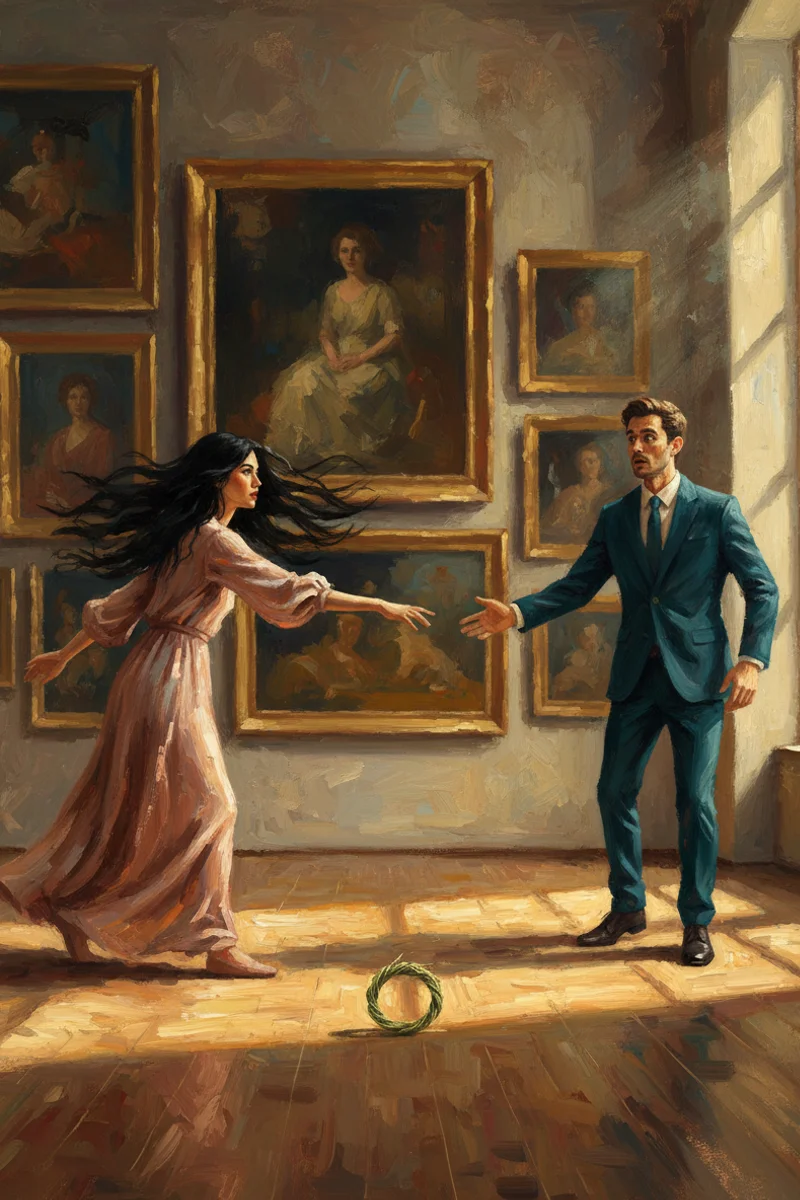
I looked down at the lawn beside the museum entrance. The grass was patchy in places, that specific D.C. government grass that gets maintained just enough to not be embarrassing. I bent down and pulled a single blade. It was warm from the sun. I knotted it. The fibre resisted slightly, the way living things do when you bend them in ways they weren't designed for, and when it broke the green smell came up sharp and fresh in the humid air.
I took her hand. Her fingers were shaking. Mine were too.
"I'm not going to promise you taco nights," I said. "I can't promise the house or the kids or the porch. I can't promise any of it happens the way we dreamed it."
"I know."
"But I'm not going to say it was fate either. I don't want it to be fate. Fate is something that happens to you. I don't want to have happened to you."
She was looking at the grass blade knotted around her finger. Already wilting.
"I choose you," I said. "Today. And I'll choose you tomorrow and I'll choose you the day after that and it won't be because the universe told me to. It'll be because I looked at every café in Madrid and sat in every one and none of them were right because you weren't in them."
"That's a lot of cafés."
"It's a stupid number of cafés."
She laughed. Not politely.
"Yes," she said.
"Yes?"
"Yes. Te digo que sí."
I stood up. The knotted grass was already browning at the edges. She looked at it and then at me and I could see her doing the thing she did, the quick calculation behind her eyes that was really just her deciding whether to say the brave thing or the safe thing. She always chose the brave thing.
"Te extrañé," I said. I missed you. And I didn't mean the four years. She knew I didn't mean the four years.
"I know," she said. "Every morning."
A taxi cut off a sedan and both drivers leaned on their horns. Chelina flinched and then laughed and I grabbed her hand tighter because for a stupid irrational second I thought the noise might break whatever was holding this together. It didn't. She squeezed back.
"I'm hungry," she said. "Is there somewhere near here that does empanadas?"
"Probably not good ones."
"I don't care about good ones."
We started walking. Her hand in mine, the wilting grass ring catching the light, the D.C. traffic grinding past us in both directions. She was telling me something about the flight from Málaga and how she'd almost not come to the museum at all, almost gone to the Lincoln Memorial instead, and I was half listening because the other half of me was busy memorising the specific weight of her hand, the way her thumb rested against my knuckle, the rhythm of her footsteps slightly faster than mine because her legs were