
She always chose pomegranate. I don't know why I'm starting there, except that it's the thing I can taste right now if I close my eyes, that sharp medicinal tang of it, steeped too long because she'd forget about it while doing something else. Watering the fern. Tuning the guitar she kept propped against the radiator. Once she left a bag steeping for forty minutes and drank it anyway, wincing, and when I asked her why she didn't just make another she looked at me like I'd suggested throwing away a firstborn child.
I can brew pomegranate tea. I've done it since. It tastes wrong every time. It took me three attempts to realise she added honey. Half a spoon, not a full one, stirred in with this specific flick of her wrist that was neither careful nor careless. I add honey now. It still tastes wrong.
The apartment was small. One bedroom, a kitchen that bled into the living room, a balcony barely wide enough for two people standing close. The bathroom door stuck if you didn't lift and push at the same time, and the first night I stayed over I was trapped in there for six minutes before she heard me knocking. She laughed so hard she had to sit on the hallway floor. That's not one of the important memories, I think. But it's one I keep replaying anyway.
I replay a lot of things. Most of them without sound.
The waltz was her idea. A Wednesday afternoon in November, the heating clicking in the pipes, nothing planned. She said she'd been watching videos online and wanted to try. She pulled up something on her phone, a Strauss piece I think, tinny through the small speaker, and she took my hand and said she'd lead.
She was a terrible teacher.
I want to be clear about this because I've spent months smoothing this memory into something it wasn't. In my head it became this scene, Octavia patient and graceful, guiding me through the steps, her hand steady on my shoulder while I stumbled. That's the version I've been carrying around. It's a lie. She couldn't count and move at the same time. She kept saying "one two three, one two three" and then stepping forward when she should have stepped back, crashing into me, and then laughing so hard she'd lose the count entirely. I stepped on her feet. She stepped on mine. At one point she tried to dip me and we both almost went through the coffee table.
We never learned the waltz. That was never the point. The point was her hand in mine on a Wednesday afternoon when neither of us had anywhere to be, and the failure was the excuse. We stood in her living room stepping on each other's feet and laughing at nothing and it was the most deliberate thing I've ever been part of. She held me like she meant it. I held her back. The Strauss kept playing from the phone on the kitchen counter, and I think the song looped three times before either of us thought to stop it.
I think about that when I'm trying to be honest with myself. About what I've kept and what I've edited.
The tai chi was mornings. She'd been doing it for years before I came along, out on that narrow balcony with the traffic noise and the pigeons. She said it centred her, which is something I would normally roll my eyes at, but watching her do it I understood. Her movements were slow and fluid and she looked like she belonged inside her own body in a way I've never managed.
She tried to teach me that too. I was spectacularly bad at it. My balance was off, my breathing was wrong, and I kept opening my eyes to check if I was doing the moves right, which apparently defeated the purpose. She'd correct my arm position by moving it herself, her fingers adjusting my elbow, my wrist, the angle of my palm. She didn't say much during those mornings. Just touched me into the right shape and let the silence do what it needed to do.
There was a specific pigeon that kept landing on the railing. Grey with a white patch on its chest like a bib. It showed up almost every morning and Octavia called it Gerald. She'd nod at it when it arrived. "Morning, Gerald." Like they had an arrangement.
I wonder if Gerald still comes.
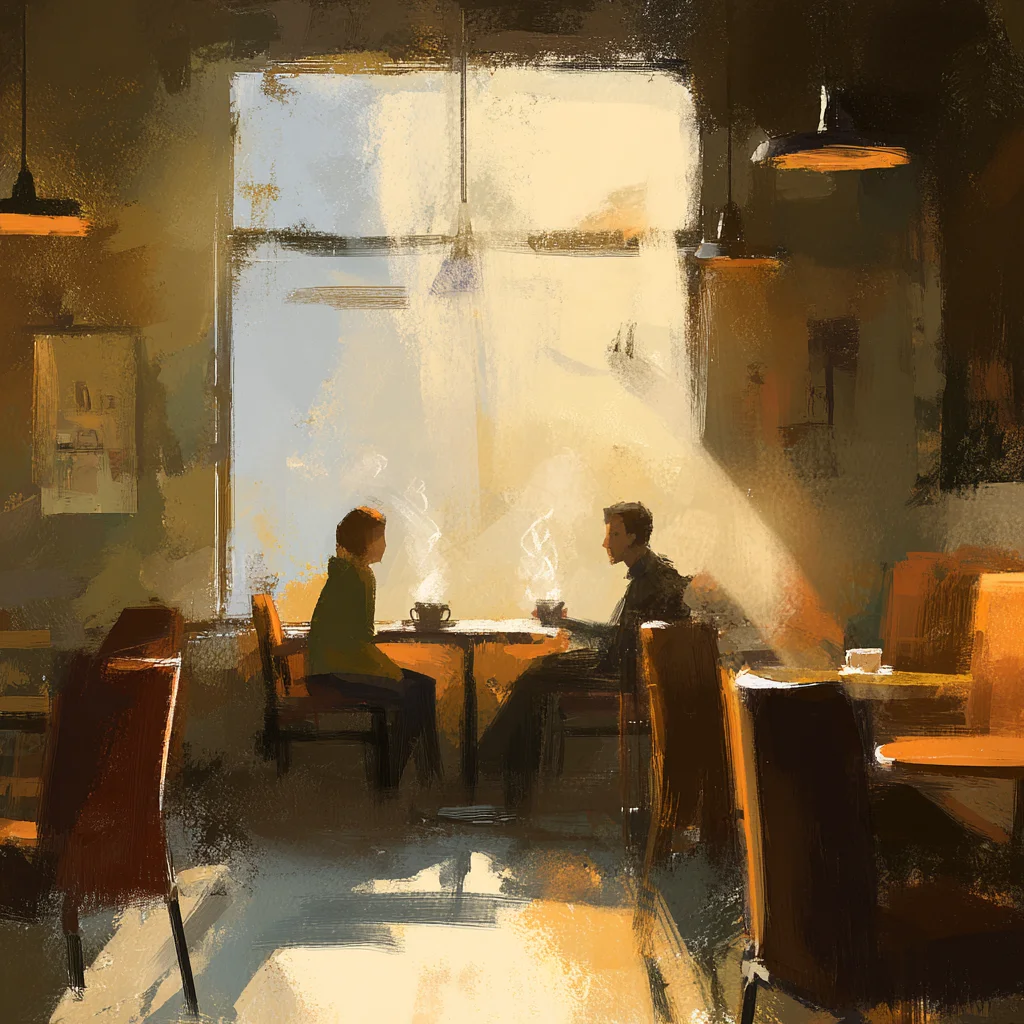
The PC cafe was on the corner of her street, down a set of stairs into a basement that smelled like energy drinks and carpet cleaner. We'd go there on Sunday afternoons sometimes, not to do anything particular, just to sit next to each other at adjacent screens and exist in the same humming space. The cooling fans made this low frequency drone that mixed with the click of her mechanical keyboard, and she typed aggressively, like every keystroke was a small argument she was winning.
We'd argue about nothing. Whether a particular film was overrated. Whether putting milk in first was acceptable. Once we spent forty five minutes debating whether a hot dog was a sandwich, and she got so heated about it that the guy at the next terminal put on headphones. I loved her voice when she was arguing about things that didn't matter. It got higher and faster and she'd start gesturing with both hands off the keyboard, and I'd disagree with her just to keep it going.
I hear that drone sometimes. In coffee shops, when a fridge compressor kicks in or the ventilation catches a certain frequency. For one breath I think she's there, just out of sight, clicking away at something. Then the breath passes.
The Halloween party was at her friend Dani's flat. Octavia went as a moth. She'd made the wings herself from wire hangers and some kind of synthetic fabric she'd found at a craft shop, and they were spectacular in the way that homemade costumes are, which is to say they were lopsided and a bit too large and she'd used too much hot glue in places. She was proud of them. I went as something I can't even remember now. Some mask I'd bought last minute. It didn't fit right and kept sliding to one side.
The fight started inside and moved outside. I'm not going to say what it was about because it doesn't belong here, not really. What I can say is that we were standing in the rain by Dani's front steps and her wings were crumpling. The synthetic fabric held water like a sponge and they were getting heavier and sagging behind her, and she was saying something I should have been listening to, and all I could focus on was the wings. They were ruined and she'd spent hours on them.
Halfway through whatever I was saying back, I stopped. Because I realised I wasn't angry about what she'd said. I was terrified. She had seen something in me that night, clearly and without flinching, and my whole body was trying to make that her fault. It wasn't her fault. She just saw me.
We stood there in the rain for a while after I stopped talking. Neither of us said anything. Then she reached out and straightened my mask, which had slid almost entirely off my face, and pushed it back into place with both hands, adjusting the elastic behind my ears. She didn't smile. She just fixed it. And then we went back inside.
Her wings left damp patches on my forearm that soaked through my sleeve. I felt the wet fabric against my skin for the rest of the night. Cold at first, then warm from my body heat. I didn't roll up my sleeve. I didn't want to lose the feeling of it.
The terrarium was my idea. I built it on a Saturday while she played guitar in the other room, badly, which was how she always played guitar, with more enthusiasm than skill. I used a glass jar she'd been keeping on the windowsill for no reason, filled it with soil and small stones, planted three tiny succulents and a fern I'd found at the market. She came in when I was pressing the last river stone against the glass and she put her hand over mine and pressed harder. "Just so," she said. "Right there." The grit of the soil was under my fingernails for days.
She named the smallest plant Biscuit. After my childhood dog. I'd mentioned him once, maybe two in the morning during one of those conversations that happen when you're too tired to filter. I'd said his name exactly once. She remembered. She remembered everything I dropped. All the scraps and offhand comments and things I said into the dark when I thought they'd dissolve by morning. She collected them. She kept them somewhere I couldn't see.
The terrarium is still alive. I know because Dani told me, months later, in a text I didn't ask for and didn't answer. "She still has that plant thing you made. It's on her windowsill." I read that message eleven times.
The Tuesday night on the kitchen floor was before all of this and after all of this because memory doesn't care about sequence.
She was sitting with her back against the cupboard under the sink. I'd come over after work and let myself in with the key she'd given me the week before, and she was just there. On the floor. Not making noise. The kettle had boiled and switched itself off and the kitchen was full of steam.
I sat down next to her. Not touching.
She said, "Before you, I taught myself to stop expecting anyone to stay." She said it flat, like a fact about weather. Her eyes were wet but her voice was steady in a way that made it worse. "I got good at it. Really good. And now I don't know how to stop being good at it."
I didn't say anything. I didn't touch her. I sat there with my back against the cupboard next to hers and I let her say what she needed to say, and I think it was the first time I got something exactly right. I don't know why I got it right. Every instinct I had was screaming to reach for her, to fix it, to say the things you're supposed to say. I didn't. I just sat there. And after a long time she leaned her shoulder into mine, just slightly, and we stayed like that until the steam cleared and the kitchen was just a kitchen again.
She said "I love you" the first time on a Thursday. She was standing at the stove stirring something in a pot, I think it was soup, and she didn't look up. She just said it. "I love you, Kane." Like she was saying pass the salt. Like it was already true and had been true and she was only just getting around to mentioning it.
She'd handed me a wooden spoon a moment before. I was holding it. I stood there holding this wooden spoon and I couldn't speak. Eleven seconds. I counted them later in my head, replaying it. Eleven seconds of silence that felt like drowning in warm water, not because I didn't feel it back but because I felt it so completely that my throat closed around it. She kept stirring. She didn't look up. She didn't need me to say it back right then. She just needed to say it.
I said it back. Eventually. Quietly. And she nodded, still stirring, and that was it.
I'm not going to tell you why it ended. That's not mine to give away, not even here, not even in the privacy of my own head where I've turned this over so many times the edges are smooth. Some things belong only to the people who lived them. I can tell you it was nobody's fault, or that it was both our faults, or that fault is the wrong word entirely. I can tell you there were conversations that I failed, moments where I understood her perfectly and it terrified me because understanding meant I couldn't pretend.
I can tell you about the door.
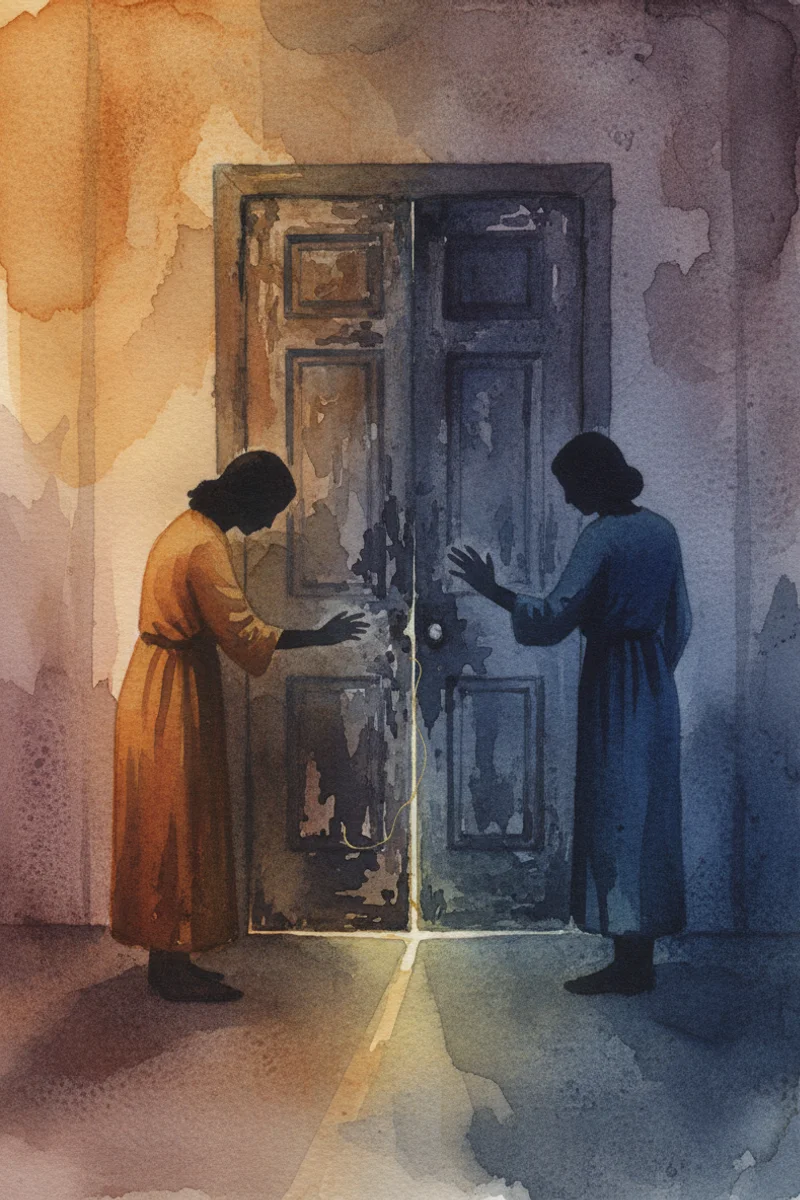
Her door. The same one I'd let myself through with the key she gave me, the one with the sticky lock you had to jiggle. We stood on either side of what was about to become a boundary and we were so composed. So bloody composed. We'd been practising this, both of us, separately, in private, and I could feel the rehearsal in every muscle of her face.
She adjusted my collar. It wasn't crooked. She adjusted it anyway.
"Okay," I said.
"Okay," she said.
And that was the whole of it. No speeches. No revelations. Just the word okay standing in for everything we'd ever been to each other, bearing a weight it was never designed to carry. She stepped back. The door closed. I stood in the hallway for a moment listening to nothing, and then I walked down the stairs and out onto the street.
I made it around the corner before I broke. Not loudly. I just stopped walking and put my hand against the side of a building and let it happen, whatever it was, this thing that moved through me like weather.
Then I walked to the crosswalk at the end of her street. The light was red. I stood with strangers and waited.
The light turned green. People moved around me. I stayed.
I don't know how to explain what happened next except to say that something arrived. Not a thought. A sensation. Low and physical, like a string being plucked somewhere behind my ribs, vibrating at a frequency I could feel but not hear. I smiled. Not because I was happy. I smiled because I was full. Full of her and of everything we'd done badly and well and the pomegranate tea and the waltz we never learned and Gerald the pigeon and the stupid argument about hot dogs and the eleven seconds of silence after she said she loved me. I was full of it and it wasn't going away and I was going to have to learn how to carry it, and the learning would take years, and I was standing still in the middle of a crosswalk while the light turned red again.
A woman beside me shifted her shopping bag to her other hand. Somewhere behind me a bus