
She said "Bellisandra" like it was three words and I almost missed the curb.
"That's my whole name, yeah. My mum was going through a phase." She caught my elbow when I slipped, her grip tighter than the moment required, and held on after I'd steadied. "Medieval romances. She read about forty of them while she was pregnant and picked the worst one."
"It's not the worst one," I said, and meant it, though I'd rehearsed something funnier. In the half second before I spoke I'd had a line ready about how it sounded like a prescription medication, side effects may include, and I could feel the shape of it in my mouth the way you feel a sneeze that doesn't come. I smiled instead. She almost believed it.
The snow had come overnight and the city hadn't caught up. Side streets were untouched. The main roads had been salted but the pavements on our route hadn't, and every step made that particular sound, the crunch and then the squeak of compacted snow adjusting under weight. I found myself matching my breathing to it. Step, crunch squeak, exhale. Step, crunch squeak, exhale. A rhythm I could lean on when my thoughts started doing their thing.
"I can't believe they cancelled it," Bellisandra said. She was talking about work. A burst pipe in the building above our office had flooded the server room and they'd sent everyone home at nine in the morning. We'd been together three months and this was the first weekday we'd had free at the same time. It felt stolen. The kind of gift I don't trust.
"Gift horse," I said.
"What?"
"Don't look it in the mouth."
"I'm not. I'm looking it in the teeth and saying thank you." She squeezed my arm. Her scarf was pulled up past her chin and her voice came out muffled and warm, directed partly into the wool.
We walked south toward the river. I don't know why south. She'd pointed and I'd agreed and that was enough of a plan for a Tuesday morning with nothing behind us and nothing ahead. The sky was that particular grey that isn't dark but isn't light either, like a ceiling painted by someone who couldn't commit. Snow still fell in occasional bursts, light enough that you could watch individual flakes descend if you tilted your head back, which she did, twice, and both times I watched her instead of the sky.
The café was on a corner I didn't recognise. Small, with a painted sign that had started to peel. The door stuck and I had to shoulder it, and the warmth inside hit like walking into someone's kitchen. There were four tables. Two were taken. The paintings on the wall were landscapes done in colours that didn't exist in nature, acid greens and purples that made the hills look diseased.
"Sit down, I'll get them," I said, and went to the counter and ordered two hot chocolates, one with an extra shot of espresso. I'd remembered that about her. She'd ordered it that way the first time we went out, and the second time, and the fourth. I'd filed it. Evidence of my attentiveness, logged and retrievable.
The woman behind the counter had a smear of flour on her cheek and didn't seem to know it was there. She made the drinks slowly, like she was being watched.
I brought them over. Bellisandra was unwinding her scarf and her hair had gone static, lifting away from her head in fine strands that caught the light from the window.
"I got yours with the espresso," I said.
She looked at the cup. "Oh. Actually I think I just want plain today. Is that okay?"
"Yeah, of course. I'll swap it."
"No, don't worry about it, it's fine, I'll drink this one."
"No, really, it's, "
"Fenwick, it's a hot chocolate. Sit down."
So I sat down. And I drank the one with the espresso because it seemed stupid to let it go to waste, and the first sip burned the roof of my mouth badly enough that my eyes watered. She was telling me about her flatmate's cat, which had learned to open the bathroom door, and I said nothing about the burn because she was mid sentence and I didn't want to interrupt. I held the pain against the roof of my mouth like a coin I was keeping warm. A small private thing. It seemed right that I should have it.
The espresso mistake sat in me heavier than it should have. She'd changed. Nothing large, nothing that meant anything, just the small change of a person deciding what they want in their hot chocolate on a cold Tuesday. And I'd missed it, because I wasn't paying attention to her. I was paying attention to my catalogue of her. There's a difference. I knew there was because I'd spent three years not knowing it, and then Mara had told me, very clearly, standing in the doorway of our flat with her coat already on and her keys already in her hand.
"You were already gone long before I left."
That's what Mara said. I could hear the exact pitch of it, the way her voice didn't crack because she'd already done her crying somewhere else, maybe in the car, maybe weeks earlier. She'd sounded tired. Not angry. Tired in the way that's worse than angry because it means they've already let go and they're just completing the motion.
"This painting is genuinely terrible," Bellisandra said, leaning toward me. The wet wool smell of her scarf came with her, warm and damp and slightly animal, like a dog that's been sleeping by a fire. I liked it. It was the smell of someone actually living inside their clothes. "Look at that sheep. It has human eyes."
"That's a cow."
"That makes it worse."
I laughed. A real laugh, or close enough that it counts, and she smiled at me with both hands wrapped around her plain cocoa like she was holding something she'd caught.
"My ex never wanted to stop anywhere," she said. Not looking at me now, looking at the painting. "Like, ever. We'd be walking somewhere and I'd see a place like this and want to go in and he'd just... keep going. Always the next thing. Always somewhere else to be."
I nodded. I knew what I was supposed to feel, which was grateful that she trusted me with this, and somewhere underneath I did feel it. Mostly what I felt was the other thing, the sickening double awareness that I was the opposite problem. That I was someone who stopped but was never actually standing where he'd stopped. That my body was in this café and my mind was in a doorway twelve months ago, listening to Mara say words I'd earned.
"I like stopping," I said.
"I know you do." She looked at me then, and something in her face was careful. Like she was handling something she didn't want to drop.
Outside the café the snow had thickened and the street looked different, softer, the edges of things rounded and buried. We walked toward the park. Her arm through mine. The crunch squeak of our boots fell back into rhythm and I let it carry me.
For about a block and a half neither of us said anything and it was fine. Then she asked.
"What are you thinking about?"
The full truth was a paragraph. The full truth involved Mara's voice and my careful systems and whether I was a person who had changed or a person performing change until the performance wore out like a coat thinning at the elbows. The full truth was not something I could afford.
"I'm thinking about how I don't want to waste this," I said.
She was quiet for a few steps. I could feel the question she wanted to ask pressing against the silence like a hand against a window. She didn't ask it. She squeezed my arm instead, and I understood that the squeeze was its own kind of sentence, that she'd been the person who pushed too hard before and had learned what it cost, and that she was offering patience in place of insistence. I didn't know if I deserved the patience. I took it anyway.
The park was mostly empty. Footprints cut across the open field, dog tracks running parallel to human ones, and near the path there was a bench someone had cleared off and then apparently decided not to sit on. The trees had that look trees get in heavy snow, bowed and enduring, like old men carrying groceries.
We walked the path. It wound through a small hill section where the snow had drifted deep against the hedges, piled two or three feet in places. Bellisandra stopped to look at one of the drifts with an expression I recognised as dangerous.
"Don't," I said.
"I haven't said anything."
"You're looking at it."
"I'm allowed to look at snow."
And then she went quiet. The quiet went on about thirty seconds longer than it should have. My chest tightened, a specific tightness just behind the sternum, the kind that comes with certainty. She'd seen through me. She'd figured it out. This silence was the beginning of the sentence, the opening of the speech, and I knew how the speech went because I'd heard it before. I could already hear Mara's words reshuffled into Bellisandra's voice, the same meaning in a different mouth. You were already gone.
Bellisandra pointed. "Oh my god, look at that dog."
A small brown terrier was coming toward us on the path wearing a red knitted sweater with white trim. It looked like a Christmas ornament that had learned to walk. Its owner, a woman in a long coat, was on her phone and paying no attention to the fact that her dog looked like a decoration.
Bellisandra laughed. Not politely. The kind of laugh that comes from the stomach and doesn't care what it sounds like. And the relief I felt was so enormous it almost made me sick, a physical wave that came with the release, because her silence had been about a dog. Just a dog. Not about me at all.
The terrier passed us. Its sweater had a small bell on the back that I hadn't noticed at first, and it jingled as it trotted away.
"Okay," Bellisandra said, and grabbed my sleeve, and pulled me toward the snowdrift.
"Wait, "
We fell. And for exactly as long as we were falling, maybe two seconds, maybe less, I felt nothing except the cold air and her grip on my sleeve and the stupid improbable thrill of gravity taking me somewhere I hadn't planned to go. My internal monologue stopped. Not quieted, not dimmed. Stopped. Like a projector cutting out mid frame.
Then we hit, and the snow collapsed around us, and it was cold and wet and she was laughing, and my monologue restarted, and I could hear the silence it had left behind like a ringing in my ears. Two seconds of nothing. I hadn't known it could do that. I hadn't known what it sounded like when it stopped.
Snow was in my collar. I could feel it melting, a slow cold line drawn down between my shoulder blades, tracing my spine with a precision that made me aware of my own body the way you become aware of a room you've been standing in for hours.
Bellisandra had snow in her hair. In her eyebrows. She was still laughing, lying in the drift with her arms out, and she looked like someone who was exactly where she wanted to be.
I could suggest we go home. Warm up. Dry off. That's what the old version of me would do. The version that chose comfort, that chose stasis, that let Mara slowly stop recognising him because he'd stopped moving in any direction at all.
"Let's keep walking," I said.
"You're soaked."
"I know."
She looked at me. That careful look again. "Okay."
We climbed out of the drift. My jeans were heavy with snow and my boots squelched and the line of cold melt between my shoulders had reached my lower back. We kept walking. Past the bench. Past a man throwing a ball for a dog that wasn't the terrier. Past a bin overflowing with takeaway coffee cups, their lids collecting small circles of snow.
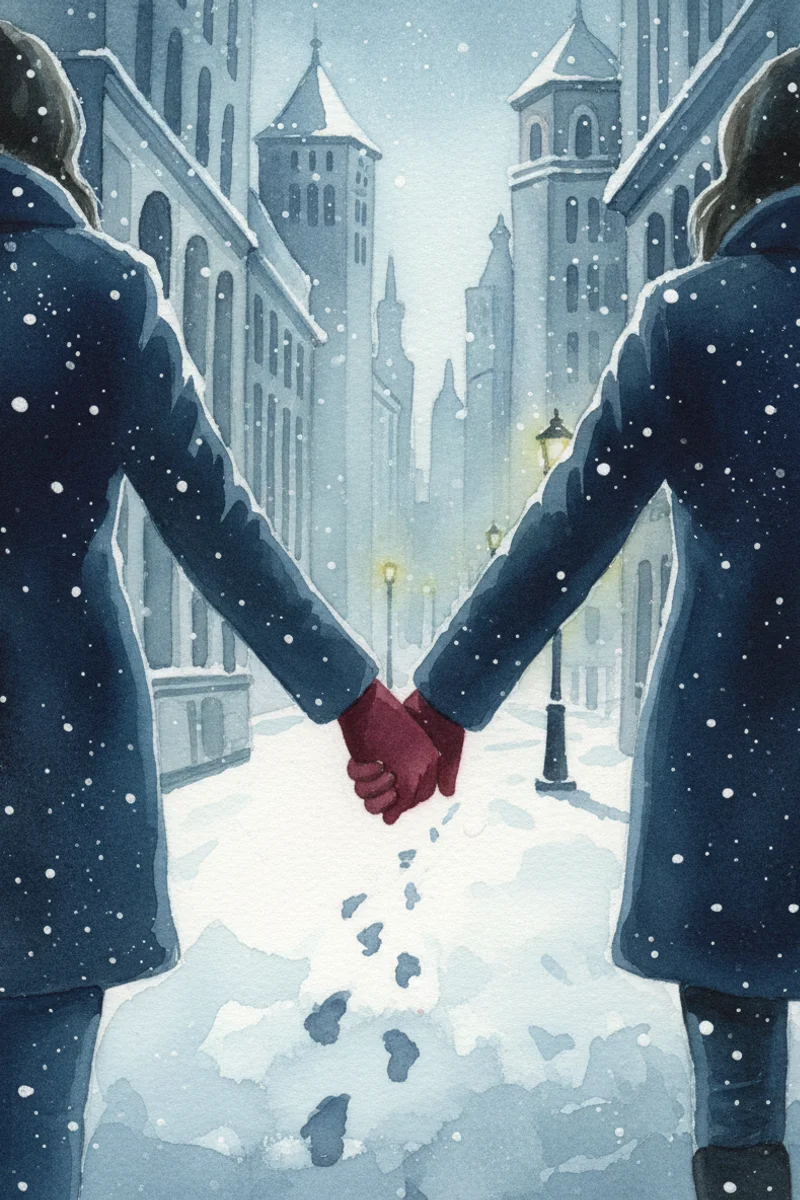
I reached for her hand. Not out of warmth. Out of need. The motion was a grasping one, too quick and too tight, and I felt it as it happened and tried to soften it into something casual, loosening my fingers half a second after they'd closed. She took my hand. She threaded her fingers through mine and held on and I could not tell if she'd noticed the desperation in the first grab. I told myself it didn't matter. Then I immediately knew it mattered enormously.
"I love days like this," she said.
"Me too," I said.
We kept walking. The snow fell and the path curved ahead out of sight and my boots crunched and squeaked and her hand was in mine and I didn't know if it was enough. I didn't know if I'd changed or if I was just running a better programme. Maybe the version of me walking through this park was the real one. Maybe it was the latest draft, better punctuated, telling the same story.
The meter was running. It was always running. And every quarter hour I had to reach into my pocket and feed it again, and the question wasn't whether I had enough change. It was whether I'd keep reaching.
She squeezed my hand.
I squeezed back.
The path kept going so we