

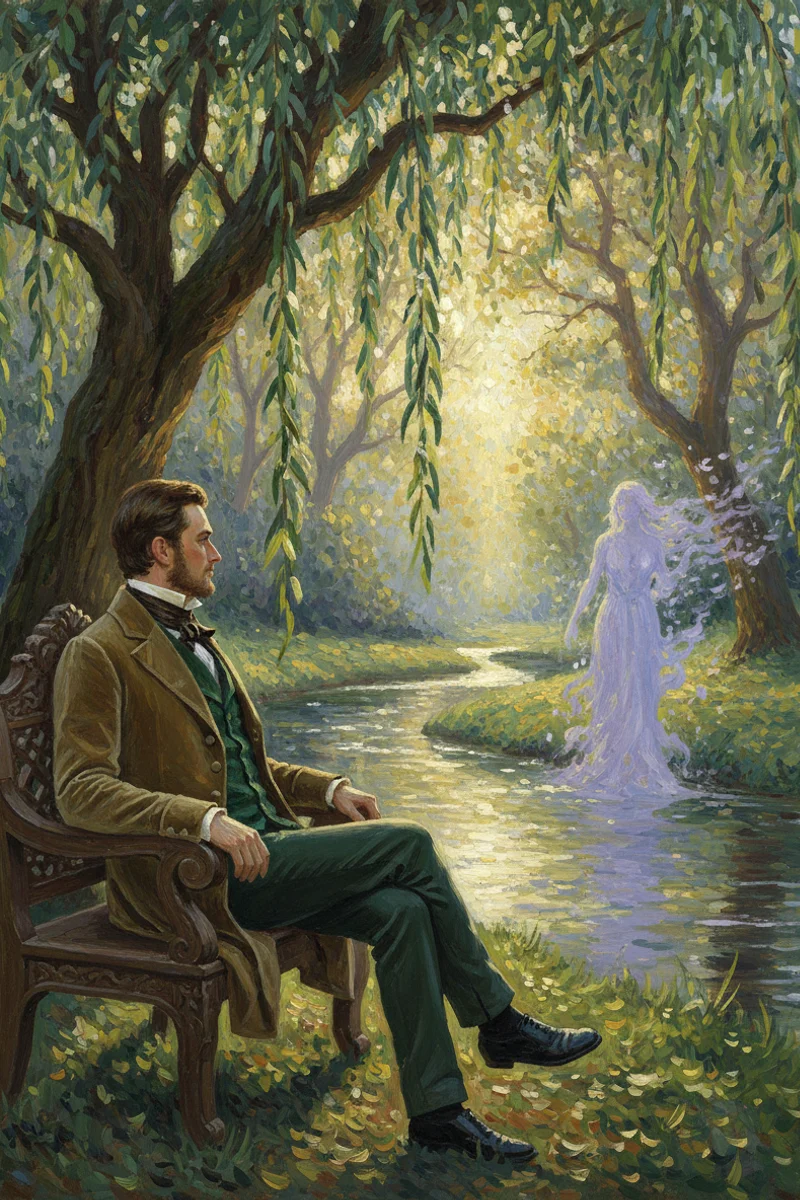
The linen smelled of him. That came first — before the light, before the rooster, before the absence settled in like water filling a boot. The smell of a body that had held one position too long, faintly sour, warm in a way that embarrassed him though no one was there to notice. He lay with his eyes shut and his right hand curled against his jaw where her fingers had been.
She had no name. He'd known that even inside the dream, known it the way you know the floor of a room you've memorised in the dark. She had touched his face and said something about summer, about kindness, and he had felt her breath on his mouth and understood with total clarity that none of it was real and that he would give anything, anything at all, to stay.
Merrick opened his eyes to the ceiling. A crack ran from the gas fitting to the cornice, hairline, the sort of thing a man notices every morning until he stops noticing it entirely. He noticed it now. He noticed everything now. The ceiling was a ceiling. The sheets were cold on the side where nobody slept.
He did not get up.
The house made its sounds around him. Wood and plaster ticking as they cooled from some interior warmth he couldn't account for, settling into morning like a large animal shifting its weight. Not silence. The sound of an inhabited emptiness, of rooms holding furniture and dust and nothing that breathed. He listened to it the way a man listens to a companion sleeping beside him, except that the house was not a companion. It was a structure that held him inside itself and did not care whether he woke or slept or wept.
The grief did not break over him. It filled him, rising from somewhere below the sternum, slow and warm and deeply wrong. His stomach turned. He pressed his knuckles harder against his jaw. The phantom pressure of her hand was already fading into the memory of a memory. He was grieving someone who had never drawn breath, and he knew it, and knowing it changed nothing. To grieve the dead was at least to grieve a thing that had been, that had walked and spoken and left marks on the world. The dead leave gaps. She had left nothing, because she had never occupied any space to leave.
He thought he might be sick. He swallowed against it.
The rooster went again. Merrick sat up. On his nightstand, a book of poetry lay open, its pages foxed and soft at the edges like old cloth. He could smell the binding glue from where he sat, faint and sweet, something like vanilla left too long in a drawer. He didn't remember opening it. He didn't remember much of the previous evening at all. He must have been reading before sleep. The page was turned to something about midsummer, some verse about dreaming, but he did not read it. He closed the book and set it face down.
The mirror above his washstand showed him what it always showed him. He didn't shave. He didn't boil water for tea. His cravat hung from the hook on the back of the door where he'd left it, and he looked at it the way a man looks at a tool he has decided he won't need today, or possibly ever again. He pulled his coat on over his nightshirt, which was ridiculous, which would have mortified him on any other morning. He didn't care. Caring about propriety required believing that other people's perceptions mattered, and other people's perceptions required other people, and there were no other people in this house. There was Merrick, and the crack in the ceiling, and the smell of linen.
He went out through the kitchen door.
The morning was neither warm nor cold. It was June and the light had that quality of being everywhere at once, sourceless, the kind that flattens shadows and makes the world look like a painting of itself. He walked without direction at first, down the lane past the Alcott property where the fence had been mending itself in stages for three years, each new board a slightly different shade of grey. He walked until the lane became a path and the path became a suggestion, and the suggestion led him through a stand of oaks into country he recognised but hadn't visited in some time.
The stream was where it had always been. Willows hung over it like old women conferring. The water moved at the pace of something with nowhere particular to go. Merrick sat on the bank and took off his shoes, because his feet were hot and because it seemed the sort of thing a man who had given up his cravat might do.
He put his hand in the water. Cold, startlingly so, and he could feel distinct currents moving between his fingers, each a slightly different temperature, as though the stream were braided from separate sources. The cold was so specific, so precisely mapped across each knuckle, that for a moment he thought: this must be real. This must be waking life. No dream would bother with such fidelity, cold against particular patches of skin. He almost laughed.
He looked at his reflection. It was trembling. The surface shivered with some disturbance he couldn't locate — a breeze, perhaps, or something beneath. But he was perfectly still. His hand was still. The water around his fingers was still. Only his face, looking up at him from the stream, was shaking, as though it were the reflection that was agitated and not the thing reflected.
He stared at this for a long time.
It was the most honest thing that had happened to him all morning. He didn't know whether the trembling was in the water or in him, and that not knowing, that small clean rupture in the orderliness of things, felt more real than the house and the linen and the rooster. It wasn't pretending. The confusion, at least, admitted itself.
He pulled his hand out and dried it on his coat, which was already ruined, so it didn't matter.
She was there on the third day.
He'd returned to the stream each morning, always without the cravat, always through the stand of oaks, sitting in the same depression in the bank where the grass had begun to learn the shape of him. On the third day he arrived and she was already on the opposite bank, feet bare, skirt tucked beneath her. She was watching the water.
He stopped walking. His breath stopped with him.
Her hair was dark. Her jaw was a specific shape he had felt against his palm in the dark behind his eyes. She looked up with a mild expression, as though men in nightshirts and coats frequently came out of the trees before breakfast.
"Good morning," she said.
He said nothing. He was trying to breathe and think at the same time and finding the two operations suddenly incompatible.
"I'm sorry. Have I taken your spot?" She gestured at the bank. She had a small, practical voice, the kind that came of speaking to people who weren't entirely listening.
"No," Merrick managed. "No, I. There isn't a spot. It isn't mine, I mean."
"Ah." She smiled. Not the smile from the dream. Close, but not it. Different teeth, maybe, or a different timing in the way her lips moved. Close enough that his chest ached. Different enough that he could tell himself she was real.
Her name was Isobel Carrow. She told him this the way people tell you practical things, without ceremony. She was staying with relations somewhere to the north, she said, and she liked to walk in the mornings. She didn't explain the bare feet. He didn't ask. He sat down in his spot and they talked across the water about small things. A bird neither of them could identify. The temperature of the stream. A novel she had been reading, which she described badly, muddling the plot, mixing up the names of the characters. He found the imprecision comforting. Dreams did not make mistakes of that kind. Dreams were either perfect or they were nightmares.
She came back the next day. And the next.
On the second meeting she crossed to his side. She picked her way over the stones with the focused precision of someone who did not want to fall and wasn't confident she wouldn't. One foot slipped, she grabbed at the air, and she said a word that a woman of her apparent standing should not have known. Merrick offered his hand. She took it. Her fingers were cold from the water and they were real, they were real, he could feel the separate bones of her hand through the skin.
They sat together. She told him about her cousin's dog, which had eaten an entire hat. He told her about the crack in his ceiling. None of it meant anything. That was why he could bear it.
On the third meeting she laughed at something he said, something about the willows looking conspiratorial, and in the middle of the laugh she said, "The world is kinder than it means to be."
Merrick felt the ground tilt.
Not physically. The grass was solid beneath him, imperfect, individual blades pressing into his palm. He gripped it with both hands and held on. Joy and horror arrived together and turned out to be a single sensation with two names, and he had no word for what they made when they collapsed into each other. She had said it. The exact phrase. The dream woman's whisper, given to him in the dark where nothing was real, now spoken aloud by a woman with cold feet and a cousin whose dog ate hats.
"Are you all right?" Isobel asked.
"Yes," he said. His hands were full of grass. "Yes, I'm. Are you cold?"
"A little."
"What flowers do you prefer?"
She looked at him strangely. "That's an odd thing to ask just now."
"I know."
"Foxglove," she said. "Though they're poisonous, which rather undermines the sentiment."
He asked her small, anchoring questions after that. Every time. What she'd eaten for breakfast. Whether she preferred morning or evening. The name of the novel she kept getting wrong. He didn't want the answers. Each answer was proof that she was still there, still generating information he had not put inside her. A dream would repeat itself. A dream would not invent a cousin's dog. He held each dull detail like a coin he suspected of being forged, turning it in the light, testing the weight.
The light, though.
He noticed it on the fourth meeting. A patch of sun on her collarbone with no source. The trees above them were thick; the willows made a canopy that should have thrown dappled shade, but the light on her skin was smooth and whole, pooling in the hollow of her throat as though a careful hand had set it there. He studied it. He tipped his head back to the canopy, close as thatch, and looked down again. The patch had not moved.
He chose not to mention it.
He chose this deliberately, with the full conscious weight of a man selecting a door to walk through. He could ask about the light. He could point at it, say something, break whatever spell was generating that bright impossibility on her skin. Or he could sit beside her in the warmth of her presence and let the architecture of truth be someone else's problem. Truth was the cold half of the bed and the smell of linen that had held one body only.
He chose her.
They met for three more days. She never asked about his house. She never asked about his life, his family, what he did with his hours when he wasn't sitting by this stream. He registered the absence like a sound below hearing, felt in the bones rather than the ears. A real woman would want to know. He held the thought at arm's length and did not look at it directly.
On the seventh day a willow leaf detached from a low branch and fell into the stream. Merrick watched it land. It turned once, caught the light, and then moved upstream. Against the current. Slowly, without apparent effort, the leaf drifted the wrong way, as though the water had reversed itself or the leaf had intentions of its own. He watched it travel three feet, four, five. It did not stop.
He looked at Isobel. She was watching the water too, or appeared to be, but her eyes didn't follow the leaf. She gave no sign at all. She hadn't noticed, or she didn't care, and he understood then, with a despair so large it felt architectural, vaulted, that he had built a cathedral inside a soap bubble. Every conversation, every anchoring question, every imperfect beautiful moment of contact rested on nothing. Inside nothing.
"You're beautiful," he said.
She turned to him. Her expression was something he would spend the rest of his life trying to name.
"You should wake soon," she said. Her voice was gentle. There was no cruelty in it. "Before the dew settles."
"I know," he said.
"I'm sorry," she said, and he believed her. The lie was sorry for being a lie. The bubble, if it could have, would have chosen to be stone.
"I know," he said again.
She reached for his hand. Her fingers were warm now. That was wrong too. Everything was wrong and everything was tender and he held her hand and looked at the leaf moving upstream and waited.
The rooster.
The ceiling, the crack, the gas fitting. The cold sheet. The linen smell. The house settling around him, tick and creak, the breathing of something vast and indifferent.
The book of poetry was open on his nightstand. He had closed it. He was certain he had closed it. He had set it face down. And yet it lay open, pages soft as cloth, the smell of old binding glue rising faintly into the morning air. The page was turned to a verse about midsummer.
He did not read it. He lay still, his right hand curled against his jaw where nothing had been, and listened to the house, and did not