

The last text I sent Declan said "I need you to say something that isn't a joke." That was eleven days ago. I know because I've checked the thread four times today, scrolling past the grey bubble above mine, some crack about how I always took longer to get ready than the actual event lasted. Funny. Classic Declan. The kind of thing you laugh at until one day you don't, and then you realise you haven't been laughing for months.
He never replied. Not a word. I sat on my bed and stared at the delivered receipt like it owed me something, and eventually the silence became the answer, and the answer became the breakup, and the breakup became this. Me, on the edge of my bed in an apartment that still smells faintly of his deodorant because I haven't washed the pillowcase on the left side. I should wash it. I'm going to wash it.
I washed it.
The first date after Declan was a Tuesday, which felt appropriately low stakes. His name was Paul. He worked in something financial that he explained twice and I retained nothing from either explanation. We went to a bar near the canal with exposed brick and too many ferns, and he was fine. He was perfectly fine. He agreed with every single thing I said.
I told him the city was getting worse for cyclists. He agreed. I told him the new Lanthimos film was overrated. He agreed. I said maybe pineapple on pizza wasn't actually that controversial and people just liked having an opinion about it. He agreed so fast he almost knocked his beer over.
Walking home I felt lonelier than I had in eleven days of eating cereal on the sofa and falling asleep to nature documentaries. Being mirrored perfectly is its own kind of invisible. Paul had seen nothing, challenged nothing, and I'd spent ninety minutes performing a person who might as well have been alone in the room. I wanted someone to push back. I wanted friction.
Ben talked about his ex for forty minutes, apologised for talking about his ex, and then talked about her some more. Sam was gorgeous and interesting and laughed at all my jokes, and I felt absolutely nothing, which taught me something miserable about how attraction actually works. Then there was the man whose name I genuinely cannot remember, who spent the whole meal on his phone and then said "Sorry, I'm just really present on socials" without any apparent irony.
I learned things. Every bad date left me holding a small sharp piece of information about myself. From Ben: I needed someone who had already done his grieving. From Sam: connection isn't something you can will into existence just because the other person deserves it. From the phone guy: my threshold for disrespect had dropped somewhere dangerous and needed recalibrating.
I met Rory on a Thursday evening in a vegetarian restaurant on Greville Street that smelled like vinegar and sesame oil, a sharp warm smell that hit you the second you walked in. We were both eating alone, which I'd started doing because cooking for one felt sadder than eating alone in public. Logic of a sort.
He was at the table next to mine. Dark hair, reading glasses he kept pushing up his nose, a book face down beside his plate that I was trying to read the spine of without being obvious about it. He ordered for himself and then, when the waiter came back, pointed at my table and said something I didn't catch.
The waiter brought me a small dish of something I hadn't asked for. Pickled vegetables.
"Excuse me," I said, louder than I meant to. He looked up. "Did you just order for me?"
"I ordered you a side dish. You looked like you were deliberating."
"I wasn't deliberating."
"You've been staring at the menu for twelve minutes."
"That's not the same as deliberating." I pushed the dish slightly away. "That's presumptuous."
"It's pickled cabbage, not a marriage proposal."
My face went hot, and not from embarrassment. He was wrong, objectively, about the ordering thing. You don't order for strangers. But he said it leaning back with his arms crossed, glasses sliding down again, entirely unbothered by my irritation, and my pulse did something I recognised immediately as dangerous.
I looked down at my plate so he wouldn't see it.
"It is presumptuous," I said, quieter now, aware I was still going even though the argument had turned into something else. "You don't know what I like."
"You're right. But the worst case scenario is you don't eat free cabbage."
I ate the cabbage. It was good. I didn't tell him that.
His name was Rory Whelan. He'd moved to the city five months ago from somewhere up north he described only as "grim." He was doing something in research that he explained once and I actually retained, because he explained it well, in a way that assumed I was smart enough to follow without performing intelligence about it. He had opinions. Real ones, ones that seemed to have cost him something to arrive at. Declan used to recycle his from podcasts.
We argued about three more things before the bill came. Whether museums should be free. Whether it's possible to be friends with an ex. Whether ordering for someone else is inherently presumptuous, which we circled back to like dogs returning to a spot they'd already sniffed.
I don't remember paying. I remember walking home with my brain pleasantly battered, like I'd been in a boxing match, and the vinegar sesame smell clinging to my jacket, and not wanting to wash it off.
The texting was terrible. I need to be clear about this. Rory texted like someone defusing a bomb in a language he didn't speak. He'd go silent for five, six hours, long enough for me to build and dismantle entire narratives about what I'd said wrong, and then three messages would arrive in rapid succession, each one a different thought, each chime landing in my chest like a skipped heartbeat.
I told myself it was annoying. I told my friend Keisha it was annoying. Keisha said "You're smiling while you complain" and I told her to shut up, which was not a denial.
We went to a museum. We walked the canal path, where he pointed out a heron standing dead still in the shallows, and we watched it for five minutes without speaking, and it was the first comfortable silence I'd had with a man in over a year. He walked me home from the train three times before I started counting, and then I stopped counting because counting felt like jinxing it.
And then Declan came back.
Not dramatically. No door, no flowers, no speech. He texted. A real text this time, no joke attached, just "Can we talk? I know I owe you a conversation." I said yes because I am not a person who says no to honesty even when the timing is terrible.
We met at a bar near our old flat. Our old flat. I ordered my usual, the elderflower thing with gin, and Declan sat down across from me looking different. Not physically. Something behind his eyes had rearranged itself.
"You look good," he said.
"Thanks."
"New jacket?"
"No. You've seen this jacket."
"Right." He drummed his fingers on the table. He always drummed his fingers when he was nervous, a pattern of four he probably didn't know he did. "I've been going to therapy."
I hadn't expected that. I sat with it a moment, turning the glass in my hands. The condensation made my fingers cold.
"That's good. I mean it."
"Yeah." He reached into his jacket pocket and pulled out a folded piece of paper. He unfolded it carefully, like it might tear, and slid it across the table. A diagram. Concentric circles drawn in pencil, labels in his blocky handwriting. The outer ring said ACQUAINTANCES. The next one said FRIENDS. Then CLOSE FRIENDS. Then FAMILY. And in the centre, in a circle erased and redrawn so many times the paper had gone thin, it said FRANCES.
I ran my thumb across it. I could feel the graphite, the indent where the pencil had pressed, the faint ridges of eraser. He'd drawn this more than once. He'd sat somewhere and thought about where I went and decided I went in the middle, and then second guessed it, and put me there again.
"My therapist asked me to map out the people I care about," he said. "By like, proximity. Emotional proximity." He looked at the diagram like it embarrassed him, which it probably did, because everything about this was the opposite of who he was built to be. "I wanted you to see it."
Something in me went warm and open and hopeless. Love, but not the wanting kind. The kind where you look at someone and see the effort they're making and you know what it's costing them and you wish, genuinely wish, that it was enough.
"Declan."
"I know."
"This is. I mean. This is really."
"I know."
We sat there a while. Keisha arrived with some of our old group, and the table filled up, and for twenty minutes it felt like before. Then I ordered another elderflower gin and Declan said, "Predictable," and the word landed on me like a slap dressed as a compliment.
The old Frances would have laughed. Would have shrunk a little and filed it away in the place where I kept all his small cuts, the place that was full. But something had shifted. I felt the shrinking start and I caught it before it finished, and I said what it was.
"Don't do that."
The table went quiet. Keisha froze mid sip. Declan looked at me with an expression I'd never seen on him, the expression of a person realising they've done the exact thing they went to therapy to stop doing.
"Shit," he said. "Yeah. Sorry."
"Okay."
The rest of the night was fine. But I kept the diagram. I folded it back up and put it in my jacket pocket and it's still there now.
Three days later Rory and I were walking back from a screening at the indie cinema that plays old films on Wednesdays. I was talking too much, the way I do when I'm nervous, filling the silence with words because silence with him still felt charged enough to make my hands restless.
"I'm afraid of how much I like you," I said. It came out without planning, the way the worst truths do. Just fell out of my mouth and landed on the pavement between us.
He didn't slow down. Didn't look at me. "Sounds like you're collecting emotionally unavailable men. What's your punch card look like, do you get a free one after ten?"
I didn't laugh.
I could feel the pull to perform. To be easy, be light, be the version of myself that doesn't need things. The version Declan built. But I stopped walking, and he went two more steps before he realised, and when he turned around I said it.
"That hurt."
His face did something complicated. It started as surprise and moved through what I think was recognition and ended somewhere I couldn't read. He opened his mouth, closed it, looked away.
"Yeah," he said eventually. "Yeah, I know. I'm sorry." Then, quieter, almost to himself. "I do that."
"I know you do."
"I'm working on it."
"Okay."
We didn't talk much after that. He walked me to my door and stood there with his hands in his pockets and said goodnight like the word had edges he was trying to smooth out, and I went inside and pressed my forehead against the cool glass of the window and watched him walk away.
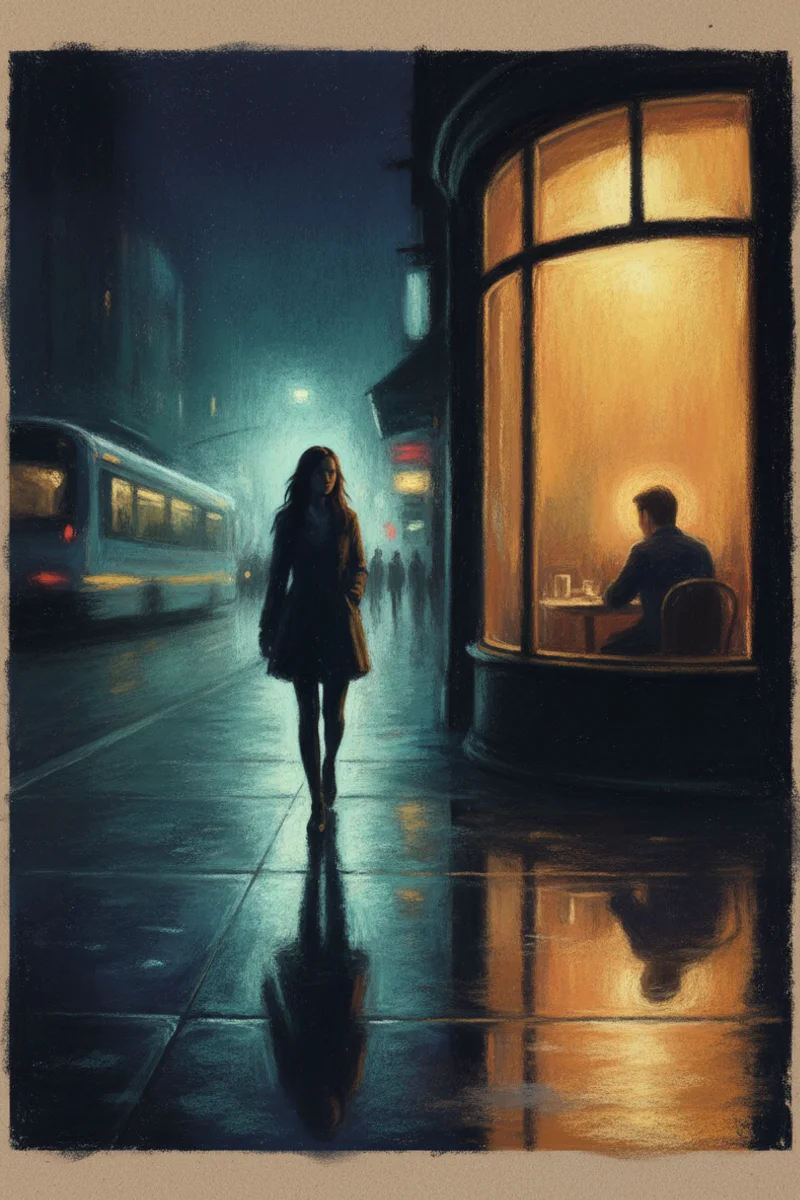
The city noise came through muffled, a hum. My own face was ghosted over the streetlights, transparent, there and not there.
Declan texted that night. Something kind, something I could feel he meant, with no joke strapped to it like a safety net. I looked at the message for a long time. I looked at the diagram, which I'd unfolded and put on the nightstand like a person trying to torture herself with evidence that people can change.
People can change. Declan was proof of that, and proof that changing doesn't entitle you to anything.
I put my phone down. Picked it up. Put it down again. It felt heavier than it was, like I was holding the actual mass of what I was about to do.
I picked it up and called Rory.
It rang four times. Five. I was about to hang up when I heard the click, and then breathing, and then a sleep rough voice.
"Frances?"
"Hi."
"It's. Do you know what time it is?"
"It's quarter past eleven."
"Yeah."
I pressed my forehead harder against the glass. "I want to try. With you. Like really try, not the thing where we both pretend we're not doing anything and then one of us gets weird about it. I want to actually."
Silence. Then a sharp intake, a small quick breath that caught in his throat. I heard everything in it. His fear, matching mine exactly, the sound of someone choosing before he was ready and knowing it.
"Okay," he said.
"Okay?"
"I mean. Yes. Thursday?"
"Thursday what?"
"Could we. Do you want to get dinner on Thursday?"
"We've gotten dinner before."
"Not like this though."
I pressed my palm flat against the window. The glass was cold. Outside, a siren started up somewhere in the middle distance and faded.
"Not like this," I said.
"So Thursday."
"Thursday."
Neither of us hung up. I could hear him breathing, the faint rustle of sheets. Somewhere in his flat a tap was dripping. I could hear that too, a small rhythmic sound that had nothing to do with anything.
"Frances?"
"Yeah."
"I'm glad you. I mean."
"I know."
"Okay."
"Okay. Goodnight, Rory."
"Night."
I kept the phone against my ear for three more seconds after he hung up. Then I set it down on the windowsill and left it there, and went to brush my