

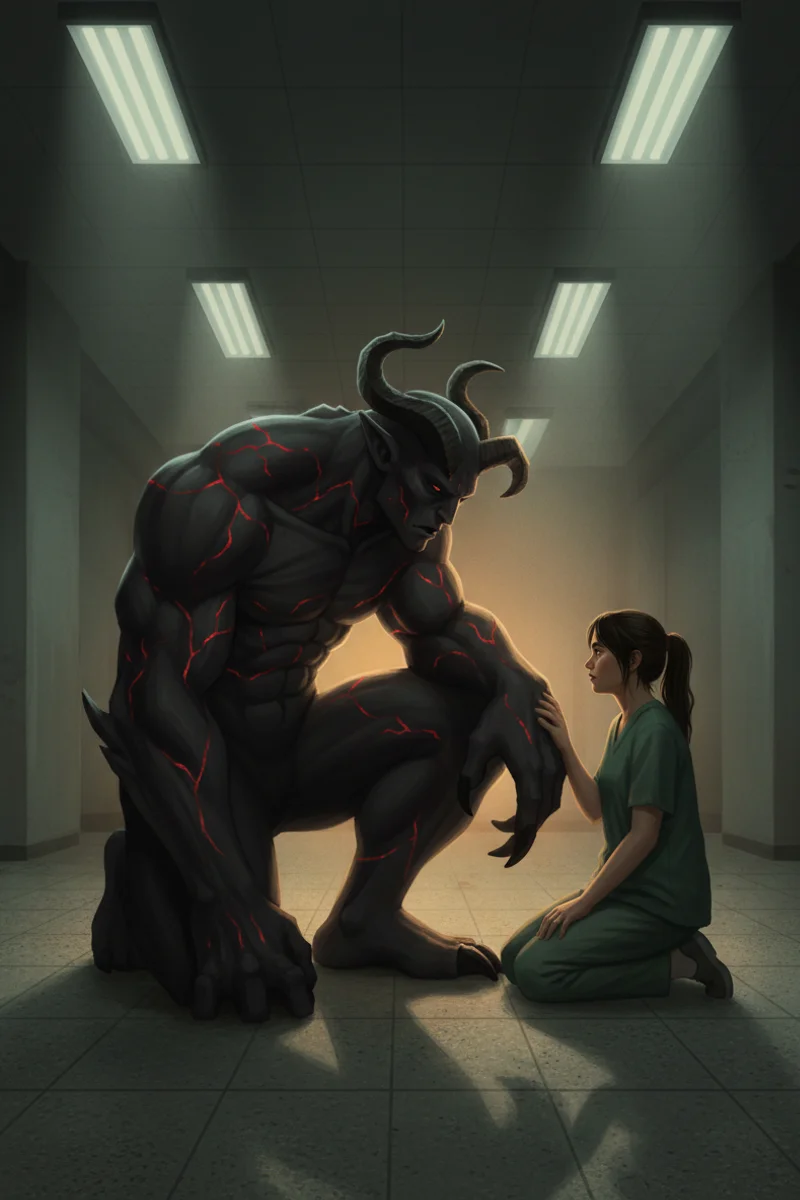
The fluorescent lights hummed at a frequency that settled into the back of his teeth. Creature 684 sat with his spine against the wall and his knees drawn up and counted the cracks in the concrete across from him. Fourteen. There had been thirteen yesterday, until sometime in the night his tail scraped a new one near the floor.
He used to have a name.
The cell was twelve feet by twelve and the ceiling was nine, which meant he had to hunch when he stood. The glass on the east wall was reinforced, three inches thick, and beyond it ran a corridor that smelled like bleach and floor wax and nothing else. They'd taken the cot out after the second week because he'd torn it apart during a bad night and decided he didn't need one. The concrete was fine for something like him. He agreed with them on that point, which was the only thing they'd ever agreed on.
Elias Crane had been twenty three when he died. Twenty three and standing in a parking garage with his friends behind him and the men with the bats and the knife in front of him, and he had been terrified. He could still feel Kyle's hand on his shoulder, saying we should just go, just go, and underneath it his own flat certainty that there was nowhere to go, because the stairwell was behind the men and the elevator had been broken since March. The first bat caught his ribs and the sound bounced off the low ceiling. He fought back the way anyone fights back, sloppy and desperate and small.
Then something broke.
Not his bones. Something deeper, underneath the architecture of who he was. It cracked open like a floor giving way and what came up through the gap wasn't him. He killed every single one of them. He didn't remember how. He remembered the feeling, though, the way it felt like breathing after being held underwater, and that was the part that made him sick afterwards, because it had felt good. It had felt correct.
When he turned around his friends were against the far wall. Kyle had his arm out in front of Sarah and Demi and his face was the colour of old paper. Elias looked down at his own hands and saw that they were wrong. The fingers too long, the nails replaced with something harder and darker. Kyle said his name. "Elias?" Like a question. Like the name didn't fit the thing standing in front of him anymore.
They ran. All three of them. They ran and he stood there in the parking garage with the dead men at his feet and his hands that weren't his hands and the fluorescent lights buzzing overhead, the same frequency, always the same frequency.
He died shortly after. That part had never come back clearly. Pain and cold, then nothing, then waking up in this cell with the glass wall and the nine foot ceiling and a man in a grey uniform reading him his designation. Creature 684. He'd been here eleven months. The lights never turned off.
The slot at the bottom of the glass wall opened and a tray slid through. On it was the usual container, beige and microwaved, the smell somewhere between cardboard and nothing. He didn't look at it. The slot closed. Whoever had delivered it hadn't said a word. They never did anymore, not since the second caretaker quit and the one before that transferred to a different wing. He'd overheard a corridor guard telling someone on the phone that nobody wanted the assignment. That the thing in cell 684 was a write off.
He ate the food eventually, because hunger was one of the things that had followed him through death, and he hated that. He hated that he still needed things.
Three days later the slot opened and something came through that the kitchens had never sent before.
A plate. An actual plate, ceramic, white with a small chip on the rim. On it was pasta, real pasta, with sauce that had garlic in it and olive oil and something green that might have been basil. The smell cut through the antiseptic corridor air like a door opening into a different building. Elias stared at it from across the cell.
He didn't move.
An hour passed. Two. Through the glass he could see someone sitting in the corridor. A woman, young, dark hair pulled back, facility uniform a size too big for her. A clipboard lay closed on her lap. She sat cross legged on the floor like she had nowhere else in the world to be.
By the third hour the pasta had gone cold and Elias finally moved toward it. He crouched and picked up the plate and his clawed hands shook badly enough that the fork rattled against the ceramic. He ate in the corner, facing away from the glass, because he didn't want her to see how he had to hold the fork, pinched between fingers that weren't designed for holding forks. The garlic sat on his tongue and for a moment he was somewhere else entirely. Not here. Somewhere with a kitchen and a window and a person who cooked things because they wanted to.
When he turned back around the woman had her palm pressed flat against the glass. No smile. No tears. Just her hand there, and an expression he had no name for, because nobody had looked at him that way in eleven months. She didn't say anything and neither did he.
Her name was Paloma Serrano. She gave it to him the next day, through the glass, from the same spot on the corridor floor, along with everything else: that she'd been assigned to him as his new caretaker, that she'd worked at the facility for seven months before this, that her commute took forty minutes on two buses because she couldn't afford a car. A song from the second bus had been stuck in her head all morning. She hummed a few bars of it, slightly off key and completely meaningless, and he sat against the far wall and listened like she was reading him something sacred.
Over the following weeks she brought real food every shift. Chicken with rice one day. Soup another. Once a sandwich she admitted she'd messed up, the bread stale, and she apologised for it and he ate every bite. She talked to him about nothing. The weather outside. A coworker who microwaved fish in the break room. A pigeon she'd seen on her walk from the bus stop that had only one foot and seemed perfectly fine about it.
He started talking back. Not much, and not at first. He told her his name was Elias and she used it immediately, as if calling a demon by his first name cost nothing at all. He told her he'd been twenty three, that he'd been a person, that he'd had friends and a flat and a job stacking shelves at a hardware store three nights a week.
"What did you sell the most of?" she asked one afternoon.
"Light bulbs," he said. "People are always burning out their light bulbs."
She laughed. It was a small laugh, quiet, and it bounced off the corridor walls in a way that made the space feel briefly less like a corridor and more like somewhere two people were just talking.
He told her fragments of the rest. Not all of it. The parking garage. The men with the bats. His friends' faces. She listened without interrupting and when he was done she didn't tell him it wasn't his fault. She didn't tell him anything. She just sat with it, the way you sit with a heavy bag someone's set down next to you, acknowledging its weight without trying to move it.
Her coworkers called her things he could hear through the glass when they thought he couldn't. Serrano the monster sitter. Serrano who's going to end up smeared across the walls. He overheard a man in the corridor saying they'd started a pool. He didn't hear on what. She never mentioned any of it.
Then came the bad night.
He didn't know what triggered it. Sometimes there wasn't a trigger. Sometimes the thing underneath the floor just cracked open again and the violence came up through the gap like groundwater. He destroyed the cell. He put his fists through the concrete until they split open and his blood, darker than it should have been, painted the walls in streaks. He broke the remnants of the shelf they'd bolted to the wall. He screamed and the sound that came out of him wasn't human and wasn't entirely demon either, something caught between the two, a frequency the room couldn't hold.
When he stopped, the concrete dust hung in the air like fog. His hands were torn open and throbbing. The cell was wreckage. He crouched in the middle of it, breathing hard, and through the ringing in his ears he heard the door.
Not the slot. The door. The actual door to the cell, the one that required three keycards and a code and was never, under any protocol, supposed to open while he was conscious.
Paloma walked in.
She stepped over a chunk of concrete and sat down in the rubble about four feet from him, still in the too large uniform, hands in her lap. She looked very small in the destroyed room. She looked at him directly and she didn't flinch.
"Last Thursday," she said. Her voice was flat, like she was reading it off a form. "The Thursday before they gave me your file. I had a bottle of pills on my bathroom counter. I'd counted them out. Thirty two. I'd even written a note but it was bad so I threw it away and figured I'd just, you know. Not write one."
He stared at her. The dust was still settling around them.
"I got the call about the reassignment on Wednesday night. I almost didn't answer. I figured I'd do the Thursday thing and it wouldn't matter." She picked a fleck of concrete off her knee. "But I answered, and they told me about you, and I thought, okay. One more week. I'll do one more week and then I'll decide."
"Paloma."
"It's been six weeks," she said. "I'm not deciding anymore."
The silence sat between them in the rubble. His hands bled onto the floor.
"I love you," she said. Same flat tone. Like weather. Like a bus schedule.
Something surged in his chest and it wasn't the good kind. "You're insane." His voice came out ragged and too loud. "You're absolutely insane. Loving me is just — it's just another way of doing it. I'm not a replacement for the pills. I'm not."
She didn't react. She sat there.
"You don't get to use me as a reason," he said, quieter, the anger draining out as fast as it had come. "You don't get to put that on something like me."
A full minute passed. The fluorescent lights hummed. Somewhere in the facility a door closed with a heavy thud.
"You're the only thing I haven't destroyed," he said. His voice was barely there. "And I am terrified of you because of that."
She didn't move toward him. She stayed where she was, four feet away, in the rubble of everything he'd broken. "I know," she said.
Two weeks later the east wing suffered a structural collapse. Something in the foundation, they said. Shifted soil, inadequate reinforcement, the building slowly eating itself from underneath. The power cut, and for the first time in eleven months Elias sat in silence. Real silence. No hum. No frequency in his teeth. Just nothing, and the nothing was so loud it made him dizzy.
They relocated him to Paloma's apartment. They framed it as a temporary arrangement, a favour, as if the unpaid overtime of housing a demon in your living room was something you should be grateful for. She signed the papers and didn't argue about the terms.
The apartment was on the third floor of a building that smelled like cooking spices and laundry detergent. She opened the door and Elias had to duck to get through the frame. He was wearing a hoodie she'd bought him from a charity shop, cheap polyester, the zipper cold against skin that ran too hot for reasons nobody had explained. It pulled tight across his shoulders and the sleeves didn't cover his hands properly, but he kept tugging them down over his claws anyway, a nervous gesture he couldn't stop.
Neve was in the kitchen.
She was holding a mug of tea and she looked up and saw him and the mug fell. It hit the tile and the ceramic shattered and the tea spread in a dark puddle and nobody breathed.
In the silence, Elias knelt down. His hands, the ones that had split open on concrete walls, the ones that could have taken the countertop apart, began carefully picking up the shards. He set each piece on the kitchen table, one at a time, so nobody would step on them. His claws clicked against the ceramic as he worked.
Neve watched him. Her breath was shallow and he could smell the cortisol coming off her skin, sharp and bright like copper, but he said nothing about that. She watched his hands and something shifted in her face. Not the fear leaving. The fear fracturing, letting something else through the cracks.
"I'm Neve," she said. Her voice was higher than normal.
"Elias," he said, placing the last shard on the table.
The three of them stood in the kitchen with the tea puddle on the floor and looked at each other and nobody knew what came next. Paloma got a towel.
That night Neve set three plates at the table without being asked. She put them down fast, like she was afraid she'd change her mind if she hesitated. The third plate sat slightly crooked. Nobody straightened it.
They went outside on the fourth day. Elias wore the hoodie with the hood up and a pair of gloves Paloma had found in a drawer that were too small for him. The zipper pressed cold against his chest. He kept pulling the sleeves down. The street was loud and bright and the air tasted different out here, like exhaust and rain and the grease off the chip shop on the corner. A woman walked past pushing a pram and didn't look at him twice.
Paloma was telling him about a programme she'd watched the night before when Elias smelled something wrong. Not a smell exactly. More a shift in the air. He turned.
The alley was narrow and dark and the man who stepped out of it was shaking. Aaron Pike was thirty, maybe older, and he held a kitchen knife in a grip that said he'd never held a weapon in his life but intended to use this one. His breath came in hitches, half sob and half hyperventilation, the wet sound of it bouncing off the brick and the dumpster and mixing with the evening traffic that kept moving like nothing was happening.
"I know what you are," Aaron said. His voice broke on the last word.
Elias's body moved before his mind did. He had Aaron's wrist in his hand and the knife pointed at nothing and Aaron pressed against the wall, and he could feel the man's pulse hammering under his grip. Fast. Terrified. Every instinct he had screamed a single word and the word was finish.
"Elias." Paloma's voice. Not panicked. Steady.
She didn't pull him away. She stepped between them, her back to the knife, facing him, close enough that he could feel her breathing.
"His name's Aaron," she said. "He lost people. That night. The night you—" She stopped. "He lost friends."
Aaron made a sound behind her. A choked, wrecked sound. He didn't say their names.
Elias looked at Aaron's eyes over her shoulder. He saw it. The helpless fury, the grief that has nowhere to go except outward. He recognised it the way you recognise your own handwriting on a page you don't remember writing. He'd felt that exact thing in a parking garage, standing over the bodies, looking down at hands that weren't his.
He let go of Aaron's wrist.
Aaron stumbled sideways, caught himself on the dumpster, and ran. His footsteps echoed and faded and then there was just the traffic and someone's car radio a street away playing something Elias didn't recognise.
They didn't talk on the way home.
That evening Neve suggested a cooking competition. She said it too brightly, her cheerfulness a little louder than it needed to be, but the effort mattered more than the execution. They made three different versions of scrambled eggs. Elias's were burned. Neve won by default because Paloma put sugar in hers instead of salt, and the arguing about whether that disqualified her lasted twenty minutes and accomplished nothing.
Later, sitting on the floor because the sofa was too small for him, Elias asked the question that had been sitting in his chest all night. "What are we?"
Neve looked at Paloma. Paloma looked at the ceiling.
"I don't know," she said. "I don't think there's a word for it."
"Family," Neve said. Then she looked surprised at herself, like the word had come out without consulting her first.
Nobody corrected her.
The next day they walked through town together, all three. Elias in the hoodie with the sleeves pulled down. Paloma on his left. Neve on his right, close enough that her shoulder nearly brushed his arm, a proximity that would have been unthinkable four days ago. The chip shop was open and the air smelled like vinegar and Neve was saying something about her boss and a broken printer when Elias felt it.
Across the street, someone had stopped walking. A man on the opposite pavement, staring directly at him. Not with curiosity. With recognition. The kind that starts in the gut and works its way up to the face and settles there like a verdict.
Elias looked away first.
None of them mentioned it. Neve kept talking about the printer. Paloma shifted her bag on her shoulder. Elias pulled his sleeves down over his hands and the three of them kept walking.