
Nothing can possibly be more baffling than
a crime in a sealed room ... but what if the
investigator happens to have an open mind?
I
I took a quick look around the apartment, even though I already knew what I had to know.
Gordon Andrews had been slain in his sleep by the quick thrust of some rapierlike instrument. There was no sign of any struggle. The wall safe stood with its door open and its contents missing. Every door and window was closed, locked, burglar-bugged, and non-openable from the inside; the front door had been forced by the police. Furthermore, it had been raining in wind-whipped torrents for hours, yet there was no trace of moisture on any of the floors.
Of course no one had heard a sound, and naturally there were no fingerprints.
Police Chief Weston spied me and snapped, "What do you make of it, Schnell?"
I shrugged and said, "Completely sealed room."
"Got any ideas?" he demanded.
I had a lot of ideas, but I was not going to express myself without a lot of stark evidence. I do not yearn to have the prefix "ex-" installed in front of my title of Captain of Detectives. I'm much too young to be retired. So instead of trying to explain, I said, "The modus operandi is—"
Chief Weston snorted, "Schnell, there isn't a clue in the whole damned building, and yet you stand there and yap about modus operandi?"
"That's the point, Chief. The cluelessness is itself the modus operandi that points to—"
"You talk as if we had a whole file of unsolved, clueless, sealed-room homicides!"
"Chief," I said, "a true 'perfect crime' would be one in which no clue existed, including the fact of the crime itself—except those clues that were deliberately planned by the perpetrator for some purpose of his own."
He glowered at me. "What are you driving at, Schnell?"
"I'm trying to convince you that we are faced with a very clever criminal mind," I said. "A man with a fine talent. One who plans his crimes so well that they aren't even recognized as criminal."
"Nonsense. You can't conceal any crime forever."
"Forever isn't necessary, Chief. Just long enough to cover up completely, to remove all connection. We don't know how many bank tellers have been running on reduced salary because they somehow paid out a hundred in cashing a ten-dollar check. We couldn't demand an audit of all the big financial accounts in town, to know the why and wherefore of the transfer of any sum of money larger than the limit of petty larceny."
"But now you are talking about a sly, clever operator, Schnell. This is a plain case of homicide and burglary."
Plain? Was he kidding himself?
I smiled crookedly. "Chief, there is no doubt in my mind that our crook intended to clean out Gordon Andrews' safe without disturbing a soul. But the imminent awakening of Andrews presented a physical threat that had to be silenced immediately."
"So that is the work of your sly thief?"
"Chief, just remember that Gordon Andrews was an eccentric old sourpuss who hated to do business with bankers. Now let's suppose that Andrews had awakened in the morning to find his safe cleaned out. He screeches for the cops. We come a-roaring in with the fingerprint detail and the safe specialists and the break-in experts. We find," I said with a wave of my hand, "everything just as we found it here and now. So we look Gordon Andrews in the eye and tell him that no one could get in, no one had gotten in, and that we suspect him of cleaning out his own safe and yelling 'Copper' to make trouble for the Mayor and the Commissioner, who refused to appoint him a special detail of city employees for bodyguards last year."
"Go on, Schnell," said Chief Weston with deadly patience.
"The homicide was a spur-of-the-moment necessity. Had it been planned, the crook would have plugged Andrews with the old man's personal Banker's Special, which he kept on the bedside table, and made it look like suicide."
"Know a lot about Andrews, don't you, Schnell?"
"What do you mean, Chief?"
"About the Banker's Special."
"I have an excellent memory," I said. "Andrews had a license for the thing. The serial number is 233,467,819 and the gun and license were acquired on August seventh, 1951."
The Chief sarcastically grunted, "Has it been fired since?"
"It was fired six times at the date of delivery by the police laboratory for the land-mark records," I said.
"Let's not try being funny, Schnell. This is a serious business. Andrews was an eccentric old curmudgeon, but he was also a philanthropist, and the papers will be after our throats if we don't come up with this super-criminal."
"He's going to be damned tough, Chief."
"Okay, this is your project. Nothing else matters until he's caught and convicted—of homicide committed during the course of grand robbery, meaning automatic hot seat."
I nodded slowly.
"Just remember, Schnell—the whole department's behind you," Chief Weston assured me.
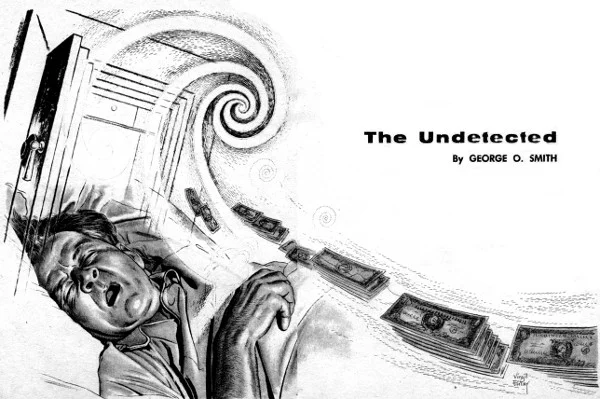
I continued to nod, but his assurance didn't reassure me in the least. With about ninety-eight per cent of the general public still not quite willing to accept rockets, missiles and space travel, I had a fat chance of convincing anybody that a telepath had kept guard over the slumbering mind of Gordon Andrews, while a perceptive solved the combination to the wall safe, so that a kinematic could twirl the dial; that the imminent awakening of Gordon Andrews had indeed been an imminent physical threat to a delicate extra-sensory undertaking, and that therefore he had been silenced by the kinematic, with a weapon located by the perceptive, after warning from the telepath; after which the crime had continued, with the loot being floated by a levitator along a freeway explored by the perceptive and scouted by the telepath and cleared of barriers by the kinematic who opened and debugged them as he went along—and that the real topper for this whopper was that this operation was not the integrated effort of a clever gang of extra-sensory specialists, but rather the single-handed accomplishment of one highly talented Psi-man!
A Psi-man ruthless enough to kill before he would permit his victim to watch the turning dial, the floating loot, the opening portal, simply because there stood a probability that one of the two billion persons on Earth might suspect the phenomena as parapsychical activity, instead of the hallucinatory ravings of a rich old eccentric who hated the incumbent political party!
How best to keep a secret?
Let no one suspect that any secret exists!
Comments (0)