
“What a fright you give me! I thought your peepers ‘ad been glued tight for hours h’and hours.”
“Has she come? Has she come? Did a lady-angel bring her?”
“Lor’ bless the boy, he’s dreamin’! Now lie down, little Round Tummy. Grice won’t be long; then she’ll hold you in ‘er arms all comfy.”
“But Grace, she’s downstairs, a teeny weeny one—just big enough for Peter to carry.”
“Now, look ‘ere, you just stop it, Master Peter. It’s no time for talkin’; you’ll ‘ear soon enough. You and your teeny weeny ones!”
Peter lay down, his little heart choking. Why wouldn’t Grace tell him?
“But, Grace———”
“Shut up. I’m a-sayin’ of me prayers.”
In the morning the hushed suspense still hung about the house. When he raised his piping voice, Grace shook him roughly. At breakfast his father’s brows were puckered—he wasn’t a bit happy like the funny man. When the table had been cleared, he laid aside his paper and sat Peter on his knee before him. “Something happened last night, sonny. You’ve got a little brother.”
“Not a sister, Daddy?”
Peter cried at that; no wonder they were all so sad. “But we asked God for a sister partickerlarly.”
All day as he played in a whisper by himself, he tried to think things out. God had become confused at the last moment, or the angel had: the wrong baby had been brought to their house. But where was the right one?
That evening the angel remembered his error and took the baby back.
Peter was being undressed for bed and Grace was crying terribly. She had just slipped him into his long, pink nightgown when his father came in hurriedly. He caught him up, wrapping a blanket round him and ran with him downstairs. The door of the room which he had watched all day was opened by a man in black. The room was in darkness, save for a shaded lamp. There were several people present; all of them whispered and walked on tiptoe. He raised himself up in his father’s arms. On the bed his mother lay weak and listless; her eyes were blue and vacant. She seemed to have shrunk and tears stole down her cheeks unheeded. Her hair seemed heavy for her head and lay across the pillow in two broad plaits. In her arms was a little bundle. The man in black commenced to talk huskily. No one answered; everyone listened to what he said. Suddenly he stooped to take the bundle from his mother, but her arms tightened. “I’ll keep him as long as God lets me.”
So the man drew aside the wrappings; Peter saw the face of a tiny stranger already tired of the world. The man in black spoke some words more loudly and touched the stranger’s face with water. Peter shuddered; it was cruel to wet his face like that. They all stood silent in the shadows—all except Peter, who cuddled against his father’s shoulder. Someone said, “He’s gone,” and the sobbing commenced.
That night Peter slept in his mother’s bedroom—she would have it. She seemed frightened that an angel so careless might carry him away as well. So they set up his cot by the side of her bed; as she lay on her pillows she could watch him.
Mummikins got happy slowly; she seemed disappointed in God. Gradually Peter learnt that, although the baby had been left at the wrong house, they had given him a name and had called him Philip. But the old question worried Peter—the one which no one seemed able to answer: where was the sister God had meant to send and which his father had promised? Since everyone treated him with reticence, he took the matter up with God himself. Often, when his mother bent above him and thought him sleeping, he was talking with God inside his head. As a result the strange thing happened.
In his room, to the left of his bed, was a large powder-cupboard, even in the day-time full of shadows. One night he had been praying out loud to himself, but his voice was growing weary and his eyelids kept falling. As he lay there, coming from the cupboard, very softly, very distant, he heard a sound of whistling. It was a little air, happy and haunting, trilled over and over. He sat up and listened, not at all frightened. He thrust himself up with his elbows, his head bent forward, in listening ecstasy. His father could whistle, but not like that. A man’s whistling was shrill and strong. This was gentle and glad, like a violin played high up—ah yes, like his mother’s whistling. Then, somehow, he knew that a girl’s lips formed that sound.
He slipped out of bed in the darkness and tiptoed to the cupboard. He opened the door; it stopped.
When he was safe in bed it again commenced, as though it were saying, “I’m coming. I’m coming, little Peterkins. Don’t be impatient.”
It was trying to say more than that, and he racked his brains to understand. When he lay quiet and was almost asleep, the picture formed. He saw a girl-angel, standing in a garden, watching God at his work. And what was God doing? He was making a little sister for Peter, stitching her together. And every time the angel stopped whistling, God’s needle dropped. And every time she recommenced, God laughed and plucked feathers from her softy wings to make garments for the little sister. Peter named her the Whistling Angel. One day, when she and God were ready, she would bring his little sister to him.
The last thing he heard, as his sleepy eyes closed on the pillow, was that happy haunting little air, like a tune played high up on a violin, faintly, faintly.
“I’m coming. I’m coming, little Peterkins. Don’t be impatient.”
It was like the rustle of wind in an angel’s wings who had already set out on the journey.
CHAPTER VIII—“COMING. COMING, PETERKINS”
Peter took all the credit to himself—she was his baby. And why not? Nobody, not even his mother or father, had had anything to do with her advent. For many months after Philip’s short sojourn, his mother had cried and his father had frowned whenever babies were mentioned. Had it not been for Peter, the little sister might have slipped God’s memory. Peter gave him no chance to forget. Every night, kneeling between the bed-clothes with his lips against the pillow to muffle the sound, he reminded God. He realized that this attitude was not respectful and always apologized in his prayers. He did it because big people wouldn’t understand if they caught him kneeling beside the bed; it would be quite easy to fall asleep there and get found.—So, of course, when she came, she belonged to him. But her coming was not yet. He had no end of trouble in getting her.
After he had heard the whistling, he tried to tell Grace about it. This happened the very next morning. She had risen late and was dressing him in a hurry in order to get him down in time for breakfast. She hardly listened to him at all, but jerked him this way and that, buttoning and tying and tucking.
“My, oh, my! There’s only emptiness inside your little ‘ead this mornin’; you must ‘ave left your brains beneath the pillow. What a lot o’ talk about nothin’.”
“It wasn’t nothing, Grace. I really and truly heard it.”
“Now then, no false’oods, young man. God’s a-listenin’ and writin’ it all down.—There, Grice didn’t mean to be h’angry! But you talk your tongue clean out o’ your ‘ead.”
“But Grace, I did. I did. It was like this.”
He pursed his lips together; only a splutter came. Grace rubbed his face vigorously with the flannel, leaving a taste of soap in his mouth.
“You should ‘ear my new sweet’eart.” She was trying to create a diversion. “‘E can make a winder rattle in its frame; it’s that loud and shrill, the noise ‘e do make. If you’re a good boy, maybe I’ll get ‘im to teach you ‘ow.”
He was bursting with his strange new knowledge; he was sure his mother would understand. While his father was at the table he kept silent. His father soon hurried away; the front-door slammed.
He plucked at his mother’s skirt. “Last night God was in my cupboard.”
“But darling, little boys oughtn’t to say things like that—not even in fun, Peter.”
“I heard him, mummikins. An angel was with him, doing like this.”
He puffed out his cheeks; but he wasn’t so clever as the angel. No sound came.
His mother gazed long into the eager face, trying to detect mischief. “Whistling—is that what you mean? But angels don’t whistle, Peter.”
“This one did—in our cupboard—in my bedroom.”
He wagged his head solemnly in affirmation. Then he drew down his mother’s face. She was smiling to herself. “God was making our baby,” he whispered, “and the angel was waiting to bring her.”
The rain came into her eyes—that was what Peter called it. “Hush, my dearest. That’s all over. You’re my only baby now.”
She pressed him to her; he could feel her shaking. Just then, he knew, nothing more must be said.
Many times he tried to tell her. One evening, while the angel was whistling, she tiptoed into his bedroom. Looking up through the darkness he saw her and seized her excitedly about the neck. “They’re there, mummy. Don’t you hear her? She’s whistling now.” He pronounced it ‘wussling.’
“Why her, Peter?”
“I dunno; but listen, listen.”
She opened the cupboard door. “See, there’s nothing.”
“She stopped when you did that.”
“Go to sleep, my precious. You’re dreaming. If there was anything, mother would have heard it as well.”
So he learnt to keep his secret to himself; no one seemed able to share it. Every now and then, he would stop in his playing, with his head on one side and his face intent; those who watched would see him creep upstairs and peep into the big, dark cupboard. Strangely enough, whatever he thought he heard, he did not appear frightened.
When the doctor was called to examine him he said, “A very imaginative child! Oh dear no, he’s quite well. He’ll grow out of that fancy. Won’t you, old chap?”
At the back of his mother’s mind was the terror that she was going to lose him. She kept him always with her. When that dreamy look came into his eyes and he turned his head expectantly, she would snatch him to her breast, as though someone lurked near to take him from her. And Peter lay still in her arms and smiled, for it seemed to him that the angel leant over the banisters and whistled softly, “I’m coming. I’m coming, little Peterkins.”
But Peter was anxious to make God hurry. It was Grace who taught him how.
Her faith came in spasms. Although she beat the drum for the Salvation Army her fervor had its ups and downs. She used to tell Peter. When her love-affairs went wrong, she was overwhelmed with doubt and refused to go on parade. “‘E can carry the drum ‘isself,” she would say, speaking of her Maker. “If ‘e don’t look after me no better, I’ve done with ‘im. It’s awright; I don’t care. ‘E can please ‘isself. If ‘e can do without me, I can do without ‘im. So there.”
These confidences made Peter feel that God was an excessively accessible person. One evening, kneeling in his mother’s lap with folded hands, he surprised her by adding to the petition she had taught him, “Now, look here, God, I’m tired of waiting. I wants——”
At this point he was stopped by a gentle hand pressed firmly over his mouth.
“I can’t think what’s come to Peter,” she told her husband; “he speaks so crossly to God in his prayers.”
“That’s Grace,” said Barrington laughing, “you mark my words. You’d better talk to her.”
“Oh, but I’m so frightened when he does like that. Billy, do you think——”
He stopped her promptly. “No, I don’t. The boy’s all right.”
Seeing how her lips trembled, he took her in his arms. “You’ve never grown out of your short frocks—you’re so timid, you golden little Nan.”
It was after Grace had been spoken to that she made it up with her Maker. When this occurred, Peter was with her in the dimly lit hall where the soldiers of Salvation gathered. She was sitting beside him sulkily on the back bench nearest the door; suddenly she rose and dashed forward in a storm of weeping. While the penitent knelt by the platform, the man who was waving his arms went on talking. Peter was growing frightened for her, when she jumped to her feet, seizing a tambourine which she banged and shook above her head, and shouted, “I’m cleansed. I’m cleansed.”
Partly because of her strength and partly because of her righteousness, she was allowed to carry the drum again and march in the front of the procession. Peter was impressed. After that when he had been impatient with God, he would seek forgiveness by declaring himself cleansed. He always thought that, following such confessions, the whistling came louder from the cupboard.
But it was Uncle Waffles who completed his information. At intervals he would come over to Topbury with Aunt Jehane. So far as the ladies were concerned, the talk was usually about their children. Aunt Jehane would rarely fail to mourn the fact that hers were both girls.
“Boys are different,” she would say; “you can turn them out to sink or swim. But girls! Sooner or later one has to get them married. It’s like my fortune to have two of them—the luck was with you from the first.”
Perhaps that was Jehane’s way of reminding Nan that she had given her husband only Peter. Waffles seemed to construe it in that light for, when she had repeated her complaint more than twice, he would tuck Peter under one arm and Glory under the other, and steal away to some hidden place where he could ask him funny questions. If he heard a cock crowing he would stop and inquire, “Why does the Doodle-do?”
The little boy almost always forgot the proper answer. Uncle Waffles would have to tell him, “Because he does, Peter.”
Peter soon learnt that Uncle Waffles had secrets as well, for, when he talked in the presence of his wife, he would hold his chin in his hand, so as to be able to slip his fingers quickly over his mouth if he found that unwise words were escaping. If he were too late in slipping up his fingers, she would say quite sharply, “Ocky, don’t be stupid. You’re no better than a child.”
It was because Uncle Waffles was no better than a child that Peter took courage to ask him, “How does people have babies?”
His uncle regarded him seriously a moment. “You’re very little to ask such questions. It’s a great secret. If I tell you, promise to keep it to yourself.”
When he had promised, his uncle whispered. And Peter knew that it was true, for he remembered that someone had been lazy and had had breakfast in bed before the coming of both Riska and Philip. So he learnt the last piece of witchcraft by which babies are induced to come into the world. From then on, until it happened, he was continually coaxing his mother not to get up to breakfast. One morning she took his advice; then he knew for certain that Uncle Waffles was very wise, even though Aunt Jehane did call him stupid.
For some time the whistling had been growing bolder: it would come out of the cupboard as though the angel were running; it would wander all over the house and meet him in the most unexpected places. When he was playing in the garden it would drift down to him from the tree-tops, “Coming, Peterkins. Coming.” It had grown quick like that, as though it, too, were impatient of waiting.
Two years had gone by since God had sent Philip and taken him back so suddenly. It was within a few days of the anniversary and very close to Christmas. All day the sky had been heavy with clouds. It was bitterly cold outside; Peter had been kept in the nursery with a big, red fire blazing. Everyone seemed busy; they opened the door now and then to make sure that he was all right, and left him to play by himself. Toward evening the clouds burst like great pillows, swollen with angels’ feathers; softly, softly, covering up bare trees, putting the world to sleep beneath a great white counterpane, the snow came down.
He woke in the night; it was like a lark singing right beside his bed. It was the old haunting little air that it sang, but so much quicker, “Coming. Coming. Coming.” Sometimes it sank into the faintest whisper; sometimes it would swell into a sound so loud and happy that even Grace’s sweetheart could not have whistled louder. Grace turned drowsily and, seeing him sitting up, drew him down beneath the clothes, putting her arms about him. No, she had not heard it.
In the morning his mother’s breakfast was carried upstairs and his father looked worried. Peter grew afraid lest he had done wrong and a little sister was not wanted. So he hid himself in the big dark cupboard in the bedroom and was not missed for hours.
Presently voices wandered up and down the house, sometimes sounding quite near and sometimes quite distant, “Peter! Peter! Where are you?” They seemed afraid to call louder.
Peter had his suspicions, so he kept quiet. They did not want her—and they knew that he had done it.
Someone said “Shish!” The other voices sank into silence; now it was only his father’s that he heard. “Peter-kins, Peterkins, father wants you. Don’t be frightened. He’s going to tell you something grand.”
So Peter came out; when he saw his father’s face, he knew that he was not angry.
“You did want her too—didn’t you, didn’t you, Daddy?”
“Of course I did, you rummy little chap. But how did you know? Who told you?”
Although he coaxed and rubbed his scrubby chin against Peter’s neck, he never got an answer to that question. Where was the good of answering? Either you had ears like Peter’s or you hadn’t.
CHAPTER IX—KAY AND SOME OTHERS
She filled all his thoughts; the world had become new to him. Picture-books were no longer amusing; just to be Peter with a little strange sister was the most fascinating story imaginable.
It was easy to keep him good; Grace had only to threaten that he should not see her. See her! He lived for that. Early in the morning he was at the bedroom door, waiting for the nurse to look out and beckon. As he followed her in on tiptoe, his golden little motherkins would turn on her pillow, holding out her hand. She was prettier than ever now. If Peter had known the word, he would have said she looked sacred: that was what he felt. And she seemed to have grown younger. She appeared immature as a girl, so slim and pale, stretched out in the broad white bed. Her hair lay in shining pools between the counterpane mountains.
“Pepperminta, you’re no older than Peter,” he had heard his father tell her; “you’re a kiddy playing with dollies—not a mother. It’s absurd.”
He knew from watching his father that, if they had loved her before, they must love her ten thousand times better now. When he went for his walks with Grace, he spent his pennies to bring her home flowers.
Everything in that room had been brightened to welcome the little sister. It had a sense of whiteness and a soft, sweet fragrance. They had to make the little sister feel that they were glad she had come and wanted her to stay. So a fire was kept burning in the grate. They spoke in whispers and walked on their toes, the way one does in church.
Climbing on a chair, he would seat himself at the foot of the bed while his mother’s eyes laughed at him from the pillow, “We’ve managed it this time, little Peter.”
Presently the nurse would turn back the sheet and show him the stranger, cuddled in his mother’s breast; he would see a shining head, like fine gold scattered on white satin.
“The same as yours, mummy.”
“And the same as yours, darling.”
When anyone found him in any way like her, Peter was glad.—If he waited patiently, the blue eyes would open and stare straight past him, seeing visions of another world.
“She sees something, mummy.”
“God, perhaps.”
Peter thought he knew better, for he heard quite near, yet so softly that it might have been far away, the violinlike whisper of one who whistled beneath her breath.
“Dearest, was Peter like that?”
“Peter and everybody.”
There were times when he was allowed to slip his finger between those of the tiny fisted hand. When he felt their pressure, they seemed to say, “I’m yours, Peter-kins. Take care of me, won’t you?”
He was sure she knew that he had seen God make her.
He did not want to speak; he was perfectly content to sit in the sheltered quiet, watching. He would listen outside the door for hours on the chance of being admitted. If Grace missed him, she always knew where he might be found.
As the little sister grew, he was permitted to see her bathed and dressed. One by one the soft wrappings were removed and folded, and the perfect little body revealed itself. No wonder God had taken so long; he had put such love into his work. By and by she learnt how to crow and splash. Her first recorded smile was given to Peter. But long before that a name had to be chosen.
She was christened Kathleen Nancy and was called Kay, because that made her sound dearer.
Peter was nearly seven at the time of her coming. Of all people, he and his mother seemed to know her best. They had secrets about her; before she could talk, they told one another what her baby language meant. During her first summer on earth, they would sit beside her cradle in the garden, believing that birds and flowers stooped to watch her.
“You’re no older than Peter,” his father had said. But, when he came home from the city, he would join them and seemed perfectly happy to gaze on Kay, with Peter on his knee, holding Nan’s free hand.
Even in those early days, it was strange the power that Peter had over her. If she were crying, she would stop and laugh for Peter. She would sleep for Peter, if he hummed and rocked her. When she began to speak, it was Peter who taught her and interpreted what she said; that was during her second summer, when leaves in the garden were tapping. They grew to trust Peter where Kay was concerned. “He’s so gentle with her,” they said.
“Might be ‘er father, the care ‘e takes of ‘er. It’s uncanny,” Grace told her sweetheart.
Her sweetheart was a policeman at this moment; his profession did not make for sentiment. “Father, by gum! Fat lot o’ care your father took o’ you, I’ll bet.”
Grace’s father was a cabby and was known to the Barrington household as Mr. Grace—a name of Peter’s bestowing. He drove a four-wheeler and had a red face. His stand was at the bottom of Topbury Crescent, which formed the blade to the sickle of which the Terrace was the handle.
When Kay was beginning to toddle, her cot was transferred from her parents’ to Peter’s bedroom. Nan was none too strong and Barrington could not afford to be roused at five in the morning—he worked too hard and required all his rest. Had Peter’s wishes been consulted, this was just how he would have arranged matters. From the moment when the light went out to the moment when his eyelids reluctantly lowered, he had Kay all to himself. Throwing off the clothes, he would slip out and kneel beside her cot, softying her with his face and hands. He had to do this carefully lest he should be heard. Sometimes, in stepping out, the mattress squeaked and a voice would call up the tall dim stairs, “Peter, are you in bed?” An interval would elapse while he hurried back; then he would answer truthfully, “Yes.” Often the voice would say knowingly, “You are now.”
But the temptation was too great. It was so wonderful to touch her in the darkness, to hear her stir, to feel her hand brush his cheek and the warm sleepy lips turned toward his mouth.
“It’s only Peter,” he would whisper; and, perhaps, he would add, “Little Kay, aren’t you glad I borned you?”
Oh yes, it was he who had contrived her birth. There, as a proof, was the big dim cupboard where it had all commenced.
In the shadowy darkness of the room, before Grace came up to undress, he lived in a world of fancy. Through the oblong of the doorway the faint gold glimmered, made by the lowered gas. In the square of the window, as in a magic mirror, all kinds of strange things happened. Great soft clouds moved across it, like mountains marching. Presently they would stand aside, giving him glimpses of deep lagoons and floating lands. Stars would dance out, like children holding hands, and wink and twinkle at him. The moon would let down her silver ladder, smiling to him to ascend. He laughed back and shook his head. Oh, no thank you; Kay needed his attention.
Beneath the sky was a muffled world, like a Whistler nocturne, of house-tops and drowsy murmurs. It was a vague field of seething shadows in which the blur of street-lamps was a daffodil forest. Dwellings which were blind all day, in streets he had never traversed, now peered stealthily from behind their curtains with the unblinking eyes of cats. What did they do down there? Church bells in the Vale of Holloway would try to tell him. Sometimes strains of a barrel-organ would drift up merrily and he would picture how ragged children danced, beating time with rapid feet upon the muddy pavement. Sometimes in the distance, like a scarlet fear, a train would shoot across the murk and vanish.
But always from these wanderings his imagination would return to the cot where the little sister nestled. Who was it put the thought into his head? Was it some strange confusion between winking stars and the Bethlehem story? Or was it Grace in one of her flights of poetry? Long ago, he told himself, like this the Boy Jesus must have sat keeping guard over a baby sister, while at the bottom of a tall steep house Mary helped Joseph, making chairs and tables.
Once Peter gave things away completely by trusting too much to his wakefulness; he was found asleep on the floor beside Kay’s cot when Grace came up to undress.
If the nights had their spice of adventure because such doings were forbidden, the mornings were not to be sneered at. He would be wakened by a small hand stroking his face and she would snuggle into bed beside him. Years after, when he was a man, he remembered the sensation of her cold feet when she had found him difficult to rouse.
But the greatest treat of all came rarely. When his father went away on a journey, his mother could cast aside her habits. She would make her home in the nursery and hirelings would be driven out. Grace would be given an evening with her policeman, and Peter, and Kay, and Nan would have each other to themselves. If it were winter, they would have supper by firelight, after which they would sit and toast themselves while Nan told stories of her girlhood. Kay would be taken into her lap and Peter would sit on the rug, cuddling against her skirt.
“How did Daddy find you, Mummy?”
And when that had been told in a simplified version, “Mummy, should I be your little boy, if you’d married someone else?”
Since there seemed some doubt, Peter made haste to assure her, “Dearest, I’m so, so glad.”
In the dancing flames and shadows, Kay would be undressed and popped into the tin-bath while Peter helped. Then, all warm and snuggly, she would be carried to her mother’s bed. In a short time Peter would follow and fall asleep with his arms about her.
Toward midnight he would rouse; the gas was lit and someone was rustling. Looking down the bed, he would see his mother with her gold hair loose about her shoulders. “Hush,” she would whisper, placing her finger against her mouth. So he would lie still, watching her shadow on the walls and ceiling. Again the room was in darkness; his face was hidden in her breast as she clasped him to her. He was thinking how lucky it was that his father had found her.
In the morning Kay would wake them, climbing across their legs or losing herself beneath the bed-clothes. Just to be different from all other mornings, they would have their breakfast before they dressed. What an adventure they made of it and what good times they had!
In after years, looking back, Peter realized what children he had had for parents; they seemed anything but children then. His father was not too old to be a lion on hands and knees beneath the table, trying to catch him as he ran round. At last his mother would cry out, “Billy, dearest, do stop it. You’ll get the boy excited.”
And then there were those empty rooms at the top of the house to be furnished. Peter’s father led him all over London, visiting beery old women and dingy old men, whose shops to the unpracticed eye were stocked with rubbish. Oak paneling, bronzes, French clocks, canvases dim with dirt, were discovered and carried home in triumph. For the canvases frames had to be hunted out; the pursuit was endless. These treasures were driven home in cabs, taking up so much room that Peter had to make himself smaller. Nan would fly to the door as the wheels halted on the Terrace.
“Peter, why did you let him? Oh, Billy, how extravagant!”
“But, my dear, it’s an investment. I paid next to nothing and wouldn’t sell it for a thousand pounds.”
“Couldn’t,” she corrected; but, as was proved later, she was wrong in that.
When the empty rooms were furnished—the oak bedroom and the Italian—the modern furnishings in other parts of the house were gradually supplanted; even the staircase was hung with paintings which Barrington restored himself. There was one little drawback to these prowlings through London which Peter was too proud to mention: his father as he walked would pinch his hand to show his affection—but it hurt. He knew why his father did it, so he did not tell him. He bit his lips instead to keep back the tears.
Four other people stole across his childish horizon like wisps of cloud—the Misses Jacobite. They lived in an old-fashioned house in Topbury and kept no servants. Peter got to know them because they smiled at him coming in and going out of church. There was Miss Florence, who was tall and reserved; and Miss Effie, who was little and talkative; and Miss Madge, who was fat and jolly; and Miss Leah, a shadow-woman, who sat always in a darkened room with pale hands folded, crooning to herself.
People said “Poor thing! Oh well, there’s no good blaming her now. She wouldn’t thank us for our pity; after all, she brought it on herself.”
Or they said. “You know, they were quite proud once—the belles of Topbury. Two of them were engaged to be married. Their father was alive then—the Squire we called him. But after Miss Leah——” They dropped their voices till they came to the last sentence, “And the disgrace of it killed the old chap.”
Even Grace, when she took Kay and Peter to visit them, left them if she could on the doorstep. Her righteous mood asserted itself; she flounced her skirt in departing, shaking off the dust from her feet for a testimony against them. “Scand’lous, I calls it. If I wuz to do like ‘er, yer ma wouldn’t let me touch yer. But o’ course, it’s different; I’m only a sarvant-gal. And they ‘olds their ‘eads so ‘ighl Brazen, I calls it. Before I walked the streets where a thing like that ‘ad ‘appened in my family, I’d sink into my grave fust—that I would. I ‘ate the thought of their kissing yer, my precious lambs.”
Peter was always wondering what it was that Miss Leah had brought upon herself. Whatever it was, it stayed with her in the room with the lowered blinds at the back of the house. She never went out; callers never saw her. Her eyes were vague, as though she had wept away their color. She spoke in a hoarse whisper, as in a dream; and her attention had to be drawn to anything before she saw it. But it was her singing that shocked and thrilled Peter, making him both pitiful and frightened. Her song never varied and never quite came to an end; she repeated it over and over. You could hear it in the hall, the moment you entered; it went on at intervals until you left. She sang it with empty hands, sitting without motion:
“On the other side of Jordan
In the sweet fields of Eden
Where the Tree of Life is growing
There is rest for me.”
Where were the “sweet fields of Eden”? Peter liked the sound of them and would have asked her, had not something held him back. She must be very tired, he thought, to be singing always about rest. Yet he never saw her work.
He had been there many times and had only heard her, until one day, as he was scampering down the passage with Miss Madge pursuing, the door opened and a woman with dim eyes and hair as white as snow looked out. She gazed at him without interest; but when Kay toddled up to her fearlessly, she stooped and caught her to her breast.
Several things about the Misses Jacobite struck Peter as funny. They divided the visit up, so that each might have a child for part of it entirely to herself. Each would behave during that time as though she were a mother famished for affection, returned from a long journey, and would invent secrets which were to be shared by nobody but the child and herself. Kay and Peter were carried off into separate rooms, and there played with and cuddled by a solitary Miss Jacobite. Though the Misses Jacobite were obviously poor, the children always went home with a present; often enough it was a toy from the dusty, disused nursery. When they met Kay and Peter on Sundays and people were watching, they pretended to forget the other things that had happened.
“I wonder you let your children go there,” people said.
Nan smiled slowly and answered softly, gathering Kay and Peter to her. “Poor things! They were robbed of everything. I have so much I don’t deserve. I can spare them a little of my gladness.”
“But, Mrs. Barrington, that’s mere sentiment. How does your husband allow it?”
One day Nan’s husband spoke up for himself. “Did you ever hear of the raft? I thought not. Well, Nan and I have.”
CHAPTER X—WAFFLES BETTERS HIMSELF
It was the month of June. A breeze blowing in at the open window fluttered out the muslin curtains and shook loose the petals of roses standing on the table. A milk-cart rattled down the Terrace, clattering its cans. Sounds, which drifted in from the primrose-tinted world, were all what Peter would have described as “early.” The walls of the room were splashed with great streaks of sunlight, which lit up some of the pictures with peculiar intensity and left others in contrasting shadow. One of those which were thus illumined was a Dutch landscape by Cuyp, hanging against the dark oak paneling above a blue couch; it represented a comfortable burgher strolling in conversation with two women on the banks of a canal. Barrington liked to face it while he sat at breakfast; it gave him a certain indifference to worry before the rush of the day commenced. But this morning, to judge by his puckered forehead, it had not produced its usual effect. He glanced up from the letter he was reading and tossed it across to Nan. “What d’you make of that?”
She bent over it, wrinkling her brows. The letter was in a man’s handwriting and the postscript, which was of nearly equal length, was in a woman’s.
“I don’t know; if it was from anyone but Ocky——”
“Precisely, Ocky’s a fool. He’s always been a fool and he’s growing worse; but Jehane ought to have sounder sense. It’s beyond me why she married him. I never did understand Jehane; I suppose I never shall.”
“You’re not a woman, Billy; or else you would. She was sick and tired of being lonely and dependent; she wanted someone to take care of her. Ocky was the only man who offered. But that’s eight years ago—I’m afraid she’s found him out; and she’s doing her best to persuade herself that she hasn’t. Poor Jehane, she always admired strong men—men she could worship.”
“That explains but it doesn’t excuse her. She had a strong man in Captain Spashett; the hurry of her second marriage was indecent. I never did approve of it. I said nothing at first because I thought she might help Ocky to grow a backbone.—And now there’s this new folly, which she appears to encourage.”
“But, dear, is it so foolish? Perhaps, she’s given him a backbone and that’s why he’s done it.” She laughed nervously. “They both say that this is a great opportunity for him to better himself.”
“Bah! The only way for Ocky to better himself is to change his character. He’s a balloon—a gas-bag; he’ll go up in the air and burst. The higher he goes, the further he’ll have to tumble. You think I’m harsh with him; I know him. Jehane’s done him no good; she despises him, I’m sure, though she doesn’t think she shows it. She’s filled his head with stupid ambitions and before she’s done she’ll land him in a mess. She’s driven him to this bravado with private naggings; he wants to prove to her that he really is a man. Man! He’s a child in her hands. It hurts me to watch them together. Why can’t she be a wife to him and make up her mind that she’s married a donkey?”
“It’s difficult for a woman to make up her mind to that—especially a proud, impatient woman.”
He paid no attention to his wife’s interruption, but went on irritably with what he was saying.
“So he’s giving up a secure job, and he’s going into this harum-scarum plan for buying up the sands of Sandport for nothing and selling them as house-plots for a fortune. Even if there were anything in it, who’s going to finance him? Of course he’ll come to me as usual.”
“But he says he’s got the capital.”
“That’s just it—from where? His pocket always had a hole in it. When he says he’s got money, I don’t believe him; when he’s proved his word I grow nervous.”
Barrington leant across the table, rapping with his knuckles. “Ocky’s the kind of amiable weak fellow who can easily be made bad—especially by a woman who refuses to love him. Once a man like that’s gone under, you can never bring him back—he’s lost what staying quality he ever had.”
Nan rarely argued with her husband. Pushing back her chair, she went and knelt beside him, pressing her soft cheek against his hand. “You are a silly Billy, dearest, to be so serious on such a happy morning. There’s no danger of Ocky ever becoming bad; and, in any case, what’s this got to do with the matter? I know he’s foolish and his jokes get on your nerves; but it isn’t his fault that he’s not clever like you. You shouldn’t be gloomy just because he’s going to be daring. I don’t wonder he’s sick of that lawyer’s office. And it’s absurd to think that he’s going to be bad; look how Peter loves him. You like Ocky more than you pretend, now don’t you?”
“If liking’s being sorry. I’m always sorry for an ass; and I’m angry with Jehane because she knows better. She’s doing this because she’s jealous of you—that’s why she clutches at this bubble chance of prosperity.”
“Ar’n’t you a little unjust to her, Billy? Since our marriage, you’ve always been unjust to her. You know why she’s jealous—she wants her husband to be like you.”
Her voice sank away to a whisper. “Oh, Janey, I did, I did play fair,” she had said that night at Cassingland; in her violent assertion of fairness there had been an implied question which Jehane had never answered. Both she and her husband knew that they had never been acquitted.
Barrington drew Nan’s head against his shoulder. “Poor people.” Then he kissed her with new and eager gladness.
“And it isn’t only pity you feel for Ocky?” She persisted. “Now confess.”
He pulled out his watch hastily and, having replaced it, gulped down his coffee. “When I was Peter’s age, we were brought up like brothers together. I loved him then; I’m disappointed in him now. And yet I’m always catching glimpses in him of the little chap I played with. You see, at school I was the stronger and had to protect him. I was always fighting his battles. And one whole term, when his hand was poisoned, I had to take him to the doctor to get it dressed—— No, it isn’t only pity, Pepperminta: it’s memories.”
As he was going out of the door she called after him, “Then, I suppose, I can write and say we’ll have them?”
“While they’re moving—the children? Yes.”
“Jehane doesn’t say how many.”
“She means all, I expect. There’s the garden for them—it’ll be fun for Kay and Peter.”
A week later, Jehane traveled across London to Top-bury Terrace, bringing with her Glory, aged nine, Riska, aged six, and her youngest child, Eustace, who was the same age as Kathleen. Jehane was now in her thirty-seventh year, a striking brooding type of woman. As her face had grown thinner and her cheeks had lost their color, the gipsy blackness of her appearance had become more noticeable. She still had a fine figure, so that men in public conveyances would furtively lower their papers to gaze at her. There clung about her an atmosphere of adventure, of which she was not entirely unaware. She was unconquerably romantic, and would spin herself stories in the silence of her fancy of a love that was crushing in its intensity. No one would have guessed from the hard little lines about the corners of her eyes and mouth that this imaginative tenderness formed part of her character.
Since the birth of Eustace her hair had fallen out in handfuls and she had adopted a style of dressing it that was distinctly unbecoming. She had had her combings made up into an affair which Glory called “Ma’s mat.” It consisted of half-a-dozen curls, sewn together in rows like sausages, which she pinned across the top of her head so that they made a fringe along her forehead. It gave her an old-fashioned look of prim severity. Jehane retained for Nan an affection which was partly genuine and partly habit; but she resented Nan’s youthful appearance with slow jealous anger, attributing it to freedom from anxiety and the possession of money. As for Nan, her attitude was one of gentle and atoning apology for her happiness. “I’m so glad you brought the children yourself, Janey.”
“And who could have brought them? I’m not like you—I only keep two servants. When this scheme of Ocky’s has turned out all right, perhaps it may be different.”
She turned swiftly on Nan with latent defiance, as though challenging her to express doubt.
“I’m sure both Billy and I hope it will. Wouldn’t it be splendid to see Ocky really a big man?”
“It would be a good deal more than splendid. It would mean the end of little houses and cheap servants and neighbors that you can’t introduce to your father’s friends. It would mean the end of pinching and scraping to save a penny. And it would mean a chance for my girls.”
Nan slipped an arm into hers and hugged it. “Dear old thing, I think I understand. And when is Ocky coming over to tell us all about it? He gave us hardly any details in his letter.”
Jehane became evasive. “He’s naturally very busy. The chance developed so suddenly that he’s hardly had time to turn round. It came to him through a client at the office. Mr. Playfair had noticed him at his desk as he passed in and out to see Mr. Wagstaff. He’s told Ocky since that he spotted him at once and said to himself, ‘If ever I want a chap with-business push and legal knowledge, that’s my man.’”
“And he’s never talked with him?”
“Hardly. Not much more than to say ‘How d’you do?’ or ‘Good-morning’.”
“Wasn’t it wonderful that he should have sized him up in a flash?”
Jehane glanced at her narrowly. “It may be wonderful to you; it isn’t to me. I’m well aware that you and Billy don’t think much of Ocky. Oh, where’s the sense in disowning it? You both think he’s a born fool.”
“I’m sure you never heard Billy say that.”
“Heard him say it! Of course I didn’t. I’d like to hear him dare to say anything like that about my husband. But actions speak louder than words. He thinks it just the same; he thinks that Ocky’s good for nothing But to sit at a desk, taking a salary from another man. P’rhaps, you didn’t know that for years Ocky’s been the brains of that office?”
Nan lifted her honest eyes; she was filled with discomfort. This kind of controversy was always happening when they met; they drifted into some sort of feud for which Jehane invariably held her responsible. “The brains of the office! No, indeed, I never heard that. Why didn’t you tell us?”
“Because you and Billy thought he was incompetent, and it didn’t seem worth the trouble to correct you.”
“I’m sure I’ve always thought him very kind, especially to Peter.”
“Kind! What’s kindness got to do with being clever?” Nan pressed Jehane to stay to dinner. She would send a telegram to Ocky; she would send her home in a cab. But Jehane was in an ungracious mood and eager to take offense. She resented the implication that a cab was a luxury. No, she couldn’t stay; there was too much to do. She had intended to return in a cab, anyhow. In reality she was anxious to avoid Barrington’s shrewd questioning. She was rising to take her departure, when she saw him descending the garden steps.
“Ha, Jehane! This is luck. I’ve had thoughts of you all day. That letter’s got on my nerves. I couldn’t work; so I came home early.—Oh no, we’re not going to let you off now. You’ve got to stop and tell us. By the way, before Ocky actually decides, I’d like to talk the whole matter over with him.”
“He’s decided already.”
“You don’t mean———-”
“Yes. Why not? He’s given Wagstaff notice. Things so happened that he had to make up his mind in a hurry or lose it.—But I really ought to be going. Nan knows everything now.”
Barrington placed his hand on her shoulder arrestingly. At his touch she drew back and colored. “This thing’s too serious, Jehane,” he said, “to be dismissed in a sentence. I have a right to know.”
He spoke kindly, but she answered him hotly. “What right, pray?”
“Well, if anything goes wrong, there’s only me to fall back on. And then there’s the right of friendship.”
“I can’t say you’ve shown yourself over friendly. If you’ve had to meet Ocky, you’ve let all the world see you were irritated. If you’ve ever invited him to your house, you’ve taken very good care that no one important was present. One would judge that you thought he lowered you. I can’t see that you have the right to know anything.”
“That can only be because your husband hasn’t told you. To quote one instance, it was through my influence that he got this position that he’s now thrown over—Wagstaff is my lawyer.”
Jehane tossed her head. “You always want to make out that he owes you everything—— Well, what is it that I’m forced to tell you?”
Barrington kept silence while they walked down the path to where chairs were spread beneath the cedar. The children ran up boisterously to greet him; having kissed them, he told Grace to take them away and to keep them quiet. When he spoke, his tones were grave and measured: “It wasn’t fair of Ocky to send you to tell us; he ought to have come himself.”
“He didn’t send——”
Barrington held up his hand. “You can’t tell me anything on that score; from the first he’s shirked responsibility. He would never fight if he could get anyone else to fight for him. Many and many’s the time I’ve had to dohis dirty work. Now you’re doing it. This is unpleasant hearing, Jehane; but you know it’s true. I’d take a wager that you spent hours trying to screw up his courage to make him come himself.”
She lifted her head to deny it, but his quiet gray eyes met hers. Their sympathy and justice disturbed her. She refused to be pitied by this man——. A great fear rose in her throat. What if his opinion of her husband were correct? It was the opinion she herself had had for years and had tried to stifle. Time and again she had listened to his plausibility—his boastings that he was the brains of the office, that luck was against him and that one day he would show the world. She had used his arguments to defend him to her relations and friends. In public she had made a parade of being proud of him. In private she had tried to ridicule him out of his shame-faced manners. And now she was trying so hard to believe that he had found his opportunity.—It was cruel of Barrington, especially cruel when he knew quite well that it was him she had loved. She could not endure to sit still and hear him voice her own suspicious and calmly analyze the folly of her marriage.
“If you think that my husband was afraid to come and tell you, the only way to prove the contrary is to let him come himself to-morrow.”
“I shall be more than glad to see him.”
But Ocky did not come to-morrow, nor the next day. The day after that Barrington went to see his lawyer.
“Good-morning, Mr. Wagstaff. I should like to speak to you about my cousin, Mr. Waffles.”
Mr. Wagstaff twitched his trousers up to prevent them from rucking as he crossed his legs. “If there’s anything I can do to help you, Mr. Barrington——”
“I understand he’s given you notice.”
Mr. Wagstaff sat up suddenly. “Understand what? He told you that?”
“No, he did not tell me. His wife did.”
“Ah, his wife! He left her to make the explanations. Just what one might expect.”
“Then he didn’t give you notice?”
“Course not.” Mr. Wagstaff spoke testily, as though for an employee to give him notice was an event beyond the bounds of possibility.
“Then he left without notifying you?”
“Well, hardly.”
The lawyer noticed that the door leading into the main office was ajar; he got up and closed it. When he returned he did not re-seat himself, but straddled the hearth-rug, holding up his coat-tails although no fire was burning.
“Mr. Barrington, sir, I put up with your cousin’s shiftlessness for longer that I ought to have done; I did it out of respect for you, sir. There was a time when I hoped I might make something of him. He can be nimble-witted over trifles and his own affairs; but he never put any interest into my work. He was insubordinate—not to my face, you understand, but when my back was turned; he wasn’t a good influence in the office. I tell you this, sir, to prove that I haven’t acted without consideration.”
The lawyer waggled his coat-tails and seemed to find a blemish in his boots, so earnestly did he regard them. When he received no help from Barrington, he suddenly came to the point and looked up sharply.
“He betrayed professional confidence; so I sacked him.”
“Had it happened before?”
“Possibly. He was always garrulous. This time it was an affair of some property at Sandport. Our client had two competing purchasers, one of whom was a Mr. Playfair. Your cousin leaked to Mr. Playfair—kept him informed as to what the other purchaser was doing. Not a nice thing to occur, Mr. Barrington.”
This last remark was as much an interrogation as an assertion. The lawyer waited for his opinion to be indorsed.
“Not at all nice,” Barrington assented. “If it’s lost you any money, I must refund it.”
“‘Tisn’t a question of money. Wouldn’t hear of that.” As Mr. Wagstaff shook hands at parting, he offered a crumb of comfort: “Mind, I don’t say your cousin is dishonest, Mr. Barrington; that would be too, too strong. Perhaps, it would be better stated by saying that his sense of honor is rudimentary.”
“Perhaps,” said Barrington brusquely. “I think I catch your meaning.”
CHAPTER XI—THE HOME LIFE OF A FINANCIER
People who loved Ocky Waffles always loved him for his good; he would have preferred to have been loved for almost any other purpose. Affection, in his experience, turned friends into schoolmasters. There was Barrington, a fine chap and all that; but why the dickens did he take such endless pains to be so uselessly unpleasant?
Ocky was on the lookout for Jehane when she returned from Topbury. As she turned the corner, he espied her from behind the curtains and lit his pipe to give himself confidence. No sooner had she entered than she commenced an account of her visit, indignantly underlining her interview with Barrington. Ocky seated himself on the edge of the table, puffing away and swinging his legs.
“Wants to see me, does he? He can go on wanting. I’m sick of his interfering. A fat lot he’s ever done to help me! And with his position and friends he could have helped me—instead of that he gives me his advice. Truth is, Jehane, he doesn’t want to see us climb; he’d rather be the patron of the family. With the best intentions in the world, he’s out to put a spoke in my wheel. Oh, I know him!—If he’s so anxious for information, he can come here to get it.”
While he spoke he scrutinized his wife, judging the effect of his blustering independence. She was suspicious of some hidden knowledge; he felt it. Something had been said behind his back at Topbury—something derogatory. Could Barrington have heard already.
Pressing down the ashes in the bowl of his pipe, he struck a match. Jehane was between himself and the door; he wondered whether he could slip past her and make his exit if things became unpleasant. He detested being cornered; he could be so much braver when the means of escape lay behind him. Meanwhile, it seemed good policy to continue talking.
“I don’t like the way they treat you at Topbury; you always come home down-hearted. There’s too much condescension. Nan overdoes it when she tries to be kind. The rich relation attitude! It riles me. When she makes you a present it’s always a dress—might just as well tell you to your face that you’re shabby. And last Christmas, sending Peter’s cast-off clothes to Eustace! Thank God, we’re not paupers and never shall be!”
As he worked himself into a passion Jehane eyed him somberly. The everlasting pipe, dangling from his mouth, annoyed her immensely. His trousers, bagging at the knees, and his pockets, stuffed with rubbish, were perpetual eyesores; she hated his slack appearance. Other men with his income at least attained neatness. It was not that he spared money on his clothes——. She caught herself comparing him with Barrington—Barrington whose tidy body was the outward sign of his well-ordered mind. Her husband went on talking and her irritation took a new direction.
“I’ll bet a fiver what they said when you told ‘em. ‘My dearest, if it could only happen’—that’s Nan. ‘Ah yes! Humph! sand at Sandport! We must talk this over before he decides’—that’s Barrington. We can guess what his advice’ll amount to, can’t we, old Duchess?”
It was safe to venture the endearment now. If they had nothing else in common, they were partners in their animosities. When running down an enemy together, he could dare to express his affection for her; his way of doing this was to call her Duchess. At other times she would brush him aside with, “Don’t be silly, Ocky.” She often called him “silly,” treating any demonstration as tawdry sentimentality. She had no idea how deeply it wounded.
Now, as she sank into the chair, he bent over and kissed her awkwardly. “Poor old gel, they’ve tired you out. Had nothing to eat since you left here, I’ll warrant. Put up your tootsies and I’ll pull off your shoes; then I’ll order some supper for you.”
“I couldn’t eat anything.”
The room was in darkness and the window wide. In the street children were screaming and playing. A mother, standing on her doorstep, called to her truants through the dusk——- Oh, for a gust of silence—a desert of sound without footsteps; Jehane felt that her life was trespassed on, jostled, undignified. Through the cramped suburb of red-brick villas crept the summer night, like a shameful woman footsore and clad in lavender. Red-brick villas! They were so similar that, if you shook them up in a gigantic hat and set them out afresh, the streets would look in no way different. They were all built in the same style. The mortar had fallen out in the same places. The front gardens were of equal dimensions. They had no individuality. If anyone attempted to be original in the color of her paint or the shape of her curtains, next day she was copied.
With the stale odor of tobacco mingled the sweet fragrance of June flowers. She had only to close her eyes and she was back in Oxford—Oxford which she had exchanged for this rash experiment. She wondered, had she been more patient, would something more delightful have happened. The sameness of economy had worn out her strength and its prospect appalled her.—If Ocky could contrive her escape, even at this late hour, what right had Barrington to prevent him?
He had gone to fetch her slippers—that at least was kind and thoughtful. She treated him with spite. She shrank from the familiarity of his touch. She hated herself for it; and yet she eked out the seconds of her respite from him.
A lamp-lighter shuffled by the garden railings; at his magic, primrose pools weltered up in the dusk.—This business of marriage—had she been less hasty, she might have done better for herself. Oh well, the wisdom which follows the event...
Footsteps on the stairs! As he knelt to put on her slippers, she conquered her revulsion and let her hand rest on his head. He started, surprised: it was long since she had shown him affection. His voice was shaky when he addressed her.
“Now you’re better, old dear. More rested, aren’t you?” She held him at arm’s length, her palms flat against his breast. In the darkness she felt the pleading in his eyes. “Oh, Ocky, you’ll do it this time, won’t you?”
“Do what, Duchess?”
“Don’t call me Duchess; just for once be serious.”
“I am serious, darling. What is it?”
“D’you remember years ago, when you asked me to marry you? D’you remember what you said?”
“Might, if you told me. Was I more than ordinarily foolish?”
“You said, ‘I need your strength. With you I could be a man.’”
“I’d clean forgotten. Funny way of proposin’—eh?”
“It wasn’t funny. That was just what you needed—a woman’s strength. I’ve tried so hard. But I’ve sometimes thought——”
“Go on, old lady.”
“I’ve sometimes thought we never ought to have married.”
“Don’t say that. Don’t you find me good enough? Come Jehane, I’ve not been a bad sort, now have I?”
“I’m accusing myself. I’ve tried to help you in wrong ways. I’ve been angry and sharp and nervous. You’ve come home and attempted to kiss me, and I’ve driven you out with my temper. And I don’t want to do it any more, and yet——”
“You’re upset.”
“No, I’m not. I’m speaking the truth. I’ve been a bad wife and I had to tell you.”
“‘Pon my word, can’t see how you make that out. You’ve given me your money to invest through Wagstaff, so he might think I had capital. And you’ve given me children, and——”
“It isn’t money that counts. It isn’t even children. Heaps of women whose husbands beat them bear them children. It’s that I haven’t trusted you sufficiently. I haven’t loved you.”
“I’ve not complained, so I don’t see—— But what’s put all this into your head?”
“D’you want to know? Seeing Billy and Nan together. They’re so different—you can feel it. They’re really married, while we—we just live together.”
Her voice broke. He put his arms about her, but even then she withdrew herself from him.
“Just live together! And isn’t that marriage? Whether you’re cross or kind to me, Jehane, I’d rather just live with you than be married to any other woman.”
“That’s the worst of it—I know you would. And I nag at you and I shall go on doing it. I feel I shall—and I do so want to do better.”
“Won’t money make a difference? That’s what’s the matter with us, Jehane; we’ve not had money.”
She placed her arms about his neck. “And that’s what I started to say, Ocky. You’ll do it this time, won’t you?”
“Make money? Rather. I should think so. Was talking to Playfair only this morning and he—— But look here, what makes you ask that? You’ll take all the stuffing out of me if you begin to doubt. Who’s been saying anything?”
“It isn’t what they said.”
He lit his pipe and crossed over to the window. In the darkness his outlined figure looked strangely round-shouldered and ineffectual. Her heart sank and her hope became desperate. His voice reached her blustering and muffled. She did wish he would remove his pipe when he spoke to her.
“I know. I know. Confound him! He’s been throwing cold water on my plans as usual. Wants to see me, does he? Well, if he wants badly enough to cross London, Ocky Waffles is his man. I shan’t go to him. That’s certain.”
Jehane strove to believe that his opposition to Barrington was a token of new strength.
Four days later a note arrived. She was tempted to open it, but it was addressed to her husband. Directly he came in she placed it in his hands.
“Read it aloud. What does he say?”
She watched Ocky’s face and saw how it faltered; then he hid the expression behind a mask of cynicism.
“If you won’t read it to me, let me read it myself.”
He crumpled it into his pocket hurriedly, as though he feared that she would snatch it from him. When all was safe, he turned toward the mantel-shelf, hunting for a match.
“Why did you do that?”
“It was addressed to me, wasn’t it? Barrington don’t let his wife read his letters, I’ll bet. Neither do I; I’m not a lawyer’s clerk in an office any longer—I’m going to be a big man.”
“But what did he say?”
Forced to answer, Ocky became reproachful. “Duchess, you’re suspecting me again—you remember what you promised the other night. He says he wants to see me—thinks there may be something in my plan. Daresay, he’ll offer to put money into it. You may bet, this little boy won’t let him. Of course on the surface he advises caution.”
“If that’s all, why can’t you let me read his letter?”
“Because if I did, I’d be acting as though you didn’t trust me. You could have read it with pleasure, if you hadn’t made such a fuss.”
Jehane knew his weak obstinacy of old and gave up the contest. “You won’t see him, of course—unless he comes to the house.”
“Don’t know about that.”
“But you were so emphatic.”
“I can change my mind, can’t I? His letter puts a different complexion on it.”
“But, Ocky, Barrington isn’t two-faced. He doesn’t say one thing to me and another thing to you. He may be awkward, but he isn’t underhand. If he’s in favor of your schemes now, he must have heard something that’s changed him.”
“Not a doubt of it. Very soon a good many people who’ve thought me small beer’ll hear something.”
“But you’ve not answered my question. Where are you going to see him?”
“Oh, maybe at his office.”
Whistling, with feigned cheerfulness, he strolled out. As she watched him slouch down the road, her fingers itched to correct the angle of his hat.
That night she searched his pockets and found the letter. It read, “Mr. Wagstaff has told me the truth. You must meet me at my place of business at twelve to-morrow.”
It was capable of the construction her husband had put on it; it was capable of many others.
Feeling through the coat next morning, searching for his tobacco-pouch, Ocky was shrewd enough to notice that the letter was in its envelope. Such neatness was not his habit. When he came back in the evening from seeing Barrington and Jehane enquired what he had been doing, he handed her the letter with generous frankness.
“You can read it now. I wanted to be sure before I told you. I was right. Barrington’s been talking to Wagstaif and has heard all about it. Oh yes, I can tell you, he’s a very different Barrington.”
“How?”
“He’s discovered that Ocky Waffles Esquire is a person to be respected.”
She scorned herself for her mean suspicions. He deserved an atonement. “Ocky, darling, I’m so glad.”
As her arms went about him, he patted her on the back. “That’s all right, old Duchess. You’ll believe in me now—eh?”
She lifted her face from his shoulder. It was tear-stained with penitence. “God knows, I’ve always tried to, Ocky.”
He must go her one better in generosity. Having deceived her, he could afford to be magnanimous.
“You’ve succeeded, old dear. You’ve given me your strength and made a man of me. I’m your doing.”
CHAPTER XII—THE ‘MAGINATIVE CHILD
The bettering of Mr. Waffles marked the beginning of that intimate and freakish association which was to shape the careers of the children of both families. Though their relationship was distant and in the case of Glory non-existent, they had been taught to regard one another as cousins. As yet they had met so occasionally and so briefly that they had not worn off the distrust, half-shy, half-hostile, which is the common attitude of children toward strangers. From now on they were to enter increasingly into one another’s lives.
Though Barrington had said that it would be fun for Kay and Peter to have Jehane’s children to play with in the garden and Nan had assented, neither of them had undertaken to tell Kay and Peter. They had promised them a surprise—that was all. Truth to tell, they had their doubts about Peter and how he would receive their information; his jealous air of proprietorship regarding his little sister gave them moments of puzzled uneasiness.
Years ago, before Kay was born, the doctor had told them, “He’s an imaginative child. Oh dear no, he’s quite well. He’ll grow out of it.” But he hadn’t. He stood by her always, as if he were a wall between her and some threatened danger. He was not happy away from her; his life seemed locked up in her life. His tenderness for her was beyond his years—beautiful and mysterious. In the midst of his play he would still raise his head suddenly, listening and expectant.
He was odd and gentle in many ways; to his mother his oddness was both frightening and endearing. Cookie shook her head over him and sighed, “‘E’s far away from this old world h’already. I doubt ‘e’ll never grow up to man-’ood.”
And Grace would reply sharply, “Wot rot!” But she would wipe her eye.
He had a habit of asking questions before guests with startling directness—asking them with big innocent eyes; they were questions for which his mother felt bound to apologize: “He’s so imaginative; for many years he was our only child.”
Peter, wondering wherein he had done wrong, would sidle up to her when the guests were gone, inquiring, “Mummy, what is a ‘maginative child?”
His father, when he heard him, would laugh: “Now, Peter, don’t be Peterish or you’ll make us all cry.”
So they did not tell him when his cousins were expected.
He was in the garden, on the grass beneath the cedar, with Kay curled against him. He was telling her stories—his own inventions. On the wall, partly hidden in creepers, basking in the sunshine, blinking down on them through slits of eyes, was a great gray tabby. The tabby was the subject of the story. One day, returning along the Terrace he had found her. Her bones were poking through her fur: she was evidently a stray. He had stopped to stroke her and she had followed. After being fed on the doorstep, she refused to set off on her wanderings again. Whenever the door opened, she entered like a streak of lightning. She was determined to be adopted; though cook had broomed her on to the pavement many times, she was not to be dissuaded by any harshness of refusal. It was almost as though she knew that Kay and Peter were her eager advocates.
With a cat so determined there was only one thing to do; take her out and lose her. So she was captured by feigned kindness and tied in a fish-basket; Grace was given a shilling and the fish-basket with instructions to go on a trip to Hampstead and to leave the fish-basket behind. Now, whether it was that Grace was more kind-hearted than her statements, or whether it was that she preferred the company of her policeman to the fulfilling of her errand, the fact remains that the cat got back before her. An incredible performance if the basket had really been left at Hampstead! Grace was circumstantial in the account she gave; there was nothing for it but to accept her word that a cat had traveled more swiftly than a train.
Stern methods were employed. Doors were closed against the cat; things were thrown at it. It was encouraged to go hungry. The children were forbidden to call it.
One morning Peter jumped out of bed and ran to the window attracted by a strange noise. Looking down into the garden, he saw a flurry of fur careering across flowerbeds till it was brought up sharply against the wall with a bang. The bang was caused by a salmon-tin, in which the cat had got its head fastened while foraging in a garbage-pail. Before he could go to its rescue, cook came out with her hostile broom and commenced the chase. The cat, blinded and maddened, by a miracle of agility climbed a tree, leapt into a neighboring garden and vanished.
A week later it returned, with a ring about its neck where the jagged edges of the tin had torn it. Such persistence and loyalty of affection were not to be thwarted. At first the animal was tolerated; then, as its manners and appearance improved, it was taken into the family. Because of its adventures, when a name had to be chosen, Peter’s father suggested Romance. When Romance gave birth to kittens, they were named after various of the novelists.
The history of Romance, where she went and what she did, was a story which Kay was never tired of hearing, nor Peter of telling. Blinking down from the wall on this sunshiny morning, Romance listened with contented pride to the children, much as an old soldier might whose campaigning days were ended.
“And what did putty say when Gwacie twied to lost her?”
The ‘maginative child was about to answer, when his mother came out under the mulberry: “Peter. Kay. Oh, there you are! Here’s your surprise.”
For a day or two, while the cousins were a novelty, there was nothing but laughter and delight; but when Peter understood that their visit was of undetermined length, he began to regard their coming as an intrusion. Kay and Eustace were of the same age and naturally chose one another as playmates. Eustace was a fat, dull boy, prone to tears, with his mother’s black eyes and handsome hair, and his father’s coaxing ways. He was only four, but he had it in his power to make Peter, aged ten, wretched; for Kay developed a will of her own, and cared no more for Peterish stories now that she could have Eustace for her slave.
So Peter was left to Riska and Glory. His old games for two were useless; he had to think up fresh inventions in which three might partake. He had no heart for it; Grace came to the rescue with pious hints from the Bible.
In the stable by a disused tank, they would enact Jacob’s wooing of Rachel; the tank was the well at which Jacob met her and Romance was the sheep brought down to be watered—she was, when they could catch her. But the game nearly always ended in flushed cheeks and protesting voices. Riska would insist on being Rachel, leaving Glory the undesired part of Leah, who was sore of eye. Of his two girl-cousins Peter preferred Glory; Riska was too high-tempered and stormy. So, when he had served for Rachel seven years and instead had won Leah, he not infrequently was content to stop, setting Bible history at defiance.
One evening his father, walking beneath the pear-trees, heard voices in the empty stable. “I won’t. I won’t,” in stubborn tones. “But you shall, you shall,” in a passionate wail.
He opened the door in the wall quietly. Glory was sitting on the ground, placid eyed, watching a hot-faced little boy who held off a small girl-cousin, fiercely determined to embrace him. When matters had been sullenly explained, Barrington drew his son to him: “If a lady asks you to kiss her, you should do it. It’s Peterish not to. But polygamy always ends in a cry. It’s better not to play at it.”
Then came the inevitable question: “What is polgigamy, father?”
Grace was asked for a fresh suggestion; the result was Samson and Delilah. To Peter’s way of thinking Riska was quite suited to the rÃÆôle of Delilah. Too well suited! In revenge, before he could stop her, she cut off Peter’s hair at the game’s first playing.
During her stay at Topbury she committed many such offences. She was a lawless little creature, strong of character, a wilful wisp of a child, and extraordinarily like Jehane. Her fragile eager face, with its coral mouth and soft dark eyes, could change from demure prettiness to a flame of anger the moment she was thwarted. Yet, smiling or stormy, her small-boned body and long black curls made her always beautiful—a wild and destructive kind of beauty. From the first she claimed Peter as her sole possession, and Peter—— Well, Peter did his best politely to avoid her.
Glory was his favorite, though he often seemed to ignore her. She was the opposite to her half-sister in both appearance and temper. She had nothing of Jehane in her; nor did she resemble her soldier father. She was oddly like to Kay and to a man whom her mother had desired with all her heart. It was strange.
She was gray-eyed and her hair was of a primrose shade. She was tall for her age—taller than Peter—and carried herself with sweet and subdued quietness. She said very little and had submissive ways. Her actions spoke loudly for anyone she loved. They spoke loudly for Peter; but he scarcely observed them. His eyes were all for Kay. Glory was like his shadow stealing after him across the sunlight through that month of June. Her hand was always slipping shyly into his from behind. And she understood his love for his sister, accepting it without question.
She would go to her small half-brother, “Come along Eustace; Glory wants to show you something.”
“But Eustace wanth to play wiv Kay.”
“Eustace can play with Kay directly. Just come with Glory, there’s a dear little boy.”
She would nod to Peter knowingly, and smile to him, leading Eustace away and leaving him alone with Kay.
He could fill her eyes with tears at the least show of irritation; her persistent following did irritate him sometimes. Once, cross because she followed, he told her to sit on the stable wall and not to move till he said she might. Tea-time came and there was no Glory. They searched the house for her and went out into the garden, calling. Not till Peter called did she answer; then he remembered why. He remembered years after the forlornness of that tear-stained face. It was Peterish of him to forget Glory, and to remember her almost too late.
Nan, sitting sewing in the quiet sunlight, would often drop her work to watch the children. She noticed how they kept together, yet always a little separate, acting out the clash of temperaments which they had inherited from their parents. And she noticed increasingly something else—something which she never mentioned and which explained Jehane to her: that astonishing likeness of Glory to Kay, as though they had been sisters.
She would call Glory to her and, as the child sat at her feet, would say, “Do you like Peter, darling?”
The honest eyes would be lifted to her own in affirmation.
“Very much?”
“Very much, Auntie.”
The girlish hand would slip into her own and presently a faltering voice would whisper, “But he doesn’t like me always. I worry him sometimes.”
Nan would call to Peter, “Glory’s tired of sitting with mother. She wants her little tyrant.”
As they wandered away across the lawn, she would follow them with her eyes.
“I hope Jehane’s good to her,” she said to Barrington. “Seems to be, in her jealous way.”
“She’s a nice child.”
“Nicer than Riska or Eustace. That’s thanks to Captain Spashett.”
“Ah, yes,” Nan would say.
Mr. Waffles, having moved his belongings to Sandport, came to fetch the intruders. Peter watched them depart with a sense of relief; now things would settle back into their old groove.
In July the house at Topbury was closed and the Barringtons went for their holiday to North Wales. The servants were sent to their homes, with the exception of Grace. Summer holidays were ecstatic times of fishing-rods and old clothes, when parents put aside their busy manners, broke rules and played truant. This particular holiday was made additionally adventurous by a tandem tricycle, on which Peter was allowed to accompany his father when his mother was too tired, trying to catch the pedals with his short legs or riding on the pedals away from the saddle, when his father was not looking.
He was his father’s companion many hours of each day, for Nan was often tired. His father had plentiful opportunities for judging just how ‘maginative was his child.
One morning, on going down to bathe, the sea was rough and Peter, reluctant to enter and still more reluctant to own it, made the excuse that he was frightened of treading on a dead sailor.
Peter, after hearing a sermon at the village chapel, grew profoundly sorry for the Devil. It seemed so dreadful to have to burn for ever and ever. He made a secret promise to God that he would take the Devil’s place. Then he thought it over for some days in horror; he had been too generous—he wanted to go back on his bargain. His mother found him crying one night; she suspected that he had been sleeping little by the dark blue rings under his eyes. She coaxed him, and he told her.
Another sign of his ‘maginativeness was his anxiety to know whether cows had souls.
“That boy thinks too much,” said his father; “he needs to rough and tumble with other boys of his own age. At ten his worst trouble should be tummy-ache.”
Nan smiled. “But Peter’s different, you know.”
“I know. But, if he’s to grow up strong, he must change. Little woman, I don’t like it.”
“Billy boy, I sometimes think it’s our doing, yours and mine. When we put toys in the empty nursery before he was born, before he was thought of, we were making him a ‘maginative child.”
“The sins of the parents, eh?”
“Not that. The love of the parents shall be visited upon the children unto the third and——”
“Pepperminta, you know more about God and Peter and love than I do. You’re right, and you’re always right. How is it that you learn so much by sitting so quiet?”
Matters came to a head through Kay. In the cottage where they stayed, Peter slept with her in the same bed, in a narrow room beneath a sloping roof. She was nervous to be left alone there—it was so dark, so far away, so strange; Peter, a willing martyr, went to bed with her at the same time. Lying awake in the dark or twilight, he would tell her stories.
“Listening, Kay?”
“Yeth,” in a little drowsy voice.
As she grew more sleepy she would snuggle closer with her lips against his face, till at last he knew by her regular breathing that his audience was indifferent to his wildest fancies.
One evening his parents returned from a ride and, entering the house, heard a stifled sobbing.
“What’s that?”
“Must be the children.”
“You wait here, Nan. I’ll go up and quiet them.”
“No, I’ll come, up too.”
As they climbed the stairs and reached the landing, they made out words which were in the wailing: “I don’t want to be a dead ‘un. I don’t want to be a dead ‘un.”
It was Kay’s voice. Peter, leaning over her, was whispering frightened comfort.
When Nan and Billy had taken them in their arms and lit the candle, the tragedy was explained. Peter had been enlarging on the magnificence of heaven and the beauties of the future life. Things went well until Kay realized that there was no direct communication by trains or buses between heaven and her parents. She didn’t want to go there. Its magnificence, unshared by anyone she loved, was terrifying. She didn’t want to be a dead ‘un. She kept repeating it in spite of Peter’s best efforts at consolation.
It was some time before it was safe to blow the candle out and leave them. Death was very imminent in their minds.
Downstairs, when it was all over, Billy looked across at Nan, his brow puckered with annoyance and his lips twitching with laughter. “That decides it.”
“Decides! How? What does it decide?”
“Something that I’ve thought of for a long time. Peter’s too imaginative. He’s not a good companion for Kay.”
“How can you say that? We all know how gentle he is with her.”
“That’s just it. It’s good for neither of them. Now that Jehane and Ocky are at Sandport it makes things easier; they can keep an eye on him.”
“An eye on Peter!”
Billy leant across the table, turning down the lamp and turning it up again. He was gaining time. “It’s for his own good. You don’t suppose I like it. It’ll be hard for all of us.” He spoke huskily.
Nan plucked at the table-cloth. She was almost angry. “You mean that you want to send him to school at Sand-port—send my little Peterkins away?”
“Sandport’s famous for its schools.”
“But Billy, you couldn’t be so cruel. He’s so young and sensitive. His heart would break.”
“Rubbish. I was sent to boarding-school when I was eight. I’ve survived.”
“You! You were different—but Peter!”
She voiced the common fallacy of mothers, that their husbands as boys were of coarser fibre than their children. She bowed her head on her arms beneath the lamp and cried. Her little Peter to be thrust out and made lonely, simply because he had too much imagination! It was cruel!
CHAPTER XIII—PRICKCAUTIONS
There was no withstanding his questions. Peter had to be told why: it was because he was too Peterish. He was going for the good of Kay. All these years in trying so hard to love her, he had been harming her—it amounted to that as he understood it. He was being sent to school that he might learn to be like other children—like Riska and Eustace, for instance.
“When I’m quite like them, can I come home?”
Ah, that was in the future.
Unknowingly he had committed an indiscretion, the penalty for which was exile—the indiscretion was called “‘magination.” He felt horribly ashamed, even though Grace did assure him that some of the very greatest people had been guilty of the same mistake.
“Why, Master Peter, you’re gettin’ orf lightly, that you are. There was once a young fellah as dreamed dreams about sheaves bowin’ down to ‘im, and the moon and stars makin’ a basin for ‘im. D’yer know wot ‘appened?”
“I think that’s silly,” said Peter. “How could the moon and stars make a basin?”
“‘Tain’t silly neither, ‘cause it says it in the Bible. Any-’ow, when ‘e told ‘is dreams d’yer know wot ‘appened? ‘Is h’eleven brethren, they chucked ‘im in a pit—yes, they did. And there ‘e’d ‘ave stayed for keeps if it ‘adn’t been for a passin’ circus as saw ‘e was queer and put ‘im in their show, and took ‘im away into Egypt. Oh my, for a boy wiv ‘magination, you’re gettin’ orf light.”
“What did he do in the circus? Did he ever come home again?”
“‘E grew to be a ruler in h’Egypt and saved ‘is pa and ma and eleven brethren, when they wuz starvin’.”
“P’raps I’ll do that for all of you one day.”
“Yer silly little monkey! There yer go again wiv yer queer sayin’s.”
Peter had been to the Agricultural Hall in Islington and had seen people in side-shows without arms and legs: bearded women; elastic-skinned men; horrid persons with one body and two heads or with a little twin, without even one head, growing out of their chests and waggling their pitiful legs. He wasn’t like that in his body; but he supposed he must be something like it inside his head. The belief that he was somehow deformed made him too humble, too abashed to protest; anything that was for his little sister’s sake must be right. But he wished that someone had warned him earlier; only in this did he feel himself betrayed.—Anyhow, never in his wildest fancies had he supposed that the moon and stars could make basins—and that boy Joseph had turned out all right. Now he was going to his particular Egypt to get cured.
Taking him on his knee, his father had explained matters. He was to be a little knight and not to cry. He was to ride out into the world alone for the good of the lady he loved best. One day he would return to her, and then——.
With his mother it was different; she wept and quite evidently expected him to weep too. She didn’t want him to go. It was not her doing. She loved him to be Peterish; she would not have him otherwise. To her he could confess.
“It’s here, mother,” tapping his breast; “I can’t help it really. But I’ll try.”
No, he couldn’t help it—that was the worst of it—any more than he could help hearing the whistling angel. He could pretend that he wasn’t Peter, just as he had pretended not to hear the angel whistle. But he would not be able to change; he could only learn to wear a disguise. If school could teach him to do that, years hence he might prove worthy to live again at Topbury. Because he felt that he was to blame, he strove to be very brave; if his eyes filled with tears sometimes, it wasn’t because he wanted them to.
The respite shortened. Letters passed to and fro between his father and Uncle Waffles, between his mother and Aunt Jehane. Their contents, discussed at the breakfast table, cast a gloom over all the day. Many schools were offered, but the best for Peter’s particular case was one kept by Miss Lydia Rufus. Aunt Jehane would look after his clothes, and he could spend his Saturdays at Madeira Lodge.
Madeira Lodge! That was the house at Sandport which sheltered Uncle Waffles. It was stamped in red letters at the top of his note-paper and proclaimed magnificence. It rather tickled Peter’s father’s sense of humor.
“Anything from Madeira Lodge ‘smorning?” he would say, with a twinkle, as he sorted out the letters. “But why stop half-way in intemperance? Why not Port Wine Terrace, Moselle Park, in the town of Champagne? Ocky’s too modest.”
Or he would say, “Lord Sauterne of Beer Castle informs his nephew that Miss Rufus’s pupils require a Bible, an Eton suit and two pairs of house-shoes.”
Peter would greet his father’s jokes with a strained but gallant little smile. “We men must keep up the women’s courage,” his father had told him.
It was hard to keep up other people’s courage when your own was down to zero.
By the time they left the cottage in North Wales everything had been arranged. There was just one short fortnight left in which to get Peter’s wardrobe together, mark his linen and finish off his mending and sewing. The mornings were spent in visits to shops, where boots and gloves and suits were fitted on and purchased. A knight when he rides into the world alone must set out duly caparisoned.
And Peter was thankful for the rush and muddle; he found it increasingly difficult not to cry, especially when his mother strained him to her breast and gazed down on him lovingly with her dear wet eyes. He was glad that people should have so much to do, for he hardly knew how to conduct himself since the discovery of his awful blemish. He was afraid to show his affection for his little sister in the old fond ways, and he could think of no new ways of showing it.
He had come to the last day. It was one of those days when summer droops her eyes and confesses that she has grown old. There was just a hint of tears in the sky—a blue film of vapor which softened the valiant smiling of grass and leaves decaying. In the garden the last of the roses were falling and Virginia creeper lay like crusted blood upon the walls. It was as though summer, like a spendthrift woman, put red upon her cheeks to pretend she was not dying. Peter, in his sensitive way, was conscious of the sadness of this vain pretending, this mimicking a beauty that was gone. He was doing the same: preparing for to-morrow and at the same time trying to persuade himself that the present was forever—that to-morrow would never dawn.
He ran up and down the house trying to seem merry and excited, watching his boxes being corded, laughing and chattering—talking of when he would return for Christmas. “We men must keep up the women’s courage”—one of the women was Kay. He was doing his best to be a little knight; it hurt sometimes, especially when his mother looked up from fitting socks and shoes into odd corners of his boxes, unhappy and surprised. She must think him hard-hearted; she should never guess.
After lunch, having watched his opportunity, he slipped out of the house without letting anyone know where he was going. His face was set in a solemn expression of serious determination. He scuttled down the Terrace and down the Crescent, till he came within sight of the cab-stand; he was relieved to find that Mr. Grace, as he called Grace’s father, was disengaged. Mr. Grace was a fat, red-faced man, and like many fat and red-faced men had his grievance. His appearance was against him. People judged him circumstantially and said that he drank. Even Grace said it. His stand was suspiciously near Topbury Cock. But most cab-stands are near to some public house. Peter had become his very dear friend and to him Mr. Grace had opened his heart, denying all charges and imputing the redness of his countenance to the severity of his calling and exposure to the weather.
Mr. Grace was asleep on his box, his face stuffed deep in his collar, the reins sagging from his swollen hands as if at any minute he might drive off. When Peter spoke to him, he jumped himself together. “Keb, sir. Right y’are, sir. H’I’m ready——— Well, I’m blessed! Strike me blind, if it ain’t the little master.”
Peter spread apart his legs, thrusting his hands deep in his knickerbocker pockets. “I’m going to be sent away, Mr. Grace, and I’m worried.”
Mr. Grace twisted his head, as if trying to lengthen his fat neck; finding that impossible, he shifted his ponderous body nearer to the edge of the seat and regarded Peter with his kind little pig’s eyes.
“Worried, Mr. Peter? Well, I never!”
“I’m worried for Kay—I shan’t be here to take care of her.” His voice fluttered, then steadied itself as he lifted up his head and finished bravely.
“We’ll do that, Master Peter. You kin rely on an old friend.”
“Thank you, Mr. Grace; that was what I was going to ask you. If anyone was to run away with her, they’d come to you to drive them. Wouldn’t they?”
“Not a shadder of a doubt. I drives all the best people in Topbury.”
“These wouldn’t be ‘zactly the best people—not if they were stealing Kay.”
“All the better; the easier for me to spot ‘em. Any par-tickler pusson you suspeck of ‘aving wicked designs upon ‘er?”
“No one in particular, Mr. Grace. I was just frightened that I might come home and find her gone.”
“What one might call a prickcaution?”
“I think that’s what I meant.”
Mr. Grace’s neck had become sore with looking down, so he tempted Peter to come on the box. Puffing and blowing, he gave him a hand to help him.
When they were seated side by side, Mr. Grace looked fondly at the curly head and straight little body. “I shall miss yer.”
“And I shall miss you. It’s nice to be missed by somebody.”
“I shall miss yer ‘cause you’ve been my prickcaution.”
“I?”
“Yas, you. You’ve been my prickcaution against my darter, Grace. She’s thought better o’ me since we’ve been friends. And then——”
“I’m glad she’s thought better of you. And then, what?”
“Well, you kep me informed as to ‘er nights out, so I could h’escape.”
Peter regarded his friend in surprise. “Escape! But she wouldn’t hurt you.”
“Not h’intendin’ to, Master Peter; not h’intendin’ to. It’s me feelin’s h’I refer to. You don’t know darters. ‘Ow should yer?—She thinks I drink, like all the rest of ‘em ‘cept you. On ‘er nights h’out she brings ‘er blooming Salvaition Band to this ‘ere corner, h’aimin’ at my con-wersion. It’s woundin’ and ‘umiliatin’, Master Peter, for a pa as don’t need no conwersion. She makes me blush all through, and that makes things wuss for a man wi’ a red compleckshon. So yer see, you wuz my prickcaution.”
“But you don’t drink, Mr. Grace, do you?”
“No more ‘an will wash me mouf out same as a ‘orse. It’s cruel ‘ard to be suspickted o’ wot yer don’t do.”
Peter looked miserably into the kind little pig’s eyes. “I’m suspected too. That’s why I’m being sent away.”
“O’ wot?”
“They call it ‘magination.”
“Ah!”
“Why do you say ah like that?”
“‘Cause it’s wuss’n drink—much wusser. But take no more’n will wash yer mouf out and yer’ll be awright. That’s my principle in everythin’—— Master Peter, this makes us close friends, don’t it? We’re both misonderstood. I——”
Just then a fare came up—an old lady, very full in the skirt, with parcels dangling from her arms in every direction.
“Keb, keb, keb. Oh yes, my ‘orse is wery safe. No, ‘e don’t bite and ‘e won’t run away. Eh? Oh, I’m a wery good driver. Eh? Three to you, mum; four bob to anyone else. Am I kind to ‘im? I loves ‘im like me own darter.—See yer ter-morrow, Master Peter.—Gee, up there. Gee up, I tell yer.”
Peter sought out Grace’s policeman on his beat and made him the same request with respect to Kay. Then he saw the Misses Jacobite and warned them. Having done his best for her safety in his absence, he hurried home.
The evening went all too fast—seven, eight, nine, ten. Every hour the clock struck he felt something between a thrill and a shiver (a “shrill” he called it) run up and down his spine. “The end. The end. The end,” the clock seemed to be saying over and over, so that he wanted to get up and shriek to stop it. Oh, that a little boy could seize the spokes and stay the wheels of time!
“Tired, Peter? Hadn’t you better——”
“Oh, not yet! Please, just another five minutes.”
“The dustman’s come to my Peterkin’s eyes,” his mother murmured.
He sat up, valiantly trying to look wakeful.
They had not the heart to cut short his respite—it was such an eternity till Christmas. His head sank against his mother’s knees and his eyes closed tightly, tightly.
“Poor little fellow,” his father said.
“My darling little Peterkins”—that was his mother.
They carried him up to bed. On the half-landing, outside the nursery door, they halted, remembering how their dreams had shaped his character long before God had made his body.
Next morning, soon after breakfast, Mr. Grace drove up to the door as he had promised. He drove all the best people of Topbury to their battlefields of joy or sorrow. He was Topbury’s herald of change, and had learnt to control his emotions under the most trying circumstances. But this morning, when the straight little figure came bravely down the steps, something happened to Mr. Grace’s eyes.
“Good-bye, darlingest mother. Good-bye, little kitten Kay. Good-bye. Good-bye. Good-bye.”
“Jump in, old man,” his father said.
The door banged.
“Yer awright?” asked Mr. Grace.
“We’re all right,” said Peter’s father.
“Kum up.” Mr. Grace tugged savagely on the reins. “Kum up, carn’t yer?” He had to vent his feelings some way.
“Dammitall,” he growled as his “keb” crawled down the Terrace, “dammitall. It’ll taik more ‘an this fare’s worf to wash me mouf out this time. It’s got inter me froat. ‘Ope I ain’t goin’ to blub. Dammit!”
CHAPTER XIV—PETER IN EGYPT
Miss Lydia Rufus was a prim person. Judging from her appearance one would have said that in her case virtue was compulsory through lack of opportunity. And yet she had had her “accident”—that was how she referred to it in conversations with her Maker. No one in Sandport, save herself and God, knew about it. It had happened ten years before Peter became her pupil. The “accident” had been born anonymously, as one might say, and had been brought up incognito. After the first unavoidable preliminaries for which her presence was indispensable, she and the “accident” had separated. She hardly ever dared to see it, for she was alone in the world and had her living to earn—to do that one must appear respectable.
For a woman of such bristling righteousness to have been so yielding as to have had an “accident” was almost to her credit: it was in the nature of a tour de force, like sword-swallowing, passing a camel through the eye of a needle or any other form of occult acrobatics. It was a miracle in heart-magic. And often in the night her heart went out in longing for the child whom she dared not acknowledge. In her soul, which most people regarded as an ice-house, a sanctuary was established with an altar of mother-love, on which the candles of yearning were kept burning. This chapter in her secret history would never have been mentioned had she not made Peter the proxy of her “accident,” because he was ten and because he was handsome.
It was lucky for Peter. Her usual attitude toward children was one of condemnation. She expiated her own sin by uprooting the old Adam from the hearts of her pupils. In her vigor and diligence she often uprooted flowers. For the rest, she was a High Church woman, wore elastic-sided boots and never permitted anything to be placed on a Bible. Her system of education was one of moral straight-jackets.
Peter found himself in a cramped new house, in a raw new street, on the outskirts of a jerry-built town. The wind seemed always to be blowing and, in whichever direction he walked, he always came to sand. It was as though this place had been planted in a desert that escape might be impossible. Twenty other little boys, about his own age, were his fellow-captives. When the school was marched out, walking two abreast, with Miss Rufus sternly bringing up the tail of the procession, he would meet other crocodiles of boys and girls, sedately parading, followed by their warders. These public promenades were a part of the school’s advertisement; deportment was strictly observed. Sandport, as Peter knew it, was a settlement for convict-children.
Miss Rufus soon formed the habit of keeping him to walk with her. At first this caused him embarrassment. Little by little—how was it?—he became aware that with him she was different. As the mood took her, she spoke to him sharply, was merely forbidding, or was so kind that he forgot the sourness of her corrugated countenance and the ugly color of her hair. It was instinctive with him to treat all women as he did his mother, with quaint chivalry and forethought. An attitude of gallantry in a pupil was something new to Miss Rufus.
When they came to the miles of beach, all tawny like a golden mantle spread out with a thread of silver in the far, far distance where the sea washed its hem, instead of going to romp with the other boys he sat himself down beside her.
“Go and play,” she told him.
“But you’d be alone, mam.”
“I was always alone before you came.”
“But I’m here now.”
He stood before her laughing, with his cap in his hand and the wind in his hair. He showed no fear of her—that was not his way with strangers. She gazed in his face—the gray eyes, the flushed cheeks, the red mouth. This was not the sullen little slave of her normal experience. In spite of herself, his bright intelligence and willingness to be loved stirred something in her breast. If she had not cared what people had thought of her—if she had been brave, her child might have been like that. Her chapped, coarse-grained features grew wistful. Peter, looking at her, saw only a disagreeable, faded woman with red hair.
“You don’t like me, do you?”
“Us’ally I like everyone,” said Peter; “I don’t know you yet.”
“I’m a cross old woman. If you don’t mind losing your play, you can come and sit beside me.”
And Peter sat down. It was dull for him. Across the sands boats on wheels raced with spread sails, dashing toward the silver thread. Ponies, which you could hire for a few pennies, were galloping up and down. Across the flat beach, like a monstrous centipede, with trestles for legs, the long pier crawled with its head in the sea and its tail on land. And the pier had its own delirious excitements: on show, in the casino at the end, was a troop of performing fleas who drove one another in the tiniest of hansom-cabs. Peter knew because a lady-flea, named Ethel, had been lost; a reward for her recovery was advertised all over Sandport. Ten shillings were offered and hundreds of fleas had been submitted for inspection. Peter had a wild dream that he might find Ethel: with ten shillings he could escape to London from this Egypt of exile in the sand.
Miss Rufus broke in on his reverie. She had been wondering how anyone who had the right to Peter could be so foolish as to do without him.
“Why did they send you?”
“Send me to you?”
“Yes.”
“Because I made Kay cry about heaven.”
“Humph! D’you know what it says about heaven in the Bible?—that there’s no marriage. Was that what she cried about?”
“Kay wouldn’t cry about a thing like that. She’s my little sister—littler than me—and she’s never going to marry. We’re going to live together always and have chipped potatoes and sausages for breakfast.”
A smile twisted the thin straight lips of the sallow woman; it was the first that Peter had seen there. It was almost tender—like a thing forgotten coming back.
He laughed—he was always ready to laugh at himself. “You think that’s funny? Father thinks it’s funny, too. He says, ‘Peterkins, Peterkins, time’ll change all that.’ But it won’t you know, ‘cause we mean it truly.”
“But wouldn’t it be very sad not to marry? Wouldn’t you like one day to have a little boy just like yourself?”
He shook his head. “I’m an awful worry. No, I don’t think so. But I’d like to have a little girl like Kay—and I’ll have her, anyhow.”
The arm of the sallow woman stole round his shoulder. “Who says you’re an awful worry?”
“That’s why I’m here, you know. I worried them with my queer questions. When I’m the same as other people, they’ll let me come back.”
“I don’t think you’re a worry. I hope you’ll never be like anyone else.”
“But you mustn’t say that, ‘cause you’re to change me. I’m glad you like me.”
“Then be glad I love you,” she whispered.
The lonely woman’s heart opened to Peter. He told her all about Kay and Grace and Romance; he thought she ought to know everything since she was to cure him. But instead of curing him she almost—almost made him worse.
There was a strange furtiveness in their relation; the other boys must not suspect. Miss Rufus despised favoritism; she tried to be very hard on Peter in lesson-hours. He understood and smiled to himself.
He was terribly homesick. He wanted Kay badly. He wanted to hear her laughter. He marked each hour by what they were doing at Topbury. Now they were sitting down to breakfast; now Kay was going with his mother shopping; now the dinner was being set and his father’s key was grating in the latch. Sounds and smells would bring sudden and stabbing remembrance. He would hear the garden with the dead leaves rustling, see the nursery gleaming in the firelight and a little girl being made ready for bed. Oh, she must be frightened without Peter, at the top of that tall dark house!
At night, when Miss Rufus broke her rule against favoritism and, stealing to his room, pressed his head against her bony breast while he said his prayers, it was then that he thought of his mother with most poignancy.
But he was to be a little knight, so those weekly letters which commenced “My Beloveds,” were written stoutheartedly. They must never guess. But Nan saw the tremble in the sprawling hand and the blots, where diluted ink had spread.
“Billy boy, we must have him back, I can’t bear it.”
“Nonsense, darling. The chap’s quite happy.”
“He isn’t. He isn’t. And you know it. Kay wants him—she’s fretting. I want him, and you want him as much as any of us. I want to hear his footsteps on the stairs, to see his clothes lying about, and—and——”
“But it isn’t what we want, little Nan; it’s what’s best for him. He’s as nervous as a cat—always has been. Give him a year of sea-air.”
Nan missed him terribly. No merry voice awoke her in the morning. The ceiling above her bed never shook with childish prancing. Kay, by herself, was very quiet. She was always asking where was Peter: had he gone to heaven?
But it was when she came home at nightfall along the Terrace that Nan’s longing was most intense. Childhood would be all too short at best. Too soon the years would take him from her. One day she would give anything for just one evening of the joy that she now might have. Who could tell what the future held? An old woman, grayheaded, she would sit and whisper to herself,
“Oh, to come home once more, when the dusk is falling,
To see the nursery lighted and the children’s table spread;
‘Mother, mother, mother!’ the eager voices calling,
‘The baby was so sleepy that she had to go to bed!’”
Thinking these thoughts, Nan would sink her face in her hands, foretasting the solitude that was surely coming.
But it was for Peter’s good, his father said. He looked very intently at the Dutch landscape by Cuyp, seeking quiet from it, when he said it.
As for curing him, Miss Rufus was the wrong person to do that. Peter was aware of it. He had made her as bad as himself. He had set her loving. He must look for help elsewhere.
On Saturdays Mr. Waffles called for him—quite a splendid Mr. Waffles with soaped mustaches and rather shabby spats. He was taken to Madeira Lodge, shiny with its newly purchased highly polished furniture. In the afternoons he walked with Mr. Waffles to Birchdale, where the dunes stretched away in billows of sand and the air was always blowy. In the evenings he played with his cousins till it was time to return to Miss Rufus. Across the road from Madeira Lodge was a Methodist Chapel and beside it a plot of waste land. To this place he would escape when he got the chance. The grass grew rank; it was easy to hide among the withered evening-primroses. He had come to a great conclusion: no one but God could cure him. There, behind the Methodist Chapel, he argued with God about it, praying for Kay’s sake that he might be made well. Nothing happened—perhaps because Glory found him and, having found him, was always following him to his place of hiding. He pledged her to secrecy, told her his trouble and asked her advice about it. But she only stared with dumb love in her eyes and shook her quiet head.
Of his longing to return he did not dare to speak to Miss Rufus—she was too fond of him. Nor must he mention it in his letters. Aunt Jehane—ah, well, she spoke of his parents as though they were entirely mistaken about everything. She was always trying to prove to him how much more broad-minded, clever and generous she and Uncle Waffles were. Her jealous nature prompted her to steal the boy’s heart by every expedient of kindness and flattery. She told him scandal about her neighbors. She spoke of love between boys and girls. She made him kiss Glory and laughed at his awkwardness. She gave him special treats at his meals. She boasted about her husband, saying how well he was getting on and how much he would do for Peter. And she did all this that Peter might tell her that he was happier at Sandport than at Topbury.
Peter couldn’t tell her that. He had commenced her acquaintance with a prejudice. He could never forget that she had once been the smacking lady. He watched her with his cousins, how she was foolishly lenient or foolishly severe, but wise never. She allowed herself to punish them unjustly; but if anyone, even their father, blamed them, they were “My Eustace” and “My girls.” Especially was this the case with Glory, in whose making Mr. Waffles could claim no share. She could always humble his uncle by speaking regretfully of Captain Spashett.
For Uncle Waffles Peter had a fellow sympathy; it was to him he turned. On those walks among the sand-hills they had fine talks together.
“Old son, I did a big stroke of business this week. Oh yes, I tell you, this little boy knows his way about town. Had two more acres offered me, and borrowed money for the purchase. They’re a long way out, but Sandport’ll grow to them. Now what d’you know about that?”
Uncle Waffles was often confessional with Peter and always exuberant. He asked his opinion on business affairs as though his opinion mattered. He seemed to keep nothing back, even touching on things domestic.
“You mustn’t think I’m complaining of the Duchess. She’s a snorter. But, you know, she’s never understood me. I’m taking her in hand though, and educating her up to my standard. When first I knew her, she seemed to think that loving was wicked. Now what d’you know about that?”
Peter watched for the results of the educating and was disappointed. When Uncle Waffles tried to kiss Aunt Je-hane, she still drew aside her head, saying, “Don’t be silly, Ocky.” She left the room when he began to tell his latest funny story. It was odd, if he was really successful, that she should always treat him like that.
And there were other secrets Peter learnt—that his uncle had an obscure disease which no one must mention. His uncle was very brave and laughed about it. It could be kept in check, so long as he took his “medicine” regularly. His “medicine” could be obtained at any public house and was frequently obtained on those Saturday excursions to and from Birchdale. When Glory accompanied them, Uncle Waffles contrived to do without it.
At Christmas Peter was put in charge of the guard and returned to Topbury. The month that followed was epoch-making—a bitter pleasure. Like a man living on his capital, he was always reckoning how much was left. And then the respite ended and the exile in Egypt recommenced.
He clenched his hands. He would not cry. And yet——.
It was Kay he wanted. His whole life was wrapt up in her.
The first day back at school he noticed that one of his companions was absent. The second and the third day passed; then the news leaked out that he was dead. It dawned on Peter that death was a peril that threatened everybody. No amount of care on the part of Mr. Grace or the policeman could shield Kay from it. The thought became a nightmare. Miss Rufus discovered that he was unhappy; he cried at night in bed. She was hurt; but, when he told her, she was more gentle with him than ever.
Midway through the term a telegram arrived. Its message was broken to him by Uncle Waffles. Kay was dangerously ill and calling for him; he was to go back.
A drizzling rain hung over London. The streets were clogged with mud, and gas-lamps shone drearily through the drifting murk. Throughout the long and dismal journey he had sat pale-faced; in the intervals between praying he had told himself that, were she to die, he would never forgive his father for having separated him from her. He was stunned and yet fiercely rebellious. In spite of his desperate hope, he was prepared for the worst.
At the station Grace met him. Indiscreet through grief, she told him how from the first of her three days’ illness his little sister had never ceased calling for him.
“‘Er temp’rature’s runned up with fretting, poor lamb; but you was allaws h’able to quiet ‘er, Master Peter.”
Before the cab had halted on the Terrace, Peter was up the steps. Someone had been behind the blinds, watching; the door opened almost before he had rung the bell. His father stood before him. In his hot anger Peter dodged beneath his arm and commenced to mount the stairs. If he had been there, he felt sure, this would not have happened.
From the room in which she had been born came the heavy smell of eucalyptus. Peter opened the door; a fire was burning, as when he had first found her there. A cot was drawn up to the fire and from it came a ceaseless tired wailing. In the wailing he made out his name, uttered over and over. As he ran forward, his mother rose to put her arms about him. He rushed past her: she did not count. Bending over the cot, he gazed into the flushed face. The hoarse voice stopped. The lips, cracked with fever, pressed against his mouth.
“Little Kay, it’s truly Peter. He’s never going to leave you.”
From the moment he touched her, she began to mend.
Some days later, when relief from suspense left leisure for attention to other matters, Mr. Barrington wrote to Miss Rufus, saying that his son would not return. In reply he received a curious confidence. She had advertised her school for sale, and it was Peter’s doing. Peter had taught her that, except love, nothing mattered.
Peter’s father had seen Miss Rufus; he thought that love on her lips was an odd word. Couldn’t one love and still keep a school? It was very Peterish of Peter to make a lady with a corrugated countenance do a thing like that. Something lay behind the letter. Later, when the scandal had become public, Jehane informed them what that something was.
Peter’s father felt penitent. He took his son between his knees, resting his hand on his curly head, and gazed at him intently as though for the first time he was beginning to know him.
“Have you forgiven me, little chap?” Then, “I was mistaken about you. Your mother was right. Go on being Peterish to your heart’s content. We love you best like that.”
To Nan he said, “You should have seen that woman. She was barbed wire all round—impregnable. Absolutely. But Peter—well! We’ve got a queer little shrimp for our son and heir.”
CHAPTER XV—MARRIED LIFE
Peter went laughing through the spring-world—it had become all kindness. In some strange way he had saved Kay’s life. Everybody said so. He did not know how. And now she was strong and well—more his than ever.
“‘Appy, Master Peter? H’always ‘appy,” Mr. Grace would say when they met on the cab-stand.
Yes, Peter was always happy now. His eyes were blue torches of joy which burnt up other people’s sadness. His golden little motherkins forgot her dread of when he would become a man; she held him tightly in the nest at Topbury, surrounding him with her gentle love. His father showed his affection in a man’s fashion by making Peter his friend. And Kay, racing down the garden-path and dancing with the flowers in the sunshine, put the feeling which they all experienced into words, “The joy’s gone into my feet, Peter; I’m so glad.”
Never again would anyone suspect him of harming her. He could gather her to him and tell her tales to his heart’s content. And what games of pretending they played together! The old-fashioned garden became a forest of limitless expanse and the house a castle. Kay was a princess in danger and Peter was a knight who came to her rescue. Peter taught his mother and father his pretence-language, so that they might play their part as king and queen of the castle. Peter’s father learnt that he did not go to business in the morning, but to the wars. In the evening, when he returned, he would sometimes see two merry faces watching for him from the top-windows—the top-windows were the battlements. Then he felt that, grown man though he was, he ought to prance up the Terrace, as his legs would have done had they been really those of a royal charger.
Peter had brought back the spirit of fun-making to Top-bury. In the garden by day, where the wind whispered round the walls, and the trees let in glimpses of high-flying clouds, and in the nursery at twilight, where the laburnum leant her arms on the window-sill to listen, nodding her golden tassels, he created his imaginary world. Here the king and queen would join them almost shyly, as if they feared that their presence might disturb. They came hand-in-hand on tiptoe. Peter noticed how different they were from Aunt Jehane and Uncle Waffles: they were never tired of being lovers.
“Please, Peter, we want to be your little boy and girl. May we hear your story?”
The invisible arms of the threatened death had drawn them very near together. Like the spring about them, their hearts were emotional with exultant tenderness.
Like all children, Kay and Peter had their place of hiding, where they lived their most secret world. It was the loft above the unused stable. One had to climb up boxes and scramble through a hole in the ceiling to get to it. It was thick in dust and cob-webs, but they cleaned a space where they could sit and pretend it was their house and that they were married. There was only one window, smothered in ivy, looking out on the garden. From here they could observe whether anyone was coming. There were chinks in the floor which served as spy-holes; through one of them they could see the stall in which the tandem-tricycle was kept. They planned to explore all manner of countries when Kay’s legs were long enough to reach the pedals.
“Can’t think where you kiddies get to,” their father said; “I believe it’s somewhere in the stable. I’ve been calling and calling’.”
And Peter laughed, for he knew that grown people were far too sensible to think of climbing into the loft in search of them. Only one grown person was so adventurous—but that comes later.
When letters arrived from Sandport they were usually addressed to Nan; as a rule the first post brought them, and she would read out extracts as they sat at breakfast.
They were curious letters, written in a jealous spirit, but intended to create an impression of contentment. They were in the nature of veiled retorts which said, “So you see, my husband’s as good as yours.” Without knowing it, they betrayed envy. If Nan had given news concerning the doings of herself, Billy or her children, Jehane would reply with parallel details concerning her family. Just as in conversation she spoke of her husband as Mr. Waffles, as though the very name were a title inspiring awe, so in correspondence she quoted his opinions, as a loving wife would the sayings of a man she worshiped. Jehane wrote less and less in the mood of spontaneous friendship; if she had nothing better to say, one wondered that she took the trouble to write at all. Probably she did it out of habit and, perhaps, in order to hoodwink herself.
And she was evasive. Questions as to how Ocky’s enterprise was progressing were left unanswered—in place of answers were loose optimistic statements. A letter from Sandport usually brought with it an atmosphere of annoyance. Nan exercised her tact in selecting portions to be read aloud. It was in keeping with Ocky’s character that, even when Barrington had written himself, Jehane did the replying, saying that her husband was very busy at present with new developments.
One morning Nan passed a letter down the table without comment. Barrington’s brows drew together in a frown; halfway through reading it he flung it from him.
“Another! Well, I must say they might have waited until they knew whether they could afford——”
Nan interrupted him quietly. “Billy, not before——”
She glanced at the children.
When they were supposed to have forgotten what their father had said, Kay and Peter were informed—Aunt Je-hane had another little girl.
That evening the king and queen of the castle talked together after the knight and the princess had been put to bed.
“They’ve no right to do a thing like that—bringing another child into the world. Jehane doesn’t love him. It’s my belief she never has. The thing’s sordid. What chance will the little beggar have? It puts the whole business of marriage on a level with the animals. Ugh!”
They were sitting beneath the mulberry in the cool dusk. From far away, like waves lapping against the walls of a precipice in a cranny of which they had found shelter, the weary complaint of London reached them. Within his own house, with his wife and children, Barrington felt lifted high above all that. He hated this intrusion of strife and ugliness.
Nan’s arm stole round his neck; she had never lost the shyness with which she had given him her first caress. “Billy, old boy, you mustn’t be angry with them—only sorry. Don’t you know we’re exceptional.”
“Not so exceptional as all——”
“Yes—as all that. How many wives and husbands are lovers after they’ve been married ten years?”
“Never tried to count.”
“How many then would choose one another again if they could begin afresh?”
“Begin afresh, with full knowledge of everything that was to happen?”
“Yes.”
“Not many.”
“Then, who are we to judge? We should just be thankful for ourselves and sorry for——”
“But it’s the children I’m thinking of—children who aren’t wanted, begotten by parents who don’t want one another.”
The silence was broken by Nan. “Perhaps, Jehane was a child like that. I’ve often thought it. She’s always been so hungry—hungry for affection.”
“Hungry—but jealous. She doesn’t go the right way to work to get it.”
“She hasn’t learnt; no one ever taught her. She’s married; yet she’s still on the raft.—Billy, I want you to do something for her.”
“Me—for her?”
“I want you to ask her, as soon as she’s well, to come here to Topbury with the baby. She’s tired. I can feel it in her letters. I’d like to help her.”
“She’ll only misconstrue your help—you know that. She’ll bore us to tears by boasting about Ocky.”
“And won’t that be to her credit?”
“To her credit, but beastly annoying. If she’d only believe in him to his face and cease shamming that she’s proud of him behind his back, matters might mend. She won’t let us make her affairs our business. Some day, when it’s too late, she may have to. That’s what I’m afraid of.”
But, when Jehane came, she set that fear at rest. It was impossible not to believe that Ocky’s feet were on the upward ladder: she was better dressed, happier and had money to spend. She wore presents of jewelry which her husband had given her—so she said. The money, she told them, was the result of speculations which Ocky had made for her with the little capital left by Captain Spashett. She spoke with enthusiasm of his cleverness. And the happiness—that was because Barrington had invited her personally. Naturally she kept this knowledge to herself.
Nan had planned to encompass her with the atmosphere of affection. Little gifts from Jehane, received in her girlhood, were set about the bedroom to awaken memories—to let her know how well she was remembered. Jehane noticed the carefully thought out campaign—the efforts that were made to win her. She wondered what it all meant; then she realized and was touched.
Nan sat wistfully beside her friend, watching the baby being put to bed. She kissed its little limbs with a kind of reverence and ministered humbly to its helplessness. When Jehane pressed its eager lips against her breast, Nan’s eyes filled with tears. Jehane looked up questioningly.
“I shall never have another,” Nan said.
Jehane stretched out her hand and drew Nan to her. She could be magnanimous when for once she found her lot coveted. When the baby had been fed and was being laid in its cot, Nan slipped to the window and leant out, gazing across the roofs of Holloway to Hampstead where the sun hung red.
There was no warning. She felt lips on her cheeks, lips violently kissing her ears and neck. She turned with a throaty laugh. “You haven’t done that for ages.”
“Not kissed you? Of course I have.”
Nan shook her head. “Not like that, as though you wanted to. You haven’t done it since we were girls.”
Jehane, half-ashamed of her impulsiveness, looked away. “We’ve been too busy to make a fuss. But the feeling’s been there.”
“I don’t call that making a fuss—and it isn’t because we’ve been busy. We’ve been drifting apart—playing a game of hide and seek with one another.” Then, before Jehane could become casual, “I do so want to be friends.”
“And aren’t we friends?”
“Not in the old sense. We’re hard and suspicious, and doubt one another.”
“Then let’s be friends in the old sense, you dear little Nan.”
Like Peter, when Nan had made up her mind to be tender, no one could resist her. She treated Jehane with sweet envy, because of the baby on her breast. She made believe that Jehane was fragile, and kept her in bed for breakfast. After Barrington had been seen off to business, she went up to help her dress. It was in this hour that Jehane was most confessional. She recalled the dreamy Oxford days, with their desperate dreams of love, when life was unexperienced. She even spoke of the great disillusion that had followed; she spoke in general terms to include all wives and husbands. She spoke of Waffles as he had been, only that she might praise him as he had become. Her fierce loyalty to him, her wilful consistency in shutting her eyes to his faults, was a form of self-respect which never faltered. Nan found a difficulty in pretending that he was all that was claimed for him; they both knew that he was not. Still, she was convinced that he was mending.
Barrington, noticing the change in Jehane, said, “There are only two things that could do it: money or love. It isn’t love, so we have to believe that it’s——”
But it was love—love for Barrington and the effect of being near him. Even she herself wondered at how the old infatuation had lasted. Her very bitterness had been a form of love. Now that he went out of his way to be kind to her all the passion in her responded—but she had to disguise its response.
At night, with another man’s child in her arms, she lay awake. In the darkness and silence she told herself stories, juggling with circumstances.
Once she heard a tapping on her door. She crouched against the wall, shuddering.
The handle turned. Nan stood on the threshold. “I thought I heard you moving.”
Guilty and angry, Jehane said nothing. Nan groped her way toward the bed and found it empty.
“Jehane, Janey,” she called.
Then she saw her, stooped to her and caught her in her arms, begging for an explanation. Just as once, when she had asserted, “Jehane I did, I did play fair,” so now she got no answer—only, “I’m stupid, dear; I’ll be better in the morning.”
Cold with alarm, Nan crept downstairs and hid herself in Billy’s arms. He was too sleepy to give the matter much attention. “She’s odd, darling. Never understood her. Poor old Ocky!”
The intoxication and the madness were gone. Fear had come. Any moment they might guess. With fear came contrition: she would idolize her husband more, till he became for her the man he was not. Next morning she surprised Nan by announcing that she was homesick for Ocky, that her things were packed and she would return to Sand-port at once. There was no dissuading her. In her heart she had determined to wipe out her faithlessness by educating her husband into largeness by love.
When the train had moved out of the station Billy stared at Nan puzzled. “Really does look as if she’d grown fond of him! Eh what?”
Nan squeezed his arm. “Perhaps she always was fond of him and we were sceptics.”
“She may be now. She wasn’t.”
“Is it because he’s got money?”
“Does make a difference, doesn’t it?”
Nan pressed against him and looked up laughing. “Between you and me it wouldn’t.”
“Think not?”
“Never.”
Hidden in a cab, he caught her to him. “You darling!” She held him from her, blushing. “But why now? What’s this for?”
“Jehane makes me thankful for what I’ve got.”
That evening a man moved along the Terrace, halted as though he were minded to turn back, moved on and at last knocked at Barrington’s door. While he waited he mopped his forehead; his manner was furtive.
Once inside the hall he became important, handing his card with a flourish. Left alone while the maid announced his presence, he fiddled with his necktie and twisted his soaped mustaches.
Barrington burst in on him. “Anything the matter, old man?”
“Matter? ‘Course not.”
“Didn’t you know that Jehane went home this morning?”
“Got your telegram just as I was leaving. Had business in London. Couldn’t put it off.”
“Must have been important. She’ll be disappointed.”
“It was.”
“Suppose it’s too late for you to start to-night?” Barrington pulled out his watch. “Humph! Stop with us, won’t you?—Had dinner?—All right. Let’s go out. Nan’s in the garden.”
What was it that had brought him? Barrington kept asking himself that question. As usual, Ocky was voluble and plausible, but—— His high spirits were forced; he avoided the eye when watched. He rattled on about the possibilities of Sandport. He talked of the friends he had made—men whom Barrington guessed to be of no importance. He repeated his friends’ hilarious stories, “Here’s a good one John told me——” It was Ocky who discovered the humor in the story and laughed.
Trees grew more dense against the dark. Lights in houses were extinguished. The roar of London, like a voice wearied of quarreling, which mumbled vexatiously in a last retort, sank away into silence. But this tireless voice at his side went on, babbling of nothing, talking and talking.
Nan rose. “I’m sleepy. You’ll excuse me, won’t you? Billy, darling, don’t be long.”
Ocky refilled his foul pipe—with a pipe between his teeth he felt fortified.
Barrington waited for him to reach his point—there was a point he felt sure. Ocky’s visits always had an ulterior motive.
“Everything all right at Madeira Lodge?”
“Topping.”
“And the land investment?”
“Fine.”
“Then what brought you?”
Ocky was as shocked as if a gun had been fired in his face. The question was unkind. He’d tried to be sociable and to stave off unpleasantness—and this was the thanks he got. He squirmed uneasily; the wicker-chair creaked, betraying his agitation.
“That’s a rotten thing to say to a fellow, Billy. What brought me, indeed!”
It was Barrington’s turn to shift in his chair. He hated to be called Billy by Waffles. The offence was repeated.
“You’re confoundedly direct, Billy. Whenever I visit you, you always think I’ve come to get something.”
“And haven’t you?” Barrington’s voice was hard. “Well, I have, now you mention it.”
A pause.
Barrington lost patience. “Why can’t you get it out like a man? You’ve done something while Jehane’s been away—something that made you afraid to meet her. Haven’t you?”
“Jehane!—— In a sense it’s her doing. Don’t see why she should make me afraid.”
“Her doing! In what way?”
Ocky struck a match; finding his pipe empty, he held the match till it burnt his fingers. “I’m not blaming Jehane, but it is her doing up to a point. She wants money to dress her girls up to the nines. She wants money to make the house look stylish. If it hadn’t been for Jehane, I should never have left old Wagstaff’s office. Mind, I’m not blaming her. But where was the money to come from?”
“You let her believe you were making it.”
“Eh? So I was. So I shall if I can only get time.”
“Where’d you get the money she’s already had?”
“It’s her money that I invested for her.”
“You’ve been living on the principal—is that it? On the money that should have gone to Glory.”
The tension proved too great for Ocky. A joke might relieve the situation. “Seems to me that’s where it’s gone.” When no laugh followed he hastened to add, “Financial pressure. Of course I’m sorry.” Then, “I want you to lend me enough to tide me over.”
“I’ve been tiding you over all your life. You’ll have to tell her. When you’ve told her, I’ll see what I can do once more.”
For the first time that evening the foolish tone of banter went out of the weak man’s voice.
“For God’s sake! Don’t make me do that. You don’t know what a punishment you’re inventing. D’you know what that’d do to her?—kill what little love she has for me. She’d hate me. She’d despise me even more than she does already. I’ve got to live with her. Oh, my God!”
Barrington drew back into the shadow. He was deeply moved, and ashamed of it.
The other man, goaded deeper into sincerity by his silence, continued, pleading brokenly.
“You can’t understand. Between you and Nan it’s always been different. You’re strong and she’s so tender. But I—I’m weak. I try to do right, but I’m everlastingly in the wrong. I’ve had to crawl for every scrap of love my wife ever gave me. She’s thrown it at me like a bone to a dog. I’m a poor flimsy devil. I know it. We never ought to have married—she’s too splendid. But she’s all I’ve got. I thought—I thought if I could take her money and double it, she’d respect me at last—believe me clever. I did make money for her at first. I saw what a difference it made. Then I lost. I was afraid to tell her, so went on. I thought I’d win if I tried again. And she—after the first time, she expected the extra money from me. Little by little it all went. But don’t make me tell her.”
“Then it wasn’t lost in land speculation?”
“Part, but most in stocks bought on margins. My life’s been hell for the past six months. Don’t make me tell her.”
Barrington rose. “It’s late. I’ll let you know to-morrow. You must give me a complete list of your indebtedness. Whatever I decide, I think you ought not to deceive Je—— And, by the way, say the thing you mean when we talk of this to-morrow. Say give, instead of lend. I prefer frankness.”
That “whatever I decide” told Ocky his battle was won. One night’s sleep placed all his dread behind him. His lack of self-respect permitted him to recuperate rapidly. Early in the morning he was up and in the garden, whistling cheerfully as though he had suffered no humiliation. Peter heard him and ran to greet him. For an hour before breakfast they exchanged secrets and Peter, in a burst of confidence, initiated his uncle into the mystery of the loft.
“A fine place to hide, Peter?”
“Rather.”
“And you never told anyone before?”
“No one.”
“And you told me! Well, what d’you know about that? You must be somehow fond of this poor old uncle.”
Peter’s father heard them laughing and was annoyed. His night had been restless. He was still more irritated when, on entering the stable, he found Ocky with his arm round Peter’s shoulder. In the sunlight he saw at a glance how his cousin had deteriorated. His gait was more slouchy, his expression more furtive, his teeth more broken with constant biting on the pipe. His attempts at smartness—the soaped mustaches and the dusty spats—were wretchedly offensive; they were so ineffectually pretentious.
The weak man’s hand commenced to fumble in his pocket as Barrington’s eyes searched him.
“Where’s my baccy? Must have dropped it. Seen my pouch anywhere, Peter?”
“It’s in your hand, uncle.” Peter went off into a peal of laughter.
“Surely you can do without smoking till after breakfast.”
Peter’s laugh stopped, cut short by the sternness in his father’s voice.
In his study, an hour later, Barrington asked, “You’re sure there’s nothing else? There’s no good in my giving you anything unless you make a clean breast to me. And mind, this is absolutely the last time I save you. From this moment you’ve got to go on your own.”
“On my honor, Billy, there’s nothing.”
Ocky had a constitutional weakness for lies; so he told one now when it hindered his purpose.
Barrington eyed him doubtfully. “If you’ve not told me the truth, Jehane shall know all.”
“Can’t pledge you more than my honor, Billy.”
The check was signed. He had gained a new lease on life. His contrition left him, expelled by his fatal optimism. He was again a facetious dog, whose paltry mistakes lay in the distant past. At parting he tipped Peter a pound, with characteristic careless generosity. As he walked down the Terrace, he tilted his hat to a more jaunty angle. On his way to the station he bought some flashy jewelry for Jehane and the children. Long before he reached Sand-port, he had so far risen in his own estimation that he thought of himself as a bold financier, who had done a most excellent stroke of business in an incredibly short space of time. As for Barrington—oh, he’d always been narrowminded. The money was a loan that he’d soon pay back.
As he approached Madeira Lodge, Jehane was watering flowers in the garden. He hailed her from a distance, “Hulloa, Duchess!”
She, being penitent for a treachery of which he had no knowledge, restrained her disgust at the detested nickname. She was going to be a good and faithful wife—she had quite made up her mind. The street-door had scarcely shut behind them, when she flung her arms about him. He was taken by surprise.
“I was lonely without you, Ocky—that’s why I came back.”
“Lonely! Lonely for me?”
“Yes. Why—why not?”
“Dun’ know. Sounds odd from you, old lady.”
“From me? From your wife? Didn’t you feel the house—feel it empty with me away?”
His hands clutched at her shoulders. “And when you were not away sometimes. Old gel, I’ve always been lonely for you.”
She brought her face down to his. “Hold me close, Ocky—close, as you’re doing now—always.”
CHAPTER XVI—THE ANGELS AND OCKY WAFFLES
Ocky was like the jerry-built houses in which most of his life was spent: the angels who made him had had good intentions, but they had scamped their work. Consequently he was in continual need of repair.
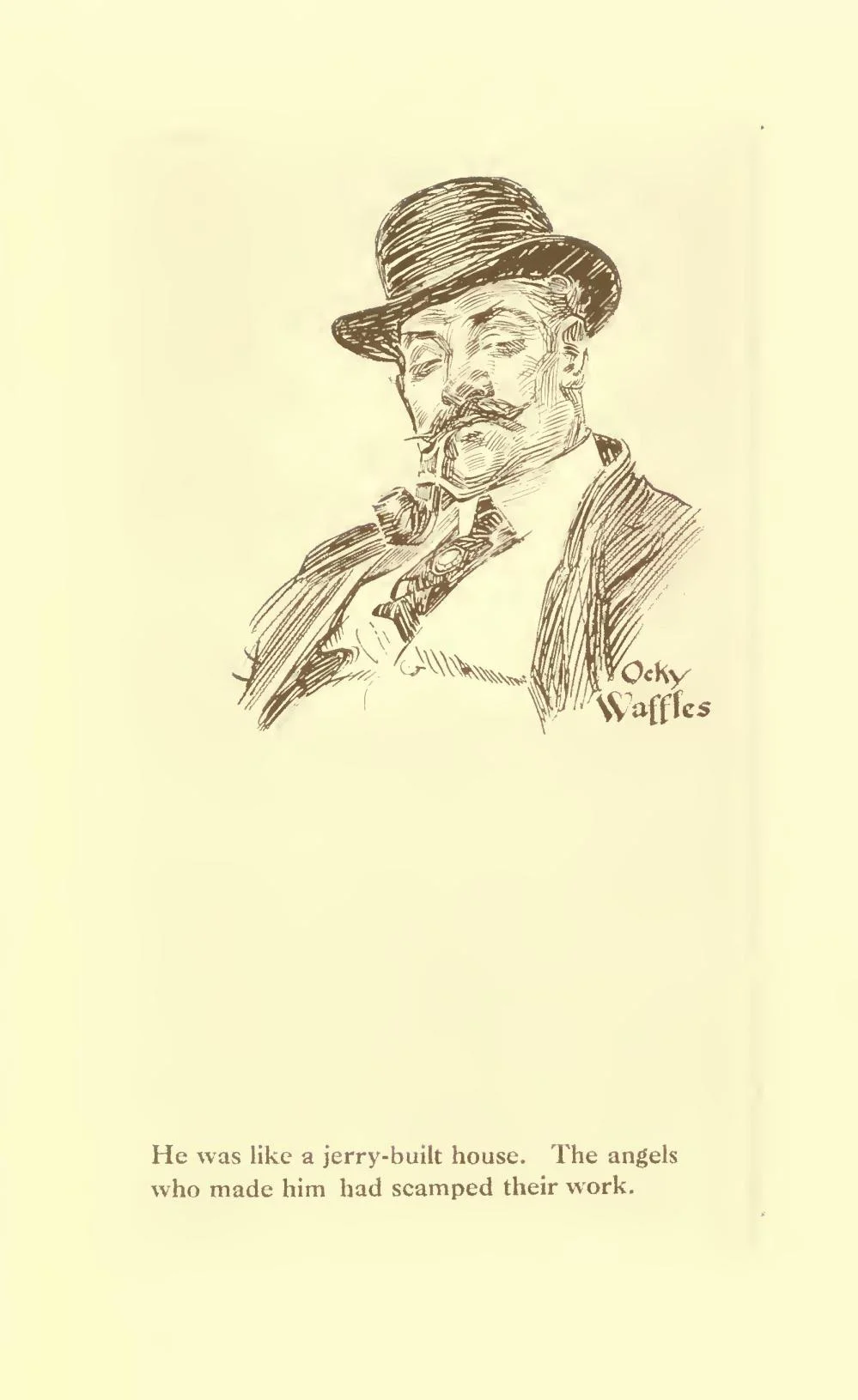

If someone had had time to spend a lot of love about him his defects could have been patched up so as to be scarcely noticeable. As it was people only came to his help when he was on the point of tumbling down. They shored him up hurriedly and left him; but no one cared enough to give him new foundations. The right kind of woman could have rebuilt him throughout—the kind of woman who knows how to love a man for his faults as well as for his virtues. But few women are architects where their husbands are concerned—only those who marry to give more than they get. Nan could have done it; but she was married to Barrington. Glory could have done it; but she was only a little girl.—So the angels had to watch their good intentions crumble.
Ocky knew quite well what was the matter with him—heart-hunger: he required a wife who would sit on his knee and ruffle his hair, and call him the funniest old dear in the world. Such a wife he would have had to carry through life; her dependence would have educated his strength. A wife who was censorious made him weakly obstinate and foolishly daring. If he had been patted and hugged, he would have been a good man. His mother had done that; but Jehane—ah, well, she did her best.
Barrington, when he signed the check, had made Ocky promise to return to Jehane the thousand pounds she had lent. It wasn’t her thousand pounds, but Glory’s, held in trust for her till she married. Ocky had pledged his word to give it back on one condition—that Jehane was to be kept in ignorance of the transaction. At the time he had quite intended to carry out the agreement; but so much can be done with a thousand pounds and an ingenious mind can invent so many excuses for dishonesty.
The morning after his home-coming he hung about the house instead of going to his office. Already his methods of holding her closely were getting on Jehane’s nerves. His shiftless easy affection tried her patience beyond endurance.
“Aren’t you going yet?”
“Presently, old gel. I want to have a good look at you first.”
“I think you ought to go. You’ll have all your life to look at me—and I’ve got my work, if you haven’t.”
“All right, old gel.”
“I wish you wouldn’t ‘old gel’ me so much. It’s vulgar and silly.”
Lighting his pipe, he strolled into the hall and picked up his hat. He stood there fumbling with it. Only when she followed him did he set it on his head, retreating toward the door. With the street at his back, he turned.
“I say, about your money.”
“For goodness sake, go. We can talk about that at lunch.”
He glanced across his shoulder at the sunlit street; his flight would be unimpeded.
“Don’t lose your wool, old—— I mean, Jehane. I’ve something to tell you. Had a nice little stroke o’ luck. Made thirty pounds for you.”
The flame of hostility sank at the mention of money. They stood gazing at one another. Each was aware that, within twelve hours of peace being declared, the old feud had all but broken out. Jehane was frightened by the knowledge and self-scornful at her lapse into temper. Ocky was congratulating himself on the dexterous lie with which the crash had been averted.
“Thirty pounds! And you kept it so quiet!”
He twirled his mustaches fiercely, straddling the doormat, all boldness and bullying self-righteousness now. “This little boy may be vulgar sometimes, but he isn’t silly—far from it.”
“But how did you do it?” She leant against him with both her hands on his arm, trying to make his eyes meet hers.
“You wouldn’t understand. Watched the market, yer know. Sold out just in time—last moment in fact.”
“You are clever—that’s what I kept telling Billy and Nan.”
“Think so? I’ve sometimes thought so myself.” He held his face away from hers as she pushed to the door and put her arms about his neck. “And yet you were treating me like a fool just now. You’re too ready at calling me silly and vulgar. I get tired of it.” As he spoke he had in mind the firm way in which a masterful person like Barrington would act. “You’ve got to stop it, Jehane. It’s the last time I mention it.”
“I know I’m unfair—unfair to you, to myself, to all of us. Oh, Ocky, be patient with me; I do so want to be better.”
She hid her face against his shoulder in contrition and unhappiness. Ocky was a generous enemy. He found it easy to forgive, being a sinner himself.
“There, there! That’s awright, Duchess. Don’t cry about it—— But I brought this matter up ‘cause I think you ought to have your money back.”
She stared at him in surprise. “Ought to! Why, what d’you mean? Is it a punishment? I don’t understand.” He set his hat far back on his forehead.
“I’m not trying to hurt your feelin’s; but you don’t trust me. Never have. It’s anxious work handling the money of a woman who don’t trust you. If I were to make a mistake, you’d give me hell—I mean, the warmest time I’ve ever had. I’d rather—much rather—you took your money back.”
He was drifting away from her—already she had pushed him from her. Something must be done.
“It’s you who don’t trust me, if you think that.” Her tones quivered with reproach as she said it.
“Then you want me to go on investing for you?”
“Of course.”
“You’re sure of it?”
“Quite, quite sure of it.”
“Then always remember, I tried to make you take it back and you wouldn’t. Isn’t that so?”
“Yes, I wouldn’t.”
“Awright, I’ll do my best; but I do it under protest, don’t forget.”
“Oh, Ocky, everything that we have we share.”
He kissed her and passed out into the street with alacrity; she might get to considering his motives. But at the garden gate he hesitated, dawdled, and came back.
“Look here, I don’t want Barrington nosing into my affairs. If I do this for you it’s between ourselves.”
“I shouldn’t think of telling Barrington.”
“Well, if you breathe a word to Nan I’ll stop dead, and you can manage your investments yourself.”
So he kept to the letter of his agreement with Barrington—and he kept to Jehane’s capital. And he accomplished this by that small lie about the thirty pounds.
When Mr. Playfair had chosen Ocky Waffles to be office-manager of the Sandport Real Estate Concern, he had shown remarkable cunning. He was tricky himself and he required a subordinate who was no more scrupulous, yet a subordinate who could give to smart transactions an appearance of honesty. Mr. Playfair’s finances were scanty; in order to extend his credit it was necessary to pose in the eyes of Sandport as a civic benefactor. Outside investors were attracted by a not too truthful, but undoubtedly clever, series of advertisements for which Ocky was responsible, such as:—
“Houses Built on Sand! We all remember the Bible parable of the foolish man who built his house upon sand: when the winds blew and the floods came, it fell. Houses built at Sandport are the exception. We have a lower death rate here, etc., etc. OUR HOUSES STAND.”
This was all very well, but several important facts were omitted from the advertisements: that a number of the land lots offered for sale were too inaccessible to be of practical value and that those marked as sold, which connected them up with the town, were actually still on the market; and, again, that many of the immediate and promised developments, which would increase the value of the property, would be indefinitely postponed by lack of capital; and, again, that, in certain cases, building would be impossible by reason of fresh-water springs which undermined the sand.
In the promotion of a shaky enterprise Ocky was in his element. He could not have brought the same cleverness to bear on an honest transaction. The school of life from which he had graduated was one of shifts, evasions and shams. Even his experiences with Jehane kept his hand expert. He was so plausible in his gilding of falsity that he made it appear like the truth itself.
But if Playfair in selecting Ocky had shown his cunning, he had also shown his lack of business shrewdness, for Ocky was not the person to trust with money. And he had to trust him, so that he might make him the scape-goat if any infringment of the law should be found out. Some of the money which Barrington had given Ocky had gone toward the straightening of the Sandport Real Estate Concern’s accounts, before Playfair should discover that they had been juggled. Ocky had not meant to steal; he never meant to do anything improper. He borrowed the firm’s money to support his private speculations. While Jehane’s affection could only be purchased, he was continually tempted to borrow. He fully intended to pay back. He always fully intended.
The angels made three desperate efforts to prevent Ocky from crumbling. They gave him Glory. A curious sympathy had grown up between him and the child of Jehane’s first marriage. Perhaps it was that they both suffered from the unevenness of Jehane’s temper. At any rate, he much preferred her to his own long-lashed, slant-eyed little daughter. Riska, though she was only seven, had learnt to be both vain and selfish; at the same time, when there was anything she wanted, she knew how to be attractive. She was her mother’s favorite and belonged to her mother’s camp. And Madeira Lodge tended to become more and more divided into two silently hostile parties. Ocky had the unpleasant feeling that Riska was amused by the outbreaks which occurred, and turned them to her own profit. Whereas Glory——
Already at ten, Glory was a woman in her forethought for him. She would follow after him, hanging up his coat and hat, rectifying his habitual untidiness, and stamping out the sparks which were so often the beginnings of domestic conflagrations. Her gray eyes were always kind when they looked at him and she was never impatient under his caresses. “Poor little father,” she would whisper, putting her soft arms about him, “I’m sure mother didn’t mean to say that.”
And the angels gave him his baby-girl. Mary they called her, which was contracted to Moggs as she grew older. But Riska called her the M. L. O., which stood for Ma’s Left Over, because she was so small that it seemed as though Jehane had run short of material when she made her. Ocky was very glad of Moggs; Moggs was too young to judge him. Even Eustace judged him, saying, “You’s been naughty, Daddy; Mumma’s vewy angwy.” There was no pity in the little boy’s tone when he said it—only sorrowful accusation.
Sitting by Moggs’s cradle, Ocky would wonder whether the day would come when she, learning what a fool she had for a father, would turn against him. In the midst of his wondering, she would wake and he would see two blue glimpses of heaven laughing up at him. He would take her in his arms, promising her, because she could not understand a word he said, that for her sake he would try not to take so much “medicine.”
“Medicine,” as a means to bolstering up his courage, was a habit which grew upon him.
Peter, who was the third effort of the angels, noticed a change every time he visited Uncle Waffles. On those walks across the lonely sand-hills, Uncle Waffles no longer pretended that he drank the “medicine” for his health.
“You’re a ha’penny marvel, Peter—that’s what you are. You get me to tell you everything. It’s ‘cause I have to tell somebody, and I know you won’t split on me. Now about this ‘medicine’; I’m taking more and more of it. And why? Because it’s my only way of being happy. Before I married the Duchess I hardly ever touched it. I had my mother then. I wish you’d known her, Peter; she was a rare one for laughing. I only feel like laughing now when I’ve taken more ‘medicine’ than’s good for me. Not that I was ever drunk in my life. It never goes to my head—only legs.”
He had usually had too much when he made these confessions. Peter knew he had by the way in which he said, “I got a nacherly strong stomick. It’s a gif from God, I reckon.”
Peter kept these disclosures to himself and walked his uncle about till it was safe to return to Madeira Lodge. Ocky would retire as soon as they entered, saying that he had a bad headache. They became of such frequent occurrence that Jehane began to be suspicious.
During the next three years Ocky’s visits to Topbury were periodic. Barrington could usually calculate his advent to a nicety. One night there would be a ring at the bell and Mr. Waffles would enter unheralded. While others were present he would joke with his old abandon, as though he hadn’t a care in the world. Then Barrington would turn to him, “Shall we go upstairs to my study for a chat?”
The fiction was kept up that Ocky’s visits were of a friendly and family nature. The constant fear at Topbury was that the servants might guess and the scandal would leak out.
When the study door had shut behind them, Barrington would give vent to his indignation.
“How much this time?”
“I’ve had hard luck.”
“You mean you want me to clear off your debts and pay back the money you’ve taken?”
“It won’t happen again, Billy. Just this once.”
“You said that last time and the time before that, and every time as far back as I can remember. D’you remember what I said?”
Before the anger in Barrington’s eyes Ocky began to crouch. “It won’t happen again. I swear it. I’ve learnt my lesson.”
Barrington knew his answers before they were uttered. “I’ve told you each time,” he said, “that, if you repeated your thefts, you’d have to take the consequences. Last time I meant it.”
Then would follow from Ocky a series of pleadings and arguments. That exposure would entail disgrace all round. That he would be arrested. That his family would be ruined. That the story would get into the papers and would reflect discreditably on Barrington. When these failed, Ocky would appeal to their friendship and the common memories they shared. The scene would usually close with a warning from Barrington that this was really the last time he would come to his rescue; then the debts would be added up and the check book would be brought out.
The threat of Ocky became a nightmare to Barrington and Nan—the children were not supposed to know about it. The finding of so much money was an intolerable burden, and they were never safe from its recurrence. On several occasions Barrington had to sell some of his pictures to meet these sudden demands for ready cash. To add to their anxiety was the fact that they had so far refrained from telling Jehane, out of fear that her resentment against her husband would make matters worse. So her letters still arrived punctually, singing his praises and saying how splendidly he was making progress.
But the day was fast approaching when the shoring up of Ocky Waffles had to end. It ended when Barrington discovered that his cousin was tapping other sources for his borrowing.
On a trip to Oxford with reference to a manuscript, he surprised Ocky leaving the Professor’s house. Nan, when calling on the Misses Jacobite, recognized an envelope addressed in Ocky’s hand.
The next time he made his visit to Topbury, Barrington kept his promise. Ocky was shown directly into the study without any preliminaries of family enquiries. He was not asked to sit down. Barrington faced him, standing with his back to the fire.
“I’ve been expecting you. My mind’s made up. I don’t want to hear what you’ve come for or any of your excuses. You’ve lied to me. I know all about the Professor and the Misses Jacobite. Doubtless there are others. You can go to jail this time, and I hope it’ll cure you. I’ve been a fool to try and save you. You’re rotten throughout.”
Since the accidental meeting at Oxford, Ocky had been prepared for some such explosion. He had fortified himself with drink for the encounter. But he was stunned by this unexpected air of judicial finality. He began to pour out feverish words. Barrington cut him short.
“For three years you’ve poisoned my life. You’ve blackmailed me with the fear that your disgrace would be made known. You yourself have made that fear certain by applying to my friends. The scandal can become public as soon as it likes. That’s all I have to say. Good-night.”
The game was up. Ocky straightened himself to meet the blow. He ceased to be cringing and humble. The drink helped him to be bold; so did his desperate sense of the world’s injustice.
“You say I’m rotten throughout. Perhaps I am. But who made me like that? I wasn’t rotten when we were boys together, and I wasn’t rotten when my mother was with me. Who made me rotten? You and clever people like you. You never let me forget that I wasn’t clever.
“You never did anything but humiliate me by reminding me that I was on a lower level. Your gifts were always bitter because they were given without kindness, to get rid of me or in self-defence; and, in return, I was expected to admire you. Oh, you hard good man! You couldn’t make me clever just by saying to me, ‘Be clever,’ or good just by saying, ‘Be good’——— You say I lied to you. Of course I lied—lied as a child will to escape punishment. You never understood me. Even before I went crooked you were ashamed of me because I hadn’t the brains to think your thoughts and to speak your language. Your intellect despised me. Yes, and you taught my wife to despise me. Didn’t you call me an ‘ass’ before company on the very night I became engaged to her. She remembered that and took her tone from you. You were her standard. From the first she was discontented with me because I wasn’t you and couldn’t give her the home you’d given Nan—— So I tried to be rich, because to be rich is to be clever. I gambled with what didn’t belong to me to get money to buy my wife’s respect. And now, because you, you, you were always there setting the pace for me with your success, I’ve lost everything. But if I’d won by my sharp-practise, you and Jehane would have been the first to say that I was a clever chap—I wasn’t born bad. What you and my wife have thought about me has made me what I am. Damn you. I wouldn’t touch a farthing of your charity now. I want to go to the dogs where both of you’ve sent me and to make as big a scandal as I can.”
He was trembling with hysteric anger; his voice was thick and hoarse with passion. His weak and genial features were absurdly in contrast with the violence of what he said. His soaped mustaches and white spats made him a comic figure at any time, but doubly comic in the r̮̫le of an accusing prophet.
Barrington eyed him quietly without the quiver of a muscle or the flicker of a lash. He had hardened his heart beforehand against the appeal of such a theatric outburst. “Is that all?”
Ocky hung his head; the fire of his self-pity was quenched by the restrained ridicule of the man who addressed him. He wiped the perspiration from his eyes with his tired hands. “That’s all.”
As he was passing into the hall, Peter looked over the banisters and saw him.
“Kay. Kay. Here’s dear old uncle,” he called and commenced running down the stairs.
At the landing his father stopped him. “Not to-night, my boy.”
Peter laughed and tried to wriggle past him; but his father held him firmly, saying, “I meant what I said.”
Looking down, Peter saw the face of his friend glance back at him; it was lined and tortured. Then the front door closed with a bang.
Barrington re-entered his study. Now that he had accomplished the difficult cruelty his mind was in doubt. If Peter loved Ocky, there must be some good left in him——
But he had used that argument with himself before. As he sat, pictures began to form of Ocky as he had been. He saw him about Peter’s age, the weakly schoolboy whose battles he had had to fight because he was strong. He recalled that term when he had had to take him to the doctor with his poisoned hand. He remembered how Ocky’s mother had always said of him that he was the most careful and dearest son in the world—— No, he hadn’t been always bad.
His thoughts became unbearable; he needed approval for his act. Stepping out on to the landing he called, “Nan, Nan.”
When she came he was again seated in his chair. The lights were out and a log of ship’s wood, spluttering on the coals, burnt violet and yellow, making the shadows wag accusing fingers. She curled herself up on the floor, leaning her head against his knees, like a small child at the story hour, before it goes to bed.
Nan always brought an atmosphere of kindness with her—of innocence and goodness. Her ways were those of a young girl, who walks on tiptoe with hands upon her breast, listening for life to call her. Barrington watched her shining head and how the fire glinted against the column of her throat. If Ocky had had a wife like Nan———-
It was some time before she spoke. Then, “Dearest?”
“I had to be a brute and I hate myself. I kicked him out.”
“Do you think you did right?”
“If I didn’t, I shouldn’t have done it. The thing had to end.”
“And what next?”
“We’ve got to think of Jehane and her children. I’m wondering how much she knows or suspects.”
“She’ll never tell—— I wonder will she stand by him?”
There was silence.
Barrington spoke. “Ocky hinted at something to-night. It might be true—something that I never thought about. It explains those letters of Jehane’s. It explains why they’ve never got on together. I’ve always said that a little love would have made Ocky a better man.”
“Dear, what was it?”
“It dates a long way back. He said that Jehane had made our home and my love for you the standard of what she expected from——”
“I understand. And it is true, Billy. She wanted a man like you from the first.”
Silence.
Nan said, “Once she used to talk about the penal servitude of spinsterhood.”
“And now,” said Barrington, “she’ll have to learn about the penal servitude of marriage. Whatever happens, unless he ill-treats her, he’ll be her husband to the end.”
“But—— But can’t we stop this dreadful something?”
Barrington stooped and took her hand.
“Little woman, we’ve been trying to stop it all these years. We can’t stop it; we can only postpone it and give him more time to drag Jehane and the children lower down. We’ve reached the point where things have got to be at their worst before they can grow better. It’s a question now of how many of them we can rescue. Ocky has to be allowed to sink for the sake of the rest.”
Nan’s forehead puckered at the cruelty of such logic. “But I don’t understand. It seems so horrible that we should sit here, with a fire burning and everything comfortable, saying things like that.”
“It is horrible. It’s so horrible that, if I were to give him everything I have, he’d still go to the devil. He’s a drowning man and he’ll drag down everyone who tries to drag him out.”
She clung to her husband aghast at this painful glimpse of reality. “But I still don’t understand. Why—— Why should he be like that? He’s kind, and he’s gentle, and he makes children love him.”
“You want to know? And you won’t be hurt if I say something very terrible?”
“I don’t mind being hurt—I’m that already.”
“I think it’s because of Jehane—because of what she’s left undone. She never brought any song to her marriage—never made any joy for him or happiness.”
“And because of that he’s to——”
“Yes. Because of that he’s to be allowed to go under. It’s chivalry, not justice. At sea one saves the women and children first. He’s a man.”
In quick revulsion from this ugliness of other people’s sordidness, he bent over her, brushing his lips against her cheek and hair. “Shall I ever grow tired of kissing you, I wonder, my own little Nan?”
And so, in one another’s arms, for a moment they shut out the memory of tragedy.
But the angels had not done with Ocky Waffles yet.
CHAPTER XVII—A HOUSE BUILT ON SAND
There was one more letter from Jehane. She wrote that Ocky had just returned from London, where he had been on important business. She understood that he had been too hurried to be able to visit Topbury. He was working very hard—too hard for his health. He was overambitious. While she was writing he had come in to tell her that he was off again to London. Then followed domestic chatter: how Glory was taking music-lessons so that she might play to her father when she grew older; and how Eustace had a new tricycle; and how Riska already had an eye for the boys. This was the last letter, very foolish and very brave—then silence and suspense.
The days dragged by. Nights stayed long and the sun rose late. In the mornings the fields, which lay in front of the Terrace, were blanketed in sulphurous mist through which bare trees loomed spectral. Railings and walls and pavements were damp as though fear had caused them to sweat.
All night Nan and Barrington, lying side by side, feigned sleep or slept restlessly. Both were afraid to voice their dread lest, when spoken, it should seem more actual. Once, when a hansom jingled out of the distance and halted outside their house, they started up together listening. The fare alighted and walked a few doors down; again they drew breath.
“Why, Nan, little lady, did I wake you?”
“No, I was awake. I thought—— I thought it was I who had made you rouse.”
“I’ve not slept a wink since I lay down.”
“Neither have I.”
As he clasped her in the dark, he could feel her trembling. He held her tightly to him, laying his face against hers on the pillow. Again they both were listening.
“What makes you so frightened?”
He whispered the question.
“Always thinking, always thinking—— of the future and what may happen.”
She commenced to sob, pressing her forehead against his breast.
He tried to soothe her. “You mustn’t, Pepperminta. You mustn’t really; it hurts. I’ll think for you. I always have. Now close your eyes and get some rest.”
And she closed her eyes and lay very tense. Hours and hours later London began to growl. Presently the door of the servants’ bedroom opened; the stairs creaked; the house was filled with stealthy sounds. At last she drowsed.
When her husband had tiptoed out to his bath, she rose hastily and commenced to dress. She must get down before him. He must be spared if the message was there; she must read it first.
The dining-room was in dusk these November mornings. At the end of the room the fire burnt red and before it Kay and Peter warmed their hands. Not until she had run through the letters did she greet them. Then, for their sakes, she tried to appear cheerful. Barrington, on entering, cast one swift look in her direction and realized that the end was not yet. Absentmindedly they took their places at the table, scarcely thankful for this respite from certainty.
The children soon apprehended that all was not well; their high clear voices were hushed—they spoke in whispers. Peter was fourteen; he had guessed the meaning of blank spaces on the walls from which some of the favorite pictures had vanished. The Dutch landscape by Cuyp was still there above the blue couch, against the background of dark oak-paneling. Across its glass the flickering reflection of the fire danced, lighting up the placid burgher as he walked with his ladies on the bank of the gray canal. Peter noticed how his father’s eyes rested on it—a sure sign that he was troubled.
Almost by stealth Peter would push back his chair and nudge his sister. Miss Effie Jacobite gave her lessons in the mornings; on his way to school he had to leave Kay at her house. Shouldering his satchel, he would lead her out into the misty streets; then at last he would dare to raise his voice in laughter.
At the departure of the children, Barrington would break off from the train of thought he had been following, and was incessantly following: had he done right by Ocky? The door would bang; through the long dark day Nan would sit alone, and speculate and wonder.
What was happening? Had the smash been postponed? Had Ocky wriggled round the corner by borrowing secretly from other people’s friends? Billy searched the faces of his business acquaintances and Nan the faces of their Topbury circle in an effort to make them tell.
Toward afternoon the fog would roll up from the city, dense and yellow. Footsteps on the Terrace would come suddenly out of nowhere; their makers were shadows. Nan, rising uneasily, would go to the window; they might be footsteps of pursuers or of bringers of bad tidings. Even Grace’s policeman filled her with panic when he paused for an instant outside the house. His tread was the tread of Justice, ponderous and unescapable.
With the return of the children her oppression lifted. Later Billy’s key would grate in the latch. She was in the hall to meet him before he had crossed the threshold. “Any news?” The servants must not hear her; she spoke beneath her breath.
“Nothing. Nothing yet.”
The children no longer called to one another as they went about their play. They tiptoed and looked up anxiously when addressed. No urging was necessary to send them to bed—bed was escape to a less ominous world.
Muffled, muffled! Everything was cloaked and muffled.
As Peter put two and two together, pain grew into his eyes; even when others seemed to have forgotten, the expression in his eyes was judging.
Only Romance was unaffected by the sense of foreboding. The servants felt it and discussed it in the kitchen, wondering whether the master was losing money. But Romance, with cat-like self-satisfaction, went on bearing kittens and so did her daughter, Sir Walter Scott, who came by her name through an accident regarding her sex.
A month had gone by.
“Should I write to Jehane?” she asked her husband.
“I wouldn’t. If you do, we shall have Ocky back on our hands. Perhaps he may pull things together now that he knows that he stands by himself. If he does, it’ll make a man of him. Anyhow, if she finds out and needs our help, she’ll send for us.”
But the silence proved too much for Nan. One morning, on the spur of the impulse, she packed a bag, left a note for her husband and set off for Sandport. On the journey through sodden country and mud-splashed towns, she fought for courage, straining out into eternity to pluck the hem of God’s mantle which, when her faith had touched, was continually withdrawn beyond reach of her hand.
She had rung the bell and stood waiting on the steps of Madeira Lodge. No one answered. She thought she heard the pit-a-pat of feet on the other side of the door. She rang again and took a pace back to glance up at the front of the house. As she did so, she saw a curtain move before a window—move almost imperceptibly. A minute later the door was flung open by Jehane; Nan saw the children grouped behind her in the passage.
“Well?”
The tone of her voice was flat and unfriendly.
“I thought I’d come and see you, Janey. Only made up my mind this morning.”
“Did you? What made you do that?”
Nan flushed and her voice faltered. She had not expected this hardness and defiance. She had come full of pity. “I came because I was nervous. You hadn’t written for more than a month. I hope—— I hope,——”
“Come inside,” said Jehane. “I can’t talk to you out there. You can stop your hoping.”
Once inside, the appearance of the house told its story. It looked bare. From the sideboard the silver—mostly presents of Jehane’s first marriage—had vanished. The walls were stripped of all ornaments which had a negotiable value. In the drawing-room there was an empty space where there had once been a piano. Only the carefully curtained windows kept up the pretence of trim prosperity. Jehane led Nan from room to room without a word and the children, shuffling behind, followed.
“Now you’ve seen for yourself,” she said, “and a nice fool you must think me after my letters. I’ve lied for him and sold my jewelry for him. I’ve done without servants. I’ve crept out at night like a thief to the pawnbrokers, when there wasn’t any money and there were debts to be settled. And the last thing I heard before he left was that he’d stolen the thousand pounds I lent him. And this—— this is what I get.”
“Before he left?”
“A month ago, after my last letter to you. You needn’t pretend to be surprised, because you’re not. You suspected. That’s what brought you.”
Nan felt faint with the shock of the realization. She tottered and stretched out her hands to save herself. Glory ran forward and put her arm round her. “Dear Auntie.” Nan drew Glory’s head against her shoulder, sobbing. “Oh my dear, my poor little girl!”
Jehane looked on unmoved, merely saying in her hard flat voice, “If there’s any crying or fainting to be done, seems to me I’m the person to do it. But I’m past all that.”
Nan quieted herself. “It so shocked me. I—I didn’t mean to make a fuss. But won’t you tell me how it all happened?”
“Nothing to tell. It’s just Ocky with his lies and promises.”
“Oh, don’t say that before the children about their father.”
“I’ll say what I like; they’re my children. They’ve seen everything.”
Nan looked round and saw sympathy only in the eyes of Glory. Moggs, balancing herself by her mother’s skirts, piped up and spoke for the rest, “Farver’s a naughty man.” Even her mother was startled by the candor of this endorsement; turning sharply, she caused Moggs to tumble on the floor with a bump. Moggs began to yell.
Grateful for a diversion in any form, Nan knelt and comforted the little girl. Jehane watched her indifferently, as though all capacity for kindness had left her.
When peace was restored, Nan said, “You’re coming home with me, all of you.”
“We’re not.”
“Why not?”
“My husband may return. If he doesn’t, I must stay here and keep up appearances till he gets safely out of the country. Heaven knows what he’s done!—— And it’s likely that I’d come to Topbury to be laughed at! You may want me, but what about Billy? You’ve both known this for a month, and you couldn’t even send me a line. Come to Topbury! No, thank you!”
There was so much to be explained and explanations were so tangled. Nan saw nothing for it but to make a clean breast. When she told Jehane of the years of borrowing that had been going on behind her back, she was justifiably angry.
“So you knew all the time! And for three years it was practically you and Billy who were running this house! And you kept me in ignorance! I must say, you’ve a queer way of showing friendship!”
“We did it because—because we were afraid, if you knew, you wouldn’t love him. And then matters would have been worse.”
“Love him! I’ve not loved him since we married. He started playing the fool directly after the wedding before the train moved out of the station. I knew then that I’d have to be ashamed of him always. I knew what I’d done for myself. He killed my love within an hour of making me his wife—— But how you must have amused yourselves, knowing what you did, when you received my letters about his getting on in the world—his progress! My God! how you must have laughed, the two of you! Every time he gave me a present it was your money.”
All this before the children!
She threw herself down on a couch and gave way to hysterics, wrenched with sobs, screaming with unhappy merriment, clutching at her breast and throwing back her head. The children began to cry, hiding in corners of the room, terrified. Only Glory kept her nerve and, following Nan’s directions, fetched water to bathe her mother’s face and hands.
When the insane laughter had spent itself, Jehane lay still with eyes closed, panting. Shame took the place of harshness. Nan asked whether there were any stimulants in the house; when a half-emptied bottle was brought from the cupboard, Jehane gesticulated it away with disgust. “I couldn’t touch it. It’s Ocky’s.” It was all that was left of his “medicine.”
Nan persuaded Glory to take the children out of the room. She seated herself by the couch in silence, stroking Jehane’s forehead.
Presently the bitter woman’s eyes opened. They regarded her companion steadily, with an expression of sad wonder. “You’re still beautiful. I’m old already.”
Nan began to protest in little birdlike whispers; she was so nervous lest she should give offence. She was interrupted. “Even your voice is young. People who don’t want to love you have to—— And I always longed to be loved.” She raised herself on her elbow, brushing back the false hair. “You’ve had the goodness of life; I’ve had the falseness. Things aren’t fair.”
Comments (0)