
“No, they’re not fair,” Nan assented. “God’s been hard on you, poor old girl.”
“God! Oh, yes!” Jehane spoke the words gropingly, as though recollecting. “Ah, yes! God! He and I haven’t been talking to one another lately. The cares of this world—— the cares of this world—— What is that passage I’m trying to remember?”
“It’s about the sower who sows the good seed, but the cares of this world rise up and choke it unless it falls on fruitful land. It’s something like that.”
Jehane looked at Nan vaguely, only half-comprehending. “Fruitful land! That’s the difficulty. I was never fruitful land—— Tell me, why did you marry Billy?”
“Why? I never thought about it.”
“Think about it now. Why was it?”
“I suppose because I loved him and wanted to help him.”
Jehane’s elbow slipped from under her. She lay back, staring at the ceiling, looking gaunt and faded, as though she had passed through a long illness. “To help him! When I loved I wanted to be helped. God’s not been hard on me, little Nan; I’ve been hard on myself. I’m a hard woman. I’ve got what I deserved. And Ocky—— He was a fool. He had no mind—never read anything. He was clumsy and liked vulgar people best. But, perhaps, he’s my doing. Perhaps!”
Seeing that she had grown passive, Nan stole out to give the children their supper and to put them to bed. That night, the first time since Cassingland, she and Jehane slept together. The light had been put out for some time and Nan was growing drowsy, when Jehane spoke.
“Madeira Lodge! It’s funny. A house built on sand! A house built on—— That’s what we came here to do for other people; we’ve done it for ourselves. O God, spare my little children, my——”
Nan took her in her arms and soothed her.
CHAPTER XVIII—PETER TO THE RESCUE
It was all up. A warrant was out for the arrest of Ocky. Accusers came forward from all directions—people whom glib promises had kept silent and people who had kept themselves silent because they were friends of Barrington. Now that silence had lost its virtue, they shouted. Their numbers and the noise they made were a revelation and testimonial of a sort to Ocky’s enterprising character. He must have been skating over thin ice for years. He had almost established a record. Such a performance, so dexterous and long protracted, had required a kind of gay courage that is rarely given to honest men. And Ocky was honest by tradition, if not in practice. His nerve was admirable. No wonder he drank.
He was wanted on many charges. There were checks which he had cashed through tradesmen, drawn on banks where he had no effects. With his habitual folly, he had left tracks by negotiating some of these in London since his flight, using letters of a family nature from Barrington to inspire confidence. These began to be presented five weeks after his departure from Sandport. It seemed as though he had been doing himself well and his supplies were exhausted. His name found its way into the papers, largely because he was Barrington’s cousin. So everything became public.
The day before the reports occurred in the press, a man of his appearance had enquired at Cook’s in Ludgate Circus about the exchange rates for French money. The Channel boats had been watched in consequence; but he must have taken warning and altered his plans.
“He’s ineffectual even in his sinning,” said Barrington. “Why couldn’t the fool have skipped the country earlier and saved us the humiliation of a trial?”
The Sandport Real Estate Concern had gone into bankruptcy. Its affairs would not bear inspection. Mr. Playfair had vanished with all the odds and ends that Ocky had spared. Both of them were badly wanted. So Jehane’s scornful loyalty in stopping on at Madeira Lodge, that her husband’s retreat might be covered, no longer served any good purpose. Moreover, every thing in the house was seized by creditors—even her own possessions were no longer hers because they had passed as Ocky’s. She and her children found themselves penniless.
Her father, when applied to, presented her with a list of the sums he had already advanced, unbeknown to her. He laid pedantic emphasis on his early objections to the hurry of her second marriage. She had always been wayward. He offered to take Glory and Riska to live with him for a time, but couldn’t put up with the younger children. Her independence had been her undoing; it must be her making now. She must work. The first Homeric scholar in Europe couldn’t afford to have his peace of mind disturbed. He was sorry.
Against her will Jehane was forced to accept the charity of the man whom she both loved and hated. She came to him a fortnight before Christmas with her four children—it was the first Christmas she had spent at Topbury since her engagement to the unfortunate Mr. Waffles.
Barrington’s relations with ‘Jehane were painfully strained. He hated the intrusion of her sordid problems on the sheltered quiet of his family. He was aware that she had grown careless of refinement in the vulgarity of her experience. She was no longer the Oxford don’s daughter, soft in speech and lively eyed, but a woman inclined to be loud-voiced and nagging. He blamed her, was sorry for her and wanted to be kind to her; but it was difficult to be kind to Jehane when her feelings were raw and wounded. She refused pity and was as hurt by the comfort which he permitted her to share as if it were something of which he had robbed her. She spoke continually of “my poor children,” betraying jealousy for the lot of Kay and Peter.
An additional cause of grievance was found in Eustace; he was an amiable mild boy, dull and fond of being petted, the miniature of his father. Barrington knew he was unjust, but his repulsion was physical: he could not restrain his dislike of the child whose sole offence was his strong resemblance to the man who had caused this misery. Jehane was cut to the quick; being forced to be humble, she sulked.
Nan tried to play the part of peacemaker. She was proud of the nobility of her husband; she understood his occasional flashes of temper. He was overburdened; he was doing far more for Jehane than she had any right to expect. He had made himself responsible for all the swindles in which his name had been employed as an inducement. To fulfil these obligations he was sacrificing many of his art-treasures; even the landscape by Cuyp was threatened.
And she also understood Jehane’s predicament. She was too gentle to resent her seeming ingratitude. Looking back over the long road from girlhood, she marveled at her friend’s fortitude—that she could still lift up her head proudly and, in spite of bludgeonings, plan for the future. Jehane might scold and grumble to her when Barrington’s back was turned; it made no difference to her unvarying tenderness.
And there were times when Jehane was ashamed of her ferocity and, laying her head on Nan’s shoulder, confessed her folly.
“I’m cruel,” she wept; “all the sweetness in me is turned to acid. I shall grow worse and worse, till at last I shall be quite impenitent. I can’t help it. Life won’t grow easier for me—— If you told the truth, you’d write over me, ‘Here lies a mother who loved too much and a wife who loved too little.’ I’m spoiling my children with my fondness and filling their heads with vanity—— And I shall often hurt you, little Nan. But you’ll stick by me, won’t you?”
Barrington was suspicious that violent scenes took place in his absence; manlike, he was irritated and could not comprehend their necessity. He was furious that his wife should be upset and forbade the name of Ocky to be mentioned in his presence.
Peter overheard much of the abuse which was showered on his uncle by both Jehane and her children. His eyes became flames when harsh things were said; quarrels were the result. The quarrels were for the most part with Riska. He could not believe that anyone he loved was really bad. Glory shared his grieved anger; a defensive alliance in the interest of Ocky was formed between her and himself. It was the first compact he had ever made with Glory. But she was too mild for Peter—too much of a Saint Teresa and not enough of a Joan of Arc. Glory knew that she could not be valiant; in secret she cried her heart out because he despised her cowardice.
Barrington might forbid the mention of Ocky’s name, but outside on the Terrace there was a perpetual reminder.
A tall man, with a straight back and wooden way of walking, watched the house. He pretended not to be watching and, when anyone saw him from the window, would stroll carelessly away as though he were just taking a breath of air; but he always returned. He got so much on Barrington’s nerves that he finally made up his mind to accost him.
“What are you doing here, always hanging round? I won’t have it.”
The man, who had tried to avoid him, finding himself cornered, answered respectfully “Sorry, sir. H’it’s orders.”
“But what are you? A plain-clothes man?”
“That’s not for me to say, sir.”
Barrington slipped him a sovereign, saying, “Come, speak out You’re safe with me. I won’t tell. You know, it’s a bit thick, having you out here. The ladies are upset.” The man scratched his head. “It ain’t the ladies I’m after. It’s ‘im. You’ve got ‘is missis and kids in there. ‘E was allaws fond of ‘is kids, so they tell us. We calkilate that since ‘e cawn’t get out o’ the country, ‘e’ll turn up ‘ere sooner or later. These things is allaws painful for the family. That chap was a mug; ‘e should ‘a planned things better.”
Barrington thought for a minute. Then he asked, “Are you a married man?”
“Married, and five nippers, Gawd bless ‘em.”
“Well, look here, put it to yourself: how’d you like to have your wife made ill and your kiddies sent frightened to bed, because a stranger was always staring in at their windows?”
“Shouldn’t like it. I’d get damned peevish, I can tell yer.”
“Good. Then you’ll understand what I’m going to say. I’m a gentleman and you can trust my word. If the man you’re after comes here, I’ll hold him for you. In return I want you to be a little less obvious in your detective work. I can’t have my family scared. Go further away, and watch from a distance. Is it a bargain?”
Just then Barrington turned and saw Peter standing with his satchel across his shoulder. How much had he heard? He was awkward under his boy’s eyes; he often wondered what thoughts went on behind them.
“Run along, Peter. I’ll be with you in a second.”
Then to the man, “Is it a bargain?”
“It ain’t reg’lar,” said the man.
“But under the circumstances, you’ll do it. I’m not trying to interfere with your duty.”
“My orders were——. Awright, sir, ‘cause of the wife and kids I’ll do it.”
That night Peter thought matters out. It was he and his Uncle Waffles against the world. He did not accuse anybody, neither his father, nor Aunt Jehane; but there was a mistake somewhere. They did not understand. Whatever Uncle Waffles had done, to Peter he was still a good man.
Peter crept out of bed and across the landing to a window in the front of the house. He peered into the blackness. By the railing of the fields, at a point mid-way between two gas-lamps where shadows lay deepest, he could see a figure watching. He must save Uncle Waffles from that.
School had broken up. It was the twenty-fourth of December. There was still no news of Ocky. In their anxiety they had almost forgotten that to-morrow would be Christmas.
That morning Barrington dawdled over his breakfast, postponing his departure for business. His wife glanced down the table at him, trying to conjecture the motive of his dallying. Presently he signaled her with his eyes, raising his brows at the children. When she had excused them, he turned to her and Jehane. “Whatever’s happened or is going to happen, we don’t want to rob the kiddies of their pleasure, do we? We’ve got to pull ourselves together and pretend to forget and try to be cheerful. What d’you say, Nan?”
“I’d thought of that. But I didn’t like to mention it. Janey and I, working together, can get things ready.”
“All right, then. And I’ll see to the presents.”
He rose and laid his hand on Jehane’s shoulder. “Come, Jehane, things are never so bad but what they may mend. I’ve not always been considerate of you. Let’s be friends.”
It was one of those patched-up truces which, like milestones, were to dot the road of their latent enmity.
Kay’s and Peter’s money-boxes were brought out; their savings for the year were counted. Nan gave to Jehane’s children an equal sum with which to go out and buy presents. Peter was kept running all morning on errands; in the afternoon he was busy decorating with mistletoe and holly. The preparations were so belated that everyone was pressed into service. Tea was over and the dark had fallen when he set out to do his own shopping.
“Be careful, Peter, and come back quickly,” his mother called from the doorway. And Kay, thrusting her vivid little face under her mother’s arm, piped up, “Don’t be ‘stravagant, Peter. Don’t buy too much. ‘Member birfdays is coming.”
Peter felt happy. It was as though a long sickness had ended and a life that had been despaired of had been restored to them. He knew that nothing for the better had really happened; but, because people had laughed, it seemed as if it had. Down in the Vale of Holloway the bells of the Chapel of Ease were ringing. They seemed to be saying, over and over, “Peace and good-will to men.”
Far away, at the bottom of the Crescent, he could see the spume of gas-light flung against the dusk. All the shops were there and the crowds of jaded people who had become for one night extraordinarily young and compassionate. He began to calculate how far his money would go in buying gifts for the family. Formerly there had been just his mother, and father, and Kay, and Grace to buy for. Now there were how many? He counted. With his cousins and Aunt Jehane there were nine people. He would divide his money into ten shares; Kay should have two of them. He was passing the gateway of an empty house; a hand stretched out of the dark and grabbed him.
“Peter. Peter.” The voice was hoarse and terrified at its own sound.
Peter broke away and jumped into the road that he might have room to run. He turned and looked back. He could see nothing—only the walls of the garden, the gateway and the wooden sign hanging over it, with the words, To Let.
“Don’t do that,” came the hoarse voice, “they may see you.”
“Who are you?” asked Peter, peering into the shadows.
“You know who I am,” came the voice; “this little boy can’t have changed as much as that.”
This little boy!
“Look out. Someone’s coming.”
A heavy tread was heard. Grace’s policeman approached with the plain-clothes man. Peter bent down to the pavement and pretended to be searching.
“Hulloa!” said Grace’s policeman. “Who’s there?”
“It’s Peter. How are you?” He continued his searching, moving away from the gate.
“Wot yer doing?” asked the plain-clothes man.
“Dropped some money. Oh well, I can’t see it. It was only sixpence.”
He straightened up.
“Cawn’t we help?” asked Grace’s policeman.
“It doesn’t matter. To-morrow’s Christmas and I’ll get more than that.”
“It’s more’n the price of a pot o’ beer,” said Grace’s policeman. “If you can afford to lose it, we can. Goodnight.”
“Good-night,” said Peter, “and a Merry Christmas.”
When they were out of sight he stole back. “Uncle! Uncle! What can I do? Tell me.”
“They’re after me. I’ve nowhere to sleep. I just want to see my kids and Jehane before they get me. That’s why I’ve come.”
“They shan’t get you,” said Peter firmly.
“Oh, but they will. I once said, ‘They shan’t get me’; but when you’re cold and hungry——”
“You stop there. I’ll be back in ten minutes.”
Peter ran down the Crescent. It was he and Uncle Waffles against the world; but there was one man who might help—a man who wasn’t good enough to be hard and judging. Peter looked ahead as he ran, shaping his plan. Yes, there he was, dropping the reins on his horse’s back from driving his last fare.
Peter tugged at his arm as Mr. Grace heaved himself down from the seat to the pavement.
“None O’ that, me boy, or I’ll tear yer bloomin’ tripes h’out—— Oh, beg parding; h’it’s you, Master Peter.”
“I want to speak to you, Mr. Grace, somewhere where we can’t be seen or heard.”
“Yer do, do yer? Wot abart the pub?”
“Not the pub, people’d wonder to see me there.”
Mr. Grace was offended; no one ever wondered to see him there. “Not respeckable enough! That’s it, is h’it. Ah well, you take my advice. You’re young. If yer want to live ter be my age, pickle yer guts. Yer’ll ‘ave a darter one day, don’t yer worry. Gawd pity a man wiv a disrespekful hussy—— Suppose yer think I’m drunk?”
The situation required tact. “Not drunk, Mr. Grace; you don’t run your words together. You’re just Christmasy, I expect.”
Mr. Grace threw a rug over his horse’s back and fetched out the nose-bag. When this was done, he addressed Peter solemnly, steadying himself against the shafts. “I am drunk. Yer know I’m drunk. I know I’m drunk. Old Cat’s Meat knows I’m drunk. Where’s the good o’ argify-ing and tellin’ lies abart it? Let’s settle the point at once. I’m damn well drunk and I’m goin’ ter be drunker.”
The minutes were flying; there was no more time to fence. “Mr. Grace, I want you to help me. There’s no one else in the world I would ask.”
Mr. Grace cocked his eye at Peter, a blind kind of eye like an oyster on the half-shell.
“‘Elp! ‘Elp ‘oo? ‘Elp wot? Me ‘elp! I need ‘elp me-self; I kin ‘ardly stand up.”
“Oh please, not so loud! I’m serious. Something dreadful’s happening and you’re my friend—— You are my friend, aren’t you?”
Mr. Grace clapped his heavy paw on Peter’s shoulder. “S’long h’as Gawd gives me breaf.”
“Then let’s sit in the cab, so no one will see us and I’ll tell you.”
“Strange h’as it may seem ter yer, Master Peter, I don’t fancy the h’inside o’ me own keb. Know too much abart it. There wuz a bloke I druv ter the ‘orspital t’other day wrapped up in blankits. ‘E died o’ smallspecks. But anythin’ ter h’oblidge a friend.”
The door closed behind them.
“‘Ere, darn wiv that winder, young ‘un. I feel crawlly wivout air. Sye, don’t yer tell yer pa wot I said abart me keb.”
Peter seized the cabman’s hairy hand and held it firmly; he had to anchor him somehow. “Has Grace told you anything about my Uncle Waffles?”
“Swiped somefing, didn’t ‘e?”
“Yes.”
“Wise bloke. Honesty’s been my ruin. H’I allaws returns the numbrella’s wot’s left in me keb. I might ‘a been a rich man; there’s lots o’ money in numbrellas.—— Wot did ‘e swipe? ‘Andkerchiefs or jewels?”
“He swiped money; but he meant to give it back.”
Mr. Grace made an explosive sound, followed by innumerable gurglings, like the blowing of a bung out of a beer barrel. “Yer make me larf. Wot d’yer taik me for? I ain’t no chicken—— Oh, me tripes and onions! He meant to give it back! Ha-ha-ha!—— Now come, Master Peter, no uncle o’ yours ‘ud be such a fool as that.”
“Well, anyway, he didn’t give it back and they’re after him.”
“Oo? The cops?”
“Yes. Grace’s policeman.”
Mr. Grace sat up with such violence that the cab groaned in its ancient timbers. “The devil, ‘e is! A nice, h’amiable man, my Grice’s policeman! ‘E’s allaws makin’ h’enmity ‘tween me and my darter. ‘E watches the pubs and tells ‘er abart me, and ‘im no better ‘imself. H’I ‘ate’ im. So ‘e’s after yer uncle?”
“He and a tall thin man who’s been watching our house for a fortnight. My uncle’s up the Crescent hiding in the front garden of an empty house. You’ve got to help me to get him away and hide him.”
Mr. Grace laid his finger against his bulbous nose. “Daingerous work, Peter! Daingerous work! H’its against traffic reg’lations to h’aid and h’abet a h’escapin’ criminal. Wot yer goin’ ter do wiv ‘im if I lends yer me keb?”
Peter bent his head and whispered.
Mr. Grace chuckled, slapping his fat thighs. “Blime! Lord love us! That ain’t ‘alf bad. That’s one in the h’eye for me darter’s young feller. H’I’m on, me lad.”
An irascible old gentleman who had been stamping his feet on the pavement, looking for the driver, now rattled his stick on the side of the cab.
“‘Ere, don’t yer do that. Yer’ll knock the paint h’orf.”
“I’ve been waiting out here for half an hour. It’s disgraceful. Drive me to Paddington.”
Mr. Grace waddled out of the cab and shut the door behind him, leaving Peter inside. “I’m h’engaged,” he said.
While he removed the nose-bag from Cat’s Meat’s head and gathered up the reins, the old gentleman addressed a few remarks, the purport of which was that Mr. Grace would find himself without a license.
As the cab turned to climb the Crescent, Mr. Grace made an effort to outdo this burst of eloquence.
“None o’ yer lip, old bladder o’ lard. I know your sort. Yer the sort ‘as ain’t got no change fer a tip and feels un-’appy as ‘ell abart payin’ a fare.”
CHAPTER XIX—THE CHRISTMAS CAB
As they neared the empty house, Peter was about to thrust his head out of the window. He had the words on the tip of his tongue to say, “Stop here, Mr. Grace.” So much were they on the tip of his tongue that he almost believed he had said them. But he darted back, crouching in the darkest corner of the fusty cab. At a little distance, watching the gate, he had caught sight of a man.
Cat’s Meat crawled on, ascending the hill. At the top, where the Terrace began, Mr. Grace halted. “‘Ere, young ‘un, where are we goin’? You’ll be ‘ome direckly.”
“Turn the corner,” Peter whispered from inside the growler; “turn the corner quickly.”
Mr. Grace turned and lumbered on a little way. Again he halted. “‘Arf a mo’, Peter. Wot’s the gime? Tell us.”
“Did you see that tall lean man, standing outside the garden of the empty house?”
“May a’ done. Thought h’I saw two on ‘em, but maybe I’m seein’ double—- H’oh yes, h’I saw old Tapeworm.”
“He’s the plain-clothes man. I know, ‘cause I heard him talking with my father. My father said he’d give my uncle up, if the plain-clothes man would trust him and not make mother nervous.”
“And wery friendly o’ your pa, h’I’m sure. Let family love kintinue—— But where’s this uncle o’ yours as did the swipin’? Come darn to facts, me friend. Where h’is ‘e nar?”
Peter’s answer was like the beating wings of a moth, rapid but making hardly any sound. “He’s hidden in the garden of the empty house.”
“Jee-rusalem!” Mr. Grace whistled, cleared his throat once or twice and spat. Then he started laughing. “Leave ‘im ter me, me ‘earty. I’ll settle wiv the spotter.”
He pulled his horse round. But when Peter saw what was happening, he gave a small imploring whisper. “Oh, Mr. Grace, please, please don’t go back yet; we’ve got to think something out.”
“Think somefing h’out! Crikey! I’ve thought. H’I’m drunk, me lad, and when h’I’m drunk h’I think quicklike. You get under the seat and think o’ somefing sad, somefing as’ll keep yer quiet—think o’ the chap as died o’ small-specks.”
Peter took his friend’s advice. Oh, what a Christmas Eve he was having! He had known Mr. Grace both drunk and sober—sober, t’is true, very rarely. But sobriety is a relative term, according to your man. Mr. Grace sober was afraid of the law; Mr. Grace drunk was game for anything.
Mr. Grace jerked on the reins. Cat’s Meat flung his legs apart, fell forward, fell backward, came to rest and grunted. He was for all the world like a chair giving way and making a desperate effort to hold together; only Cat’s Meat was always successful in dodging disruption—a chair in collapse isn’t.
“I see yer, Mr. Piece o’ Sucked Thread. I see yer. Yer cawn’t ‘ide from a man as sees double. Come h’out o’ that there shadder. Come h’out inter the blessed light. ‘No shadders yonder, no temptations there,’ as they sing in the H’Army o’ Salwashun.”
When there was no answer, Mr. Grace continued his harangue. “Blokey, yer ain’t got a chawnce in the world. I knows yer by yer ‘ang-dawg h’air. Yer wanted by the cops, I’ll bet a tanner. It’s Christmas h’Eve, blokey, so I won’t be ‘ard on yer; but yer’ve got ter pay fer ridin’ in me keb. Every bloke ‘as, or else I whacks ‘im on the snout.”
“Shish! Wot’s the matter?” The shadow by the wall spoke and stirred.
“Wot’s s’matter! I’ll let yer know wot’s s’matter if yer don’t pay me my fare. H’I druv yer from the Terrace and yer wuz goin’ ter King’s Cross, yer were. And yer opened the door by the pub darn there and jumped h’out.”
“You’re drunk, me man. H’I’m lookin’ fer the very chap yer blatherin’ about. Where did ‘e jump h’out?”
The detective stepped into the road so that the lights of the cab shone on him.
“Kum up, Cat’s Meat. I see nar; ‘e ain’t the feller.” Cat’s Meat came up one weary step and the wheels protested.
“No, yer don’t.” The detective caught hold of the reins. “Where’d this chap jump h’out?”
“‘Ands h’orf.” Mr. Grace rose up on his box threateningly, his whip raised as if about to bring it down. “‘Ands h’orf, I sye. Leave me prancin’ steed to ‘is own dewices, le’go o’ me gallopin’ charger.”
“Where’d this chap jump out? If yer don’t tell me, I’ll arrest you instead.”
“Awright, yer Royal ‘Ighness! Don’t lose yer ‘air. Why didn’t yer sye yer was a cop at fust. H’I’m lookin’ fer ‘im as much as you are. I want ‘im wery bad. You and me’s friends.”
“Friends! I choose me own friends. I’m a respeckable man, I am. Tell me quickly, where’d ‘e jump out?”
Mr. Grace removed his hat and scratched his head. “Of h’all the fiery blokes I h’ever met, you taik the biscuit, me chap. ‘E h’excused hisself darn there by the pub and the trams. I ‘ears the door o’ me keb a-bangin’. I looks round and, lo, ‘e’d wanished in the crards.”
The detective waited to hear no more, but set off running down the Crescent. As he dwindled in the darkness, Mr. Grace called after him, “Me and Cat’s Meat’ll miss yer—so agreeable yer were. Merry Christmas, ole pal.” Then, in a lower voice to Peter, “Yer kin forget the smallspecks, young ‘un. Yer——”
But Peter had leapt to the pavement and slipped through the gateway under the sign To Let. “Uncle. Uncle. He’s gone. Hurry.”
He listened. The shrubbery about him rustled. He looked up at the empty windows, wondering if Uncle Waffles had got inside the house. He was a little frightened; the darkness was so desperate and lonely. He called more loudly. “Uncle. Uncle. Make haste.”
Then he heard a sound of shuffling and something stirred beneath the steps. He ran forward and seized the man’s coat—it was sodden—dragging him through the garden toward the road. It was strange that so small a boy should take command of a grown man.
“You won’t give me up, Peter, will you?”
Give him up! That was likely! Fancy Peter allowing anyone to suffer if he could prevent it! Why, Peter, when Romance’s kittens were to be drowned, would steal them away and hide them. He couldn’t bear that anything should be wounded or dead. He pushed his uncle into the cab and, before following, held a whispered consultation with Mr. Grace.
“You remember my plan—what I told you?”
Mr. Grace digressed. He twisted round on the box, craning his neck to look in at the window. “‘E don’t strike me as much ter make a fuss abart.”
“That’s ‘cause you don’t know him.”
“Well, I ain’t pining’ fer an introduction.”
“But you’re not going back on me, Mr. Grace! He doesn’t look very grand; but he’s kind and gentle.” Peter was dismayed by this sudden coolness.
“H’I’m not the chap ter go back on ‘is friends. Hook inter the keb. I remember wot yer told me.”
At the top of the Crescent they turned to the left, crawled a hundred yards and then turned to the right, going down the mews which ran behind the Terrace. The mews was unlighted and humpy. On one side stood the high closed doors of stables; on the other, rubbish heaps and the backs of jerry-built houses not yet finished building.
The man at Peter’s side said nothing. Every now and then he shivered and seemed to hug himself. Once or twice he twitched and muttered below his breath. There was the stale smell of alcohol and wet clothes about him. To Peter it was all so terrible that he could not put his comfort into words. This man, who swayed weakly with each jerk of the cab and crouched away from him, was a stranger—not a bit like the irresponsible joking person he had known as his Uncle Waffles.
The cab stopped. Mr. Grace waddled down and blew out his lamps. Then he tapped on the window. “‘Ere we are, Master Peter. H’I’ve counted the doors; this ‘ere’s the back o’ yer ‘ouse.”
Peter stretched out his hand gropingly in the blackness and touched his uncle’s. “I’m going to hide you so you’ll never be found.”
Ocky’s voice came in a hopeless whisper. “Are you, Peter? But how—— how?”
“You remember the loft above the stable I told you about? No one goes there but Kay and myself—it’s our secret. It’s too cold for Kay to go there now. Mr. Grace and I are going to help you over the wall; then you must climb into the loft the way I once showed you and lie quiet. To-morrow I’ll come to you as soon as I can and bring you whatever I can get.”
“You’re a good boy, Peter. You’re a ha’penny marvel; I always said you were.”
The whisper was hoarse, but no longer hopeless.
Suddenly the door was jerked open irritably. “‘Ere, make ‘aste. Come h’out of it, you in there.”
When Peter and his uncle had obeyed orders, the cab was backed up against the tall doors which gave entrance to the yard of the stable.
“Get h’up on the roof o’ me keb, climb onter the top o’ the doors and see if yer kin drop h’over.” Mr. Grace spoke gruffly.
Ocky did as he was bidden but, either through timidity or weakness, failed to scramble from the cab on to the top of the doors. Mr. Grace growled impatiently and muttered something explosive at each failure. Now that he was in mid-act of contriving against the law, he was anxious to be rid of the adventure.
Ocky excused himself humbly. “I’m not the man I was. I’ve had my troubles.”
“To ‘ell with yer troubles! They cawn’t be no worse’n mine; if yer want ter know wot trouble is, taik a week o’ bein’ father ter my darter—— Kum on, Peter, you and me’s got ter chuck ‘im h’over.”
Standing on the roof of the cab, they each caught hold of a leg and hoisted. Ocky protested, but up he went, till in desperation he clutched at the doors and sat balancing astride them.
Now that he had something to do, Mr. Grace’s cheerfulness returned. “Like bringin’ ‘ome the family wash, ain’t it, Peter?” Then, to Ocky threateningly, “Nar Bill Sykes, yer’ve got ter tumble darn t’other side; I’m goin’ ter drar awye me keb.”
Ocky said he’d break his legs—he might need them, so he didn’t want to do that. He lay along the narrow ledge like a man unused to riding, clinging to a horse’s neck.
“Awright, yer force me to it.” Mr. Grace spoke sadly with a kind of it-hurts-me-more than-it-does-you air. Peter was told to get down. Mr. Grace having driven away a few paces, dropped the reins and stepped on to the roof, whip in hand.
“Me and Peter is good pals. Peter says ter me, ‘My uncle’s swiped somefing. The cops is after ‘im.’ ‘Righto,’ I says. Now h’it appears yer don’t want ter be saved; but h’I’ve give me word and h’I’m goin’ ter do it.—— Are yer going’ h’over?”
Mr. Grace brought his whip down lightly across Ocky’s legs; his humor made him a humane man. Ocky squirmed, lost his balance and disappeared, all except his hands which clung desperately. Once again the whip came down and a muffled thud was heard.
Mr. Grace took his seat on the box and gathered up the reins. “Any more h’orders, sir?” he asked of Peter. “Keb. Keb. Keb.—— Thirsty work, Master Peter. Poor chap lost ‘is nerve; ‘e needed a little stimerlant. We h’all do sometimes.”
But when Peter tried to pay Mr. Grace, he refused indignantly. “H’I h’ain’t like some folks as would rob a work ‘ouse child o’ its breakfust. Wot I done I done fer love o’ you, Master Peter. You buy that little gal o’ yours a present.” Then, because he didn’t want to be thought a good man, he spoke angrily. “H’I’ve got ter be drunk ter-night. Yer’ve wasted enough o’ me time awready. Kum h’up ‘ere beside me h’at once and I’ll drive yer ‘ome.”
So they drove round the mews to the Terrace and halted this time in front of the house. When Peter had rung the bell, his friend beckoned him back. “Sonny, ‘e weren’t worf it. ‘E weren’t reelly.”
Before Peter could answer, the door opened and he heard his mother’s voice saying, “Why, it’s Peter in a Christmas cab! Oh, how kind of Mr. Grace to bring you back! Were you so loaded down with presents, Peter?” And he entered empty-handed. He would need all his Christmas money to help Uncle Waffles. Kay came running to meet him and halted in bewilderment. “But, Mummy, where are Peter’s presents?”
Grace’s mind was taken up with another subject; from the steps she had caught her father’s eye and had seen that it was glazed. As she passed her mistress she sought sympathy, whispering, “Pa’s drunk as usual, Mam. Ain’t it sick’ning? Fat lot o’ good me prayin’!”
But Mr. Grace, pottering down the Terrace, felt a Christmas warmth about his heart. It wasn’t because he had saved a man from Justice; he was happy because Peter had told him that he was the only friend in the world from whom he could have asked help.—— Grace might call him a drunkard, and to-night he intended to be very drunk; but he must be something better as well, or else Peter wouldn’t have talked like that.
So, because he was happy, he sang as he pottered down the Terrace. It wasn’t exactly a Christmas carol, but it served his purpose. It expressed devil-may-care contempt for public opinion—and that was how he felt.
“Darn our narbor’ood,
Darn our narbor’ood,
Darn the plaice where I’m a-livin’ nar,
Why, the gentry in our street
In the cisterns wash their feet,
In the narbor’ood where I’m a-livin’ nar.”
Mr. Grace very rarely sang, because he was very seldom happy. Cat’s Meat quickened his step; he knew what that sound meant. It meant no more work.
In the distance the lights of the public-house grew up.
CHAPTER XX—THE HIDING OF OCKY WAFFLES
Peter’s Christmas cab! Why a cab? What had he brought back in it and where had he hidden it? It must be something very grand and splendid to demand a cab. Kay coaxed him to give her just one little hint as to what it was: she went through all her love-tricks without success, rubbing her silky hair against his cheek and kissing his eyes while she clasped his neck. It was useless for him to declare that he had bought no presents; she snuggled against him laughing—she knew her Peter better than that.
In the high spirits that surrounded him Peter was very miserable. He was wondering whether Uncle Waffles had hurt himself when he tumbled into the yard from the top of the doors. He was wondering whether such a timid climber had been able to find his way into the loft. He was wondering how he could help him to escape to safety. Mr. Grace might not be willing to assist a second time; he had said that Uncle Waffles “weren’t worf it.” But he was; he was.
Wild plans were forming in Peter’s brain. Would it be possible to put his uncle on the tandem tricycle and ride off in the night undetected? Would it be possible to——?
And then there was another thought. Ever since he was quite a tiny boy he had had a secret dread of the loft after nightfall—a fear which he knew Kay shared. It was all right in the day when the sun was shining; there was nothing to be afraid of then. But his strong imagination made him suspect that the loft was used by tramps, hungry, fierce-eyed tramps, when darkness fell—tramps who climbed over the wall, just as Uncle Waffles had done. If that should be true and one of them should find his uncle there——. Peter shuddered.
“Peter, little man, you’ve been getting too excited,” his father said; “we don’t want you ill to-morrow. Don’t you think you’d better go to bed?”
And Peter was glad of the excuse to get away to where no one would observe him. He felt an outlaw. He had taken sides against his father and his family. He wasn’t at all sure that he hadn’t committed a criminal offence; the police, if they knew, might lay their hands on him and lock him up with Uncle Waffles. What would Kay think of her brother then?
In the darkness of his room he lay awake, listening to footsteps in the downstairs part of the house. The servants came up and the gas on the landing was lowered to a jet. Then he heard the rustling of paper, and his mother and father whispering together.
“That’s for Glory.”
“It won’t go into her stocking.”
“Oh, yes, it will at a stretch.”
“And who’s this for?”
“That’s for Peter, old silly; go and lay it on his bed.” Through half-closed eyes Peter saw his father enter, straight and tall, with his cropped hair and direct way of walking, so much like a soldier-man. He came on tiptoe, trying to be stealthy; but he stumbled against a chair.
Nan came hurrying noiselessly. “Oh Billy, darling, you’re a rotten Santa Claus. Have you wakened him now?”
They listened. When Peter did not stir, his father whispered, “It’s all right, kiddy; the little chap sleeps soundly. By Jove, he’s not hung up his stocking!”
They examined the end of the bed. Then his mother spoke. “No, he hasn’t. He couldn’t have been feeling well. He’s been worrying, I’m sure he has, all this last month.”
“A boy of his age oughtn’t to worry. What about?”
Nan hesitated. “Our Peter’s very compassionate—— He loved Ocky. I’ve looked through his eyes often lately; I’m sure he’s condemning us.”
“Us! Poor little Peterkins! It must hurt—— Well, he doesn’t understand.”
They bent over him, kissing him, thinking he slept.
“Peter always fancies that everyone must be good whom he loves.”
And Nan answered, “You can make anyone good by love—don’t you think so, Billy?”
He slipped his arm about her and leant his face against her hair. “I know you made me better, dearest.”
The gas was extinguished and their feet died out on the stairs.
One! Two! Three! The grandfather-clock in the hall struck out the hours. Peter could not bear it. He must tell someone. He threw back the clothes and crept to the door; his parents’ room was under his—they must not hear him. A board creaked. He halted, his fingers on his mouth, his heart drumming. No one stirred; through the heavy silence came the light breathing of sleepers.
Pressing his hand against the wall to steady himself, he tiptoed along the passage, past Riska’s room, past Grace’s, till he came to the door of the room in which Glory and Kay lay together. He looked in; a shaft of moonlight fell across their faces on the pillow. He was struck with how alike they were: the same narrow penciled eyebrows; the same sensitive bowed mouth, just a little short in the upper lip; the same streaming honey-colored hair.
He stood looking down at them. Since he had noticed this, he felt a new kindness for Glory. Kay turned on her side and the paper on the presents at the foot of the bed crackled. Should he—should he tell Glory? She looked so gentle. No, it would be selfish; he must endure the burden of his knowledge himself. And yet——. He was very troubled.
Up the frosty silence, tremulous and distant, climbed the sound of music—a harp and a violin playing. His brain set the playing to words:
“It came upon the midnight clear
That glorious song of old,
From angels bending near the earth
To touch their harps of gold.”
Its beauty quieted his dreads, lifting his spirit to the world of legend. It hushed, halted and again commenced. It was like the feet of Jesus on the London house-tops, bringing safety to sinful men. Perhaps Uncle Waffles heard it.
It ceased. A man’s voice rang out: “Fine and frosty. Three o’clock in the morning. A Happy Christmas. All’s well.”
Peter had turned his eyes to the window where the moon sat balanced on a cloud; now that the stillness was again unbroken, he looked down at the faces on the pillow. The eyes of Glory were wide open. She showed no surprise at seeing him there. How long had she been watching?
He stooped over her and whispered, “It was the waits, Glory.”
Her arms reached up and dragged him down. “Peter, Peter, you don’t hate me, do you? I can’t help being a coward.”
“Shish! We’ll wake Kitten Kay. Of course I don’t hate you. I try to love everybody.”
“And me just as one with the rest? Not even with the rest, Peter.—No, no, kiss me now.”
He kissed her; it was almost like kissing Kay. She held him so tightly that she took away his breath. He drew back, a little thrilled and startled. He looked down. Kay’s eyes were closed; Glory’s were smiling up at him, timid with puzzled longing. Years later he was to remember that. Then, yet more distant, the waits re-commenced, like the feet of Jesus bringing peace to sinful men. And that also he would remember.
Back in bed he lay very still. The fear had gone out of him; once again the world seemed kind and gentle. “Christ was born this morning,” he whispered; “Christ was born this morning. Oh Jesus, who came into the world a little boy just like Peter, you can understand. I’m so troubled. Oh Jesus——” But sleep was sent in answer to his prayer.
It was dark when he awoke. What was it he had been dreaming? Ah yes!—He rose stealthily and dressed. The morning was chilly. His teeth chattered and shivers ran through him; that wasn’t all due to coldness. Without looking at the packages on his bed, he stole across the landing and down the stairs. Outside the servants’ room he listened. One of them was snoring loudly; that was reassuring. As he drew further away from the bedrooms, he moved more hurriedly. All the time he was expecting to hear a door open and to see a head peering over the banisters. Having reached the hall, he ran down into the basement, taking less care to make no sound. His feet on the stone flags of the kitchen seemed as loud as those of a procession marching. Something brushed against his legs. He jumped aside with a cry of terror. It came again, a shadow following. Then he saw that it was only Romance.
What was it he must get? It was difficult to think; a hammer was knocking, in his temples. He felt along the dresser; sent a pan clattering; stood tense, listening; found what he sought; struck a match and lit the gas The light helped him to think more clearly, but it also convicted him of wrong doing. Everything he saw, even Romance looking up at him unblinking, seemed to say, “I shall tell. I shall tell.”
Things looked cheerless. Chairs were pushed back from the table, just as they had been left by the servants. The grate was choked with ashes, in which a few coals glowered red. But he must hurry. What was it he must get?
In the pantry there were sausage-rolls—so many that no one would miss a few of them. There were loaves of bread, an uncut ham from which Peter took some slices, a jug of milk from which he took a glassful, making up the deficit with water, and a dish of baked apples. He helped himself, feeling horribly thief-like. Then he thought of how cold it was out there. He crept upstairs to the cloakroom and unhooked one of his father’s coats from its peg. He returned and took a cushion from Cookie’s favorite chair in which the cane was broken and sagging. Thus loaded, he unlocked the door into the garden, closing it behind him, and shuffled out.
How unfriendly and treacherous everything was! Even the kind old mulberry, stripped of its leaves, seemed to scowl and threaten to reach down and clutch him. The laburnum, which in summer was a slim gold girl, pointed thin derisive fingers at him. Across neighboring walls came an icy breeze, which whispered, “Cut off his head. Cut off his head.” As he tiptoed down the path, the gravel turned beneath his tread. Dead leaves rustled. His breath came pantingly and steamed through the shadows.
He hoped Uncle Waffles would come to meet him. And yet he dreaded. He could still feel the shaking of his uncle’s clammy hand as he had felt it last night in the darkness of the cab. Sometimes he fancied that he saw him crouched beneath the bushes.
He paused irresolute. Should he go forward or——?
He glanced back. The windows were wells of blackness—hollow sockets from which the sight had been gouged out. He fixed his gaze on the window ahead, the loft-window behind the ivy, which spied on the garden. He had always expected to see a man’s face there. It was to be a face about which the hair hung long and lank, with the mouth pendulous and the eyes cavernous.—What would Kay think if she could see him now?
He raised the latch of the door which led into the yard. He looked round, hesitating on the threshold. His imagination told him he would be clutched forward. Nothing happened.
In the stable it was dark as death. He set his burdens down before entering, so that he might be ready for a hasty exit. He stood still, his left hand pressed against the door-post; if he had to run, he would push himself off with a flying start. He was even afraid of Uncle Waffles now.
Heavy breathing! Where was it? He called. He heard something whirr, and jumped back. The same instant he recognized the sound: it was the turning of a pedal on its ball-bearings. From beneath the tandem tricycle, with many groans and curses, a man emerged.
“Bruised all over. That’s what I am.—Hulloa! You there, Peter? Oh damn! That’s another on the forehead. Disfigured for life, I am. Nice way you’ve got of treating your poor old uncle.”
He pulled himself up by his hands. Even in the dusk he looked crushed and sheepish. But every situation, however shameful, had to be made an occasion for jest. “Wonder how I came here! Tandem trikes make strange bedfellows. You must excuse my language. Your Aunt Jehane always told this little boy he must never swear.”
As his uncle approached him, zigzagging and groping for support uncertainly, Peter became again aware of the stale smell of alcohol. He did not need to be told why his uncle had proved such an inferior climber.
“Why, I brought you here last night—I and Mr. Grace together.—Did you hurt yourself when you fell?”
“Fell! Did I fall? I’m used to falling these days. I’m a li’le bird tumbled out of its nest. Broke to the wide, I am. And nobody cares—nobody cares.”
Peter, hearing his weak self-pitying sobbing, overcame his momentary physical repulsion. “But I care, Uncle. I do care. Glory cares.”
“Where’s the good o’ your caring, dear old chap? You’re only a boy and Glory’s only a girl—you can’t help me.”
“But I can.” He pulled at his uncle’s trembling hands. “I’m going to hide you in the loft till they’ve all forgotten to look for you, and then——”
“But, chappie, I’ve got to be fed and my money’s all spent.”
“I’ll get food for you.”
Uncle Waffles bent above Peter, trying to catch his eyes.
“You’ll get food for me—but from where? Whose food?—You mean you’re going to steal for me. No, Peter, you shan’t do that.”
Peter was perplexed. “If I don’t, you’ll go hungry. People aren’t good to you. I won’t steal, I’ll—I’ll just borrow. When you’re safe, I’ll tell them and pay it all back.”
“That’s what I said, ‘I’ll just borrow.’ That’s why I’m here. I can’t bear to let you do anything wrong for me.”
“But if I don’t they’ll take you away and lock you up. My heart would break if that should happen.”
Ocky sat down on a box and drew Peter to his knee in the darkness, putting his arm about him. “I’ve never been loved like that; if I had I’d have been a better man. If I let you do this I want to make a promise. Whether I’m caught or not, for your sake I’m going to be good in the future.—You don’t know what I am—how foolish and bad. I was drunk last night—I got drunk to forget my terror. Do you think I’m worth doing wrong for, chappie?”
Peter drew the unshaven face down to his shoulder. “You poor, poor uncle! It wouldn’t be doing wrong if you became good because I stole, now would it?—You’ll let me do it?”
They stood up. “What you got there?”
“Food. We must hurry. If we don’t they’ll find out.—And here’s some money.”
“Did you steal that?”
“I saved it for Christmas. I want you to take care of it. Now, here’s the way we go upstairs.”
Peter tried to laugh. He showed his uncle where to find a foothold in the wall and, by pushing and whispering instructions, got him through the trap-door into the room overhead. Then he handed up the results of his foraging and followed.
The loft was big and cheerless, thick with dust and hung with cobwebs. Across the roof went rafters; where they joined the wall sparrows had built their nests. Over the stalls were holes in the floor through which hay could be pitch-forked down. There was only one window at the far end, which looked out into the garden; several of the panes were broken and let in the wintry air.
Ocky shivered. For comfort he fell back on his pipe and began to fumble in his pocket for a match. When he struck it Peter saw for the first time what he was doing. He snatched it from him and blew it out. “But you mustn’t do that.”
“Why not?”
“They might see you from the house.”
“Not if I’m careful.”
“You never are careful,” said Peter wisely.
“But baccy’s all I’ve got.”
“You’ve got me. I’ll come as often as I can.”
As he was going, Uncle Waffles hesitated and called him back. “Could you manage to let me see Jehane and Glory? Couldn’t you coax ‘em into the garden? I’m longing for a sight of them. They’d never know I was watching.—It’s an odd Christmas I’m going to have.”
Peter had no idea that the time had flown so fast. As he passed up the garden, the sun was swinging above the house-tops like a smoky lantern. He could see the mold beneath the bushes, glistening and frosty, chapped and broken into little hollows and cracks. In one of the top bedrooms a light sprang up; it was Riska’s—she must be examining her stocking.
He had hoped to creep into the house undetected, but at the door he was met by Cookie.
“So that’s it, is h’it? There’s no tellin’ wot you’ll be h’up to next. I was just goin’ ter count the forks. I thought as we’d ‘ad beargulars. Awright Grice, it’s the young master been h’out for a h’early mornin’s h’airing.” He ran past her, but she caught him. “Lor’, yer cold, boy. Come and warm yerself. If you h’ate meat three times a day the same h’as I do yer wouldn’t get blue like that.”
Cookie’s one claim to distinction, which she invariably introduced into conversation, was that she was a great meat-eater. It made her different from other people and, having no beauty with which to attract, afforded her a topic with which to draw attention to herself.
“You need some ‘ot chockerlit, that’s wot yer want. Not but wot meat ‘ad be better; but there, that’s where h’I’m pecooliar. ‘Never was such a gel for eatin’ meat. Lor, ‘ow yer runs my bills h’up!’ that’s wot my ma used to say abart me. She’s dead, Gawd rest ‘er bones.—Now, drink that h’up, yer little sinner. Thought h’it was summer, did yer? Went h’out to ‘ear the pretty burds. I’m only pecooliar abart meat; but, the divil take me, if you ain’t pecooliar all over.”
Cookie sat down in her favorite chair; the cane burst under her. Her legs shot up and her arms waved wildly. “‘Elp! ‘Elp me, Master Peter. For good luck’s sake!”
Peter helped her.
“H’it’s a wonder I didn’t break no bones. Bones is brittle this weather. But where’s me cushion? If that cat’s ‘ad it——”
Peter escaped and slipped into the cloak-room. Hidden behind the coats, he listened to Cookie stamping up and down, breathing threatening and slaughter against all cats—especially cats who stole cushions.
In her search for the lost cushion she began to make discoveries. “Where’s them sorsage-rolls? There was twenty. And ‘oo’s been cuttin’ the ‘am? She was allaws a wery honest cat. Can’t understand it. Never knew a cat to cut ‘am. Cats ain’t us’ally fond o’ h’apples—leastwise no cat I h’ever ‘eard of.—Shish, yer warmint! Shish! Get along wi’ yer.”
Something was thrown. There was a loud me-ow. Romance, followed by Sir Walter Scott, followed by Cookie, fled upstairs. Peter was pained that others should be blamed—even though they were only cats—for his wrongdoing. Anything like injustice hurt him. And Romance knew that he was the thief! How could he ever face her again, and how could she ever love him? If a cat could steal a cushion and cut ham, she could also take a coat. Would they blame her for that?
He was in his bedroom, finishing the postponed odds and ends of his dressing, when Kay called him. He pretended not to hear her. At last he had to answer, “Coming.” He went to her shame-faced, like a guest without a wedding-garment: he had no present.
She was kneeling up in bed in her white night-gown. The gas was lit and the floor was strewn with paper from unwrapping her discoveries.
“Merry Christmas, Peterkins. Oh, come and look! This is what Grandpa sent me from Cassingland. And this is what Aunt Jehane gave me. And this—— But why didn’t you come sooner? I’ve been calling and calling.”
Peter hung his head. Glory was looking at him. Was it just wonder in her eyes or a question? Had she guessed? Would everybody guess?
“I didn’t come, Kitten Kay, because I haven’t anything for you.”
She gazed at him incredulously. Her face fell with disappointment. “But the cab, Peter? The Christmas cab!”
“There was nothing in it. I’ve not got anything for anybody.”
She couldn’t understand it; he could see that. She was saying to herself, “Did Peter forget me?” But her face brightened bravely. “I’ve something for you.”
“I couldn’t take it, Kay. No, really.”
He was nearly crying with mortification. “I’ve nothing for you, little Kay; and, yet, I love you better than anyone in all the world.”
She held out her arms to him with the divine magnanimity of childhood. “Dear, dear Peter. Softy me. It’ll do just as well.”
He returned to his room while she dressed. He sat on the edge of his bed with the gas unlighted. He did not open the parcels which his father and mother had left. He did not deserve them. He had nothing to give in exchange. He would be ashamed to look them in the face at breakfast—especially to meet Riska, who was certain to show what she thought of his meanness. In the darkness he reflected how wise he had been to give that money to Uncle Waffles before the temptation commenced.
Kay entered. “Coming downstairs?”
He took her hand. She pressed his and laughed up at him, trying to make him smile back.
It was their custom to go to their parents’ bedroom first thing on Christmas morning. Outside the door Peter hung back, but Kay dragged him forward.
Billy sat up, throwing back the counterpane, pretending to be terribly excited at the thought of what they had brought him. Kay held up a parcel. “What is it?” he asked. “Let me have it. What is it?”
“Guess. Father’s got to guess, hasn’t he, mother?”
“A fishing-rod?”
“Don’t be silly, father. How could a fishing-rod be as small as that?”
The guessing went on—such absurd guessing!—until the paper was torn off and a match-box was revealed.
“And now, what’s Peter brought me?”
“Nothing, father. I haven’t got anything for anybody. So, please, I don’t think I ought to take any of your presents.”
Billy looked at Nan; this explained the absence of the Christmas stocking. “But, old boy, what became of your money?”
“I—I gave it away, father.”
“Last night? To a beggar?”
“Not—not exactly a beggar.”
“But to someone who needed it badly?”
“Yes, badly. I couldn’t give it to—to them and buy presents as well.” Peter swallowed. He hated lies and would tell the truth at all costs. “And it wasn’t last night. It was this morning.”
His father regarded him gravely. “To someone in the house?”
“Not exactly.”
“I can’t see how it can be both in the house and out of it. It must be exactly one or the other.” Silence. “You don’t want to tell?”
“I can’t tell. But I want to so badly.”
His mother leant out and caught his empty hands, pressing them to her mouth. What a strange little conscience this son of hers had. “I’m sure he did what seemed to him more generous. Now here’s what mother’s got for you.”
“Darling motherkins, I do love you—all of you. But I mustn’t take anything this Christmas.”
“Nonsense,” said his father.
“I mean it,” said Peter proudly.
At breakfast the thing happened which Peter had expected. Riska was too outspoken. Eustace had asked her a question in a whisper. She replied, so everyone might hear her, with mocking eyes slanted at Peter, “Because he spent it all last night in driving about in cabs.”
There was another shock when his father remarked that the milk was rather thin this morning.
When they walked down the Terrace on the way to the Christmas service, they passed the lean man. He was watching: he was there when they came back.
Billy noticed that his little son was furtive and restless; he was always going to the window, when no one seemed to be looking, and peeping out into the garden. When the coat was found missing and word was brought of Cookie’s lost cushion, he noticed that Peter got red.
He called him aside that evening. “What is it? Can’t you trust me? Can’t you tell me, little Peter?”
How he longed to tell. But he looked up with troubled eyes. “I can’t even tell you, father.”
During the days that followed food was continually disappearing. Every morning, as a habit now, they glanced out to see if the lean man was there. Then the eyes of the elders signaled to one another, “So he’s not caught yet.” Peter’s responsibilities were increasing. He found it more and more difficult to go on supplying the wants of his uncle without betraying his secret. Moreover, Ocky himself was getting tired of his confinement; a loft has few diversions. It has no refinements: he had not shaved for many days and his appearance was terrifying. The mustaches had come unwaxed. The white spats were gray with dust and climbing. Still, when Peter visited him, he was unconquerably cheerful. He was only depressed when Peter had again failed to persuade Glory or Jehane to come into the garden. “I want a sight of ‘em, sonny. A ha’penny marvel like you ought to be able to manage that.”
Frequently he discussed marriage with Peter, warning him against it and tracing his own downfall to it. “It’s awright if you meet the right girl. But you never do—that’s my experience. People think you have; but you know you haven’t. I knew a chap; his wife had black hair. They seemed so happy that folk called ‘em the love-birds. Well, this chap used to get drunk. Not often, you know, but just as often as was sensible. Well, when he was drunk, he’d give himself away, oh, entirely—let all his bitterness out. He’d always hoped that he’d marry a girl with yellow hair. His wife was awright except for that; but he couldn’t forget it. Of course he never told her. But there’s always something like that in marriage—something that rankles and that you keep to yourself. That little something wrong spoils all the rest. Then one day there’s a row. Chaps have killed their girls for less than that.—Ah, yes, and folk called ‘em the love-birds!”
Or he would say, “Love’s a funny thing, Peter. Some men fall in love with the slope of a throat or the shape of a nose, and marry a girl for that. Now there was a chap I once knew——- Umph! Did I ever tell you? This chap and his wife were known as the love-birds and his wife had black hair.” Then out would come the same old story.
Jehane had black hair. Peter wondered whether ‘the chap’ was Uncle Waffles. And he wondered more than that; he was surprised that Uncle Waffles should keep on forgetting that he’d told him the story already. He supposed it was because he sat there all alone, brooding for hours and hours.
“Mustn’t mind if I’m queer, Peter. I’d be awright if you’d let me have some baccy.”
But Peter wouldn’t let him have it; it would increase the risk of discovery.
One night he ceased to be surprised at his uncle’s lapses of memory. His father and mother had gone out to dinner. The younger children had been put to bed. Jehane and Glory were sitting by the dining-room fire, darning socks and whispering of the future. Peter took his opportunity, slipped into the garden and down to the stables.
Snow was on the ground; every footstep showed like a blot of ink on white paper. He was surprised to see that someone had crossed the flower-beds. Then he was startled by a thought. Perhaps the police, or the man whom Mr. Grace called ‘the spotter,’ had guessed. He listened. No sound. He entered the yard; the footprints led into the stable. He called softly, “Are you there?” No one answered. With fear in his heart he climbed into the loft: Uncle Waffles had vanished.
CHAPTER XXI—STRANGE HAPPENINGS
Had they caught him? Ever since the beginning of the adventure Peter had wondered interminably how it would end. He hadn’t been able to see any ending. It had seemed to him that, if nothing was found out, Uncle Waffles might go on hiding in the loft forever and he might go on pilfering for him.
Peter had watched his uncle carefully; he knew much more about him now. He knew that he was a great disreputable child, much younger than himself, who would always be dependent on somebody. He came to realize that through all those years of large talking his uncle had never been a man—never would be now; that he was just a large self-conscious boy, boastful, affectionate and unreliable, whose sins were not wickedness but naughtiness. The odd strain of maternity in Peter, which prompted him always to shelter things weaker than himself, made him love his uncle the more for this knowledge. And now he was distracted, like a bantam hen which has hatched out a swan and lost it.
He set to work searching in the coach-house, under the tandem tricycle, in the harness-room. He went out into the yard, following the footprints. They led through the door into the garden, under the pear trees, across a flower-bed to a neighbor’s wall and there terminated abruptly. What could have happened?
The night about him was spectacular and glistening as a picture on a Christmas card. Everything in sight was draped in exaggerated purity. Like cotton-wool, sprinkled with powdered glass, snow lay along the arms of trees and sparkled in festoons on withered creepers. The march of those countless London feet, that invisible hurrying army, always weary, yet never halting, came to him muffled as though it moved across a heavy carpet. “Be quiet. Be quiet,” said the golden windows, mounting in a barricade of houses against the stars. “Be quiet. Be quiet,” whispered the shrouded trees, as their burdened branches creaked and lowered. But he could not be quiet. Cold as it was, sweat broke out on his forehead. What had happened?
A crunching sound—a mere rumor, seeming infinitely distant! A head appeared above the wall, right over him. A man lumbered across and fell with a gentle thud almost at his feet.
“Oh, how could you? How could you do that?”
The voice which answered was thick and truculent. It made no pretence at being secret. “And why shouldn’t I? That’s what I ask. I was tired of sticking up there. It’s no joke, I can tell you.”
“Shish! Where’ve you been?”
“Found a way out four gardens down—the wall’s lower. No danger of breaking one’s legs—not like the way you brought me.”
Peter was a little staggered by this hostile manner; it was as though he were being charged with having done something wilfully unfair and cruel. “But to-morrow they’ll see that somebody’s been there. They’ll follow your tracks from garden to garden and then———”
“I don’t care. Let ‘em. You’d never do anything I ask you. You wouldn’t let me see Jehane and Glory. They’re my flesh and blood; and who are you? You wouldn’t give me any baccy. You gave me nothing. Buried me alive, that’s what you did for me. So I just slipped off by myself.”
It was like an angry child talking. Ocky pulled a bottle from his pocket, drew the cork with his teeth and tilted the neck against his mouth. “Must have my medicine. Ah!”
Peter watched him. He was thinking fast, remembering past queernesses of temper. “You’ve done this before?”
“Of course. And not ashamed of it either. I’ll do it again as soon as I get thirsty. It’s cold up there.” He jerked his thumb toward the loft. “Has it ever struck you?”
Peter disregarded the question. “You did it with my money—the money that was to help you.”
“And isn’t it helping me?” Another long draught. “Ah! That’s better!—You gave it me to take care of—I’m taking care of it. See? You ought to know by now that I’m not to be trusted.”
Peter saw that nothing was to be gained by arguing. He helped his uncle to scramble into the loft. “We’ll be lucky if you’re not caught by morning.”
“Think so? What’s the odds? Couldn’t be worse off. Now shut up scolding; you’re as bad as Jehane. Let’s be social. Did I ever tell you that story about the chap whose wife had black hair?”
“Yes, you did. I know now that you’d been drinking every time you told it.”
“Hic! Really! Awright, you needn’t get huffy. It’s a good story.”
Peter had at last hit on a plan. “Will you promise to stop here to-night, if I promise to find you a better place to-morrow?”
“Now you’re talking. Reg’lar ha’penny marvel, that’s what you are. Before I promise I must hear more. Where is it?” He spoke with the hauteur of a townsman engaging seaside lodgings. He was Ocky Waffles Esquire, capitalist, who wasn’t to be beaten at a bargain.
“Well, it’ll probably be in a family.”
“Depends on the family.”
“Then promise me you won’t go out again to-night.”
“Shan’t be able when I’ve polished off this bottle.”
Peter appreciated the unblushing honesty of that prophecy. Before he went he said, “It’s my fault. I ought to have thought how lonely it was for you.”
Uncle Waffles tried to get up, but found that he maintained his dignity better in a sitting posture. “Don’t take it to heart, sonny. Forgive and forget—that’s my motto.” He reached up his hand to Peter with a fine air of Christian charity. Peter just touched it with the tips of his fingers.
That night, knowing that her mistress was out, Grace had done a thing which was forbidden. There was a passage running by the side of the house, ending in a door which gave access to the Terrace. During the day it was kept on the latch for the use of the children, the dustman, the gardener and all persons of secondary importance. It saved continual answering of the front-door and prevented muddy boots from tramping through the hall. At night it was locked and the key was hung up outside the diningroom, where anyone would be heard who tried to get it. Grace had borrowed the key and admitted her policeman. She very rarely got the chance, and always had to do it in secret. Barrington was firm regarding kitchen company. “I won’t have strange men lolling in my house without my knowledge. That’s how burglaries happen. The servants can meet their friends on their nights out. I may seem harsh, but it’s none of my business to supply ‘em with opportunities for getting married.”
So Grace had to do her love-making on one evening a week, walking the pavements with the object of her passion. Now and then she contrived stolen interviews after nightfall, standing on the steps which led up from the area and talking across the railings. Cookie sympathized with her and helped her. “It’s a burnin’ shime,” she said, “cagin’ us h’up like h’animals. H’it’s a wonder ter me as we h’ever get married. The master thinks that, ‘cause we’re servants, we ain’t got no pashuns.”
This evening when Grace had stopped her lover on his beat, Cookie had suggested that they should borrow the key and let him into the kitchen by the side-passage. That was why Peter heard a man’s voice when he crept stealthily into the basement. The sound was so unexpected that he paused to listen without any intention of eavesdropping.
“It started Christmas mornin’, didn’t it, Grice?” It was Cookie speaking. “The door was h’on the latch, the milk was watered, the sorsage-rolls and me cushion was gone. We blimed the cat at first. H’I was that h’angry, I threw a broom at ‘er. Not but wot I might ‘a known as no cat could water milk if I’d ‘a stopped ter thought. And then Master Peter, ‘im that’s so ginerous, ‘e forgets to give anyone ‘is Christmas presents. H’it beats creation, so it does. And h’ever since then, though I h’ain’t said much abart it, ‘cause I didn’t want ter git ‘is pa h’angry, h’ever since then h’its been goin’ h’on. One day h’it’s h’eggs missin’. ‘Nother day h’it’s beef—little nibbles like h’all round. And yer may taik my word for h’it, the little master’s h’at the bottom h’of it. What d’yer sye abart that, Mr. Somp? Yer ‘andle crimes, don’t yer? Wot’s yer sudgestion?”
Mr. Somp was the name of Grace’s policeman. Mr. Somp thought. “Kid’s got a h’appetite, ain’t ‘e?” he procrastinated. “I ‘ad a h’appetite once.—But h’I wouldn’t ‘a believed it h’of ‘im.”
Grace giggled. She had evidently felt the pressure of a burly arm. “Not so frisky, cop. You ‘old too ‘ard. I ain’t a drunk and disorderly.” Then, taking up the thread of the conversation, “A fine policeman you are! ‘Ow could a little boy h’eat Cookie’s cushion?”
Mr. Somp growled. Peter could imagine how he threw out his hands as he said with all the weight of the noncommittal law, “Ah, there yer are!”
“Come h’orf it, dearie. Yer don’t know nothing.” Grace tittered.
“H’if that’s so, h’I’d best be goin’.”
Cookie laughed. “Ain’t ‘e the boy for losin’ ‘is ‘air? And me cookin’ ‘im a h’om’let? Yer’ll ‘ave a ‘andful ter manage, Grice, when yer marry. ‘Is temper’s nawsty.”
Mr. Somp must have changed his mind at the mention of the omelet, for he postponed his departure.
In the dining-room Peter found Glory alone.
“Where’s Aunt Jehane?”
“Mother’s got a headache. She’s gone to lie down.” Peter took his place on the hearth-rug, his legs apart, his back to the fire, in unconscious imitation of his father. Glory bowed her head, hiding her face, and went on with her darning. Peter watched her. How slight she was! How lonely she looked in the great arm-chair. Then it struck him that she was always working, and that Aunt Jehane very frequently had headaches.
“Don’t you ever want to play, Glory?”
“Oh, yes, I want.”
“Why d’you say it like that? Just I want.”
“Where’s the good of wanting?”
The head bowed lower. The firelight shone in her hair. Her face was more than ever hidden from him.
“But you’re such a little girl—a whole year younger than I am. When I want to play I do it.”
“Do you?”
It was always like that when Peter took notice of Glory—short questions and short answers which led no further.
Peter leant over her and stayed her hands. “I don’t like to see you work so hard.”
“It’s sweet to hear you say so, Peter.” He felt something splash and run down his fingers. “I love to hear you say that. But you see, there’s no one to care for us now. I’ve got to do it. I always shall have to do it, more and more.”
“Not when I’m a man.”
“When you’re a man, Peter? What then?”
“When I’m a man no one shall be sorry. I’ll make people ashamed of prisons and of letting other people be poor. No one shall go hungry. No one shall go unhappy. I’ll build happy houses everywhere. And, oh Glory, I’ll take all the little children with no shoes on their feet out into the country to where the grass is soft.”
She looked up at him with her grave gray eyes—eyes so much older than her years. “When you’re a man, Peter, you’ll be splendid.”
“But I didn’t say it to make you say that. I said it because I wanted you to know that there’s a day coming when—when instead of making you cry, dear Glory, I’ll make you laugh.”
“Just me, Peter, all by myself?”
She tilted back her head, gazing up at him, so that her hair rippled back across her shoulders and her throat stretched white and long, like a mermaid’s looking up through water, Peter thought.
“Just me only, Peter?”
He couldn’t understand why she should always want him to do things for her only. She wasn’t selfish like Riska. He was puzzled.
“Why I’ll make you laugh and Kay laugh and everybody, because you know, Glory, we all ought to be happy.”
Her face fell. The eager gladness was dying out of it, so he added hurriedly, “And most especially I want to help Uncle Waffles.”
Was he going to have told her? Probably he did not know himself. There was a sound of running feet in the hall; Grace burst in on them breathlessly. “Oh, mum, can I ‘ave a word with you? There’s a light in the winder of the—— Where’s yer ma, Miss Glory? Quick, tell me.”
“She’s gone to lie down with Moggs. Her head—— But what’s happened?”
Grace was gone. As she climbed the house they heard her calling. Out in the hall they found the policeman standing, with his baton in his hand; he was trying to appear very brave, as though saying, “Fear nothing. I am the law. I will protect you.”
Peter took one swift glance at Glory. Did she understand? He almost fancied——
“Keep them here as long as you can,” he whispered; “I’m going out.”
The last sight he had was of Aunt Jehane coming down the stairs. She was in her night-gown with a counterpane flung round her. Moggs was in her arms, crying against her shoulder. Eustace was clinging stupidly to her nightgown. Aunt Jehane’s ‘mat’ was off. Her forehead looked surprised and her scant hair straggled away from it. Grace was explaining vociferously.
“I’ve called in the policeman, mum. Luckily ‘e was passin’.”
“But what’s he wasting time for?” Aunt Jehane asked tartly. “If you didn’t imagine the light, they’re still there in the loft and he can catch them.”
Mr. Somp spoke up for himself. “H’I was waitin’ your h’orders.”
Peter flew down the path. The window was in darkness. Directly he entered the stables he knew what had happened, for the air was heavy with the smell of tobacco.
“Uncle! Uncle!”
“Here, sonny.”
“Quick. Come down. Grace saw you strike a match in the dark and a policeman’s coming to catch you.”
Peter had to go up after him, for Ocky’s wits were clouded. He shook him, saying, “Make haste. Can’t you understand? Surely you don’t want to be caught.”
The fear, in Peter’s voice pierced through the fog of alcohol and reached Ocky’s intellect. “But what’s to be done?”
“There’s an empty tank in the yard—you know it? If you can get in there before they come, they mayn’t find you.”
Ocky woke to life. Stumbling and hurrying he dropped down through the trap-door. As they ran across the yard, they heard the grumbling of voices approaching. Ocky climbed on the tank, keeping low so as not to be seen from the garden, and vanished.
“Whatever you do, don’t make a sound,” Peter warned him.
Uncle Waffles replied disgustedly, “It isn’t empty. The water’s up to me ankles.”
Peter had hoped to get out of the stable before the search began; it would look suspicious if they should find him. It was too late for that. The voices were near enough for him to hear what was being said.
“Nothin’ ‘ere, me gal. You must ‘ave h’imagined it.”
“I didn’t imagine it, neither. And don’t call me ‘me gal’ as though h’I was nothin’ to yer.”
“I calls you ‘me gal’ in me h’official capacity.”
“I don’t care abart yer capacity, h’official or defficial, I won’t ‘ave it.”
“My, but yer crusty, Grice!”
“H’I am crusty and h’I tell yer for wot. Yer doubt my word—throw h’aspersions on it. I did see a light, I tell yer.”
“Well, it ain’t there now. The chap’s gone.”
“Ow d’you know ‘e’s gone without lookin’?”
“By a kind o’ h’inkstink one dewelopes by bein’ in the police force.”
“D’you know wot I’m thinkin’?—Yer funky.”
“Funky, h’am I? H’awright—h’it’s h’all over between us. Never tell me h’again that you loves me.”
They had been talking in loud voices from the start—quite loud enough to warn any burglar. Now that they had quarreled their voices cut the still night air in anger. Not a word was lost.
Suddenly they paused. “Wot’s that?” Grace asked the question in a sharp whisper.
“Footsteps or I’m no cop.”
Peter heard the click of Mr. Somp’s lantern; it must have struck against his buttons as he bent to examine. “Footsteps. Someone’s been a-climbin’ this ‘ere wall.”
“Well, ain’t yer goin’ ter do nothin’?”
“You stand there, Grice, while I go for’ard. The chap may fire h’on us. Good-bye, Grice. H’if anythin’ should ‘appen, remember I died a-doin’ o’ me dooty.”
“Yer shan’t. I’ll come with yer. If ‘e shoots we’ll die together.”
“Grice, h’I commands yer in the nime o’ the law ter stay where yer h’are.”
But when the door into the yard opened cautiously,
Grace was clinging to her lover’s arm. They both looked frightened and ready to withdraw. Slowly, slowly the bull’s-eye swept the surface of the snow.
“More footsteps!”
The ray of light followed along the tracks till it fell on Peter.
“Well, I’ll be blessed. Of h’all the—— I’ll be blowed if ‘e aren’t!”
Peter laughed. “It looked so lovely I couldn’t stop indoors.”
“Yer’ve given us a nice scare, young master.”
“I didn’t mean to. And when I heard that Grace thought it was a burglar, I thought it would be such a lark to let you find me—just Peter.”
“That boy’s dotty,” said Grace’s policeman; “a little bit h’orf.”
“Yer come ter bed h’at once,” said Grace severely. “I’ll tell yer pa. See if I don’t.”
She caught him roughly by the arm. Then Peter did something mean—he hated himself while he did it. “If you do, I’ll tell that you had Mr. Somp in the kitchen. Father’ll say you’re not to be trusted.”
“Ah!” said Grace’s policeman. “There’s somethin’ in that.”
“Ain’t he artful?” said Grace.
“Well,” asked Peter, “will you keep quiet if I do? Is it a bargain?”
“We didn’t find nothink,” said Grace’s policeman. “We was mistooken.”
“It must ‘a been the snow reflected in the winder,” said Grace. “Cur’ous, ‘ow the snow deceives yer!—But oh, Master Peter, I never thought this h’of yer. I reelly didn’t.”
“Until to-night I never thought it of myself,” said Peter a little sadly.
“Ah!” sighed Grace’s policeman. But to himself he thought, “More in this than meets the h’eye. I’ll be danged if there aren’t.”
CHAPTER XXII—CAT’S MEAT LOOKS ROUND
Peter kept awake for his parents’ home-coming. Long before the cab drew up he heard the jingle of the horse’s harness and was out of bed. The key grated in the front door; in the silence it sounded to Peter as though the old house cleared its throat, getting ready to tell. Leaning out across the banisters with bare feet shivering against the cold linoleum, he lost little of what was said.
Grace met his father and mother in the hall. “Why, Grace, you ought to have been asleep two hours. I thought I told you not to wait up for us.”
“And you did, mam. So you did. But after the disturbance that we’ve ‘ad——” Her voice sank to a mumbling monotone.
Then his father spoke. “I never heard anything more absurd.—Can’t be away for a single evening without a stupid affair like this happening. Lights in the stable, indeed! You ought to be ashamed of yourself. And you a grown woman! I wonder what next!”
Grace was boo-hooing. “H’I’ll never do it again. I did think I saw ‘em. No one’ll know abart it. Mr. Somp won’t tell.”
“Oh, go upstairs. The children’ll be frightened for months now.”
Peter heard Grace come up to bed sobbing. Where would his wrong-doing end? Romance had had a broom thrown at her; Grace had received a scolding. The injustice was spreading. He examined the stain on his heart in much the same way that Lady Macbeth looked at the stain on her hands. Would it ever be clean again? “Never,” he told himself in his desperation, “never.”
As he turned to go back to his room he was alarmed by the sudden scurry of naked feet. A flash of white disappeared round the corner and a mattress creaked. Glory had been watching.
When his mother bent over him that night he told another lie—he feigned that he slept. As her fluffy hair touched his cheek he longed to drag her down to him and tell her all. She would stretch herself beside him in the darkness, holding him tightly, as she had done so often when he had had something to confess. He denied himself the luxury.—That night as he lay awake and listened, the angel in the cupboard whistled very softly, very distantly, as though she were carrying Kay far away from him.
When he had offered his uncle a change of lodging, his uncle had said, “Depends on the family.” Peter had only one family to suggest; he didn’t at all know whether the family would accept Uncle Waffles. Gentlemen for whom the law is searching are not popular as guests.
During breakfast, despite frowns from Barrington, all Aunt Jehane’s conversation had to do with the shock she had suffered by reason of Grace’s folly. When Barrington banged his cup in his saucer, she lost her temper. “Well, I don’t see why I shouldn’t talk about it. I had to put up with the worry of it.”
“My good Jehane, haven’t you any sense? You can say anything you like, except before the children.”
“Goodness!” Jehane replied pettishly. “The children were here and saw it.”
Peter slipped out. Through the white snow-strewn fields he hurried and through Topbury Park where the snow was trodden black, till he came to a quiet street and a tall house with stone steps leading up to it. Miss Madge, the fat and jolly Miss Jacobite, answered his knock.
“What a long face for a little boy to wear!”
“If you please, I’d like to speak to Miss Florence.” Miss
Florence was the sister who was tall and reserved; she managed everything and everybody.
“Won’t I do, Peter? She’s busy at present.”
“Please, I’ve got to speak to her.”
Miss Madge ruffled his hair—she had seen his mother do that. “What a strange little boy you are this morning! You look almost stern.”
She wanted to show him into the faded dining-room where a meager fire was burning; but he said that he preferred to wait in the hall. She looked back and laughed at him as she mounted the stairs. He did not reply to her friendliness. Then she ran; he had some trouble which he would not tell her.
He stood there on the mat twisting his cap. From the varnished paper on the wall a portrait of old Mr. Jacobite looked fiercely down. It seemed to say to him, “Little coward, coming to a pack of women! Learn to bear your own burdens.”
But where else could he go? Even if other friends were willing to help him, they kept servants and had people in and out of their houses. At the Misses Jacobite, provided he kept away from the windows, Uncle Waffles might hide for a twelve-month and never be caught.
Eerily, from the second floor, came the sound of Miss Leah singing. Her song never varied and never quite came to an end. Peter could picture how she sat staring straight before her through her red-rimmed eyes, her empty hands folded in her lap.
“On the other side of Jordan
In the sweet fields of Eden
Where the Tree of Life is growing
There is rest for me.”
It almost made him cry to hear her. He was beginning to know just a little of that need for rest.
A door opened. The singing came out. To his astonishment Peter saw Miss Leah approaching. Up to now she had never left her room to his knowledge. She beckoned. Then she spoke in that hoarse voice of hers. “I heard her tell Florence that you’re in trouble. You’re too young to know sorrow. That comes surely. But for you not yet.”
She placed her thin hand on his shoulder and drew him with her into the room where the blinds were always lowered. Closing the door, she searched his face. “You have the look. Sorrow! Sorrow! I have suffered and can understand. Don’t be afraid. Tell me.”
And he told her—he never knew why or how. She listened, rocking to and fro in her chair, with her dim eyes fixed upon him. When he paused for a word she nodded encouragement, pulling her woolen shawl tighter round her narrow shoulders.
“And in spite of that you love him?—You’re like a woman, Peter. You love people for their faults and in defiance of common sense. And you refuse to think he’s bad?”
“He’s not really,” said Peter. “The world’s not been good to him.”
“Not really!” She spoke reflectively, as though she groped beneath the words. “No, we’re never bad really—only seem bad to other people till they make us seem bad to ourselves.—Yes, you can bring him.”
But to bring him Peter needed Mr. Grace’s help, and Mr. Grace had been so candid in saying that “‘e weren’t worf it.”
When he reached the cab-stand, Mr. Grace wasn’t there. He had waited an hour before he saw Cat’s Meat crawl out of the traffic.
“Well?” said Mr. Grace, with an instinctive fore-knowledge.
He let Peter explain his errand without comment till he came to the account of the part played by Grace’s policeman.
“‘Oly smoke! ‘Fraid, was ‘e?—But wot yer tellin’ me h’all this for? H’out wiv it?”
“I want you to drive down the mews to-night and take us round to the Misses Jacobite.”
Mr. Grace became very emphatic and solemn. “Cawn’t be done. H’I wash me ‘ands of ‘im. Plottin’ ag’in the law. Too daingerous.”
“Mr. Grace,” asked Peter, softly, “who’s afraid now?”
“H’I’m not. Me afraid o’ Grice’s young man! Was that wot yer was h’insinooating?”
“But aren’t you?”
“No, I ain’t.”
“Then prove it.”
“‘Ow?”
“By doing what I’ve asked you.”
Mr. Grace stared between Cat’s Meat’s ears, twisting a straw in his mouth. The ears were pricked up. He nudged Peter. “D’yer see that? The ‘oss is a-listenin’. ‘E ain’t much ter look h’at, but ‘e’s won’erful h’intelligent. When h’I’m drunk ‘e just walks by h’every pub and pays no h’attention to my pullin’. ‘E’s like a mother, that ‘oss is, ter me. ‘E’s more kind than a darter, which ain’t sayin’ much.”
“Well?”
“Well wot? Oh, yes. H’am I goin’ to ‘elp yer stink-pot of a h’uncle? Ter be frank wiv yer, I h’am.”
Cat’s Aleat frisked his tail. Again Mr. Grace nudged Peter. “See that? ‘E likes h’adwentures. Won’erful h’intelligent h’animal, but not much ter look h’at!”
With the falling of dusk they met. Peter heard the wheels coming down the mews; slipping the bars from the stable door, he let his uncle out.
“Yer a nice old cup o’ tea,” growled Mr. Grace, addressing Ocky, “a reg’lar mucker. Tell yer wot yer oughter do—yer oughter sign the pledge. ‘Ope yer ain’t got much luggage; me keb ain’t as strong as it were.”
Ocky retreated into the darkness of the interior. He had promised Peter he would become a good man and for once was ashamed of himself.
Seated by his side, Peter felt after his hand. “Don’t mind what he says.”
“But I am. It’s true. I’ve been a mucker to you from first to last.”
Ocky coughed; the water in the tank had given him a cold on the chest.
“I’m sure you haven’t. Anyhow, you’re going to be better now.”
“Going to try till I bust.”
As the cab lumbered out on to the Terrace a man saw it. He scratched his head, thought twice, then began to run and follow. Coming up behind he did what street-urchins do—he stole a ride on the springs, crouching low so as to be unobserved.
Cat’s Meat alone was aware that something wrong had happened. He felt the extra weight and halted.
“Kum up.”
He refused to come up.
“Kum up, won’t yer?”
No, he wouldn’t. He planted his feet firmly. There was something that had to be explained to him first.
Very reluctantly Mr. Grace got out his whip—it was there for ornament; he rarely used it. “Nar, look ‘ere old friend, h’I don’t wanter do it.” But he had to.
Cat’s Meat shook his head sorrowfully and looked round. His feelings were hurt. When his master was drunk he accepted worse punishment than that without resentment, but his master wasn’t drunk now. Mr. Grace laid the whip again across his back. Cat’s Meat shrugged his shoulders and snorted, as much as to say, “Don’t blame me. Never say I didn’t warn yer.” Then he moved slowly forward.
“Now h’I wonder wot was the meanin’ o’ that?” reflected Mr. Grace. “Don’t like ‘is cargo, h’I bet. Well, h’I don’t, either. Won’erful h’intelligent h’of ‘im!”
Inside the cab Peter was asking, “But if you don’t like the ‘medicine,’ why do you take it?”
“Life’s dull for a chap,” said Ocky. He would have said more, but was shaken by a fit of coughing.
They crawled along by ill-lighted streets purposely, avoiding main thoroughfares. As they drew up outside the Misses Jacobite’s house, Peter saw the slits of the Venetian blinds turned and guessed that four tremulous ladies were watching. He opened the door for his uncle to get out As Mr. Waffles alighted, a man jumped from behind the cab.
“Yer caught, Cockie. Come along quiet.”
Mr. Grace heaved himself round. “Wot the devil!” He was blinking into the eyes of Grace’s policeman.
“We can walk to the station,” said Grace’s policeman, “but h’if you’d care to drive us—— Yer seem kind o’ fond o’ conductin’ this party round.”
“I’ll drive ‘im, but I’ll be ‘anged h’if I’ll drive you, yer great fat mutton ‘ead.”
“Mutton ‘ead yerself.”
Peter jumped into the gap. “Oh, do drive them, Mr. Grace. Don’t let him be dragged there in public.”
“If that’s the wye yer feel abart it—— Anythin’ fer you, Master Peter.”
“Look ‘ere,” said Grace’s policeman, “h’I’m in love with yer darter—as good as one o’ the family. We don’t need to sye nothink abart the keb.”
“Get in, mutton ‘ead.”
They got in.
Cat’s Meat shook his harness as much as to say, “Now you’re sorry, I suppose. What did I tell you?”
Peter, as the cab grew dim in the distance, leant against the wall sobbing. The door at the top of the steps opened timidly and Miss Leah looked out. “Peter. Peter.” But he couldn’t bear to face her.
As he stole home through the unreal shadows, he tried to persuade himself that it hadn’t happened. It must be his old disease—his ‘magination. It was as though he had been playing with fear all this while and now he experienced its actuality. It hadn’t happened, hadn’t—— Then the pity of the pinched unshaven face, the huddled shoulders and the iron hardness of the world overwhelmed him.
And Uncle Waffles hadn’t said a word when he was taken—he hadn’t even coughed.
CHAPTER XXIII—AND GLORY SAID
Peter asked to see his father alone. They went up together to the study. Barrington knew that a confession was coming. He was curious. Peter’s sins were so extraordinary; they were hardly ever breaches of the decalogue. His sensitive conscience had framed a lengthier code of commandments, which no one but he would dream of observing. Barrington struggled to keep his face grave and long; inwardly he was laughing. He drew up his big chair to the fire—his soldier’s chair the children called it. He put out his knee invitingly. “Sit down, little son. What’s the trouble?”
“I’d rather stand, father. You’ll never want to speak to me again when I’ve told you.”
Barrington observed Peter’s pallor and the way his hands kept folding and unfolding.
“It can’t be as bad as that, old man. Nothing could be.”
“But it is, father. I’m a thief and a liar, and I expect I’ll be arrested before morning.”
Peter’s tense sincerity carried conviction. This time there was certainly something the matter.
“Well, Peter, I’ll forgive you before you tell me. Now speak up like a little knight. The bravest thing in all the world is to tell the whole truth when it’s easy to lie.—Queer things have been happening lately. It’s about those Christmas presents, now, isn’t it?”
Peter stood erect with his hands behind him, his curly head thrown back and his knickerbockered legs close together. “You mustn’t be kind to me, father. It makes it harder. I’m going to hurt you.”
Barrington had never felt prouder of his son. He rested his chin on his fingers and nodded. “Go on.”
In a low, tremulous voice he told him all, keeping the tears back bravely. When he paused, his father waited; he wanted to hear Peter’s own story without frightening him by interruption. He had had an important engagement that evening, but he let it slide. As the account progressed he saw that here was something really serious. And yet how Peterish it was to feel so poignantly the unjust punishing of Romance! The humor of it all vanished when Peter told how Uncle Waffles had been arrested.
“And then,” he said, “I came straight home to tell you. I don’t suppose you’ll want me to live here any longer. It wouldn’t be good for Kay; I’m too wicked. I’m almost too bad for anybody. Kay—Kay’ll never be able to love me any more.”
They gazed at each other in silence. Barrington did not dare to trust himself to talk; he knew that his voice would be unsteady. He was frightened he would sink below Peter’s standard and give way to crying. He had to keep his eyes quite still for fear the tears would fall. And he recalled the last confession that this room had heard—it was from Ocky. He compared it with Peter’s.
The minutes dragged on. Peter watched his father’s face; he saw there the worst thing of all—sorrow.
A coal falling in the grate took their attention for a moment from themselves.
Barrington leant further forward. “What made you do it, Peter?”
“I loved him.”
“But what made you love him when you came to know all?”
“Because nobody else loved him.” Peter caught his voice tripping on a sob and stopped.
“But he made other people unhappy. Just think for a minute: Aunt Jehane’s homeless and so are all your cousins.”
“I know. But it seemed so dreadful for him to be lonely, wandering about—wandering about at Christmas.”
“But wasn’t it his own fault?”
Peter bit his lip—he’d never thought of not loving people just because they’d done wrong. Things were all so tangled. He remembered Jesus and the dying thief on the cross. Surely that, too, was the thief’s own fault? But he knew that people rarely quoted the Bible except on Sundays—so he just looked at his father and said nothing.—Again the minutes dragged on.
There was a tap at the door. Glory entered shyly. “I’m going to bed, Uncle. May I kiss you and Peter goodnight?”
Barrington nodded. “Come here, little girl; but first close the door.”
As she stooped over him, he slipped his arm round her and drew her to his knee. “Peter isn’t going to kiss you to-night. He thinks he isn’t worthy.”
“Peter not worthy!” She shook back the hair from her eyes and gazed from Peter to her uncle incredulously.
“He doesn’t think he’s worthy to be loved by any of us. He expects he won’t live here much longer.”
“But why? Why?—Peter can’t have done anything wicked.”
“I’m going to ask him to tell you what he’s done, just as he told me. And then I want you to say what you think of him.”
It was hard to have to repeat his confession, but Peter did it. While he spoke, his father could feel how Glory’s body stiffened and trembled. Sometimes her eyes were unexcited, as though she were listening to an old story. Sometimes they were like stars, fixed and glistening. When the end was reached, she bowed her head on her uncle’s shoulder, shaken with deep sobbing. “Poor father! Oh, poor father!”
As she grew quiet, Barrington turned her face toward his. “And that,” he said, “is why Peter thinks he isn’t worthy. He’s waiting, Glory. You’ve not told him yet what you think of him.”
She looked toward Peter, dazed, as though not fully understanding. Then she saw how alone and upright he was standing; it dawned on her that he was really waiting for her to pronounce his sentence. She rose to her feet; her uncle’s arm still about her.
“Why—why, I think Peter’s the most splendiferous boy in the world.”
Barrington laughed. “D’you know, I didn’t dare to say it; but that’s just what I’ve been thinking all evening.”
It was only when Glory’s arms went about him that Peter sank below his standard of courage.
“I guessed it all the while,” she whispered; “I was waiting for you to tell me. Why wouldn’t you let me help you?”
Ah, why, why? How often in years to come would she ask him that question, not with her lips as now, but with her gravely following eyes!
CHAPTER XXIV—THE TRICYCLE MAKES A DISCOVERY
H ‘I’m a better man than you are,” said Mr. Grace.
“In wot respeck?” asked Mr. Somp.
“In h’every respeck,” said Mr. Grace. “Nice wye yer’ve got o’ h’arsking fer me darter’s ‘and.”
Mr. Somp rubbed his nose, finished off his beer and winked at the barmaid. Then he turned with a smile of tolerant patronage to his future father-in-law. ‘Any’ow, Cockie, h’I didn’t need to h’arsk yer. Yer must allaws remember that you come in on the second h’act.”
“Wot d’yer mean?”
“H’I mean the curtain was h’up and the play’d began when you h’entered.”
“H’information ter me—I’m larnin’.” Mr. Grace tossed off his pot to show his supreme contempt and signed for another. Having wiped his mouth with the back of his hand, he spoke reflectively. “So I h’entered when the bloomin’ curtain was h’up! Now I h’allaws thought as I wuz be’ind the scenes and ‘elped ter mike ‘er.”
“A peep be’ind the scenes,” chirped the barmaid; “read a book called that once. Mr. Grice this ‘ouse is respeckable. If you ain’t careful you’ll get chucked h’out.”
Mr. Somp looked deeply shocked. “That ain’t no subjeck to mention before ladies—birth ain’t a matter ter be discussed in publick. It ‘appens to h’all of us, but people as is well brought h’up tries to ferget it.”
Glancing round and seeing that opinion was against him, Mr. Grace retreated a step in the argument. “You said as h’I came in on the second h’act. As ‘ow?”
“H’after I’d h’arsked yer darter and she’d said ‘yus.’ In ‘igh society h’it’s considered perlite to h’arsk the purmission o’ the parent.”
“‘Igh society be blowed. Pooh!”
“Well, and ‘avn’t I been purmoted?” said Mr. Somp importantly, scenting an affront.
Mr. Grace was surprised into an expression of astonishment. Then, in an effort to recover lost ground, “Wot mug purmoted you?” To the barmaid he said, “H’I’ll be King’s jockey if h’I wite long enough.”
Mr. Somp swelled out his chest. “H’I got purmotion fer nabbin’ that bloke Waffles. Wot d’yer sye ter me proposal now?”
An audience of tap-room loafers had gathered; there was a reputation to be won. “H’I sye wot h’I’ve awready said. H’I’m a better man than you are and me darter’s better.”
“In wot respeck?” Mr. Somp was tenacious.
“She’s a h’orator as yer’ll soon find h’out if yer marry ‘er.”
The policeman gazed at the cabman sombrely. “That don’t mike ‘er no better; h’it mikes ‘er wuss. H’I’ve found that h’out. It’s my h’opinion that wimen should be seen and not ‘eard.”
“So yer’ve found it h’out, ‘ave yer?” Into Mr. Grace’s voice had crept a sudden warmth of fellow-feeling and friendliness.
“Ter my regret,” sighed Grace’s policeman, wagging a mournful head. “If I’d knowed before h’I got ter love ‘er—— Ah, well! It don’t mend matters ter talk abart it.”
Mr. Grace heaved himself off the bench. “Shike ‘ands, old pal; yer goin’ ter suffer.”
Mr. Somp gloomily accepted the proffered hand, looking at the barmaid. “H’I’m afraid I h’am.”
“Then why not taik me?” asked the barmaid cheerily.
“And why not? That’s the question. My dear, you might mike me suffer wuss.”
“And I mightn’t ‘ave you,” she said coyly. “Any’ow, Mr. Somp had no sympathy with the Salvation Army old top, try me next. Yours truly, Gertie, h’always ready ter oblige a friend.”
It was the day after the honeymoon, which had consisted of a steamer-trip to Greenwich, that Mr. Somp confided to Mr. Grace, “Too much religion abart your gel.” At that hour Mr. Somp and Grace’s father became friends.
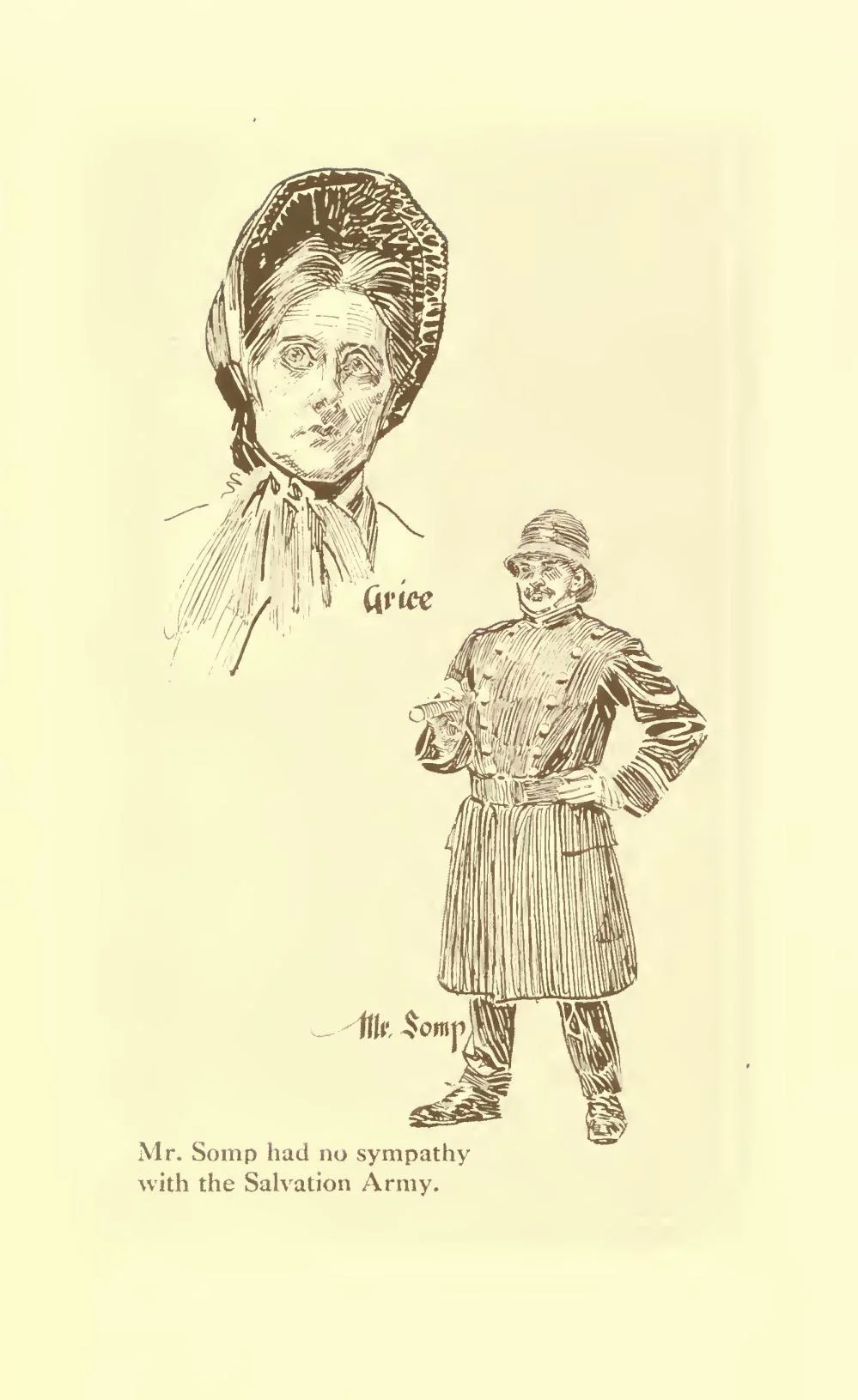

Grace’s husband had no sympathy with the Salvation Army—he didn’t feel the need of conversion; and Grace, for her part, had no patience with men who refused to sign the pledge. Mr. Somp took revenge for domestic wrongs in his official capacity, by moving his wife along when he found her beating her drum at street corners. Mrs. Somp punished him by keeping him awake at night while, to use his own words, she sneaked to God abart him. She even addressed God in the highways on this intensely private matter, when she saw her husband approaching. She followed St. Paul’s advice by being urgent in season and out in her rebuking, long-suffering, teaching and exhorting. Her lofty sense of right and wrong depressed him; he grew slack, lost his standing in the force and gradually ceased to work. His self-confidence melted before her superior morality.
So she went back to the Barringtons by the day to do charring and to give extra help. That was how Peter came to know all about her intimate matrimonial problems. He heard the other side from Mr. Grace and Mr. Somp, who now had a common grievance—they wanted to drink and Grace tried to prevent them. “Don’t you never marry a good woman,” they both advised him; “good wimen is bad.”
Grace, on the other hand, despite her frequent complaints, held that her husband was a very decent man, but bone-lazy. Having proved prayer useless, she could think of only one other remedy. “If I was ter die, father’d be sorry and my ‘usband ‘ad ‘ave ter work; but I ain’t got the ‘eart ter do it.”
To which Cookie would reply, “I’m sure yer ‘aven’t, dearie. It’s them as should do the dyin’.”
After Ocky’s arrest a period of flatness followed. The uncertainty which had kept the household nervous and hoping for the best no longer buoyed them up. Until they heard that Waffles had been sentenced, they could make no plans for Jehane’s future. Barrington placed money at his disposal for his defence and went to see him once. He never disclosed what happened; but his face was ashen when he returned. All that evening, when anyone spoke to him, he seemed to have to wake before he could answer. Next morning he told Jehane, “Ocky wants to see you.” She shook her head. “He’s dragged me low enough. I never intend to see him again.”
“If that’s the way you feel, you couldn’t help him; it’s better that you shouldn’t visit him.”
She looked into the shrewd gray eyes fiercely. She wanted to find anger there—she could resent anger; she found only quiet judgment. “You don’t mean that you actually expected me to go to him?”
“I expected nothing, but he’s in trouble. You’ve given him children—he’s your husband. In all your years together there must have been some hours that are sweet to remember. I did rather hope that, now that he’s in trouble, you might have remembered them.”
“Well, I don’t. I’m ashamed that I ever had them.”
“All right. It’s strange; but I think I understand. He still loves you, Jehane, and you could have helped the chap.”
“Love! What’s the value of his love?”
“I think its value once was whatever you cared to make it.”
Later in the day he said to her, “And you wouldn’t let Glory see him, I suppose? He mentioned her.”
“No, I wouldn’t. He’s not her father. Captain Spashett was a gentleman.”
The children were never told what occurred at the trial; all they knew was that the man who had laughed and played with them, who had loved the sunshine so carelessly, was to be locked up for a time so long that it seemed like the “ever and forever” of the Bible. It was like burying someone who was not dead—they seemed to hear him tapping. And they must not go to him; they must pretend they had not heard. He was a thing to be shunned and forgotten.
Jehane was anxious to earn her living. But how? She had been trained to do nothing. Barrington bought her a little cottage near Southgate, which at this time was still in the country. Gradually he got into the habit of letting her do a little outside reading for his firm—he did it to enable her to pretend that she was self-supporting. To his surprise she developed a faculty for the work and he began to trust her judgment. She had inherited a literary instinct of which, during her married life, she had remained unaware. It was a feeble instinct, but in the end it proved sufficiently rewarding. She took to writing sentimental novelettes, which found a market. Whatever her faults of heart, she had always been capable and gifted with a strong sense of duty; so, now that she had found a means of making money, she worked hard with her pen, stinting herself and treating her children with foolish liberality.
Her chief regret was that Ocky had spoilt the marriage chances of her girls; she tried to rub out this social stain by creating the impression that her husband was dead. She had two extravagances—the purchase of hair-tonics and a mania for visiting fortune-tellers. She had one great hope—that in the future she might re-marry. This would entail Ocky’s death; but she was not so cruel as to reason that out. She had one great mission—to teach her daughters to catch men. Her chief theme of conversation with her children was the wickedness of their father and the heroic loyalty of her own conduct. No doubt there were times when her conscience troubled her.
Peter was just fifteen and Kay was nearly nine when all this happened. It made a deep impression on both of them, but especially on Peter. For months the crushed shoulders and sunken face of Uncle Waffles haunted his memory, so that it seemed a crime to be happy. He could not bear to enter the stable; he was always expecting to hear a hoarse voice addressing him in a whisper from the loft, calling him a ha’penny marvel or enquiring whether he knew the story of the husband whose wife had black hair. Often in the street he would turn sharply at the sight of some shabby outcast, shuffling through the crowd with bowed head. He would run to the window, hardly daring to own what he expected, when he heard the mournful singing along the Terrace of a group of out-of-works:
“We’ve got no work to do,
We’ve got no work to do;
We’re all thrown out, poor labourin’ men,
And we’ve got no work to do.”
Sooner or later he would recognize, he knew, in one of the tattered singers his Uncle Waffles. Peter was suffering from a suddenly awakened social conscience; he did not know enough to call it that.
It was partly because Barrington had observed and was distressed by his boy’s sadness, that he granted his desire. He granted it to give him a new interest. Peter had always dreamt of a day when he should polish up the tandem tricycle, put Kay on the back seat and ride off with her into the country.
“Well, Peter, I’ll let you do it if you’ll promise to be very careful.”
It was early summer when these splendid adventures commenced. Peter had to do all the work—Kay’s legs were too short to reach the pedals. But what did he care? Just to have his little sister all to himself, London dropping away behind and the world growing greener before him—what more could a boy ask to make him happy?
The tandem trike was a clumsy solid-tired affair—desperately heavy and beyond belief old-fashioned. Peter managed to accomplish six miles an hour on it. The way out, along Green Lanes to Wood Green and up Jolly Butcher’s Hill, would have been full of ignominy for anybody less light-hearted. Kay’s flying hair and plunging legs would have attracted attention had the tricycle been ever so new and handsome.
Errand-boys stood still and whistled after them. Tradesmen followed them in their carts, offering to race them and grinning ridicule. Very frequently insult set itself to the words of a street song then in fashion:
“It won’t be a stylish marriage;
For I can’t afford a carriage;
But you’ll look sweet with your two little feet
On a tricycle made for two.”
What did Peter care? Ill-nature failed to touch him. Little boys who pulled faces at him from the pavements, made long noses at him or stuck out their tongues, did it in envy. He wished he could take them too. So he and Kay turned their heads and threw back laughter. It was fun—all fun. And then there was the anticipation of lunch; two shillings between two people can buy so much.
Shortly after Jolly Butcher’s Hill the country began. At Southgate they would stop to see their cousins. Riska affected to despise their means of traveling. She was shooting up into a tall girl, like her mother; she was darkly handsome and carried herself with a gipsy slouch. Jehane’s philosophy, of teaching her girls how to catch men, was already beginning to take effect. Outside the cottage-gate she had a little table from which she sold ginger-beer to Cockney cyclists. She did it to make pocket-money; even as a child, by this means of introduction she gathered about her a group of boy-lovers. She was learning early how to attract when she cared. Her mother was pleased by her foolish conquests—in the rose-scented air of the cottage garden they seemed very guileless and humorous. In the presence of men, whatever their years, Riska invariably tried to fascinate.
“It’s an instinct with her, the little puss,” said Barrington; “she even tries to make love to her old uncle.”
It was a subject for laughter in the family.
On these short visits Kay and Peter saw hardly anything of Glory—she was doing the work. Just as they were going she would come out from the kitchen, untying her apron, or would pop her head out of a bedroom window to shake a duster and smile at them. Then, as the pedals began to turn, Riska would sing half-tauntingly, and Eustace and Moggs would join in with her pipingly:
“Daisy, Daisy, give me your answer true,
I ‘m half-crazy, all for the love of you.
It won’t be a stylish marriage,
For I can’t afford a carriage,
But you’ll look sweet-”
The words would be lost as the tricycle lumbered into the sunshine between the hedges.
Kay used to say, when she was very little, that the gladness went into her feet when she was happy. On these expeditions it went everywhere, into her feet, her eyes, her lips, her hands. She did the things that boys do, and yet she had the sweetness of a girl. She ran like a boy and she swam like a boy. She was a darling and a puzzle to Peter; he could never make her out. He was always trying to put her dearness into words and always failing.
“Your voice is like the laughter of birds,” he said. “But why do you love me so much, Peter?”
He slanted his eyes. “Because I borned you.” He knew better than that now.
Sometimes they spoke of their cousins.
“I did something horrid this morning.”
“Don’t believe it.”
“Oh, but yes. I was brushing the dust off my shoes in the kitchen, and what do you think I found?”
“Hurry up and tell me.”
“That Glory hadn’t had time to eat her breakfast and that some of the dust had gone into her plate of porridge.”
“Oh, Peter! How careless! Did you tell her?”
“She came in and saw it. You’d never guess what she said.—‘Never mind, old boy. One’s got to eat a peck o’ dirt before one dies. So mother says.’ And she took a spoon and——-”
“And ate it?”
Peter nodded, trying to look penitent, but laughing.
Then Kay became grave-eyed and asked one of her questions. “But do you?”
“Do you what?”
“Have to eat a peck of dirt before you die?”
Peter wriggled his toes in his shoes and looked down to see them moving. “Don’t know. You and I don’t. But that’s what Glory says.”
Having learnt to walk like a boy, Kay learnt to whistle. One hot summer’s afternoon they had ridden out and were lying on their backs in a field tall with grass, nearly ready for cutting. Peter had almost drowsed with the heavy smell of the wild flowers, when he sat up suddenly and seized his sister by the arm quite roughly. She was only whistling a little tune softly and was surprised at the strength he used.
“Peterkins, what’s the matter? You’re hurting. I’m sure you’ve made a bruise.”
He paid no attention to her protest. “Where’d you learn that?”
“What?”
“That tune you were whistling?”
“Don’t know. Just made it up, I suppose. I never heard it.”
“But you must have.”
“But I haven’t, Peter.” She was frightened by his earnestness, mistaking it for anger.
“Did you never hear it in the cupboard in the bedroom—the one that was yours and mine?”
She hardly knew whether to laugh or cry. “You’re joking.”
“I’m not. I’m in dead seriousness.”
The tears came. “I’m telling the truth. I never knew it till this moment.”
“Whistle it again.”
“I can’t. I forget it.”
As the children’s legs grew stronger they went further afield, conquering new territory, exploring all kinds of dusty lanes and by-roads. They had turned off from Potter’s Bar to Northaw, working round through Gough’s Oak to Cheshunt when they were hailed by a freckled boy, about Peter’s age, who sat astride a gate, playing a mouth-organ.
“Hey, kids! Want to buy anything?”
They jammed on the brakes and addressed him from the trike. “Got anything to sell?”
“Nope. Just wanted to talk and had to say something.”
“But who are you?”
“I’ve lived in America and now I’m living here in Friday Lane. I’ve often seen you go by.”
They looked round to discover Friday Lane; on every side was a sweep of country, rolling away in sun-dazzled fields and basking woodlands.
“But—but it’s lonely here.”
“Yup. But it’s lonelier where I come from. Nothing but Indians and prairie.”
Even Indians didn’t turn them aside; they were trying to unravel the mystery of Friday Lane.
“Is this road the Lane?”
“That’s the Lane.” The boy pointed with a brown hand to a grass-grown field-track starting from the gate on which he sat and vanishing between a line of tall oaks—oaks which had probably been standing when the land was part of the royal chase.
“But there aren’t any houses.”
The boy laughed. “Oh, aren’t there? There’s our house, right over there, out of sight.”
“And who are you?” Kay and Peter asked together.
“I’m Harry Arran and the house belongs to my brother. He’s the Faun Man; I kind o’ look after him and keep him straight. He’s a wonder; you’d be lucky if you knew him.”
“We’d like to know him. We’d both like to know him very much.” Again they spoke together.
The boy thrust his hands in his pockets and eyed them.
“Don’t know so much about that. I’m very particular about my brother. I don’t let him know just anybody.”
He twisted round on the gate, turning his back on them, and re-commenced playing, giving them plainly to understand that their too eager interest in his family affairs had made conversation undesirable.
CHAPTER XXV—THE HAPPY COTTAGE
It was the way in which the boy had said “just anybody.” Peter gazed beyond the gate into the green mysterious depth of country—an Eden from which he was excluded by that hostile back. His eyes followed Friday Lane: it ran on, trees, sunshine and shadows, tremulous with the wings of birds, a canopied track, across fields, into the heart of wooded fairyland. What promises lay over there? A voice of ecstasy kept calling.
Reluctantly he set his feet against the pedals, glanced across his shoulder to Kay and was going to have said—
Something that glistened shot down her cheek and swiftly vanished.
Very deliberately he dismounted. Yankee-Doodle, or a tune not unlike it, was being played at the moment. He thumped the student of the mouth-organ in the place from which Eve was created. Kay, all legs, flushed face and blown hair, watched from the back seat of the trike the novel sight of her brother being violent.
The boy tumbled from his perch, putting the gate between himself and Peter. Yankee-Doodle ended abruptly—the mouth-organ slipped from his hand. The freckled good humor of his face changed to an expression of amused and fierce intelligence. It was his way to be amused when he was angry or in danger—Kay and Peter were to learn that later. He bobbed in the grass, recovered his fallen treasure, rubbed it on his sleeve, stuffed it into his knickerbockers’ pocket and grimaced across the rail.
“You’re a fresh kid.”
Peter removed his cap; his curly hair fell about his forehead. “You’ve made my sister cry,” he said. His hands were clenched.
One leg hopped over the gate; then another. “I haven’t,” the boy denied stoutly.
“You have. You called her ‘just anybody.’”
The boy stepped into the road—a pugnacious little figure. “Pshaw! What of it? Girls cry for nothing.”
Peter drew himself erect. “My sister doesn’t.”
The boy raised his eyes and met Kay’s. Ashamed of himself, but more ashamed of showing it, he spoke stubbornly, “She’s doing it now.”
There was silence. A small strained voice, which sounded not at all like Peter’s, said, “I never hurt people. I never fought in my life. But if I did ever fight, I’d like to punch your head. And—and I think I could do it.”
The boy lost his shame and became happy. “Guess you can’t. Anyhow, why don’t you have a shot at it?”
Without waiting for a reply, he commenced to take off his coat and to roll up his shirt-sleeves. He did it with an air of competence which was calculated to intimidate. All the while he carried on a monologue. “So he’d like to punch my head—my head. Why, I could get his goat by just looking at him. In America I’ve licked boys twice his size, and they hadn’t curly hair, either.” He faced Peter, doubling his fore-arm, and inviting him to feel his muscle. “See that. Say, kid, I’m sorry for you.—Ready?”
Peter nodded; before his nod had ended something hit him on the nose. He threw up his arms to defend himself, but the something seemed all about him. Always smiling into his own was the freckled face of a pleasant looking boy—so pleasant that it was hard to believe that it was he who was doing the hurting. And Peter—he hit back valiantly; but somewhere at the back of his brain he kept on seeing pictures of the boy dead. It was disconcerting; every now and then, when he should have pressed home his advantage, he shortened his blows intentionally, with the strong weakness of the humanitarian.
A bird rose twittering out of a hedge. From a meadow across the road, a cow hung its mild head over, looked shocked, switched its tail disapprovingly, mooed loudly, swung round and lumbered away uncertainly, like a distressed old lady with gathered skirts, in a futile endeavor to bring help.
Peter saw it all. His faculties were unnaturally and desperately alert. It was odd how time lengthened its minutes—how much he saw and heard: the deep blue stillness of sky-lagoons, the foam and wash of traveling clouds, the erect and listening quiet of tree-sentinels and hedges, and, somewhere out of sight, the sigh-sigh-sighing of wind in distant country.
There was a cry behind him. How long had he been fighting? He could not guess. Between himself and the boy rushed a little girl. Her small hands commenced to beat the boy furiously. She could not speak; she was choked with sobbing. The boy’s arms fell to his side; he let her aim her puny blows at his impudent face, making no attempt to stop her. Suddenly she swayed and sank into the flowers at the side of the road. Peter stooped; his arms went about her. The boy looked on, gazing from these strange invaders to the waiting trike. It was he who was excluded now. He wanted to say something—opened his mouth several times and halted. At last he stumbled out the words.
“I’m—I’m sorry. And you’re not just anybody.” And then, “I say, you’re plucky ‘uns—won’t you shake hands?”
The bird came back to the hedge and dropped into its nest. The cow, having sought help in vain, looked distractedly into the road and saw a boy pushing open a gate, while another boy, a little bruised and battered, pushed an ancient tandem tricycle into a meadow, and a small girl, with flushed face and blowy corn-colored hair, dabbed her eyes furtively with the hem of her dress.
The trike had to be hidden. It was unlikely, but always possible, that it might be coveted by tramps. Friday Lane lay before them. The boy turned to them with abrupt frankness. “Here, what your names?”
“Mine’s Peter, and my sister’s is Kay.”
“Well, Peter, I guess I hit harder than I meant. But—but I reckon you could have punched my head if you’d chosen. Didn’t get warmed up to the work before she stopped us—was that it?”
They were up to their knees in the meadow-world; the air was full of kind new fragrances. Peter’s eyes were dreamy. The boy rambled on, leading deeper into the avenue of oaks, so that already the first straggling fringe of woods commenced. “My brother’s like that. In Alaska, when the dogs took to fighting, he’d just stand still and laugh and holler at them. Then, all of a sudden, when he saw that they were eating one another, he’d go clean mad and wade in among ‘em and lay ‘em out with the butt of his rifle. He’s a wonder, my brother.”
“I’m sure he is,” said Peter, and Kay, trotting closely by his side, repeated his words to show her interest.
The boy, flattered by the attention of his audience, with the treachery of the born story-teller, sharpened their appetite by suspense. He wagged his head mysteriously. “I could tell you heaps about him if you were to come here often.”
He waited to see what effect that would have. Kay had been hiding behind her brother, clinging to his hand. Now she came level with him, bending her face across him so that she could meet the eyes of the boy. She asked, “May we, Peter? Do you think we can?”
“Not often,” said Peter guardedly; “but as often as we can.”
The boy held out a further inducement. “One day I might show him to you. He’s like that with dogs and—and especially with girls: laughs at ‘em, hollers at ‘em, and then——-. He’s the most glad-eyed chap that ever came down the pike, I reckon. That’s what gives me all my trouble.”
Neither Kay nor Peter knew exactly what was meant. So Peter said, “You’ve been everywhere, haven’t you? And we—we just tricycle out and——”
The boy had drawn his mouth-organ from his pocket and was playing, stamping his feet and swaying his body. Suddenly he stopped and his voice took up the air:
“I’ve been shipwrecked off Patagonia,
Home and Colonia,
Antipodonia;
I’ve shot cannibals,
Funny looking animals,
Top-knot coons;
I’ve bought diamonds twenty a penny there,
I’ve been somewhere, nowhere, anywhere—
And I’m the wise, wise man of the
Wide, wide world.”
They gazed at him wide-eyed in the hushed summer woodland. Then they beat their hands together, crying, “Oh, again, again, please.”
The boy smiled tantalizingly. “Can you climb?” He shot the question out. The next moment he was scrambling up a tall oak. Sometimes his body was lost in leaves. Sometimes it sounded as though he were tumbling, tumbling through the branches to the ground. At last, from a bough high up where the sky commenced, his impish face gazed down on them. First they heard the mouth-organ, then the voice, singing of somewhere, nowhere, anywhere—of the splendidly imagined No-Man’s-Land through which every child has longed to wander.
And they believed his song, as though it were autobiography. In a picture-flash they saw the world, beautiful, tumultuous, full of terrors—saw it as a vast balloon, swimming through eternal clouds, painted with the dreams of young desire: islands in sun-drenched seas, where palms stood motionless, pointing to the skies with silent hands; countries of yellow men, small and crafty, who lived in paper houses and fed on flowers; enfeebled cities, dazzlingly white, whose eyes had been burnt out by the door of hell left open in the iron heavens; and snow-deserts where the frost carved Titans with his breath.
This freckled pugnacious master of the mouth-organ,
This pugnacious master of the mouth organ, caroling a street song in the tree-turrets of Friday Lane, became for them the embodied soul of adventure.
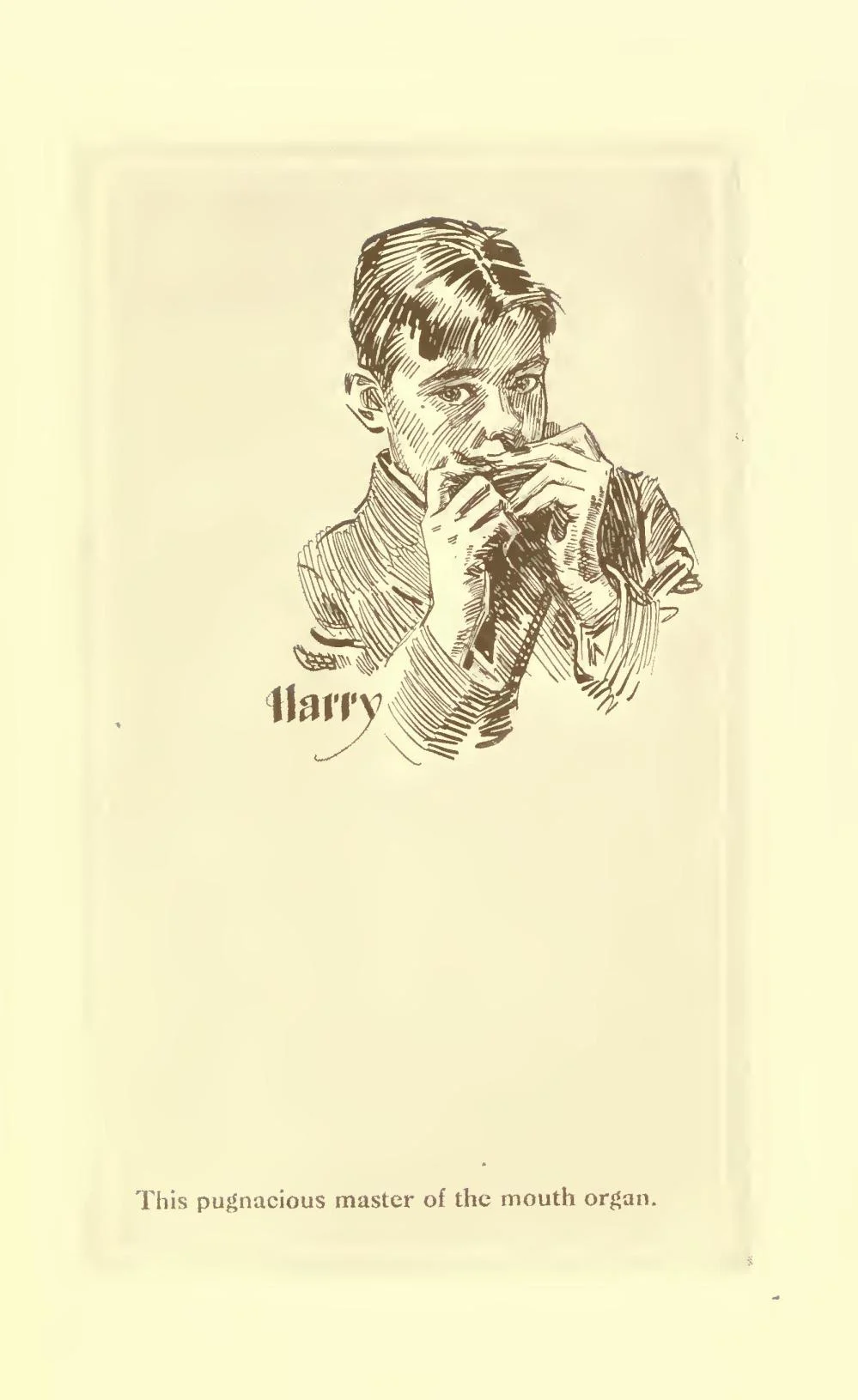

The boy came slithering down. Kay watched him, how he dangled by his arms, caught on with his legs, dug in with his toes, got himself completely dirty and always saved himself at the last moment from falling.
He dropped breathless at their feet. “It’s fine up there. Different from down here. Up there it belongs to anybody.”
Kay wasn’t quite sure that she approved of him. He had ripped his coat, and it didn’t seem quite kind to give his mother so much work. She spoke reproachfully. “D’you like tearing your clothes?”
He gazed at her out of the corners of his eyes with a sly expression. “I don’t mind. Don’t need to mind—my clothes are magic. They mend themselves.”
“Mend themselves!” She tugged at Peter, to see in what spirit he was accepting this amazing assertion. “Why, how wonderful!” And then, reluctant to show doubt, “But—but how can they?”
The boy grinned broadly. “Not really, you know—just pretence. I—I mend them myself. I’m an awful liar. Come on now.”
Confession had made him self-conscious; he darted ahead. Kay and Peter followed slowly. He turned. “Aren’t you coming?”
It was Peter who answered. “But to where?”
“To where I live—the Happy Cottage.”
Was this also pretence? The name sounded too good to be true—and yet it was the kind of name you tried to believe, despite yourself.
The boy left the grassy avenue and broke into the undergrowth of woods. He went in front, parting the branches for Kay. He explained to them, “Friday Lane’s shorter, you know; but this other way’s heaps jollier.”
Presently above the rustle of their passage they heard a little singing sound. Sometimes it grew quite loud and near them; sometimes it died away into the merest breath.
It was like someone who was almost asleep, humming over and over the first two notes of a tune that refused to be remembered. Kay snuggled her hand into Peter’s; she was a little scared. Everything was so dark and eerie. The sound drew near and seemed to slip away from under her very feet. She cried out; it was as though someone had touched her and had vanished before she could turn round.
The boy heard her cry and looked back. He nodded reassuringly. “It’s always doing that—plays no end of pranks. You needn’t be frightened; it won’t hurt you.”
“But what is it? What won’t hurt you?” Peter asked almost angrily.
The boy laid his finger on his lips. “The wood’s haunted. That’s the queen fairy calling. There are all kinds of fairies hidden about here. When you see them, they turn into rabbits and birds, and——” Because Kay had covered her face, he stopped. “I’m—I’m an ass. It isn’t really, you know. I just tell myself that.”
“Then what is it?” asked Peter, slightly awed, for the voice kept on singing.
The boy laughed. “It’s the tiniest little river that’s lost itself. It creeps about under the bushes and wriggles through the leaves on its tummy, trying to find a way out.”
“And does it find it?” asked Kay, plucking up her courage.
“You bet you. Wait till we get to the Happy Cottage.” And all of a sudden they got there. It was as though the little river had led them, for just where they broke out into the sunlight it rushed past them, flashing silver and singing merrily, with all the words of its song remembered. At first they saw a green, green stretch of grass, over which the yellow of cowslips drifted like blown gold-dust. Then they saw Friday Lane, with its tall oaks holding back the woods, like big policemen marshaling a crowd when a procession is expected. And then they saw the Happy Cottage—a bee-hive, with low-thatched roof, set down in a refuge of flowers. It had one chimney, from which smoke was lazily ascending; and it must be logs that the fire was burning, for the air was filled with the indescribable homey smell that sets one dreaming of all the country cottages, tucked away in gardens, and all the summer happiness he has ever chanced on.
They followed the little stream right up to the high hedge which went about the Happy Cottage; they crossed it by a plank, pushed open a gate and entered. Flowers, flowers everywhere and the banjo-music of bees humming. A red-tiled path, moss-grown and edged with box, led through a wilderness of beauty, comfortably untrimmed and neglected. The door of the cottage stood open; across its threshold lay a Great Dane, which rose up and growled at sound of their footsteps. The boy called to him, “All right, Canute, old dog. Come here, old fellow.”
Canute came with the solemn suspicion of majesty, ignoring the strangers, and placed his great head against his master’s breast, gazing up attentively.
“Canute, this is Kay and this is Peter. They’re my friends. You’ve got to look after them. D’you understand?”
The dog blinked his eyes and turned away indifferently, as much as to say, “Your friends! Humph! We’ll see. Very sudden!”
“He’s always like that with newcomers,” said the boy. “He’s very particular about my brother. Guess he’s thinking what I said, that he don’t let the Faun Man know just anybody.” Fearful lest he should have given offence, he made haste to add, “But you’re not just anybody any longer.”
The door opened without ceremony directly into the living-room. The leaded windows were pushed back; roses stared in and bent inquisitively across the sills, spilling their petals. The house was silent; it was like stealing into someone’s heart when the soul was absent. Guns on the walls, brilliant little sketches, golf-sticks in a corner, old oak furniture, a mandolin lying in a chair—everything betrayed the room’s habitation by a strong and alluring personality. Peter, looking round, became conscious of a spirit of loneliness and yearning. On the walls were pictures of many beautiful women, but in the house itself were no signs of a woman’s hands.
The boy explained. “He’s not here to-day. He’s gone to town. This is where we play; it’s upstairs that he works.” He volunteered no information concerning the task at which the Faun Man worked. Casting his eyes round the walls, he said, “Those are all his girls. Pretty! Oh, yes. But they give me an awful lot of trouble. Want some tea? Yes?”
He went out into the kitchen at the back. He let the children follow him, but refused their offers of help. “I’m a rare little cook, I can tell you. Had to be on our ranch in America—there was no one else. You just watch me.”
But Kay had been thinking. She had supposed that there were mothers everywhere—that every boy had a——. She said, “Where are your mother and sisters?”
He looked up from toasting some bread. “Haven’t any.”
She laid her hand on his arm. “But—but didn’t you ever have any?”
He answered cheerfully, not at all sorry for himself, “Nope. Not that I remember.”
She glanced at her brother. “Peter and I’ve always been together.”
Peter added, “So that’s why you thought girls cried for nothing? You don’t know anything about them. I shouldn’t have been angry.”
The boy winked joyfully. “Oh, don’t I know anything! Leave that to the Faun Man. I know just as much as I want to. But say, I’d have liked to have had your sister for my sister. I really would have.”
Kay leant over his shoulder as he knelt before the fire. “If I were your sister, d’you know what I’d do for you? I’d tell you not to climb trees and, if you did do it, I’d mend your clothes for you.”
He told them something of his history as they sat at table. How he’d left England with his brother when he was so little that he couldn’t remember. How he’d lived on a cattle ranch and knew how to ride anything. He tried to make them understand the freedom and the solitariness of his life in those wide stretches, where there weren’t any street lamps but only stars, and where one gazed on green-gray grass for miles and never saw a single house. And he told them of the places he had been to—the queerly natural ghost corners of the earth, Alaska, Mexico and the South Sea Islands. Every now and then his imagination would gallop away with him. Then he’d twist his head and stoop forward, as if listening for the first expression of doubt. Before it came, he would try to forestall it by saying, “You know, that last part’s not really.”
When he had said it several times Kay laughed softly. The boy looked up, a little offended. “What is it?”
Her eyes were dancing with happiness. “You’re—you’re a very pretence person, aren’t you? Peter and I, we’re pretence persons. We’re always going to one place and telling ourselves we’re going somewhere else.”
The boy sank his head between his hands. His words came timidly. “It makes one happy to pretend, especially when one’s always been lonely. It’s like climbing a tall tree—it belongs to anyone up there.” He turned slowly, staring at his guests. They wondered what was in his mind. At last he said, “I wish—I wish you’d call me Harry. And please don’t tell me where you come from. Let’s be pretence persons—— I’d like to be your friend.”
With the quaint solemnity of childhood, they clasped hands. Outside the bees played their banjo-music, the flowers whispered, laying their faces close together, and the stream ran singing past the cottage, with all the words of its song remembered.
CHAPTER XXVI—THE HAUNTED WOOD
Life at its beginning and its end is bounded by a haunted wood. When no one is watching, children creep back to it to play with the fairies and to listen to the angels’ footsteps. As the road of their journey lengthens, they return more rarely. Remembering less and less, they build themselves cities of imperative endeavor. But at night the wood comes marching to their walls, tall trees moving silently as clouds and little trees treading softly. The green host halts and calls—in the voice of memory, poetry, religion, legend or, as the Greeks put it, in the faint pipes and stampeding feet of Pan.
We have all heard it. Out of fear of ridicule we do not talk about it. Do we revisit the wood, it is when sleep, or the dream of death, has claimed us and made us again children.
Because secrecy adds to happiness, Kay and Peter told no one of their discovery. In the early morning they would tricycle out through red-brick suburbs, where nurse-girls wheeled fretful babies in prams and wondered what love meant. Having spent their day in fairyland, they would tricycle back through those same brick suburbs where tethered people found romance in twilit reality. They almost feared to speak aloud of their doings, lest speech should break the spell—lest, were they to tell, they might search in vain for Friday Lane, Canute, and Harry of the mouth-organ, and find them vanished.
On their first visits they did not meet the Faun Man; in proportion as they failed to meet him, they grew more curious about him. Sometimes they were quite certain he was there, but Harry—— He was strangely reluctant to share him—as reluctant as Peter was to share his sister. And yet, in-all the rest of his secrets he was generous. He showed them how to find beneath stones in the river the homes of fishes—tiny fellows, who darted away with agitated tails the moment you took the roofs off their houses. And he showed them how you could make whistles out of boughs, if you chose the right ones. He taught them to mimick the notes of birds, so that they would follow through the woods, answering and hopping, twisting from side to side their perky heads. He was the Pied Piper of the open world, and willing to make them his confederates. “Where—where did you learn?” They asked him. Sometimes he looked away from them, narrowing his eyes; sometimes he answered, “The Faun Man—he taught me.” So the Faun Man became a kind of god, whose handiwork was seen in many wonders, but who never showed himself.
It was a scorching afternoon. In London water-carts were going up and down; the less refined portion of mankind had removed their collars and had knotted handkerchiefs about their necks. Along Green Lanes and as far as Jolly Butcher’s Hill, costers tempted villadom to extravagance, crying, “Strarberries. Fresh strarberries,” in voices grown cracked from over-use and thirst. It made one’s throat dry to listen to them. The tricycle seemed to feel its weight of years; despite frequent oiling, it insisted on running heavily. At Aunt Jehane’s house they halted for a rest; then, on again. The country drowsed: big trees in the meadows seemed to fold their hands; birds had hidden themselves; there was scarcely a sound.
When they came to the gate leading into Friday Lane, Harry wasn’t there. Pushing the machine behind a hedge, they went in search of him. They called his name and paused to listen. He had tricked them before, trying to make them believe that they wouldn’t find him, then startling them into laughter by playing his mouth-organ in a tree right above their heads. They persuaded themselves that that was what was happening now. Every few steps they would stop and look up into the boughs, shouting, “We’ve found you. We know where you’re hiding. You may as well come down.” If he heard them, he refused to fall into their trap.
They came to the Haunted Wood and entered. In its dark green shadows, where all things trod softly, they dared not shout. They whispered their assertion that they had guessed his whereabouts. Only the little river answered, now mocking them secretly, now babbling hoarsely, alarmed that it would never get out. They began to tiptoe. Fear of the silence seized them. A branch cracked; they only just saved themselves from running. It seemed as though a magician had waved his wand, casting a spell; everything slept. Everything except the river—and at last, because its voice was solitary, it became terrible, like that of a dying man in a shuttered room, who muttered deliriously and tossed upon his bed.
The green stretch of grass, with the cowslips scattered over it, brought relief to their suspense. But, here again, there was no welcome. Bees hummed above the flowers, quite indifferent to their presence. The bee-hive cottage stood with door and windows wide, as though its inhabitants had been called away suddenly and would never return. Beneath the smiling of the summer stillness lay the threat that something evil had happened. Even Canute had vanished.
They stole round the house and at last crossed the threshold. Everything was as they remembered it, even to the mandolin lying across the chair. They listened. Voices! Yes, certainly. Then laughter, clear and pleasant; it broke off in the middle, as if someone paused for breath. It came from the Faun Man’s room overhead, which Harry had never invited them to enter. Hand-in-hand they’ climbed the stairs—steep and narrow stairs, which ended abruptly in a white door. They tapped. A man answered. Peter raised the latch.
The ceiling sloped down from the centre, giving to the room the appearance of a tent. There were two lattice-windows, on opposite sides, which opened outward on to the thatch. Against one of them stood a desk, littered with papers, from which a rush-bottomed chair had been pushed back. A pen, lying on a sheet of partly written foolscap, had rolled across it, leaving blots, as if the writer had put it down and turned hastily at the sound of someone’s entrance. In one corner of the room there was a high-peaked saddle and on the walls a strange collection of memories and travel—a study of a girl’s head by Rossetti, old Indian muskets used in frontier warfares, a pair of sabres, a college oar with the names of the crew gilded on it, and everywhere the faces of women. Among them one face occurred often—Peter had noticed its frequence on the walls downstairs. And now he saw the living woman before him.
She was dressed in white, lying on a rose-colored couch, stretched out carelessly full-length, with her small feet crossed. Her age might have been anywhere from twenty upward. It didn’t matter—one forgot years and only thought of youth in looking at her. Was not Helen past mid-life when two continents went to war for her beauty? Somehow she reminded one of Helen—was it the way in which experience mixed with artlessness in her expression? The mind went back. Dr. Faustus might have addressed his sonorous lines to her:
“Was this the face that launched a thousand ships?
And burnt the topless towers of Ilium?
Sweet Helen, make me immortal with a kiss:
Her lips suck forth my soul, see where it flies:
Come, Helen, come, give me my soul again.
Here will I dwell, for heaven is in these lips.”
She was golden, splendidly negligent of what was happening about her, insolently languid with a lazy ease that seemed to take all the world into her confidence and actually shut all the world out. She was a lonely tower of snow and ice, rosy in the sunlight, luring, cold and inaccessible. Her eyes were intensely blue and innocent. She had fine teeth and an almost childish mouth, which was contradicted by the powerful molding of her chin and throat, and the capability of her hands. One wondered what difference it would make to her if she were ever to be roused by love or anger. She was built on heroic lines, long and full and gracious, yet she seemed to prefer to be treated as a plaything. One arm was curled beneath her golden head, the other hung down listlessly and was held by a man who was pressing the hand to his mouth. Peter noticed in a flash how the woman paid no attention to what the man was doing. And the man——
Peter had never seen anyone quite like him. He was tall and strong and slender. Even though he was kneeling, Peter knew that he must be of great height. His face was smooth, lean and tanned. His lips were thin—unusually red and delicate for a man’s. His nose was straight and arched at the nostrils. His ears were set far back and pointed. But it was by his eyes that Peter recognized him as the Faun Man. They were brown and filmed over with blue like a dog’s, showing scarcely any white. They had a dumb appeal in them, a hunger and melancholy because of something which was never found, which the eager happiness of the rest of his appearance disguised. They had a trick of veiling themselves, of becoming dull and focusless, as though the spirit, whose windows they were, had drawn down the blinds and lay drugged with sleep and satiety. Then suddenly they would flash, become torches, all enthusiasm, crying out that there was no truce in the forward march of desire. At such times the face became extremely young—as young as his long fine hands. Only the black hair, brushed straight back from the forehead without a parting, betrayed his age by the gray which grew about the temples.
The golden woman withdrew her hand from his, and raised herself on her elbow at the children’s entrance. She gazed at them doubtfully, like a young pantheress disturbed. Her red mouth pouted. Her blue eyes feigned a laughing shyness. Only one small foot, tapping against the other, told of her impatience. “Oh, it isn’t—— I thought it was Harry. Who are they, Lorie?”
Her voice was soft and caressing. She spoke in the “little language” which mothers learn in the nursery. In her way of talking there was a guttural quality which marked her foreign parentage.
The Faun Man, unabashed by the unexpected company, bent toward her and kissed her arm. “I don’t know,” he laughed. Then he turned with a smile that was all courtesy and kindness, “Won’t you tell us? Who are you?”
Peter didn’t answer at once. He was fascinated. He had never seen a man’s ears move like that. As the Faun Man had asked his question, his ears had pricked up as a dog’s do when he pays attention. And then there was something about his voice—— It was so sad and intense.
It hurt by its longing. It didn’t seem right to meet this man in a house. Peter both distrusted and liked him—the way we do nature.
The white room became a blur as he gazed into the soft brown eyes. Woods and meadows, seen distant in the sunlight, became flat like painted canvases hung across the windows. Real things grew vague, or took on the aspect of artificiality. The question came again. “Tell us, little chap. Who are you?”
Peter’s brain cleared. “If you please, we’re friends of Harry, the boy with the mouth-organ.”
The golden woman leant forward, resting her hand intimately on the Faun Man’s shoulder. She was interested and her face became gentle. “Harry’s friends! But we’re in disgrace with Harry. He’s run away with Canute because—because he’s jealous. He wants his big brother all to himself—— What shall we do with them, Lorie? I think we’ll have to make them our pals.”
Kay had been hiding behind Peter in the doorway. She looked round him timidly, still ready for escape. “But—but will Harry come back?”
The concern in her voice made the woman clap her hands. “He always comes back. Men always do come back, don’t they, Lorie?” She slipped her feet off the couch and came across the room. “What a dear little girl!”
Kay looked up at her, willing to be frightened. Then her arms reached up and the woman stooped over her. “You’re nice,” she said.
“Have you been here often?” It was the Faun Man speaking.
Peter thought. He tried to reckon. “Not often, but several times.”
The Faun Man took him by the shoulders, looking down on him. Seen that way, from below, he seemed tremendously high. “You needn’t be afraid, young ‘un; I’m not angry. You won’t get Harry into a row. Where d’you come from?”
“Come from!” Peter laid his fingers on the thin brown hand. “Would you mind very much if I didn’t tell? You see, Harry doesn’t know. It’s such fun—we’re just pretence people. We tricycle out from—from nowhere on a tandem, Kay and I. And then we meet Harry and leave the trike behind a hedge and go into the Haunted Wood together. You see, if Harry doesn’t know who we are, it’s almost as though we were fairies, and as though he were a fairy, and we—— You know what I mean: we meet in fairyland, and can do what we like with the world.”
The Faun Man turned his head. “Eve, did you hear that? He wants to do what he likes with the world. He’s one of us.”
But Eve had Kay on her lap and her lips were in her silky hair. Something had happened to her—something difficult to express. She had melted. With the child pressed against her bosom, she looked a mother—very young and good. As the Faun Man watched her, his eyes became tender—oddly tender.
“Eve. Eve.”
He went over to her and took her hand. She lifted her face to his. “If you hadn’t kept me waiting——” He got no further.
There was a pause.
“I was thinking the same,” she said; “and yet——”
“And yet?” he questioned.
She drew Kay nearer to her. “Where’s the good of talking. We’ve talked so often—so often.”
He went to the open window and stared out. A butterfly flew in and alighted on his forehead. He took no notice; he stood rigid like a man of stone. A little muscle in his cheek kept twitching; his arms hung straight down and the fingers worked against the palms of his hands. Seen on either side of him, in two narrow strips, was the basking unimprisoned country, which rolled on marvelously, this visible landscape building into the next, and the next into all the others that lay beyond the horizon, continents, seas and wonderlands, like a carpet of ever-changing pattern wrapped about the world for his feet to tread. And he, without bonds, was a prisoner.
He swung round. To Peter’s surprise he was laughing. His dark face was narrow in mockery. “Come on, young ‘un,” he said; “let’s get out.”
He had to double himself up to pass down the low-ceilinged stairway. Peter followed; in leaving the room, he glanced back. The golden woman had raised her eyes—the eyes of a child who has been selfish and has wounded itself. She was fondling Kay, as though she thought that her kindness to the little girl would atone for her unkindness to the man.
As he crossed the living-room, the Faun Man picked up the mandolin from the chair. He did not walk through the garden; he walked into it. That was his way with everything. Leaving the path, he pressed waist-deep through roses and fuchsias, scattering their blooms and petals. Like soldiers approving his lawlessness, sunflowers swayed their golden heads and nodded. Swarms of winged insects, whose homes he had disturbed, rose up in busy protest. His face was wrinkled with determination to be glad—to be glad whatever might lie in the future. In the heart of the fragrant nature-world he halted, and sat down on the hard-baked earth. He looked like a great supple hound with his legs crouched under him. Through the walls of their house of leaves and blossoms they could see the window of the room they had left.
The Faun Man commenced to tune his mandolin. “Ever been in love, Peter?”
The boy reddened. He didn’t know why he reddened. Perhaps he was proud that he should be asked such a question. Perhaps he was a little angry because—well, because everyone he had ever met seemed a little ashamed of love—everyone except the Faun Man. So he answered, “Only with my little sister.”
The man laughed. “That isn’t what I meant. That’s different. Love’s something that burns and freezes. It fills you and leaves you hungry. It makes you forget all other affections and keeps you always remembering itself. It makes you kindest when it’s most cruel. It demands everything you possess; and you’re most eager to give when it gives you nothing back. It’s hell and it’s heaven. No, I’ll tell you what it is. It’s a small child pulling the wings off a fly, and then crying because it’s sorry, and didn’t know what it was doing. Ah, Peter, Peter, you haven’t met love yet.” He bent forward and tapped him on the arm. “Be wise. Run away when you see love coming.”
Peter felt embarrassed. The Faun Man closed one eye and watched him—watched how the sun splashed through the creeping shadows and fell on the boy’s flushed face and curly hair. “Here’s a little song about love,” he said. “A very high class song, written not improbably by the poet Shelley.”
He struck the strings of the mandolin, playing a little jingling introduction and then commenced, lifting his long face to the window in the thatch, singing through his nose and burlesquing all that had happened:
“If yer gal ain’t all yer thought ‘er,
And fer everyfing yer’ve bought ‘er
She don’t seem to care a ‘appenny pot o’ glue;
If she tells yer she won’t miss yer
And she doesn’t want ter kiss yer,
Though yer’ve cuddled ‘er from ‘Ammersmif ter Kew;
If yer little side excurshiums
To lands of pink nasturtiums
Don’t make ‘er ‘arf so soft as they make you,
Why, never get down-’earted,
For that’s the way love started—
Adam ended wery ‘appy—and that’s true.”
He had scarcely finished, when the golden woman came to the lattice in the thatch. She stood framed there, with the whiteness of the room as a background. Her hands were crossed upon her breast. The shining masses, wrapped about her head and forehead, accentuated her vivid paleness. She looked as idealized as a girl on canvas, put there by her lover in a bid for immortality. She glanced this way and that to discover the Faun Man. She leant out, listening and searching. She could not detect him.
“Lorie,” she cried, addressing the garden, “you’re unkind. I hate you when you’re flippant.” She waited for him to answer. Nothing but silence, and the little river whispering to itself beyond the hedge. “Lorie, I suppose you think I’ve got no right to talk about being flippant, because—— But I’m not flippant. I like you, and—— But I can’t help myself if God made me as I am.” Again she waited. “Lorie, I’ll be awfully nice to you if you’ll only show yourself. I do so want to see——”
The Faun Man stood up ecstatically, with his arms stretched out to her. It was absurd to call him a man. The pollen of flowers had smirched his face and hands. His head was bare, and the hair had fallen forward over his forehead.
“I’m crying for the moon,” he chanted, “and because she won’t come down to me I’m calling her names—saying that she’s a Gorgonzola cheese flying through the heavens.”
“My Lord,” laughed the golden woman—she pronounced it Looard, in her most foreign accent; “what an imagination you have!”
“Jump down,” urged the Faun Man; “I’ll catch you, little Eve. I’d catch you and carry you anywhere.”
She thought and slowly shook her head, as if she had been considering his suggestion as a feasible, if unconventional, plan of descent. “I’d rather trust the stairs.”
“You’d rather trust anything than trust me,” he said ruefully; “but I don’t care, so long as you do come down.” She was leaving the window, when she turned back. “What was that silly song you were singing?”
He answered her promptly. “Words by Shelley. Accompanied by Lorenzo Arran. Title, ‘A Bloke and ‘is ‘Arriet.’ Scene laid in London. All rights reserved.” She pulled a face, exceedingly provocative and naughty. “Words by Shelley, indeed! But I can believe all the rest.”
She vanished.
The Faun Man turned to Peter. “You see, young fellow, it’s as I told you. Love’s always like that. It comes to a window and looks down at you. You hold out your arms to it and say, I want you.’ Love came to the window that you might say that; but the moment you say it, love shakes its head. If you told it to walk decently down the stairs to you, it would immediately fling itself over the sill and toboggan down the thatch. You’re fool enough to say to it, ‘Slide down the thatch,’ and it immediately walks decently down the stairs. If I were you, Peter, I’d never fall in love with anybody.”
Then Peter surprised himself; he mimicked something he had just heard. “My Looard!” he said, “I’m never going to.”
The Faun Man held his sides and threw back his head, laughing loudly. That was how the golden woman found him when she came with her arm about Kay’s neck. She halted on the path, six feet away, smiling at him across the barricade of flowers. She cuddled the little girl closer to her. “Aren’t men funny, Kay?” And then, slanting her face and stooping with her neck, “Lorie, you queer boy, what’s the matter now?”
The Faun Man waded through the roses to her, catching her by the shoulders and bending over her. “Peter’s the matter. I was telling him never to fall in love with anybody, because—well, because love’s cruel and only looks out of a window in order to go away and leave the window vacant. And what d’you think he said? I’m never going to.’ He said it sharply like that, as if I’d been telling him never to be a pickpocket. Fancy a little boy having made up his mind never to walk in the sunlight because the sunlight scorches.”
“Ah, but he did not mean it.” She spoke as though Peter had been unkind, and had said that he would not love her. “But he did not mean it,” she repeated, tilting Peter’s face up in her hollowed hand. “And love isn’t cruel—he mustn’t believe what Lorie says. Love is the flowers and the dusk falling, and the sound of birds and rivers, and the dearness of little children. Love is—— How shall I put it? Love is eyes in the head. Without love one can see nothing.”
Peter gazed into her eyes. She was charming. He felt as though he had hurt her. And he felt that, if he had hurt her, he ought to go all across the world on his knees and hands till he obtained her forgiveness. He remembered afterward that, when her eyes were on his, he saw nothing but blue—just her eyes and nothing else.
“He didn’t mean it, did he?” she coaxed.
In a very small voice he answered, “I did mean it. You see, there’s Kay; I have to love her.”
“But some man may love Kay presently—may take her away from you. What then?”
Peter had never thought of that. He wouldn’t think of it now, just as years later he refused to face up to it. “Kay would never allow anyone to take her. Would you, Kay?” Kay shook her head. “I only want Peter.”
She freed herself from the golden woman and went and stood beside her brother with her arm about him—an arm so small that it wouldn’t come all the way round.
The man and woman stared at them. Here was something outside their experience. They had found hard knocks in the world and occasional stolen glimpses of tenderness—not a tenderness which one could carry about as a thing expected, could arrange life by, and refer to as to a timepiece in the pocket. Both were conscious of a hollowness in their living. And the woman—she had dreaded permanency in affection lest it should become a chain to gall her.
A shadowy hurdler, very distant as yet, over trees and fields and hedges, evening came vaulting. No one could hear his footsteps, only the panting of his breath. He was racing from the great red door in the west, from which he had slipped out—racing, with his head turned across his shoulder, as though he feared to see a presence on the burning threshold and to hear a voice that would call him. The small applauding hands of leaves moved gently. The red door sank lower. Snared in the branches of the Haunted Wood, it came to rest.
Far away and out of sight, deep-toned and mellow, came the lowing of cattle and the staccato barking of a dog, driving the herd to the milking. One by one live things of the country-side commenced to wake and stir. Rabbits hopped out among the cowslips and nibbled at the turf. Birds, like children put to bed and frightened of being left, called “Good-night. Good-night. Good-night,” over and over. From watch-towers of tall trees mother-birds answered, “Good-night. Good-night. Good-night.” The world had become maternal. The spirit of life’s brevity, of parting, of remembrance, of regret, of happiness withheld was in the air. The golden woman felt her loneliness. Looking at the children, so defiant in their sureness of one another, she recalled her lost opportunities.
An arm stole about her. A brown hand covered hers. She leant back her head so that it lay against the Faun Man’s jacket. So many things seemed worth the seeking in this world—so few worth the keeping when found. For the moment she liked to fancy that her search was at an end.
Peter spoke. “If you please, I think we must be going. I’ve got to get Kay back, you know. Even now, I’ll have to light the lamps.”
“But—but we haven’t seen Harry.”
A light woke in the golden woman’s eyes. She was about to speak; the Faun Man pressed his hand against her mouth. “You can see him to-morrow, little girl, if Peter will bring you.”
“But where is he?”
The Faun Man swept the horizon. “Somewhere over there. He’s gone away into the wood with Canute, because we hurt his feelings.”
“But what’s he doing?” Kay insisted.
The Faun Man looked at the golden woman; his eyes asked, “Shall we tell?” They turned back to Kay. “What’s he doing? Sitting with his head in his hands. Crying, perhaps—— Do boys cry, Peter? He doesn’t like his brother and this little woman to be together. The poor old chap doesn’t think we do each other any good.”
“And do we?” The golden woman spoke softly.
The Faun Man became very solemn. His voice was husky. “We don’t. But we could.”
She twisted round in his embrace so that she met him breast to breast. “Ah, there’s the voice of every tragedy! We don’t. But we could—— And we know we could; and yet we don’t.”
Down the garden, over the plank-bridge, across the meadow, through the Haunted Wood they went together: the boy and girl, like lovers with arms encircling; the man and woman, like brother and sister, holding hands, brushing shoulders, and following. As they entered into Friday Lane, Kay looked back. At the foot of a big oak Canute was lying, his nose between his fore-paws, his eyes red-rimmed with vigilance.
She tugged on Peter’s arm. “Why he must be up there. Oh, do let’s be nice to him. Just one minute. Let’s.”
But when they approached, the dog’s back bristled and he growled. He lifted his black lip, showing the whiteness of his fangs. His sullen eyes were on the golden woman. Like one embittered, who had ceased to believe that virtue could be found anywhere, he regarded all four of them in anger.
The Faun Man shrugged his shoulders. “When he climbs trees that means he’s getting better. There’s no sense in worrying him; he won’t come down till he’s ready.”
“Good-night,” Kay called to him with piping shrillness.
“Good-night,” called Peter.
And again, when the tree was growing small in the distance, Kay shouted, “Good-night, Harry. We’ve missed you.”
From up in the clouds, very faint and little, came the sound of a mouth-organ playing the wander-tune of romance:
“I’ve been ship-wrecked off Patagonia,
Home and Colonia
Antipodonia;
I’ve shot cannibals,
Funny-looking animals,
Top-knot coons.
I’ve bought diamonds...”
Their memories set the tune to words.
The old tandem trike was trundled out from its hiding place behind the hedge. The Faun Man lifted Kay on to her seat at the back; Peter mounted. All was ready.
“So you’re riding away from fairyland,” sighed the golden woman. “Foolish! Foolish! It’s so easy to do that—— And when you’ve gone and until you come again, there won’t be any fairyland. It’s so easy to ride away; so difficult to come back.”
Kay thought that a doubt was being cast on Peter’s cleverness. “It isn’t difficult at all,” she protested; “not if you have a tandem tricycle and a big brother like Peter.”
The golden woman laughed with her hand against her throat. “But I hav’n’t a tandem tricycle, and I hav’n’t a big brother like Peter.”
Kay knew she hadn’t; she wondered what made the golden woman say that, and—— yes, why she choked at the end of her words.
“Good-by till we come again.”
They rang their bells as a parting salutation. The wheels began to turn. They disappeared between the hedges down the road, a vision of plunging legs, bent backs and flying hair.
The man and woman were left alone on the highway between the Haunted Wood and the town, to both of which these children had such ready access.
Slowly, slowly the sun was vanishing; once a ball of fire; now the boldness of sight on which an eye-lid was closing; at last a glory to be taken on faith and conjecture. The country became vague as though seen through water. Its greenness had a coolness which was more than color; which had to be realized by a spiritual sense. The evening dimness, like the hand of death, removed sharp temporary edges from the landscape and revealed an expression which was timeless, which had been always there. Birds had ceased calling. The moon floated out—the soul of the night, high-lifted and inspired. Trees sought to touch her with their fingers; she slipped by them, unhurried by their effort.
He had said so much to her in the past with his eager lips and words. Now, for some time, he had been saying everything, while seeming to say nothing.
He held her pressed against him. “Ah dearest——”
She stirred. “But I’m not good.”
“You are. But you’re not kind to me often.”
“Not often,” she murmured.
He stooped; in the darkness he could say it—the old, old question which, through repetition, had lost its generosity and splendor. “Am I never going to make you love me?”
She turned her face away, so that his kiss fell on her neck. “I don’t know, don’t know, Lorie? How should I? I don’t want to hurt you. You do believe me when I say that? But I’m fickle. I’m not at all what you think me. I’m all wrong somewhere inside—cold and bad-hearted.”
He laid his cheek against hers, holding her more tightly. “Little Eve. Please! You shan’t accuse yourself. It wounds.”
She broke away, but only that she might return of herself. She caught him by the lapels of his coat and tiptoed against him. “But I am. Harry’s quite right to hate me. I send you on long journeys, and you can’t forget me. I won’t love you myself, and I keep you from loving another woman. You offer me your soul, and I allow you to go thirsty. I torture you, and give you nothing.”
He spoke very gently, for the first time honest. “I can put it in fewer words: you want to be loved; you won’t pay the price of loving. Isn’t that it?”
She pressed her golden head against his shoulder in ashamed assent. Behind her shuttered eyes she had the vision of a long white road leading up to a city, of a curly-headed boy and an elfin-girl steering through the traffic beneath street lamps. She wanted to have the palm without the dust, to be a mother without the sacrifice of having children. Seeing the vision of children going from her, and knowing that he would understand, she whispered, “One day I shall be old—and I shall have missed all that.”
“Poor little Eve! Poor little girl!”
He picked her up in his arms and commenced to walk through the twilight, across fields, to the cottage.
She raised her hand and touched his cheek. “You wonderful, strong Faun Man.”
He halted in his stride and bent over her; then went on into the shadows.
CHAPTER XXVII—PETER FINDS A FAIRY
At the Faun Man’s birth an angel and a witch attended. The angel brought him the supreme gift of making people love him. The witch made the gift fatal, by wishing that he might be loved not as a man, but as a woman is loved—with jealousy. So his friends were all enemies to each other because they had to share him. Even Canute was like that; he had to be chained when admirers were calling.
Strange company invaded the Happy Cottage. Women predominated—women who tried to treat the Faun Man as their property. They wore fluffy gowns and had fluffy manners; even their voices were fluffy. Their attitude was that of princesses who had journeyed into the wilderness to borrow something. They were a little annoyed by the country, and found it dirty. Very few of them addressed him as Mr. Arran; each invented a pet-name for him, which seemed to make him hers peculiarly. They were all consumed with a desire to touch him and to go on touching him, beating about him like birds about a lighthouse which shines out hospitably, but permits no entrance. Most of them mingled with their admiration a concerned and respectful sorrow. His lonely manner of living moved them to the depths. They formed individual and brilliant plans for the glorious reconstruction of his future—plans which these female geographers handed to him boastfully, as though they were maps of fascinating lands which awaited his exploring. For satisfactory exploration the presence of the female geographer was necessary.
Peter was usually forewarned that an invasion was in progress by the crescendo cackling which rushed out from doors and windows into the basking stillness of the garden. Then he would hear the mild protest of the Faun Man, “But, my dear lady, my dear lady—but really——” Harry would meet him by the hedge, his face flushed and his mouth sulky. Jerking his thumb across his shoulder he would whisper, “The Hissing Geese! Hark at ‘em! Ain’t it sickening?” Sometimes he’d call them the H. G. for brevity. He called them that because of the way in which they sat round his brother with their necks stretched out, all making sounds. He hated them unreasonably, and hated them to excess when they tried to curry favor with him by kissing. And yet, it was silly of him; with a few years added to his age, he would have found most of them pretty and quite suitable for loving.
Surliness on these occasions gave Harry a strong sympathy for Canute. If he had been a dog and unrestrained by chivalry, nothing would have pleased him better than to have bitten the ladies’ legs. He felt that it was unjust to chain Canute up as a reward for his loyalty. So usually, when Kay and Peter had arrived, the three of them would sneak round the cottage to the kennel and attempt a rescue. Then came the exciting escape through the garden, crouching low and stealing behind the flowers so as not to be observed, holding on to the collar of the Great Dane for fear he should break away and glut his anger. Sometimes they were heard above the rattle of tea-cups and the ladies would bunch themselves in the cottage window, like a nosegay, with the Faun Man in their centre. Then would follow a series of high-pitched questions and exclamations, fired off for the sake of noise. “What dear children! Is that your sister? Are they both your brothers? What a perfectly sweet dog!”
The “perfectly sweet dog” would growl and show his fangs, as much as to say, “Leave me out of it. Look after your legs. I wish I had half a chance of showing you how perfectly sweet I am.”
Where did they all come from, these amorous butterfly excursionists? Harry kept his mouth shut. He wasn’t going to tell, only—— Well, he hinted that they might be insincere experiments of the golden woman, sent to supplant her—sent because she knew they couldn’t do it. “And jolly good care she takes not to send the right one. Trust her.” Harry said it in a growl which he copied from Canute.
It wasn’t until they had entered the Haunted Wood and the green wall of bushes and make-believe had shut out intruders, that his ruffled spirit regained its levity. Then he’d light a fire, and play at Indians who had taken their revenge in scalps. Presently, if the Faun Man had been lucky in getting rid of his worries, he would join them. They would boil a kettle and have tea in the open, after which the Faun Man would light his pipe and smoke it, lying flat on his back. They knew what to expect. Soon he would sit up, press his tobacco down with a lean finger, pluck a twig out of the fire and use it as a match. Then, very deliberately, he would begin, “I remember, once upon a time.”
What a lot of magnificent things had happened once upon a time that he could remember! He had chased cattle thieves across the border and had come up with them, intending to shoot if necessary, only to find them such human fellows that he’d parted friends. “Human” was his word for describing the kind of people he liked, many of whom were disreputable. One night, when camping in the Canadian Rockies, a hundred miles from anywhere, a stranger had crept from the forest and shared his supper and blanket. They had talked of London, London street-songs and Leicester Square, till the stars were going out. Next morning he was wakened by a member of the North West Mounted Police who was hunting a murderer. The fugitive had already vanished. “A pity he’d killed some one,” said the Faun Man; “he was one of the most charmin’ chaps I ever met. Oh yes, he was caught and hanged.”
The Faun Man had played hide-and-seek with death in many quaint corners of the world—getting his “liver into whack,” he called it, and gathering “local color.” What local color might be, and why anyone should want to gather it, Peter didn’t understand. But he learnt that its gathering took you down into Mexico in search of secret gold, where Indians hid behind rocks and potted at you with poisoned arrows, and that it took you up to Fort Mackenzie with dogs to the very edge of the Arctic. While he listened to these stories of adventure, the shadows of the Haunted Wood lengthened, the river sang more boldly, evening fell, and the fire, from a pyramid of leaping flames, became a hollow land of scarlet which grew slowly gray, fluttering with little tufts of ashen moss and ashen feathers, until it at last lay charred and dead.
The Faun Man captured Peter’s imagination and affections. He filled him with strange new longings. He sent his spirit reaching out after unattainable perfections, whose lure and desire are both the glamour and torture of childhood. He made Peter want to be a man, so that he might be like him. The Faun Man was a stained-glass window which, when looked through, tinted and intensified life’s values. Peter was going through the experience of hero-worship which comes to most boys when sex is dawning, and they have not yet realized that its sole and splendid meaning is that woman shares the same world.
And yet there were moments when Peter almost feared his friend; his character was a sand-desert in which the track followed yesterday was soon wiped out. One day he would cry, “Ah, I know him!” and the next, “I know nothing.” The whole passionate urgency of a child’s heart in friendship is to know everything.
But the Faun Man was too big and elusive to be known by one person. Four walls could not contain him. He came into a house like a half-tamed animal—but where had he been, where had he come from? He had tricks, curious tricks, which linked him to the creatures which make their homes in the leaves and holes of the earth. He seldom sat on chairs, but huddled himself on the floor while he talked to you. He could sit for an hour, saying nothing. In the middle of a conversation he would jump up and go out without apology, as if he heard a voice which you had not heard. And he had. The sound of the wind told him something, the altered note of a thrush, the little shudder, scarcely perceptible, that ran through the flowers; to him they all said something. If you asked him what they said, he could not tell you. So it was no good wanting him to belong to you; he belonged out there.
To Peter, who had always been smiled at for his compassion, it was comforting to find some one as compassionate as himself. It removed the dread of abnormality. There was a nightingale which used to come every evening to sing in an apple-tree near the Happy Cottage. They used to wait for the romance of its silver voice slanting across the velvet dusk, as though it were a thing to be seen rather than heard. One night they waited; it did not come.
The Faun Man grew nervous. He could not rest; at last he went in search of it with Peter. Beneath the apple-tree they found it still warm, with its wings stretched out. And then the unexpected happened. Kneeling in the twilight beside the dead singer, as though music had departed forever from the earth, the Faun Man wept.
And yet the same man could be harsh in anger—that was how Peter found the fairy. On entering the cottage one afternoon he heard the sound of sobbing upstairs and a voice protesting, “I didn’t mean to do it. She drove me mad—you and she together. You don’t care for me—don’t care for me; and I love you better than anything in the world. Oh, do forgive me, kind Faun Man.”
A pause. Peter knew she was on her knees before him, kissing his hands. It was as though he could see her doing it. “But you did mean to do it, Cherry.” It was the Faun Man speaking deliberately and coldly. “You did it on purpose. It was stupid and babyish of you. It didn’t do her any harm, and it didn’t do you any good. I don’t want to see you, and I don’t like you any longer.”
A passionate voice declared, “If you say that again, I’ll kill myself.”
Again a pause. The door overhead opened; a wild thing came tearing down the stairs. Peter had a vision of something in skirts, something with an intense white face, tragic gray eyes and a mass of black flying hair. He was bumped into. In stepping backward he tripped against a chair. When he picked himself up and looked out into the garden she had disappeared—all he heard was the running of her swift feet growing fainter and fainter.
He gazed about the room, wondering what he ought to do. Should he steal back quietly to where he had left Kay and Harry, and pretend that he had seen nothing? His attention was arrested. So that was what had caused the disturbance? Every portrait of the golden woman had been torn from its place on the wall and trampled. While he hesitated, he heard the Faun Man descending. It was too late to go now.
The Faun Man entered without seeing him. His face was stern; two deep lines stretched like cuts from the nostrils to the corners of his mouth. He looked leaner than ever. He was already stooping over the ruined portraits when Peter addressed him. “Won’t you ever forgive her? Please do. Never to forgive a person, not forever and forever, seems so dreadful.”
The Faun Man jumped; his eyes, when they turned on Peter, were the eyes of a stranger. “And where did you come from? And who asked you for your opinion? You’d better get out.”
When he came to the plank which crossed the little river, Peter halted. Down Friday Lane he could hear the mouth-organ and, looking, could see Harry beating time with one hand while Kay danced to it. No, he didn’t want to join them. Harry would laugh at him for paying heed to one of the Faun Man’s moods. And Kay—why, if she guessed that he was unhappy, of course she’d become unhappy, too——. And that girl—she’d said that she was going to kill herself. He ran across the meadow to the Haunted Wood. She must be there. She shouldn’t do it.
Just where he entered, he stooped and picked up something white. She had dropped her handkerchief, so he knew that he was on the right track. He followed on tiptoe, afraid lest, if he overtook her suddenly, he might scare her. In the stealth of the pursuit a novel excitement came upon him. His eyes were glowing. His breath came and went pantingly. He had removed his cap; his curly hair lay ruffled on his forehead. He went forward timidly, half-minded to turn back, ashamed lest he might find her looking at him. As he penetrated deeper, the stillness grew and magnified ievery sound. Overhead the branches were woven closer together, shutting the sunlight out. An air of secrecy gathered round him. Birds, hopping out of his path under bushes, looked back at him knowingly. They knew what he did not know himself.
Out of sight, beyond him, there was the sound of moving. Leaves rustled; silence settled down. They rustled again. He followed. Then he heard the voice of the river—a little voice which grew louder. It sang to itself softly. It seemed to be trying to say something. Did it sing in lurement or warning? Now it seemed to be saying, “Turn back, turn back, turn back”; and now——. But he couldn’t make out the words.
He lifted his face above a clump of shrub-oak and found his eyes peering into hers. She was too startled to jump back from him; she gazed wide-eyed, with lips parted and one hand plucking at her breast. She saw a boy, swift and straight as an arrow, a boy who seemed to stand tiptoe with eagerness, who had the grace and strength of a Greek runner and the smooth skin and gentle mouth of a girl.
And Peter in looking at her saw a white face, sensitive as a flower’s; and a mouth, red as a cherry, long and drooping and curved; and two great gray eyes, clear and wistful in expression; and over the eyes, dark brows, like a bird’s wings spread for flight. Her black hair had broken loose and hung about her shoulders, giving her a touch of wildness. Across the whiteness of her forehead it brooded like a cloud. In the green church of the wood she seemed sacred to Peter.
She laughed throatily, breaking the suspense. “Oh, it’s only you.”
Peter stepped out of the underbrush. Then he saw that she had removed her shoes and stockings, and was standing on the edge of the little river. Her feet were wet and as small as her hands. They looked cold as marble in the green dusk. Why was it? More than anything else, the sight of her feet made him unhappy for her, made him want to care for her, made him want to bring a smile to her mouth.
“Yes, it’s only me,” he said; “but—but I wish it wasn’t. I’m sorry.”
She tossed her head, as though she were indignant with him for being sorry, but she looked at him slantingly, curiously and kindly. “Why should you be sorry? You don’t know who I am? You’re not sorry; you only say that.”
He protested. “But I am. I didn’t mean to overhear; but, you know, I heard what you said—— I was afraid you’d do it.”
She sat down, trailing her feet in the water. She was smiling now, secretly and to herself, as if she didn’t want him to know it. “It’s too little,” she pouted. “I couldn’t drown in that.”
Peter seated himself at her side, with his knees drawn up to his chin. When he spoke, it was with an air of grave confession. “I’m awfully glad it was too little.”
She turned her head, looking at him from under her long lashes provocatively; but he was staring straight before him with vacant eyes, as if something very sweet and awful were happening. She reached out her hand and touched him; she noticed how he trembled. “And if it hadn’t been too little, it wouldn’t have mattered—not to you.”
He didn’t answer her immediately. When he spoke it was slowly, as if each word hurt as he dragged it out. “It would have mattered, because then you wouldn’t have been in the world.”
“But you didn’t know that I was in the world this morning.”
He shook his head, as much as to tell her that her objection was quite beside the question. “I know that. But I think I should have missed you just the same, without knowing exactly what I was missing.”
She laughed outright, swaying against him and burying her hands in the green things growing. “You are funny—yes, and dear. I never met a boy like you. You didn’t really think——?”
He gazed at her wonderingly. Each time he looked at her, he found something new that was beautiful. It was her throat this time, long and delicate like a Lent lily. As he watched it, he could see how the laughter bubbled up inside it; he longed, with the instinct of a child, to lay his fingers on it.
“You didn’t really think——?”
He nodded. “That you were going to kill yourself? Yes—and weren’t you?”
She ceased laughing. “I don’t think so. I’m such a coward. And then,” she commenced laughing again, “killing yourself is such a worry—you can only do it once and, if you’re not careful, you don’t look pretty. I always want to look pretty. Do—do you think I’m pretty?”
He choked and swallowed. His mouth was dry. He couldn’t bring his voice to the surface. She drooped her face away from him, pretending to take offense. “You don’t. I can see that. You needn’t tell me.”
His words came with a rush. “I do! I do! I think, when God made you, He must have said to Himself, ‘I’ll make the most beautiful person—the most beautiful person I ever made.’ It was something like that He said.”
His quivering earnestness made her solemn. She hadn’t meant to stir him so deeply. “What an odd way of saying things you have. I don’t suppose God cared much about my making. He just had me manufactured with the rest.”
A warm hand slipped into hers and a shy voice whispered, “He made you Himself. I’m certain.”
She gazed at him, at the narrow sloping shoulders and the shining curly head. She felt very much a woman at the moment—years older than the handful of months which at most must separate them. She laid her cheek against his and slid her arm about him. “I’m so glad you’re not a man.”
He stared straight before him. “I shall be soon.”
“How old are you?”
“Sixteen next birthday.”
She drew him nearer to her. He was so young as that! “How old d’you think I am?”
He searched her face, trying to make her as near his own age as possible, and not to be mistaken. “Sixteen?” he suggested.
“Almost seventeen,” she said; “I’ll soon be twenty, And then——”
“And then,” he interrupted, “I’ll be eighteen—almost a man.”
She withdrew her face from his. “Stupid. I don’t want you to be a man. When you’re a man, I shan’t like you; you’ll become hard and masterful like... like the rest.”
“I shan’t.”
She relented. “No. I don’t think you will. But then it’ll be all different.”
Yes, it would all be different. Peter had been a child when, in the early summer, he had stumbled on the Happy Cottage. Until then he would have been perfectly contented to have gone on living at Topbury and to have been fifteen forever. It had scarcely occurred to him that childhood was a preparation which would soon be ended. He had never looked ahead—never realized that he, with all the generations of boys who had lived before him, must one day be a man. In a vague way he had known that once his father and mother had been young and protected, as he and Kay were young and protected. But it had seemed a fanciful legend. And now the great change, which formerly he would have dreaded, he yearned for. The ignorance and inexperience of being young, the habit grown people had of treating him as a person of no serious importance, galled him. It had begun with the Faun Man and his desire to be like him. It was ridiculous when he imagined his own appearance, but he wanted to be respected. These longings had not come home to him before—they had been a gradual growth of weeks and months. It was contact with a vitalizing personality that had done it, and listening to talks of strange lands and the doings of strong men. And now this girl——. To her he was no more than amusing. She could do and say to him things that she would never do or say to men. Yes, when he was older it would all be different. She had wakened him forever from the long and irrecoverable sleep of childhood. He might dose again, but he could never sink back into its deep unruffled calm and indifference. Was it this that the river had tried to tell him, when he had heard it singing, “Turn back, turn back, turn back”? It still sang, going round the white feet of the girl in little waves and eddies, but its voice was indistinct, like that of an old prophet, who mumbles a forgotten and disregarded message.
The girl at his side stirred. “What do they call you?”
And he returned the question. She leant her head away from him on her shoulder. “What do you think they call me? What name would suit me best? But you’d never guess. They call me Cherry, because my lips are red.”
Cherry, because her lips were red! And who were they, who had called her that? He felt jealous of them. They knew so much about her; he knew nothing. And here was the supreme marvel, that for years she had been walking in the same world and, until now, he had found no hint of her. He might have passed her in the street—might have come often within touching distance of her. Some of this he tried to say to her; she listened with a faint smile about her mouth. He fell silent, fearing that he had amused her by his sentiment.
She patted his hand. “D’you know, you’re rather wonderful? You put such private thoughts into words. Do you always think behind things like that?” Without waiting for him to reply, she continued, “But you never passed me in the street. You couldn’t have met me any earlier, because I’ve lived always in America. I was born there. That’s where I met——.” She did not name the Faun Man, but her face clouded. “I must be getting back,” she ended vaguely.
Outside the wood he would lose her—lose her because she had belonged to other people first. He would become again a schoolboy, tricycling out into the country with Kay. It would take years to become a man.
She stood up. “You must go now.”
How sweet and slight she looked, like a tall white flower swaying in the shadows. He had read in books of spirit-women who, in the bygone days of romance, had lifted up their faces from amid the bracken to lure knights aside from their quest; and the knights, having once kissed them, had lost them and hungered for their lips forever. He wanted to speak—wanted to say something true, wanted to tell her of this dynamic change that she had worked for him. All that he could say was, “Cherry”; and then, “But how shall I find you?”
“Find me!” she laughed, tiptoeing on her bare feet with her hands clasped behind her head. “Oh, you’ll find me,” she nodded.
“But promise.”
She half-closed her eyes, as though tired by his urgency. Then she threw her hands to her side. “I like you, Peter. I promise.”
Picking up her shoes and stockings she pushed back the bushes. “You’re not to follow.”
He listened. Was she standing there, hidden by the screen of leaves? He had not heard the rustle of her going. Suddenly the branches were thrust back, and again he saw her. Her eyes were alight with merriment and her mouth was puckered. “Oh, little Peter, if you’d only been older——”
Like a secret door in a green wall closing, the branches swished back. The wood muttered to itself as she went from him, and then fell so silent that it seemed to stand with its finger pressed against its mouth.
CHAPTER XXVIII—WAKING UP
The world is a mirror into which we gaze and see the reflection of ourselves. So far to Peter it had been a foreground of small boys and their sisters, with a background of occasional adult relatives. But now, like a fledgling which has grown to strength lying snugly in its nest, he had looked out and seen the leafy distance below him. His curiosity was roused; the commonplace was a wonderland. What went on down there? Where did the parent birds go, and how did they find their way back? What was the meaning of this sun-and-shadow landscape that people called “living”? Because he was young, when he looked out of the nest, the distance below him seemed full of youngness. All that had happened up to now, the collapse of Aunt Jehane’s fortunes, the imprisonment of Uncle Waffles, his father’s problems and the marriage of Grace to her policeman, were mere stories which he had heard reported. There was a battle called life, going on somewhere, in which he had never participated. He was tired of being told about it. He wanted to feel the rush of wind under his outspread wings; this afternoon, in a gust of vivid and personal experience, he thought he had felt it. What was it? By what name should he call it? Because he was only fifteen, love sounded too large a word. And yet——- If it wasn’t love, what was it?
All along the dusty summer road, through the golden evening, as he tricycled back to London, he argued with himself. Kay interrupted occasionally and he answered, but his thoughts were elsewhere. They had discovered the gray-built city of Reality, and went from door to door tapping, demanding entrance. Ignorance had kept him unadventurous and contented; his contentedness was breaking down—he was glad of it. The urgent need was on him to explain creation and his presence in the world. How were people born? Why did they marry? How did they get money? The child’s mind, like the philosopher’s, goes back to fundamentals. All this outward pageant which had passed before his eyes for fifteeen years as a sight to be expected, had suddenly become packed with hidden significance. What was the meaning of this being born, this getting and spending, this disastrous and glorious loving, struggling and being buried? There was no one to whom he dared go for an answer; he must find the explanation within himself. In the isolation of that thought he felt a great gulf opening between himself and his little sister, between himself and everyone he loved. Whether he liked it or not, one day he must grow into a man; he was elated and terrified by the certainty. And all the while, set to the creaking music of the lumbering tricycle, one word sung itself over and over, “Cherry, Cherry, Cherry.”
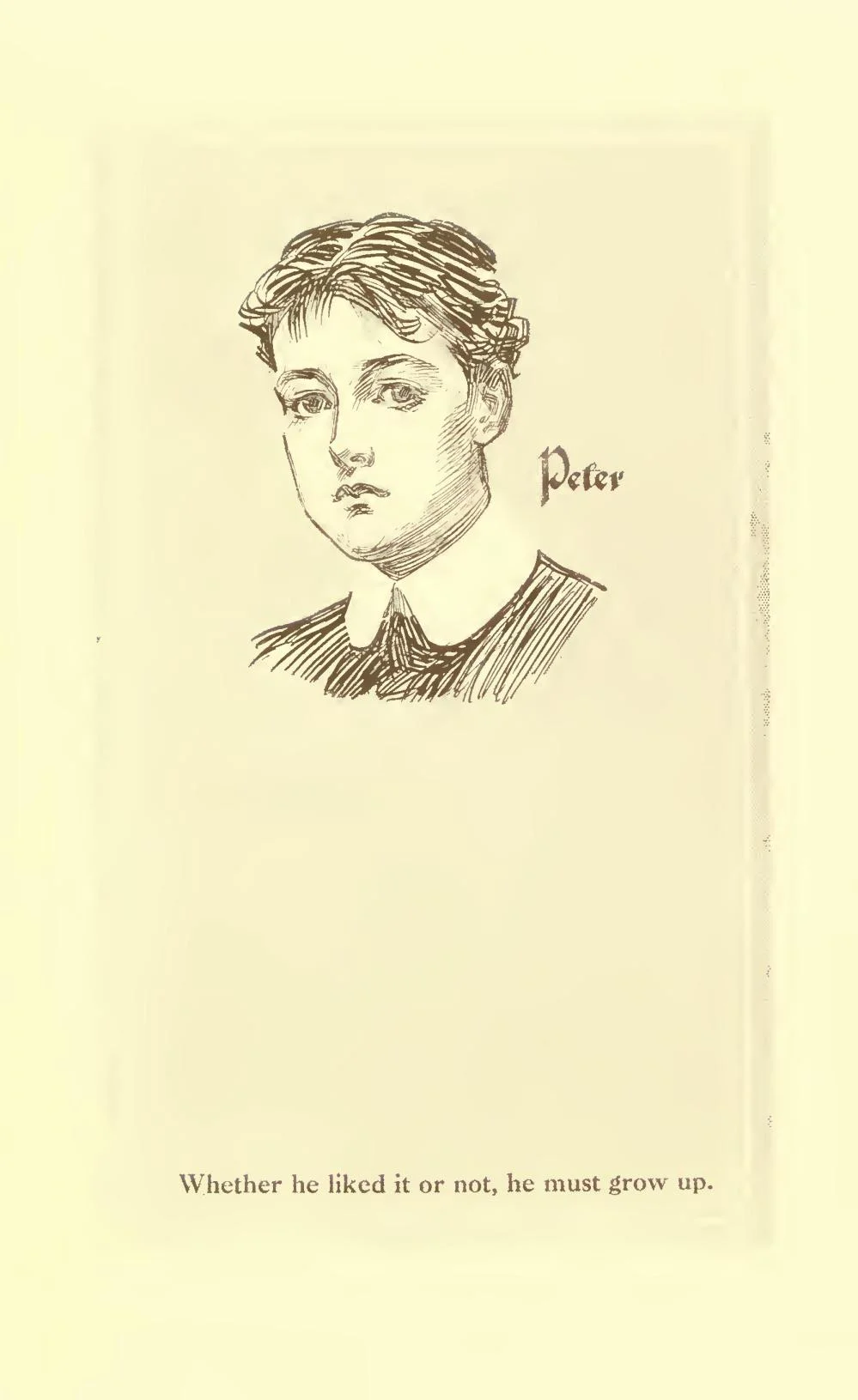

No one, looking at his childish face, would have guessed the grave suspicions and wild hazards that walked in the desperate loneliness of his imagination. It was the key to existence that he sought. He had arrived at that crisis of soul and body, when every child is driven out, a John the Baptist, into the wilderness of conjecture, there to live on the locusts and wild honey of hearsay, till he finds the fruit of the Tree of Knowledge.
As they neared the suburbs, a stream of bicyclists—city clerks riding out with their sweethearts—met, engulfed and gave them passage. After all, it was a merry, laughing world! Above the tinkling of bells, evening birds were calling. All these people, how did they live? Where did they come from? Had they, too, slept and been awakened questioning, because a girl had touched them?
Down the road he saw his aunt’s cottage. Riska would be there by the gate, sitting behind her table spread with cakes, mineral-waters and glasses. He recalled all the things he had heard said of her, things to which he had paid no attention—that she was a born flirt and that her mother was teaching her to catch men. As they came up, she lifted her soft eyes and let them rest on him with contemptuous affection. Why did she do that? Why did she always seem to despise and tolerate men and boys? A bicyclist, who had ridden past, turned his head, caught sight of her and came back slowly. Peter felt that it was not thirst, but Riska’s prettiness that had recalled him. He felt angry with Riska—unreasonably angry, for she had said and done nothing.
“We’re late,” he told her; “we can’t stop.”
She nodded. She didn’t care. Her whole attitude seemed to tell Peter that he wasn’t worth wasting time on. Just as the pedals had begun to turn, Glory came out and stood in the porch. She waved to him and shouted something. He called to her that they were in a hurry. Further down the road, he turned his head; her eyes followed him.
It was nearly dark when they reached Topbury. Lamps stood like marigold splashes on the dusk in a quivering line along the Terrace. In the garden he found his parents, sitting close together beneath the mulberry-tree like lovers. They drew apart as Kay ran up to them.
“You’re late, children.” It was his mother talking. “We were getting nervous.”
He kissed her; for a moment, the old sense of security returned.
“It’s time Kay was in bed.”
She crossed the gravel path with her arm about the little girl, and disappeared up the white stone steps to the house.
Far away, as of old, like waves about the foot of a cliff, the roar of London threatened. It seemed to be telling him that he would not be always sheltered—that one day he would have to launch out, steering in search of the unknown future by himself. It was not the boldness, but the loneliness of the adventure that now impressed him.
“Father.”
“Yes.” The voice came to him out of the darkness. “What does it feel like to become a man?”
“Feel like, Peter! I don’t understand.”
“To have to—to have to fight for oneself?”
His father leant out and touched him. “Have you begun to think of that already? Fight for yourself! You won’t have to do that for a long while yet.”
“But——.” Peter allowed himself to be drawn into the arms of the man who had always stood between him and the world. “But when the time comes, I don’t want to fail like——,” he was going to have said like Uncle Waffles, but he said instead, “like some people.” And then, after a pause, “I feel so unprepared.”
“We’ve all felt that way, sonny. Somehow we get the strength. You’ll get it.”
Peter sighed contentedly. He was again in the nest with the creeper-covered walls about him. The strained note had gone out of his voice when he spoke now. “There’s so much to learn. It seems so strange to think that one day I’ll have to grow up, like you, and marry, and earn money, and have little boys and girls.”
His father laughed huskily. “Very strange! Strange even to me, Peter—and I’ve done it: And, d’you know, there are times when even a man looks back and is surprised that he’s grown up. He feels just what you’re feeling—the wonder of it. It seems only the other day that I was as small as you are; and only the other day that I was frightened of life and what it meant. Are you frightened?”
For answer Peter stood up. “Not so much frightened as puzzled.”
His father rose and led him out from beneath the leaves, which crowded above their heads. He pointed up past the roofs of houses. “We couldn’t see them under there,” he said. “Every night they come to their places and stand, shining. Some one sends them. Some one sent you and me, Peter. We don’t know why. There are people who sit always under trees and never look up. They’ll tell you that there aren’t any stars overhead. We’re not like that. We know that whoever is careful enough to hang lamps on the clouds, is careful enough to watch over us. So we needn’t be afraid of living, need we, old chap?”
Peter pressed his father’s hand. “I’ll try to remember.”
That night, when the house was all silent, he crept out of bed. Leaning from the open window, he looked down on London, stretching for miles and miles, with its huddled roofs spread over its huddled personalities. Why were things as they were? If some one lit lamps in the heavens and followed each life with care, why did four women, who loved children, sit forever with their arms empty, while one sang of the sweet fields of Eden; and why did Uncle Waffles——-? The questions were unanswerable and endless. And then, in defiant contrast, there came bounding into his memory the courageous figure of the Faun Man, with his cavalier attitudes and strong determination to make of life a laughing affair. The night quickened; the ghostly feet of a little breeze tiptoed across the tree-tops, causing their leaves to rustle. From the far distance, the throb of belated traffic reached him like the beat of a muffled drum. He heard London marching to the martial music of struggle; his heart was stirred. Life was a fight—well, what of it? When his time came, he must be ready. He looked again at the stars, remembering what his father had said. One need not be frightened. And then he looked away into the blackness; somewhere over there the houses ended and the wide peace of the country commenced. Somewhere over there was Cherry.
He waited impatiently for his next half-holiday, when he would be free to tricycle out. When he went, she was not in the Haunted Wood; nor the next time, nor the next. He wanted to ask the Faun Man, but postponed through shyness; he was afraid his secret would be guessed. He was always hoping and hoping that he would find her behind the green wall of leaves, where the little river ran. One afternoon, when tea was ended and Kay and Harry had gone out, he asked, “Does the girl who broke your pictures never come here now?”
The Faun Man looked up sharply and stared, trying to guess behind the question.
“I wasn’t very decent to you that day, was I? And I was beastly to her.”
“I think she was sorry,” said Peter softly. “I wish you’d let her——. Does she never come here now?”
The Faun Man leant forward across the table, with his face between his long brown hands. “Did you like her, Peter?”
“Yes.”
“Very much?”
Peter lowered his eyes. “Very much.”
When he dared to glance up, he found that the Faun Man wasn’t laughing. He reached out his hand to Peter. “You’re young,” he said. “Fifteen, isn’t it? Well, she’s a year older. It’s dangerous to like a girl very much—especially a little wild thing like Cherry. I’m a man and I know, because I, too, like some one very much; and it doesn’t always make me happy. You’ll like heaps of girls, Peter, before you find the right one.” He felt that Peter’s hand had grown smaller in his own and was withdrawing. “You think it isn’t true?” he questioned. “You think it wasn’t kind of me to say that? And you want to see her?” Peter gazed out of the cottage window to where sunlight fell aslant the Haunted Wood. Why should he want to see her more than anyone in the world? But he did. And he knew that because he was so young, most people would consider his desire absurd. But the Faun Man, who found so much to laugh at, was regarding him seriously. “And you want to see her?”
Peter whispered, “Yes.”
The Faun Man’s eyes filmed over in that curious way they had. He said: “I want you to trust me. There are reasons why you can’t see her. I’ve sent her away because I think that it’s best. I can’t tell you why or where I’ve sent her; or what right I have to send her. But I want you to know that I don’t smile at you for liking her. It doesn’t matter how old or young we are; when love comes, it always hurts. And it seems just as serious whether it comes late or early. But some day I’ll let you see her. To you at fifteen, some day seems very far from now. But if you wait, and still think you care for her, I’ll let you see her when the time comes. I don’t think we ought to speak of this again till then. We’ll keep it a secret which we never discuss; but we’ll each remember. Is that a bargain?”
Peter had no other choice than to accept. They shook hands.
Shortly after this Kay and Peter went away to a farm in North Wales for their summer holidays. Their first intention on their return was to visit the Faun Man and Harry. On going to the stable, they found that the tricycle was no longer there. Their father was very mysterious and unconcerned when they told him; evidently he knew what had happened. “All right,” he said, “just wait a day or two. You’ll see—it’ll come back.”
And one morning it did come back, ridden by a man with a face all smudges, who presented a bill for payment. It had entirely transformed itself, like a widow-lady who had been brisked up by an unexpected offer of marriage. From a sober, old-fashioned tricycle it had taken on an appearance almost modern and festive. Its handle-bars had been replated; its framework re-enameled; its tall wheels cut down; its solid tires removed and replaced by pneumatics. It sparkled in the sun, as though defying butcher-boys to jeer at it. The man, with the face all smudges, wheeled it through the stable into the garden; he left it beneath the mulberry-tree, and there the children, on arriving home from school, found it.
“Why, it’s a new tricycle!”
Peter looked it over, “No, it isn’t, Kitten Kay. It’s the old one altered.”
Their mother, hearing their shouts, came out into the garden, nearly as excited herself. They had visions of spinning out to the Happy Cottage at the breakneck speed of eight miles an hour. While they clambered on to it, examined it and spotted new improvements in the way of a lamp and saddles, she explained to them how it had happened. “It’s your father’s doing. He meant it as a surprise. He thought the old tires made it too heavy, so——.”
Kay interrupted. “Oh, Peter, do let’s take it out on to the Terrace and try it.”
As they wheeled it down the gravel path between the geranium beds, they chattered of how they would surprise Harry. But Harry was fated never to see it. On the Terrace, when they had mounted, while their mother watched them from the window, they found that everything was not well. The man with the face all smudges had been wise in demanding his money before his handiwork was tested. He had cut the wheels so low that, where the road was uneven, the pedals bumped against the ground. Life had, indeed, become serious for Peter; through his father’s well-intentioned kindness, his means of communication between reality and fairyland had been annihilated. For a time it looked as though so small an accident as the indiscreet remodeling of a tricycle had lost for him forever the new friendships formed at the Happy Cottage.
But one evening a dinner was given by Mr. Barrington to a famous man whose work he was anxious to publish. Kay and Peter were allowed to see him after dessert.
The moment Peter’s head appeared round the door the famous man rose up and shouted, “Hulloa, young ‘un, so at last I’ve found you! Where the dickens have you been hiding?”
Mr. Barrington lay back in his chair, his arms hanging limp on either side, the image of amazement. He heard his son explaining: “It was the tandem trike. Father wanted to be kind to us and——. Well, after he’d had it improved, it wouldn’t work. And so, you see, there was no way of getting to you.”
The Faun Man spread out his long legs, laughing uproariously; until the appearance of the children, he’d been most scrupulously conventional and polite. “But, Peter, an immortal friendship like ours cut short by a tandem trike! You little donkey, why didn’t you write?”
Kay rose up in her brother’s defence. “He isn’t a little donkey. We were all to be pretence people, don’t you remember? We didn’t know your address.”
The Faun Man stroked his chin and lengthened his face. “If you’d left me alone much longer,” he said, “you wouldn’t have found me; I’m moving into London.”
Then their parents began to ask questions; the story of Friday Lane and the mouth-organ boy came out.
That evening, after Lorenzo Arran had said good-by, he turned back to his host, just as the door was closing.
“Oh, I say! One minute, Barrington. That matter we were discussing yesterday—let’s consider it settled.”
Barrington watched the tall, lean figure go striding down the Terrace. He was so taken up with watching, that he didn’t know that Nan had stolen up behind him until she touched his hand. He turned; his mouth was crooked with amusement. “Did you hear that? He agrees—I’m to publish for him. And it’s Peter’s doing. One never knows where that boy won’t turn up.”
And Peter, snuggled cosily in bed, was wondering whether, now that he’d found the Faun Man, he’d refind Cherry. He reflected that when life could play such tricks on you, a lifetime of it wouldn’t be half bad. He was no longer frightened to remember that, whether he liked it or not, he must grow up.
CHAPTER XXIX—A GOLDEN WORLD
And he refound her, when he had almost forgotten her. In those four long years, which stretch like a magic ocean between the island of boyhood and the misty coasts of early manhood, it is so easy to forget. Those years, between fifteen and nineteen, are the longest in life, perhaps.
They had been spent by Peter among books, watching, as in a wizard’s crystal, the dead world-builders at work; they had risen from their graves in the dusk of his imagination, stretched themselves, gathered strength and marched anew to the downfall of Troy and the conquest of befabled empires. How real those poignant religions were, telling of the loves of ruffianly gods for perishable earth-maidens—so real to him that he had paid little heed to the present.
In his outward life nothing had much altered; things were called by different names. They spoke of him as nearly a man now—servants addressed him as “sir”; they had never doubted that he was a boy once. Kay stood a few inches higher on her legs. Romance had retired from active business, leaving to her children the unthankful task of having kittens.
Just as Peter was said to be nearly a man and hadn’t changed, so the nursery was said to be his study, though it was almost the same in appearance. A student’s lamp had replaced the old gas-jet. Shelves, which had held fairy-tale volumes in which truth was depicted with a laughing countenance, now supported serious lexicons from which truth stared out with austerity. But his study retained reminders of those tremulous days when it was still a nursery, and hadn’t grown up—when it was the dreaming place of a girl whose arms were empty, in whose heart had begun to echo the patter of tiny footsteps. The tall guard stood before the fireplace, as though it feared that the long youth, who sat continually poring over a book with his eyes shaded by his hand, might shrink into the curly-headed urchin who hadn’t known that live coals burned. The laburnum still leant her arms upon the window-sill and tap-tap-tapped, shedding her golden tassels; she gazed in upon him with the same indiscretion as when he was a newcomer, with ungovernable arms and legs, who had to be tubbed night and morning. And she saw the same mother, who had sung him to sleep, peer in at the door on her way to bed, tiptoe across the threshold, ruffle his hair and whisper, “Peter, darling, you can’t learn everything between now and morning. Won’t you get some rest?”
He had exchanged tandem tricycles for lexicons as a means of locomotion to the land of adventure. His little sister could no longer accompany him; but the desire for wisdom had left room for the heart of tenderness. When his lamp shone solitary in the darkened house, he would straighten his shoulders and listen, fancying he heard the angel’s whistle.
In four months he was going up to Oxford, to live in gray cloisters where boys at once become men. His father shared his anticipation generously. “You’re going to recover my lost chances. Lucky chap!”
It was summer. He had risen early and sat by his study window reading the Iliad. The house was full of lazy morning sounds—bath-water running, breakfast being prepared, doors opening and shutting, footsteps on the stairs. Outside in the garden the sun dropped golden balls, which tumbled through the trees and rolled across the turf. Birds, hopping in and out the rose-bushes, were industriously foraging. Tripping up the gravel-path, with fresh-plucked flowers in her hands, he could see his little sister, her gold hair blowing. A tap fell upon his door. A maid, rustling in a starched dress, entered. “It’s just come, Master Peter.”
“For me? A telegram!”
He slit it open and read: “At Henley with ‘The Skylark! Can’t you come for Regatta? Cherry with me.”
Cherry with him! It was signed Lorenzo Arran. So he was keeping his promise! But why should Cherry be with him? And where had she been hiding all those long four years? So the Faun Man had taken his houseboat to Henley! It would be rather jolly to join him; but, after all, He ought to stick to his work. And this girl—did he want to see her?
The maid was waiting. A telegram at Topbury was a rarity in these days. It cost sixpence at the cheapest; therefore its use was restricted to the announcement of the extremes of joy and sorrow—births, deaths and financial losses. She showed relief when he looked up cheerily and said, “Tell the boy no answer.”
When she had gone he stood up, walked about the room excitedly and halted by the window. He wouldn’t go, of course; it would run his father into expense. Then, again he read the words, “Cherry with me.” It would be amusing to see her. He began to wonder—did she know that the Faun Man had sent for him? If she did——? His thoughts flew back across the years: he was in the Haunted Wood. The little river was singing, “Turn back, turn back, turn back.” He refused to turn back, and followed; suddenly, across the scrub-oak, he found himself gazing into the gray eyes of a girl. It was the grayness of her eyes and the whiteness of her feet that he remembered.
He leant over the table and closed the book with its unreal love-legends of gods and goddesses. “By Jove, but I’d like to go,” he said aloud.
The maid had spread the news of the unusual happening. As he entered the breakfast-room all eyes examined him. They waited for him to be communicative. At last his father said, “Had a telegram?”
Peter drew it from his pocket and passed it.
His father looked up. “‘Cherry with me.’ What does he mean by that?”
Peter raised his eyebrows, as much as to say “How can I tell?”
His father handed it back. “Are you going?”
“Costs money, and I’ve too much work.”
It was the mention of work that roused his mother. She smiled gently, and glanced down the table at her husband. “It would do him good, Billy.”
“Yes, it would do you good,” his father said. “Why don’t you go, old chap?”
“Yes, why don’t you go?” Kay echoed.
His things were quickly packed. In a flannel suit, with his straw hat in his hand, he was saying good-by on the doorstep. His father bethought him. “Here, wait a second, Peter; I’ll walk with you to the end of the Terrace.” While walking he delivered his warning, “This man Arran—personally I like him and I know he’s your friend, but——. I’ve nothing against him, but he’s a queer fellow —clever as the dickens and all that. The fact is, curious tales are told about him—all of them too far-fetched to be true. You know the saying about no smoke without fire, well——. It may be that he’s only different; but he strikes people as being fast and dangerous. Be careful; I’d trust you anywhere. Have a good time. I’ve got it off my chest—my sermon’s ended.”
At the bottom of the Crescent, to his great relief, Peter found that Cat’s Meat’s master was not on the stand. He wouldn’t have hurt Mr. Grace’s feelings for the world. He was free to jump into a spanking hansom. Cat’s Meat may have seen him; but Cat’s Meat couldn’t tell. Surely, at his age, he must have been glad to escape the long crawl to Paddington. The younger horse in the hansom stepped out gaily, making his hoofs ring smartly against the cobblestones. “Cherry, Cherry, Cherry,” they seemed to be saying. Taking short-cuts by side-roads, now following gleaming tram-lines, now dashing through mean streets, past public houses in plenty, they sped till they struck Paddington and drew up in the glass-roofed station. And then the drifting motion of the train and the unbelievable greenness of the country—the glimpses of silver water, quiet meadows and cottages in which people were born and died, and never traveled! And the holiday crowds on the platforms! The girls in summer dresses—the superb cleanness and coolness of them, and the happiness! It was exciting. The wheels beneath his carriage drummed out one word, “Cherry, Cherry, Cherry.” He didn’t know even yet whether he wanted to see her.
The train achieved the surprise of the century—it arrived early. He examined the expectant faces of the people; neither Harry nor the Faun Man was there. He refused to hang about; his legs ached to be moving. Picking up his bag, he set out to walk, hoping he would meet them.
Streets were garish—flowers in gardens, foamy toilets of women, college blazers and rowing colors, and, over all, swift white clouds and the fiercely gleaming sun. From under wide river-hats girls laughed up into men’s tanned faces. Everyone was young or, because the world was golden, seemed to be young. Peter wanted some one to laugh with. Walking down the middle of the street, the crowd moved in pairs, a man and a woman together, almost invariably. The old gray town, like Peter, looked lonely in this hubbub of jostling love and merriment.
As he came in sight of the Catherine Wheel, a distant cheering commenced. Feet moved faster. Men caught at women’s arms, and women caught up their dresses; the army of pleasure-seekers commenced to run. Because Peter was by himself he forged ahead and found a place on the bridge where people stood yelling and jammed, shoulder to shoulder. At first he could make out hardly anything, because of the sea of hats and backs in front of him. Then the crowd swayed; he took advantage of it and found himself leaning over the crumbling stone balustrade, gazing down on one of the most gallant sights in England. Through a steep bank of posies, made up of river gardens, house-boats and human faces, ran a silver thread. Approaching, with what seemed incredible slowness, were two specks about the size of matches. As the sun caught them, one saw the flash of blades, whipping the water with the regularity of clockwork. Stealthily, with infinite labor, one stole ahead. The garden of faces on either side of the silver thread trembled; a roar went up which gathered volume as it drew from out the distance. Peter pressed his lips against a man’s ear—a complete stranger—and shouted, “What is it?”
The man stared at him despisingly, “The Diamond Sculls. Roy Hardcastle again the Australian.” He turned away and paid Peter no more attention.
Peter, though not much wiser, at once became a partisan and screamed the one name he knew, “Hardcastle! Hardcastle! Hardcastle!” till his throat felt as if it had burst.
And now they were well in sight—two men with bent backs and arms that worked like levers, each seated in a machine as narrow as a needle, with long wooden legs which stuck out on either side, striding the water and keeping the balance. They looked like human egg-beaters gone mad. The river rose to its feet; the winning-post was nearing. The channel of free water seemed to narrow as skiffs, gigs, punts, dingeys and every kind of craft pressed closer to the booms which marked the course.
Something happened. Both men drooped inertly forward over trailing sculls. It was dramatic, this immediate transition from frantic energy to listless collapse. Hats were tossed up. Launches shrieked and whistled. Everyone tried to make more noise than his neighbor, Peter with the rest. “Well rowed. Well rowed, sir. Well rowed.”
When the clamor had died down he turned to where the man had been standing. “Who won?” And then, “Oh, I beg your pardon.”
He was gazing into the amused face of a girl with gray eyes and brown-black hair, that swept like a cloud across a Clear white forehead.
“Who won! Roy Hardcastle, of course. England’s not beaten yet.”
He wasn’t thinking of England’s honor; the race—it had never happened. He was looking at her mouth. They called her Cherry, because her lips were red.
She was going from him. How straight she was! How slender! Like a slim spring flower—a narcissus, perhaps. He went after her and raised his hat. “Forgive me for speaking to you. Just a minute before a man was standing there, and—-”
“That’s all right,” she said; “I understand.”
Again she was on the point of leaving. He had to make certain. “Since I’ve been so rude already, would you mind if I asked you one more question?”
She looked him over casually and seemed more satisfied that she was willing to admit to anyone but herself. “Not at all.”
He straightened his necktie nervously. “Then, can you tell me where I’ll find The Skylark? It’s a house-boat belonging to Lorenzo Arran.”
She laughed softly and stood with her eyes cast down, tapping the pavement with her foot. He was sure now. She looked up. “Where have I seen you? Somehow you’re familiar. It’s annoying; you knew me in a flash.”
“You’re Cherry?”
“Only to a few of my dearest friends.”
He glanced away from her. “You were Cherry to me once for about an hour; you’ve been Cherry to me ever since then.”
There was a long pause. “And yet I don’t know you,” she said. “You must be the friend Mr. Arran was expecting down from London.”
Peter nodded.
“He and Harry went to meet you. You must have missed each other at the station. If you like, I’ll show you the way to The Skylark; I’m going there. They’ll be wondering whether you’ve come. We’d better hurry.”
“Oh, please not yet.”
“But why not?” she asked, puzzled.
“Because I’m—I don’t know. My pride’s touched that you don’t know me. Would you think it awfully cheeky if I were to ask you to come and have tea with me first?”
She opened her parasol, gaining time while she made her mind up; and then, “I’m game. I haven’t had much adventure lately. I’m just out of a convent school in France.”
He opened his eyes wide. “Ah, so that was it!”
They entered the Red Lion and walked through into the garden. They ordered tea at a small table from which they could see the river.
“Why did you say that?” she asked.
“What did I say?”
“You said, ‘Ah, so that was it!’ You opened your mouth so wide when you said it that I thought you’d gape your head off. When I was a little girl in America we had a colored cook with a decapitating smile—it nearly met at the back of her neck. Well, your ‘Ah’ was a decapitating ‘Ah.’ Now tell me?”
“Because I’ve waited four years to find out where you’ve been hiding.”
“Four years!” She tried to think back.
He leant his elbows on the table, his face between his hands. “Seems a long while, doesn’t it? In four years one can grow up. Last time we were together you made me a promise—you said we’d meet again often in the same place. I went there and went there—you didn’t keep your word.”
She laughed. “I suppose it’s a trifle too late to say I’m sorry. I don’t suppose you minded much.” She waited for him to contradict that; when he didn’t she continued, “How much do you know about me? For instance, what’s my real name?”
He laughed in return. “You’ve got me there. All you told me was that people called you Cherry, because your lips were red.”
She sank her head between her shoulders; then she looked up flushing and pursing her lips together, like a child who wants to extract a favor by being loved. “Be a sportsman. You’re awfully tantalizing. Give me a pointer that’ll help me to guess. You know, I ought to know who you are; it isn’t good form for a girl to take tea with a strange young man.”
“Well,” he said, speaking slowly, “do you remember a day when you knocked down and walked over, oh, let’s say about twenty photographs of the same lady?”
“Do I remember!” She sniffed a little scornfully. “‘Tisn’t likely I’d forget; that was why the Faun Man sent me to a convent.”
She had said rather more than she intended. She was provoked with herself and with Peter, for the moment, because he had drawn her out. She twisted round on her chair, so that he could see only her shoulders.
Not realizing that he was being snubbed, he pushed the subject further, “What an unfair punishment! That doesn’t sound like the Faun Man. But, perhaps, you liked it. What did you do at the convent?”
“Always praying,” she answered, with her shoulders still toward him. “And, look here, don’t you say that the Faun Man was unfair. He wasn’t. He didn’t send me away only for breaking his pictures.” And then, inconsequently, “If it wasn’t too childish I’d go and smash them all afresh.”
Suddenly she swung round, “I know who you are. Hurray! You’re Peter. You see, I remember the name. Shall I give myself away and tell you why I remember?”
“Do. Do,” he urged.
The answer came promptly. “Because you paid me compliments. You thought that God said to Himself when He made me, ‘I’ll make the most beautiful person I’ve ever made.’—Hulloa! You don’t like that. It wasn’t quite what you expected. What did you expect? Until you tell me I won’t speak to you.”
Compelled by her silence, he confessed, “I did hope that you might have remembered me for something—something more romantic. You see, we met in the Haunted Wood, and there was the river, and you were going to drown yourself. You’d taken off your shoes and stockings as a first step, which was very economical of you. And I—I saw your feet, and——”
She waved her handkerchief at him, her eyes a-sparkle. “I know. I know. Very pretty and very foolish!” She rose. “We ought to be going.”
Outside the Red Lion, she turned toward the river; “I left my boat at one of the landings.”
When they had found it and he had helped her in, she said, “You can row, I suppose? All right, then, I’ll steer; you take the sculls.”
They drifted down with the stream, the gray bridge, spanning the river, growing more distant behind them; the wooded hills swimming up on every side to form a green cup, against which the sky stooped its lips. They floated by lazy craft, in which women lay back on cushions beneath sunshades and men with bare arms clasped about their knees watched them. Snatches of laughter reached them, to which the murmur of voices droned an accompaniment. On green lawns, beneath dreaming garden trees, little groups of brightly attired people clustered. From houseboats along the river-bank stole music, one air creeping into another as they passed, fashioning a medley—coon songs from America, Victorian ballads of sentiment, a wild scrap of Dvorak and the latest impertinence from London. Of all that they saw and heard, they alone were constant in the shifting landscape.
“After four years!” she murmured.
He stopped rowing and gazed at her wonderingly, repeating her words, “After four years!”
Then a familiar voice leapt out at them from a sky-blue house-boat, with sky-blue curtains fluttering in the windows and a rim of scarlet geraniums running round it in boxes. The voice lent the touch of humor to their tenderness, which saves sentiment from sadness and makes it ecstatic. It sang to the twinkling tones of a mandolin, struck sharply:
“Come, tickle me here;
For I ain’t what you thought me—
I ain’t so ‘igh and so ‘aughty, my dear.
But there’s right times for lovin’,
And cooin’ and dovin’,
And wrong ways of flirtin’
That’s woundin’ and hurtin’—
I’m a lydy, d’you hear?
But just under the neck,
Peck ever so softly—
I allow that, my dear.
Not my lips—you’re too near.
Come along, lovey; come along, duckie;
Tickle me, tickle me here.”
CHAPTER XXX—HALF IN LOVE
The Faun Man looked up from his writing. Peter had been with him on The Skylark for five days—five gorgeous days. He had found to his surprise that the golden woman was of the party. So far as outward appearances went, the picture-smashing incident might never have happened; Cherry conducted herself as a good comrade and the golden woman called her “dear.” They had to act as friends, since the Faun Man had taken rooms for them at the same hotel that they might chaperone each other. The men slept on board the house-boat.
It was nearly six. The last of the Finals had been rowed; the Regatta was ended. Far up the course one could still hear the distant cheering from the lawn where prizes were being distributed. The most sensational race of the afternoon had been the Diamond Sculls, in which Hardcastle had won by a bare half-length. Peter still tingled with the madness of the excitement, the splendid grit of the contested fight and the wildness of the applause. He had seen a slight young hero lifted out of his shell and carried shoulder-high; he wanted something like that to happen to himself so that Cherry might approve of him. He had just come from accompanying her back to The Red Lion; in an hour, when she had changed for dinner, he was going to fetch her. He had one more night before him—the gayest of them all, when the crews broke training, and then——. How often would he see her again? The gray old town would recover from its invasion, and settle back into routine and eventless quiet. Would something similar happen to his life? Nevertheless, he had one more night.
As he climbed aboard The Skylark and entered, the Faun Man looked up. “Peter, i’m tired of being respectable—I want to be vulgar.”
Peter threw himself into a creaking wicker-chair. “That’s not difficult; it’s chiefly a matter of clothes.”
“And accent,” the Faun Man added; “refined speech is the soap and water of good manners.”
Peter chuckled. “Then don’t tub.”
The Faun Man stood up and stretched himself. “I haven’t. I’ve written a love-lyric that never saw a nailbrush. It’s called The Belle of Shoreditch. When I’ve sung it to you I’ll tell you why I wrote it. Isn’t this a ripping tune?” He tinkled it over; then sat down crosslegged on the floor and commenced to drawl the words out:
“My bloke’s a moke
And ‘e cawn’t tell me why;
But the fust time ‘e spoke
‘Twas no more than a sigh.
Says I, ‘Don’t mind me; we’ll soon be dead.’
Says ‘e, ‘If yer dies, I’ll break me ‘ead.’
Says I, ‘Why not yer ‘eart instead,
Yer quaint old moke?’
“For yer cawn’t be ‘appy when yer ‘alf in love—!
Yer must taik one road or the other;
Yer can maike o’ life an up’ill shove,
Or marry a bloke wot ain’t yer brother.”
“Chorus, Peter. Pick it up.”
The Faun Man nodded the time, swaying from the hips and rolling his head.
“For yer cawn’t be ‘appy when yer ‘alf in love.”
He laid his mandolin aside. “Catchy, isn’t it? There mayn’t be much soap about the dialect, but there’s plenty of philosophy in the sense. More than one person in this party is half in love. Take example from me, Peter; don’t make a fool of yourself.”
Peter’s face went red. He didn’t think he’d been so obvious. To escape further pursuit, he turned the corner rapidly, “When are you going to start being vulgar?”
“Ah, yes!” The Faun Man came back. He struck a pose, his left hand resting on his hip, his right beating against his breast. “To-night,” he said. “To-night I lose my identity. I cease to be Lorenzo Arran and become Bill Willow, with his performing troupe of eccentric minstrels. I wear a red nose. My clothes might have been picked out of any ash-barrel.”
Peter interrupted. “From where do you get the eccentric minstrels?”
The Faun Man grabbed him by the shoulder, as though he feared he might dash away when the full glory of the project was divulged. “My boy, you’re one of them. You operate upon a bun-bag folded over a hair-comb. You wear—let me see? You wear a sheet, with holes cut in it for your eyes and mouth. Your nose may remain incognito; I’ve seen better. In a word, you play the ghost to my Hamlet.”
“And Harry and the girls?”
The Faun Man passed his hand over his forehead and reflected. “Let me see! Harry blacks his physiognomy; the mouth-organ disguises the rest of him—it always does. And as for the girls—they hang their hair before their faces and sing through it. Believe me, nothing alters a woman’s appearance so much as letting down her hair; that’s why all divorces occur after marriage. Now, with me it’s different; I look my best in bed. Of course I can’t ask anyone to see me there—that’s why I’m a bachelor.—But to get back to vulgarity; we start to-night in a punt. We’ll wait till it’s dusk, and we’ll have lanterns. We’ll collect money for the private insane asylums of Alaska. I’ll make a little speech explaining our philanthropy. Young feller, Bill Willow and his minstrels are going to make this Old Regatta rememberable for years to come.”
“You mean it?”
The Faun Man grinned; all the boy in him was up.
“Peter, don’t look so pop-eyed; of course I mean it—I mean it just as truly as Martin Luther did when he said, ‘Here I take my stand, because I’ve got nowhere to sit down.’ A profound utterance! I’m tired of watching all these people spooning under trees, wearing Leander ties, comparing their girls’ eyes to the stars and being afraid to touch each other. They’re too much of ladies and gentlemen; even we are. To-night I’m going to be a ruffian. Cut along and fetch the girls. I’ve got to write another song and it’s almost time for rehearsal.”
“A dress rehearsal?”
“In spots,” said the Faun Man.
When Peter broke the news to the golden woman she covered her face and laughed through her hands. She had a trick of treating Cherry and Peter like children, although she looked no more than twenty herself. She put her arms round their shoulders, drawing their faces close together, on either side of hers. She was so happy and beautiful it would have been difficult not to love her. “My Loo-ard!” she said, “I’d do a skirt-dance to-night if it wasn’t for the water under the punt. I’m all against getting wet, aren’t you, Cherry?”
Peter looked knowing. “The first thing she’d do if she knew she was going to drown, would be to take off her shoes and stockings.”
The golden woman pinched the girl’s cheek. “Hulloa! Secrets already!—But I don’t like Lorie’s idea for disguising us. Let’s see what we can do with five minutes’ shopping.”
When they rowed up to The Skylark they were met by a mysterious silence. Lifting out their parcels, they tiptoed into the cabin. Harry was bending over a table-cloth, with a tooth-brush in his hand and a bottle of blacking at his elbow. The Faun Man was melting the bottoms of candles and making them stick to the bottoms of empty jam-jars.
“What are you doing?”
They both looked up.
“I’m getting the illuminations ready,” said the Faun Man.
“And I’m making our flag,” said Harry, scrubbing hard at the table-cloth. “Blacking’s awful stuff; it’s so smudgy.” They crowded round him to inspect his handiwork and read:
BILL WILLOW’S
IMPROMPTU TROUPE OF ECCENTRIC MINSTRELS
NO FUN WITHOUT FOLLY ENVY THE POOR MAD
The Faun Man affixed his last candle. “Now, then, you crazy people, rehearsal’s in five minutes. Let’s fortify our tummies.”
Behind the house-boat the sun was setting; in patches, where water lay most still among rushes, the river shone blood-red. Sometimes, beneath the window, they heard the dip of oars and a boat drifted past. They were miles from reality, in a hushed and painted world. They had become little children for the moment, though the Faun Man had called it “being vulgar.” They had become immensely serious over a thing which didn’t matter. There were the words of the songs to learn, and then the tunes. After that there were the cretonnes to cut out and run together into burlesque night-gowns, extremely ample so as to cover their proper dresses. The golden woman had surprised a prim widow in Hart Street by asking for “The ugliest materials you have in your shop.” She had met with success; no materials could have been uglier. One had a straw-colored background, strewn with gigantic poppies; across another floated, in a kind of sky-blue gravy, the unbarbered heads of bodyless angels. The Faun Man and Peter, when their needles lost the thread, gave up sewing and fastened theirs together with paper pins. And all the while beneath the absurdity of it there was an atmosphere of tenderness, as if folly had brought them all nearer. The Faun Man kept watching the golden woman; and Cherry the Faun Man; and Peter, Cherry. As for Harry, he was the only one whose eyes were free to take in everybody.
When night had fallen they slipped on their masks and stepped into the punt. Harry took the pole and pushed off from The Skylark. The Faun Man sat next to the golden woman, humming snatches of song beneath his breath, to which he picked out an accompaniment on the mandolin. She lay back gazing up at him.
Above a wooded knoll the moon rose, setting the river a-silver. Trees knelt along the banks like cattle, stooping to drink. In the distance the bridge leapt the chasm of darkness and lights of the town sprang up. Like a fleet of dreams against green wharfs of fairyland, illumined houseboats shone fantastic. Chains of lamps, strung through boughs of gardens, gleamed like jewels on the throat of the dusk. The river sang incoherently, in a voice that was half asleep. Peter slipped his hand into Cherry’s; her hand seemed quite unconscious of what he was doing.
And now they drew near to the crowd of pleasure-craft, which jostled one another and beat the water like a run of salmon in shallows. Harry laid aside the pole and took to the paddle. They lit their candles and flew their heraldry. In their disguises no one would know them; with the restraint of their identities lifted from them they scarcely recognized themselves. The Faun Man gave the word; the punt was allowed to drift. They all struck up:
“Go h’on away. Go h’on away.
Mind yer, I’m meanin’ wot I say.
My ‘air and ‘at-pin’s gone astray—
Stop yer messin’.
A pound a week yer earn yer say—
Oh, I don’t fink!- Two bob a day’s
More like. I loves yer. Yer can stay,
Yer bloomin’ blessin’.”
They tickled the people’s fancy; they were so obviously out for a lark and so evidently intended to have it. When “My bloke’s a moke” was sung, from bank to bank the chorus was taken up; even the strollers, hanging over the bridge, caught the swing of it.
“For yer cawn’t be ‘appy when yer ‘alf in love—
Yer must taik one road or the other;
Yer can maike o’ life an up’ill shove,
Or marry a bloke wot ain’t yer brother.”
The Faun Man turned to the golden woman and addressed the words to her shamelessly. He put his arm about her, and drew her head down against his shoulder. Through the slits in her mask her eyes gleamed up. Peter, watching, wondered why it was that she would only be kind to him in fun; he had noticed that, when the Faun Man was in earnest, she never responded.
They had been singing for an hour, pushed this way and that, too jammed to attempt steering. Their punt had drifted near a house-boat, all a-swing with lanterns and steep with flowers. Through the windows they could see that a dinner had just ended; tall young men in evening dress sprawled back in chairs. Corks were still popping.
The Faun Man whispered, “They’re one of the crews breaking training. What’ll we give ‘em? Oh, yes, this’ll do. Tune up.” So they tuned up:
“If yer gal ain’t all yer thought ‘er,
And for everyfing yer’ve bought ‘er
She don’t seem to care a ‘appenny pot o’ glue;
If she tells yer she won’t miss yer,
And she doesn’t want ter kiss yer,
Though yer’ve cuddled ‘er from ‘Ammersmif ter Kew;
If yer little side excurshiums
To lands of pink nasturtiums
Don’t make ‘er ‘arf so soft as they make you,
Why, never be down’earted,
For that’s the way love started—
Adam ended wery ‘appy—and that’s true.”
The young men had come out. They were slightly unsteady; some of them found difficulty in keeping their cigars in their mouths. They held one another’s arms and laughed loudly. Their faces were flushed and their hair ruffled. But, for all that, because they were young and had done their work gamely that afternoon, they seemed in keeping with the atmosphere of carnival. A voice on the edge of the darkness shouted one word, “Hardcastle.” The crowd stood up in their boats, and commenced to cheer. From the group of crewmen one tall fellow was pushed forward and lifted on a chair. He looked slim as a girl in his evening-dress; his thin, rather handsome face, wore a weak, inconsequential expression. When the babel of voices had died down he spoke thickly and hesitatingly. “Yes, I won. I dunno. Did I win? I can’t remember. Suppose I must have. One of you chaps tell me to-morrow.—Anyway, if I did win, here’s to the losers. Plucky devils!”
Cherry had been leaning forward; her mask had slipped aside in her eagerness. Hardcastle saw her. He stared—made an effort to pull his wits together. In a second he had jumped from the chair, had caught her by the hand, was helping her aboard the house-boat. She held on to Peter, laughing and dragging him after her. The others followed reluctantly—after all, they were out for adventure.
As soon as he had entered the cabin, Hardcastle slipped his arms about her and swung her up on to the table amid the clatter of breaking glasses. “Sing, you little beauty. Sing something.”
The Faun Man pushed his way forward; the matter was going beyond a joke—his intention was to stop it. The golden woman clutched him, “Don’t make a row, Lorie, They don’t know who we are. We’ve let ourselves in for it; let’s go through with it like sports.”
Cherry seemed not at all offended; the spirit of bacchanalia possessed her. Her usually pale face had a pretty flush. She stood tiptoe, her red lips pouting, watching through the slits in her mask these fine young animals whom the river had applauded. Her eyes came back to Hard-castle. “I don’t want to sing.” It was like a shy child talking. “If you like, I’ll dance.”
In a trice Hardcastle had lifted her again in his arms. To balance herself she had to cling to his neck and shoulders. “Clear the table,” he shouted.
With his free hand he commenced tugging at the cloth. Others helped him. With a jangle and smash that could be heard across the river, silver, glass and lighted candles were swept to the floor. He set her back on the polished surface and ran to the piano in the corner, crying, “I’ll tickle the ivories—you dance.”
With his head turned, he played and watched her. From the ruin she had caught up a red rose and held it between her red lips by the stalk. Her feet began to move, slowly at first—then wildly. She swayed and tossed, glided stealthily, bent and shot upward like a dart. Her breath was coming fast—all the while her gray eyes sought the man’s who watched her across his shoulder. The other men were infected by her madness—they took hands and circled the table, singing whatever came into their heads. To Peter it was torture. He thought that she knew it. He guessed that she had done it on purpose. He had wearied her with his respect He remembered one of the Faun Man’s sayings, “No woman likes to be respected; she prefers to be loved, even by a man whom she doesn’t want.”
The piano stopped. Hardcastle leapt up. “Here, I want to see her.”
“No. No,” cried Cherry.
“I do, and I will,” he retorted. He had stumbled against the table and caught her by the knees; his hands were groping up to tear aside her mask. An arm shot out; he staggered. Another blow struck him between the eyes. He measured his length on the floor. Peter dragged Cherry to him, pressing her against him. All was hubbub. The Faun Man and Harry were on either side of him, forming a guard. Of a sudden the lights went out—some one had knocked over the lamps. In the darkness the sound of scuffling subsided. The Faun Man’s voice was heard, saying, “Look here, you chaps, that wasn’t very decent of Hardcastle. He’s drunk, so we’ll say no more about it. But you’re gentlemen. Let us out. We’re going.”
As they stepped into the night, Cherry felt warm lips touch her forehead. She heard protesting voices, and one which whispered, “You get off with her. We’ll follow.” The punt stole out into the darkness of the river. When she lifted her head from the cushions she found that the ripples on the water were a-silver, and that a solitary figure was seated in the stern, paddling.
CHAPTER XXXI—A NIGHT WITH THE MOON
He was taking her in the wrong direction. Why? To reach the Red Lion he should have steered upstream. Far behind, chiseled out by the moonlight, the town stood sharp against the star-strewn sky—sagging roofs, twisted chimney-pots and tall spires. From its walls came the shouts of roisterers and the sound of discordant singing, which broke off abruptly, only to commence again more faintly.
She was inclined to be penitent. She was both annoyed and amused with herself for what she had done. On the spur of the moment she was always doing wild things like that to people she cared for—doing them that she might measure their love by her power to hurt them. She wondered whether he blamed her, and how long he would keep silent.
The river had become a pathway of ebony, inlaid with silver by the moonlight. Along its banks illuminations smoldered, scorching red wounds in the shadows. Here and there a candle flared, sank and died, like a heart which had broken itself with longing. Craft drifted like logs through the blackness. They seemed deserted, unpiloted; yet they bore with them the sense of lips that whispered against other lips and of hands that touched. “To-morrow!” everything seemed to say. “To-morrow! But there is still to-night.”
To-morrow lovers would have vanished. Faces, which in the past week one had learnt to recognize, about which one had built up fancies, would be seen no more. The haunting poignancy of parting was in the night, the memory of things exquisite and unlasting.
And Peter, he couldn’t understand what had happened to him. It seemed a dream from which he was waking; he wanted to sleep again and recapture the illusion. From the first he had recognized an atmosphere of danger in her presence. She was so foreign to his experience; it was scarcely likely that a friendship with her would lead to happiness. And yet he could not do without her. On those sunlit mornings aboard The Skylark, when he had opened his eyes to hear the river tapping, had looked out of his window to see the breeze whipping the water and the plumed trees nodding, there had been no rest in the day’s gladness till he had heard her tripping footsteps. She had crept into his blood. All past things were unremembered—past ambitions and past loyalties. Every beauty grouped itself about her. The grayness of her eyes drew his soul out. The soft, slurring notes of her voice were for him the finest music. Had he been offered the joy of one month with her, for which all the years of his life should be forfeit, he would willingly have accepted. The thought of marriage had already occurred to him. That he should be only nineteen was a tragedy. Would she wait for him? With no more than a week’s acquaintance by which to judge he knew that she would wait for no one. She was elusive—one moment a child, the next a woman. And she sat there gazing at him through the shadows, her hands folded meekly on her breast—a nunlike trick which she had learnt at the convent. It gave her an appearance of piety, which the red defiance of her mouth and gray challenge of her eyes negatived. She was the first woman he had loved. He loved her uncalculatingly, with his soul and body, as a man loves but once, when he is young.
They had passed The Skylark and were nearing the island. All the other boats were left behind. Her voice came to him throbbingly, like a harp fingered softly. “You’re disappointed in me. You’ll often be disappointed.”
He could not bear that she should blame herself. He drew in his paddle. “I’m not, only——”
“Only what? A man always says ‘only’ when he’s trying to deceive himself.”
“Only, why did you do it?”
She didn’t answer his question. How could she tell why? Because she was young; because she knew that she was pretty. “You looked splendid,” she said, “when you struck him.” And then she mentioned the one thing concerning which he, as a man, would have kept silent. “You kissed me, Peter.”
His blood quickened. Was she reproaching him or simply saying, “You love me; we’re alone together?” She was leaning forward now, looking away from him, her throat resting against the back of her hand. He crept toward her, knelt at her feet and pressed his lips against her dress.
Her eyes came back to him. “You’d better go away and forget me.”
He slipped his arm about her body, drawing her to him. “Do you want me to go away—to go out of your life forever?”
“No.” The word was whispered and slowly uttered. She touched him gently, patting his hand. “Peter, I’m not your sort. You know that.”
“But you are my sort, or else how could I feel—feel what I am feeling? You’ll learn to love me, Cherry.”
She took it without a tremor, this declaration which had cost him such effort. She shook her head. “The Faun Man tells Eve that every time they’re together. I wonder how many men have said it. Love comes in an instant. You can’t learn it.”
“But why not?”
She bent over him like a mother. Her mouth was rounded; no wonder they called her Cherry. She was adorable in compassion. “You don’t know me. I’m not at all what you think. Ask the Faun Man. Don’t you remember at the Happy Cottage? It wasn’t for breaking his pictures that he sent me to the convent.”
“But I’ll make you love me,” he insisted. “You don’t know what I’d do for you. I’d die for you, Cherry. There’s nothing about you that I don’t worship. You’re so long and sweet—and———” He laid his face against her cold, white cheek and caught his breath. She was like marble; he could feel no stir in her—and his every nerve was throbbing. “Don’t you like to be loved?”
She seemed to marvel at his passion, as if it were a thing which she did not understand, by which she was puzzled. Oddly, to his way of thinking, she showed no terror of him. Her eyes dwelt on him with clear and kindly interest. “Every girl likes to be loved. But that’s different. I don’t think you’ll ever teach me, Peter. And yet——. Hadn’t we better be getting back?”
“Oh, not yet.” He felt that he was going to lose her—lose her forever. Surely, surely he could rouse her to a sense of the poetry and drama which was burning in his blood. It was impossible that she should not feel it. She had been sleeping, as he had been sleeping, letting love go by with its banners and drums. “Oh, not yet,” he pleaded; “all these years we’ve lived—we’ve hardly ever been together.”
She broke the suspense by laughing. “What’s your favorite hymn, Peter?”
He was puzzled. “Haven’t got one. Never thought about it. What makes you ask?”
She wriggled her shoulders. “Because mine’s ‘Yield not to temptation.’”
He didn’t catch the significance of her remark. She saw that. “Still a little boy, aren’t you? A little boy of nineteen, who thinks he’s in love. There are heaps of other girls in the world.—Yes, I’ll come.”
He piled the cushions for her; then took the paddle and seated himself so he could face her. Their conversation was carried on by fits and starts, with long pauses.
“He was a beast.” She spoke reflectively.
“Who was?”
“Hardcastle.”
“But I thought—I was afraid you liked him.”
She trailed her hand in the black water, watching how it slipped through her fingers. “I did like him for the moment. That proves I’m not nice. Women often like men who are beasts.”
“But you don’t like him now?”
She teased him, keeping him waiting. “I’m glad you struck him.”
Presently she said, “Peter, I’ve been thinking, why can’t we have good times together? We could be friends and—nothing serious, but more than exactly friends. Lots of girls do it.”
Peter stopped paddling. “I should have to love you. I should be always hoping that——”
“Then it wouldn’t be fair to you,” she said.
He had been silent for some minutes. “Where did you learn so much about men? I know nothing about women.”
“Where did I learn?” she laughed. “Girls know without learning. Until to-night no man ever kissed me—not the way you kissed me. So you needn’t be jealous.”
The punt nosed its way among rushes and came to rest. He crouched against her feet, holding her hands, trembling at her nearness. The deep stillness of the night enfolded them. Reeds stood up tall on every side, shutting out the world. Above their heads a flock of fleecy clouds wandered, with unseen shepherds swinging stars for lanterns. The man in the moon looked out of his window with a tolerant smile on his mouth. She lay against the cushions, white and impassive, her long, fine throat stretched back.
“Peter,” she said, “look up there; those clouds, they don’t know where they’re going. Someone’s driving them from one world to another, like sheep to pasture. We’re like that; someone’s driving us—and we don’t know where we’re going.” And then, “You love me, with all your heart—yes, I believe that; and I—I love someone else. We each love someone who doesn’t care; and I have to let you do it—I, who know the pain of it. Poor Peter, what a pity God didn’t make us so that we could love each other.”
And again, “I don’t know any man in the world with whom I’d trust myself to do what we’re doing. Oh, I don’t want to hurt you, Peter. If ever I should hurt you, you’ll remember?”
He couldn’t speak—didn’t want to speak. He and she were awake and together, while all the world slept—that was sufficient.
How still it was! He could hear the soft intake of her breath and the rustle of her dress. “So this is love!” he kept saying to himself. It wasn’t at all what he had expected. It wasn’t a wild rush of words and an eager clutching of hands. It wasn’t an extravagance of actions and language. It was just tenderness. He unbent her fingers, marveling at their frailness. He pressed the palm of her hand against his mouth. He felt like a little child as he sat beside this silent girl.
Cherry lifted herself on the cushions. She gave him both her hands.
“What is it?”
She seemed afraid. When she spoke, her voice trembled. “When two people are married, is it always one who allows and one who loves? You don’t know; you can’t tell me. If both don’t love it must be terrible. I couldn’t bear only to give everything; and only to take everything, that would be worse. Oh, Peter, I have to tell you. It was like that with my mother. She couldn’t give everything to my father, and then—she found someone else. My father worshiped her—just as you’d worship me, Peter; when he knew that she was going away from him he—he kept her.” She covered her face. “He was hanged for it. And that’s why the Faun Man——. He was his friend. Oh, I’m afraid of myself; I almost wish we’d never met.”
He held her to him; she was shaken with sobbing. Suddenly he recalled how he had first seen her, rushing out of the Happy Cottage, with her brown-black hair tumbled about her white face and her gray eyes wide with tragedy. She was so wilful, and she so needed protection.
“Cherry, Cherry. Don’t be frightened. Don’t cry, dear. I love you. Nothing like that could ever happen to us.”
She stared at him. “Nothing like that could ever happen! I expect they said that.”
They! They! And was it they who had called her Cherry, because her lips were red?
Her eyes closed. Her lashes were wet; beneath them were shadows. He gazed on her, clasping her to him tenderly, as though she were a bewildered bird which had flown blindly into his breast. Her breath came softly. He thought her sleeping and kissed her mouth; her hand sought his and lay there trustingly.
What pictures he had of her! He saw her dancing before the flushed and foolish faces of those men; he saw her as he had met her on the bridge in her cool, blowy summer dress; he saw her in the Haunted Wood, where the little river ran, bidding him turn back. Because of what she had just told him, he felt that he had never loved her until now.
Like a counterpane tucking in the sleepy stars, the mist of dawn crept up. Near into the bank, behind the wall of rushes, a moor-hen was splashing. The countryside whispered with creature sounds. A bird was calling. How long had it been calling? An owl flew over his head, in haste to keep pace with the retreat of darkness. Along the east, above the spears of the reeds, a little redness spread. A thrush tried over a few staves. Before he had burst in song a perky blackbird was piping valiantly. The fields fluttered, as though a messenger ran through them, telling wild-flowers to raise their heads. The east smoldered higher; conflagration smoked sideways and upward. A door opened in a cloud; the sun stepped out. Like the unhurried crash of an orchestra the world shouted. It happened every morning while men slept. It was stupendous—appalling.
How white she was! He bent over her. Her eyes opened. She gave his arm a little hug. “Were you kissing me, Peter? You mustn’t, mustn’t love me like that.”
Ah, mustn’t! It was too late to forbid him. The insanity of the night was all forgotten; only its sweetness was left. From his window the man in the moon looked down; his mouth seemed to droop at the corners. He would watch for them next night, and they would not come. He might never know the end of their story. He was despondent; he had to go to bed.
Peter was chafing her hands.
“How good you are!”
“Not good. Only in love.”
And she, “I dreamt of you. We were in the Haunted Wood. My feet were bare, and——”
He held her eyes earnestly. “I wish I had been there. All these years it was the grayness of your eyes and—and something else that I remembered.”
“What else? No, tell me.”
“The whiteness of your feet,” he whispered.
Again they were in fairyland. Yellow as a topaz set in turquoise the sun stood free in the heavens. Inhabitants of the fearless morning went busily about their tasks. Clear as a mirror, through the perfumed stillness of meadows the river ran. Mists curled from ofif its surface and hung white in tree-tops. Within hand-stretch fish leapt; peering over the side of the punt, they could follow their retreat through waving weeds and black willow-stumps. Only a magpie noticed their passage and became interested, fluttering from bough to bough and asking them, “What d’you want? What d’you want?” Dragon-flies ventured forth as the sun’s heat strengthened; butterflies and the teeming insect world rose out of water-lilies and foxgloves—out of the destructible homes which Nature builds for their brief and perishable existence. He and she, drifting through the golden quiet with clasped hands, seized their moment unquestioningly, and were thankful for it.
Ahead they saw swans; then cattle wading knee-deep. Rounding a bend, they came in sight of a trellised garden, with green tables set out on a close-cut lawn. Boats swung idly in the stream, tethered to a landing. In the background was a thatched house, from whose chimney smoke waved back in a thin plume. When they came near enough they made out a white post, with a sign swinging from it. On the sign was depicted a brown bird, fluttering its wings in a golden cage; painted over it were the words, The Winged Thrush. In lifting their eyes to read the sign they caught sight of the faint moon, weakly smiling, as though saying, “I’ve got to go. They won’t let me stay. Goodbye, and good luck.”
They landed, leaving their foolish disguises in the punt. Through the dew-drenched wistfulness of summer roses they approached the inn, and entered. The room was strewn with sawdust, and stale with the smell of beer and tobacco. An ostler-like person, with a full-blown face and little blue pig’s eyes, met them. They asked for breakfast. He knew his business well enough to suggest that missie would prefer to have it in an arbor.
While they ate he hovered round them, continually inventing excuses to interrupt their privacy. He reminded them of the magpie in his frank display of curiosity. He informed them that trade was wery bad. He’d ‘arf a mind to try ‘is luck in Australy. If it weren’t for the young bloods from Henley, he’d ‘ardly take a ‘appeny from month to month. Did they know of anyone, an artist chap for h’instance, who’d like to combine pleasure with business by tryin’ his ‘and at runnin’ a nice pub? An artist chap could paint that bloomin’ bird out, and call the place The White Hart or somethin’ h’attractive. Whoever ‘eard of an inn payin’ which was called The Winged Thrush? People didn’t want their meals messed about by a bloomin’ poet. Not but what the sitiyation was so pleasant that he’d tried to write poetry ‘isself—love-poetry for the most part. His verses allaws came to ‘im when ‘e were groomin’ the ‘orses. If things didn’t brisk up, ‘e’d give Australy a chance, as ‘e’d many times promised.
At last he left them. Cherry gazed out dreamily across the river. “I wonder, is it true that one has always to pay with sorrow for happiness?”
Peter shivered. How old she could be when she chose to borrow other people’s disillusions! He tried to restore her to cheerfulness. “What a pagan notion! It’s the old idea of the gods being jealous. You shouldn’t think such thoughts.”
“But happiness does bring sorrow,” she insisted. “We shall have to pay for this to-morrow, and to-morrow, and to-morrow.”
Her voice trailed off, giving him a vision of all the tomorrows when he would be without her. And he wasn’t sure of her. She had told him that she didn’t love him. He drew her closer. “But a sorrow’s crown of sorrows is to have no happier things to remember—to be old and never to have been young, to be lonely and never to have been loved. You mournful little person, do you think you’d be any happier because you’d never known happiness?”
“I don’t know.” She shrugged her shoulders with a touch of defiance. “I’m not clever; I can’t argue.” Then, her face clearing as suddenly as it had clouded, “I can’t think why you like me, Peter.”
He laughed gladly. “And I can’t tell you, Cherry. It’s as though I’d waited for you always, without knowing for whom I was waiting. I was a kind of winged thrush in a golden cage; but you’ve opened the door, now you’ve come.” His explanation wasn’t sufficient. She snuggled her chin against the back of her hand and watched him seriously, as though she suspected him of hiding something. “But what is it that you like most about me?”
He tried to discover; he dug back into his own sensations. What was it that he liked most about her? For the life of him he couldn’t put it into language. Then he thought he might find out by examining the white face, with the red lips and tragic eyes, of the girl-woman who had asked the question. What an uncanny faculty she had for stillness! A sunbeam, falling from the leaves above, crept up her slender throat and nestled in her hair.
He shook his head. “It’s just you, Cherry. Your voice, your eyes, the way you walk, the way you try to be sad. It’s just you and your sweetness, Cherry. I think if I didn’t love you so much I could say it better.”
She stood up. “You poor boy, you’ve said it well enough. I wish I could feel like that.—And now we should be going.” They had stepped outside the arbor; they halted at the sound of voices. Coming round the bend was a scratch eight, the oars striking the water raggedly. The men were joking and laughing; the cox, a pipe hanging from his mouth, was urging them to spurt with humorous insults. Having landed, they tumbled into their sweaters and came strolling through the garden. They were discussing the previous night in careless voices.
“Did you hear about Hardcastle?—When he isn’t in training he’s always like that. Ugh! At six o’clock a hero—by midnight a swine you wouldn’t care to touch.”
The voices passed out of earshot.
Cherry turned to Peter, “And I let him touch me. I’d have known by instinct if I’d been nice. Oh, Peter, you mustn’t love me.”
When he attempted to kiss her she refused to allow it, saying, “I’m not your sort.”
Paddling back between flowering banks, where trees cast deep shadows and birds sang full-throatedly, she again became tender. “Life’s just a yesterday, Peter—a continual bidding good-bye and coming back from pleasures.”
Her sadness hurt him. She knew it; she told herself that it would always hurt him. He didn’t want ever to say good-bye to her. And she, she felt sure that their comradeship would be always finding a new ending.
“Cherry, darling,” he reproached her, “don’t go in search of unhappiness. Life’s a to-morrow as well as a yesterday; it’s full of splendid things—things which aren’t expected. We’ve all the to-morrows before us.”
She trailed her hand in the water, snatching at the lilies, as if by an effort so slight she could delay their progress and prolong the present. She didn’t lift her eyes when she whispered, “I was thinking of that—of all the to-morrows before us.”
Again her words brought a vision of the long road of future days, down which he would walk without her. There was nothing to be said. Surely she would learn to love him! Reluctantly he paddled forward to their place of parting.
CHAPTER XXXII—IF YOU WON’T COME TO HEAVEN, THEN——
The train swung down the shining rails and rumbled into Paddington. Passengers pulled down their parcels from the racks, jumped out and disappeared in the crowd. Peter sat on. This carriage at least had known her; she had looked in through its window and had waved her hand. Out there in the stone-paved wilderness of London there was nothing they had shared.
A porter looked in at the door. “Train don’t go no further, sir. Lend you a ‘and? Want a keb?”
In the cab, Peter closed his eyes, shutting out the cheerful grime of streets, the nipped impertinence of Cockney faces, the monotonous anonymity of the ceaseless procession—the stench of this vast human stable where lives were stalled and broken. He was trying to get back to green banks, to a river molten in the sunset, and to a redlipped girl.
Was she thinking of him? If they thought of one another at the same moment, could their thoughts meet and interchange?—But she didn’t love him. Oh, the things he had left unsaid—the things he would say to make her love him now, if she sat beside him!—She had spoken truly—happiness had to be paid for with sorrow. His share of the paying had commenced, and hers——? Would she dodge payment by forgetting? The law of change was cruel; it diminished all things, even the most sacred, to mere incidents in a passing pageant. A pigmy charioteer, with the futile hands of imagination, he was making the old foolish endeavor to rein in Time’s stallions.
He pictured himself as painted on a frieze with her in the moment of their supreme elation—the moment when attainment had been certain, just before it was realized. The frieze should represent a meadow in the early morning, a river with mists rising from off it, and a boy, stooping his lips over the naked feet of a girl. Someone else had uttered the same fancy:
“Fair Youth, beneath the trees, thou canst not leave
Thy song, nor ever can those trees be bare;
Bold lover, never, never canst thou kiss,
Though winning near the goal—yet do not grieve!
She cannot fade-”
She cannot fade. Already it seemed that the sharp edges of his memories were lost to him. How was it that her face lit up? How did her voice shudder and slur from sudden piping notes into tenderness? How——? Things grew vague—he had meant to treasure them so poignantly. Like a dream from which, against his will, he was waking, Illusion gathered in her skirts from his clutching hands, growing faint against the background of reality.
The waking had commenced before he left Henley. On his return to The Skylark he had found a note waiting him. It had been forwarded from Topbury. His name and address were printed, evidently to disguise the hand of the sender. Inside, on a half sheet of note-paper, was scrawled:
“For God’s sake meet me. Seven o’clock at the bottom of the Crescent. I’m lonely.”
It was signed with the initials, O. W.
So he was out of jail! Looking at the date of the postmark, Peter had discovered that for two nights the man who was lonely had waited. In the four and a half years since he had vanished from the living world his name had been scarcely mentioned. At Topbury the effort had been made to blot out disgrace by forgetting. Jehane, when she had left Sandport, had purposely dropped her old acquaintance and had passed among recent friends as a widow. The fiction had been so earnestly cultivated that it had seemed almost true that Ocky Waffles was dead—true even to Peter and Glory. Now, like the remembered tragedy about a death-bed, when the hands had been long since folded, flowers placed upon the breast and the coffin carried out, the dead man had come back to die afresh. To say that Peter resented his return would be an exaggeration. But he shrank from the intrusion of the sordid past upon the golden poetry of the present—shrank from it as he would shrink from meeting someone hideously marred in a gay spring woodland.
The cab wheels caught in the tram-lines and jerked him into consciousness of his whereabouts. They had turned into the High Street. In three minutes they would be at Topbury Cock, and then——. Already in the distance he could see where the plane-trees in the Fields commenced. What should he do if his uncle were standing there? His father’s house? No. He raised the trap in the roof. “When you come to the bottom of the Crescent walk your horse. Understand?”
Shops were closing. Girls and men were pouring out on to the pavement, meeting with a quick flash of eyes and strolling away together. Some of them boarded trams, going up to Highgate to breathe the evening air. The sun was setting.
The horse slowed down. At the corner a crowd was gathered about a band. People were singing. Peter caught the words:
“If you won’t come to Heaven
Then you’ll have to go to Hell;
For the Devil he is waiting,
But with Jesus all is well.
Though your sins be as scarlet,
He will wash them in His blood;
So hurry up to Jesus
And He’ll make you good.
Hallelujah!”
Grace was standing in the middle of the circle banging on her drum, her mouth wide open in her big poke-bonnet. On the cab-stand, lolling on his box, pretending to be half asleep, sat Mr. Grace. His daughter’s eyes were on him.
Peter scanned the crowd. It was composed of idlers, onlookers and scoffers, with a sprinkling of converts. The converts were noticeable by their pale, indignant enthusiasm.
At first he saw no one who attracted his attention, and then——. A man with dejected shoulders was crouching in the gateway of a house. He seemed to be trying to be unobserved. His clothes were shabby—out of fashion. His linen was soiled. It was the dirty white spats above his unshone boots that made Peter notice. He told the cabby to wait for him.
He walked by the man once. In passing he noted the total slovenliness of his appearance, the unkempt hands, the defeated air and the hat jammed down to hide the close-cropped hair. He turned back and was repassing. Like a whipped dog the man raised his eyes; then instantly lowered them. Peter held out his hand; his throat was too choked to say anything. The man seemed about to take it; then slunk back.
“You don’t want to know me.”
“I do. If I hadn’t, I shouldn’t have come. I’m——I’m awfully sorry.”
“If you won’t come to Heaven, then you’ll have to go to hell,” sang Grace and her followers; it sounded as though they were passing sentence.
To the driver’s amazement, Peter helped him into the hansom. “Trot us round for an hour or two,” he said.
“If you won’t come to Heaven, then you’ll have to go to hell.” The singing hurled itself after them—seemed to be running and to grow out of breath as they drew into the distance.
They set off through Holloway. They reached the foot of Highgate Hill and had not spoken. Ahead blazed the dome of St. Joseph’s, catching the redness of the sinking sun. The cabby asked for further instructions. “Go up the hill and out to Hampstead.”
Waterlow Park brought a breath of country; children were laughing and playing there. The sternness of the city, like the brutality of just judgments, was dropping away behind them. Streets took on a village aspect. Over to the left, within sound of the living children, lay the stone-garden where little Philip rested. The horse clambered slowly to the top of the ascent.
Peter touched the knee of the man beside him. “I’m glad you sent for me. It’s—it’s a long time since we met. I mean—what I mean to say is, you might have forgotten me. I’m glad you didn’t.”
“A long time since we met!” The dull eyes stared at him as lifelessly as through a pair of smoked glasses. “I’ve been buried. They’d better have dug a hole for me.”
The man paused and looked from side to side stealthily. He had the hoarse prison voice which whispered and cracked. It was painful to see how he cringed and shrank. He pulled himself together and laughed huskily. “They didn’t let us speak in there.” He spoke reflectively, as if to himself. “Silent for more than four years! Strange to be back!”
They were bowling down a smooth road. To the right were cricket-fields and boys at the nets. Across the blue stillness of evening came the sharp “click” of balls against bats.
“So this is Uncle Waffles! So this is Uncle Waffles!” Peter kept saying to himself. His thoughts searched back, trying to trace a resemblance between the irrepressible, joking companion of his childhood and this mutilated scrap of humanity. The low-pitched voice crawled on like the sound of dragging footsteps. “I couldn’t have done anything bad enough to deserve that. If I’d only known that someone outside was caring. There were no letters, no—no anything. Just to get up in the morning and to work, and then to go back to bed. Sundays were the worst—there wasn’t any work.—And then they opened the gates and shoved me out. I couldn’t think of anyone but you, Peter.”
Peter made an attempt to cheer him. “You could have thought of someone else.”
The man shook his head.
“Oh, yes, but you could. There was Glory.”
“Glory!” He showed no animation. “She’s eighteen, isn’t she? No, Glory wouldn’t care. But Jehane, how is she?”
Peter had feared that question. “She’s well.”
The man looked away. “She won’t want to see me. She never loved me. D’you think she’d let me see her, Peter?”
“I’m afraid—afraid she wouldn’t. She’s thinking of Eustace, and Moggs and Riska. But Glory—I’m sure Glory——-”
“Ah, Glory! She’s forgotten me. And Jehane, she never thought of me; it was always of the children.”
His voice fell slack with utter hopelessness. Peter remembered Cherry’s words, “It’s always one who allows and one who loves.” Jehane hadn’t even allowed; the ruin at his side was her handiwork.
The hansom halted. Hampstead Heath was all about them, falling away in gorse and bracken and yellow earth. A little farther on was the Flagstaff Pond. Toy yachts were scudding across it; excited boys ran round its edges to retrim their sails and send their craft on fresh adventures. A dog jumped into the water, barking; they could see his head bobbing as he swam. To their left, between the trees of the Vale of Heath, London lay like a sunken rock with the surf of smoke breaking over it.
The cabby spoke, “Look ‘ere, young gentleman, my ‘orse is tired. H’I’ve got to be gettin’ back. ‘Ow abart a rest at The Spaniards?”
They returned over the way they had come. The tall firs of the Seven Sisters stood up black and weather-beaten before them. In the yard of The Spaniards they stepped out. The cabby climbed down and began to unharness. Behind his hand he said to Peter, “Rum old party you’ve got there, mister.” And then, glancing up at the labels on the bag, “Been to ‘Enley, ‘av’n’t yer? ‘Ad luck?”
At the bar Peter ordered supper in a private room. He noticed that, when they had sat down, his uncle still kept his hat on. When he reminded him of it his uncle glanced at the door furtively and whispered, “Daren’t take it off. They may guess.”
He fell upon his food ravenously. In his eating, as in his way of talking, there was something inhuman, something—yes, lonely was the word. Slowly it was coming home to Peter that through all these years, while he had been housed, and safeguarded, and attended with affection, this man had been used like an animal. He was repelled and filled with compassion. He wanted to escape; he was unmanned.
The dusk was falling. “I’ll be back in a moment. Order what you like,” he said.
In the fragile darkness he clenched his hands. Last night he had been so happy! How had he dared to be happy? He recalled the jolly buffoonery of Henley—the songs they had sung, the swaying of lanterns, the swan-like gliding of punts, the muffled laughter, the hint of stolen kisses. And all the while this man had been lonely; and his chief fault had been the fault of others—that he had not been allowed to love.
Peter found himself walking across the Heath, following no path. Now and then the rough ground tripped him and he stumbled. He couldn’t bear the reproach of that—that thing that had once been a man, that had no courage left to accuse anybody. Peter felt as though he himself were responsible, as though he had done it. He lifted his eyes to the stars. Indifferent and placid, stretched out on the blue-black couch of heaven, they stared back at him and told him cantingly:
“God’s in His Heaven,
All’s right with the world.”
He shook his fist at them. That was the trouble. God was too much in His Heaven. He felt that he could never again be happy.
The image of Cherry grew up—Cherry with her red mouth. God had made her, as well. He unclenched his hands and stood puzzled. God had made her, as well! The golden panes of the inn shone and winked at him; he retraced his steps.
The man still wore his hat, but——. Alcohol had changed him from a thing limp and hopeless into Ocky Waffles. As Peter entered he staggered to his feet with both hands held out.
“Why, if it isn’t the ha’penny marvel. God bless me, how he’s grown. Quite a man, Peter! Quite a man!” He put his lips against Peter’s ear. “Mustn’t tell anybody. They wouldn’t understand. Have to keep it on.” He pointed to his hat. “Been away for a rest cure—you and I know where. Had brain fever. Had to cut my hair. It isn’t pretty.” Then, in a lower voice, “Mustn’t tell anybody. You won’t split on me?”
For the first time Peter was delighted to find his uncle drunk. He assured him that he wouldn’t split on him.
“Shake hands, old son; it’s a compack. Cur’ous! Here’s all this great world and only I and you know about it. Makes me laugh. Our little joke, isn’t it?”
Peter took the whisky bottle from him. “You don’t want any more of that.”
The trembling hand groped after it; the weak mouth quivered. “Just to forget. Just to make me forget. Don’t be hard on poor old Ocky Waffles. Everyone’s been hard on Ocky Waffles.”
For a moment Peter wavered; then poured an inch more of liquid courage into the empty glass. “That’s the last for to-night; we’ve got to plan for your future.”
“My future!” Ocky Waffles twisted his unwaxed mustaches and spread his arms across the table. “My future! Oh, yes. I’ve got a great future.”
Peter tapped him on the hand. “Not a great future; but a future. There are two people who care for you. That’s something.”
“Two people? There’s you, but don’t count me in on it. This little boy isn’t very fond of himself.”
“There’s me and there’s Glory.”
“Glory!” Ocky Waffles smiled grimly. Then he seemed ashamed of himself and repeated in an incredulous whisper, “Glory!”
“She cares more than I do,” Peter said. “She and I and you, all working together—do you understand?—she and I and you are going to make you well. We’re going to show everybody that you’re a strong, good man; and we’re going to work in secret until we can prove it.”
“A strong, good man!” The subject of this wonderful experiment looked down at himself contemptuously. “A strong, good man, I think you said. Likely, isn’t it? I’ve started by getting drunk.”
With sudden loathing and concentrated will power he swept the glass of whisky from him. It fell to the floor with a crash. He had become sober and rose to his feet solemnly. “Not a strong, good man. I could have been once. I’m a jail-bird. I’ve got my memories. My memories!—Good God, I wouldn’t tell you! You’re young. I can only try to be decent now, if that’s enough. And—and I’d like to try, Peter, if you’ll help me.”
As they drove back to Topbury the fumes of the drink overcame him. He fell asleep with his head rolling against Peter’s shoulder. Even in his sleep he seemed to remember his shame, and how he must keep it hidden from the world. His hand kept traveling to his hat, when a jerk of the cab threatened to remove it.
What to do with him! As the night fled by him Peter planned. No one but Peter would have thought out a plan so humanely idiotic. The silver moonlight fell between clumped trees and flooded all the meadows. Houses became more frequent. Above the trotting of the horse the grumble of traffic was heard. They were descending High-gate Hill; Peter put his arm about his companion to prevent his slipping forward. He stirred and muttered, “Poor old Ocky! Too bad! Too bad, going and getting drunk! Just out of prison and all that.”
Peter bit his lips and drew his brows together. Life—how strange it was! How slender, and fierce, and pantherlike and cruel! And yet how beautiful at times and splendid! Who could foresee anything? Last night he and the same moon had gazed on romance—to-night on disillusion. At the bottom of the hill lay London, like an immense quarry, tunneled, lamplit, treacherous, industrious, carved out of the precipice of darkness. It seemed a clay modeling of a more huge world, placed there for his inspection. Down there this man at his side had been crushed; they had cast him out. They had told him, “If you won’t come to Heaven, then you’ll have to go to——” Well, he’d been to hell, and now they’d got to take him back. In his heart Peter dared them to refuse him.
He spoke to the cabby and gave him an address. The man complained of the lateness of the hour. A reward persuaded him.
They were jingling through side-streets now. They came out on to a broad road, with trees on either side and houses standing in gardens, with steps going up to them. The horse halted and the cabman blew his nose loudly. “Nice little jaunt you’ve ‘ad.”
The house was all in darkness. Peter rang the bell. On the second story a blind was raised; someone saw the lamps of the hansom. Feet descended the stairs. The door opened timidly. Miss Florence stood there, her hair in curl-papers, with a candle in her hand. She looked extraordinarily angular and elderly. Behind her, peering over the banisters, were Miss Effie, Miss Leah and Miss Madge, with petticoats thrown over their shoulders. Peter entered the old-fashioned hall and explained his errand. “You were going to do it once; he needs it more than ever now.”
“Bring him in,” Miss Florence said.
In an odd old-maidish room he undressed his uncle and slipped him into one of the late Mr. Jacobite’s night-shirts.
The situation was not without its humor. Before he left he promised to be round early.
It was nearly midnight when he arrived home at Topbury Terrace. Only his father was up. He opened the door to him. “You’re late, Peter. We thought something had happened.”
Peter waited until the door had closed behind him. “It has. I met Uncle Waffles. You’re tired; don’t let’s talk about it now. He’s all right for a little while, anyhow.”
His father drew a long breath. Peter knew what he was thinking: “So the dead man has come back to die afresh!” They put out the lights in silence and climbed the stairs. In the darkness his father laid his hand on his shoulder. “You were always fond of Ocky; so was I once. Poor fellow! I tried to be just.”
“You were just,” said Peter; “you had to be just. But it isn’t justice that he’s needing now; it’s—it’s kindness.”
His father’s voice became grave—a little stern, perhaps. “For years he had the kindness; he was dragging us all down. He lied to me so often. Well——. Humph! Can’t be helped. Do what you can. Good night, son.”
As Peter entered his bedroom something fluttered. He struck a match. It was a sheet of paper, written on in a round, girlish hand and pinned against the door-panel. It read, “Welcome home, Peterkins. All the time I’ve been thinking of you. I’ve missed you most awfully. I wanted to sit up, but they wouldn’t let me. With love and ten thousand kisses, Kay.”
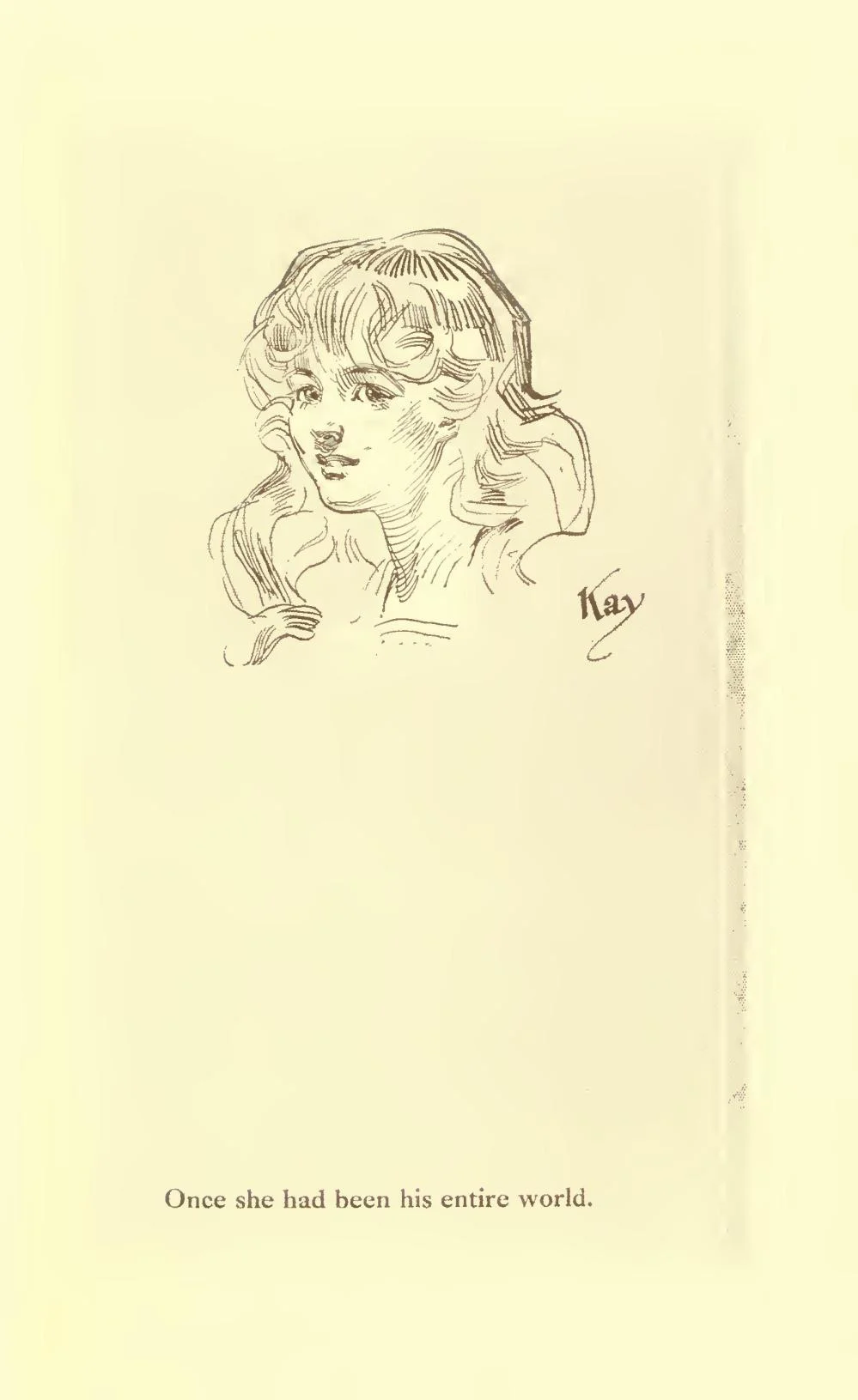

His heart reproached him. Little Kitten Kay! In the last week he hadn’t thought much of her, and once—once she had been his entire world. He had promised her once that he was never going to marry. And now there was Cherry. It was Cherry he thought of as his eyes were closing—Cherry and her saying that there are those who allow and those who love.
CHAPTER XXXIII—THE WORLD AND OCKY
Whenever Peter thought of the Misses Jacobite, the picture that formed was of four lean-breasted women, who spoke in whispers and sat forever in a room with the blinds down. They seemed to have no passions, no desires, no grip on reality, no sense of life’s supreme earnestness. They were waiting, always waiting for something to return—something which had once been theirs: youth, the hope of motherhood, love, the admiration of men. The day of their opportunity had gone by them; they could not forget. It was odd to remember that these gentlewomen, prematurely aged, had once been high-stepping and courted—the belles of Topbury. One of them sang, day in, day out, of the rest to be found on the other side of Jordan; it was all that she had to hope for now. Directly the front door opened you could hear her. The sound of her singing sent shivers down your back. It made you think of a mourner, sitting beside the dead; only the dead was not in the house. It had never come to birth. It was something once expected, that no one dared speak about.
When Peter called next morning he was aware of a changed atmosphere. The sense of folded hands had vanished. The singing was no longer heard; instead, there came to his ears a number of busy, orderly sounds—doors softly opening and shutting, feet making discreet haste upon the stairs, the clink of dishes in the basement and the sizzling of cooking.
As he had passed through the hall, with its varnished wall-paper, to the drawing-room in which he waited, the portrait of old Mr. Jacobite had gazed fiercely down. Quite evidently the old gentleman disapproved of the use being made of his night-shirt.
Peter didn’t seat himself; it would have been impossible to do so without causing havoc. Every chair had its antimacassar, spread at its correct old-maidish angle. He stood by the window, looking out into the cool little garden—a green, shy sanctuary for birds, across which the July sunlight fell. Overhead was the room in which Uncle Waffles had slept—he hoped he had behaved himself. The chandelier shook; several people were very industrious up there. And Peter wondered. Old Mr. Jacobite—had he always disapproved of men where his daughters were concerned? Had he kept them from marriage? Had the tall and reserved Miss Florence ever been kissed by a man? In the light of his own romantic experience he pitied all people who hadn’t been kissed and married. Life was wasted if that hadn’t happened; it was meant for that.
The handle turned. It was Miss Effie, the little and talkative Miss Jacobite, who entered. She was smiling and lifted to Peter a face all a-flutter, thanking him with her eyes, as though he had given her a present.
“How is he?” Peter asked. “I oughtn’t to have brought him here at all—let alone at such an hour. Only you see—you see there was nowhere else to bring him.”
She seated herself on the edge of a chair, patting out her dress. “He’s tired.” She spoke with an air of concern. “He wasn’t very well. We made him stay in bed. We’re going to keep him there; he needs feeding.”
She was flustered. Her hands kept clasping and unclasping. She seemed afraid of being accused of immodesty. She raised her eyes shyly. “It’s so nice to have a man in the house. Not since poor dear father——. I wonder what he’d have said.”
Peter didn’t wonder. He thought it was high time that he made matters clearer. “Of course, I’m not going to leave him on your hands. I only brought him for a night because——”
She interrupted anxiously. “Oh, please, until he’s better. He’s so run down. They made him work so hard in—in there.”
So he had brought his derelict uncle to the one spot on earth where he was regarded as a treasure! He was so amazed at Miss Effie’s attitude that he doubted whether she was in full possession of the facts.
“But—but,” he faltered, “didn’t Miss Florence tell you where he’s come from—where it was that he had to work?”
She answered in a low voice. “We’ve all done wrong.” It seemed she could get no further. She sank her head, gazing straight before her, tracing out the great red roses in the carpet. Peter thought of her sister, Leah, the shadow-woman; he knew what she meant. She raised her eyes to his with an effort. “We’ve all done wrong; I think to have done wrong makes one more gentle. It makes one willing—not to remember.”
Miss Florence opened the door and looked in on them. “He’s ready to see you now.” She hated scenes. Because she saw that one was in preparation, she made her voice and manner perfunctory. “You’d better go alone. You’d better go on tiptoe. I wouldn’t stop too long; he’s got a bad head.”
Peter couldn’t help smiling as he climbed the stairs, and yet it was a tender sort of smiling. Didn’t these innocent ladies know that too much whisky invariably left a bad head? Or, with their divine faculty for forgetting, were they willing to forget the whisky and only to remember to cure the bad head?
It was a white room—a woman’s room most emphatically. The pictures on the walls were triumphs of sentimentality. Gallants were kissing their ladies’ hands and clutching them to their breasts in an agony of parting, or looking meltingly at a flower which they had left. The seats of the chairs wore linen covers to prevent their upholstery from getting shabby. The window was wide; on the sill crumbs had been scattered. Sparrows chattered and, grown bold from habit, flew in on to the carpet and preened their feathers.
On the bed, the sheets drawn close up under his chin, lay Uncle Waffles. He had the look that invalids sometimes have, of being made to appear more ill by too much attention. He had not shaved—his cheeks were grizzled; that help to make him look worse. The atmosphere of a sickroom was completed by a table placed beside the counterpane, on which lay an open Bible and some freshly plucked wall-flowers. Peter had never seen his uncle in bed—for the moment he was embarrassed. He drew up a chair. “How are you? Getting rested?”
Uncle Waffles hitched himself higher on the pillow, reached out and took Peter’s hand. A glint of the old love of fun-making crept into his eyes. “I’ve not been treated like this since my mother—not since I was married. They’re pretending I’m ill because they want to nurse me. Carried off my trousers, they did, to prevent me from getting dressed. What’s the matter with them? Don’t they know who I am?”
“They know.”
“Then why are they doing it?”
“Because they’ve suffered themselves.”
Ocky tightened his grip on Peter’s hand. “One of them been to—to where I’ve been, you mean? Which one?” Peter shook his head. “They’ve all been to prison in a sense—not the kind you speak of. They had a big tragedy, when everything looked happy. Since then——. Well, since then people have pitied and cut them. They’ve been left. They’re glad you’ve come, partly because life’s been cruel to you, and partly——. Look here, I don’t want you to laugh!—partly because you’re a man.”
Ocky pulled the late Mr. Jacobite’s night-shirt tighter across his shoulders. It was much too large for him—as voluminous as a surplice. “Not much of a man,” he muttered; “not much of a man. Arrived here—you know how. Before that had been hanging about street corners, watched by the police and jostled into the gutter. My own wife won’t look at me; and yet you tell me these strangers——.”
His voice shook. “I don’t understand—can’t see why——.”
Peter spoke after an interval. “You—you haven’t often been surprised by too much kindness, have you? Comes almost like a blow at first?”
“Almost. It kind of hurts. But it’s the right kind of hurting. It makes me want to be good. Never thought I’d want to be that.”
“What did you think?”
For a moment a fierce look came into his eyes. “What does an animal think of when it’s trapped? It thinks of all the ways in which it can get back at the people who put it there. But now——.” He picked up the wall-flowers and smelt them. “She brought them this morning—the littlest one, with the gray hair and tiny hands. They were all wet with dew when she brought them. You need to go to prison, Peter, to know what flowers can mean to a chap.”
There was a tap at the door. Miss Madge entered, bringing some beef-tea. When she had gone Ocky said, “They take it in turns.”
Peter remembered how, going always into separate rooms with them, they’d taken turns in owning himself and Kay when they were children. How rarely life had allowed them to love anything!
Uncle Waffles’ thoughts seemed to have been following the same track. He paused, with the cup half-way to his mouth. “Those women ought to have married.—Been in prison most of their lives, you said? But I don’t know; marriage can be a worse hell.” He turned to Peter. “D’you remember at Sandport how she’d never let me kiss her? It was like that from the first. She kept me hungry. I stole to make her love me. She was always talking about her first husband and making me jealous. And yet——.”
He stopped and gazed vacantly across the room to where sparrows fluttered on the sill and sunlight fell. Peter supposed that he had forgotten what he was going to have said. Suddenly his face became all purpose and pleading. He flung back the bedclothes and leant out, gripping Peter’s shoulders till they hurt. “I’d steal again to-morrow to get one day of her bought affection. My God, how I’ve longed for her! Make her come to me. You must, Peter. You shall. Don’t tell her who I am. Oh, don’t refuse me.”
The sharp agony and desperate determination of a man so drifting and careless took Peter aback. He recalled those days when he had hidden him in the stable—it had been the same then. He had always been urging that Je-hane should be persuaded to walk in the garden that he might catch a glimpse of her. The one strong loyalty of his weak existence had been the love of this woman.
“Get her to come to you!” Peter said. “But how? She wouldn’t. She——” Ocky burried his face in the pillow. How thin he was and listless! How spent! How——. What was the word? How smashed! It was as though in the human quarry some chance stone of calamity had fallen on him, making him a moral cripple. He was what he was through the sort of accident that might happen to any man—to the Faun Man, if Eve refused to love him; even to Peter himself.
The boy pulled the clothes back over the man. “Somehow—I don’t know how—somehow I’ll do it. I promise.”
After that, whenever Peter entered the white room, he saw how his uncle watched for someone to follow.
The Misses Jacobite had found a doctor who supported their opinion that their guest must be kept in bed. The prison fare and long confinement had broken down his constitution. The doctor didn’t know what had done it; he advised food and rest.
From time to time Peter brought visitors to the room overlooking the garden. His father came and was shocked by the wasted look of the man who, in earlier years, had been his friend. It was of those earlier years that they chose to speak, by an instinctive courtesy; they, at least, had been happy territory. They recalled together their schoolday pranks—the canings they had earned, the football matches they had lost or won, the holidays when they had broken boundaries, going on some secret adventure. But, when Barrington rose to go, Ocky said, “Don’t come again, Billy. You used to hate to hear me call you Billy; you’ll dislike it just as much when I’m better. We’ve both been forgetting what I am, and what I’ve done. If you come again we may remember. For years I’ve worried you; well, that’s ended. But—you’re a man of the world, and you understand. I’m a jail-bird—and I don’t want to spoil the memory of this hour. Good-bye, old man.”
It turned out that Mr. Grace hadn’t slept on his box so soundly that evening of Peter’s return—at least, not so soundly as to keep his eyes shut.
“All swank on my part, Mr. Peter,” he said; “she’s been h’at me for years, my darter Grice ‘as, and I don’t mean to get conwerted. H’I’m not a-goin’ ter come ter ‘eaven, so long as ‘er voice is the only voice as calls me. ‘Eaven ‘ud be ‘ell, livin’ wiv ‘er in the same ‘ouse, if I wuz ter do that. We’d be for h’everlastin’ prayin’ and floppin’. Not but wot religion ‘as its uses; but not for me in ‘er sense. That’s why I shut me h’eyes when she was a-bellowin’ at the corner. But I saw yer. ‘Ow is the old bloke nar? Your uncle, I mean, meanin’ no disrespeck. I’ve h’often thought that if we ‘ad met under ‘appier h’auspices—h’auspices is one of my Grice’s words—we might ‘ave been pals.”
Peter brought about the ‘appier h’auspices. One afternoon Cat’s Meat halted before the house and Mr. Grace climbed down from his box, a bag of apples in one hand and his whip in the other. He was very red in the face and embarrassed; he had anything but a sick-room appearance, though he often drove in funeral processions. He was immensely careful about the wiping of his feet. Peter tried to coax him to leave his whip in the hall; he wouldn’t. He seemed to think that it lent him dignity, and explained his status in the world. So it was clutching a bag of apples and clasping his whip against his chest, that he entered the white room where the birds hopped in and out.
Ocky Waffles, shifting his position on the bed, caught sight of the weather-beaten, alcoholic figure. Before he could say a word, in a thick, husky voice Mr. Grace offered his apologies.
“‘Ere. ‘Ave ‘em. I ‘ear you ain’t well.” He swung the bag of apples on to the bed. “Bought ‘em from a gal off a barrer” He paused awkwardly.
“That was good of you,” said Ocky. “Come and sit down.”
Mr. Grace scratched his head. “I dunno as I want to sit down. I dunno as you and me is friends. Remember the last time we met and h’all the trouble we ‘ad? You wuz a nice old cough-drop in them days. I ‘ad to ‘it yer wiv this ‘ere whip—the wery same one—to make yer let go o’ the top o’ the gate and fall inter the stable. Well, I ‘it yer in kindness; but it’s because I ‘it yer that I dunno whether you and me is friends.”
“We’re friends,” said Ocky.
Mr. Grace sat down. It was most curious, all this. He hadn’t got his bearings. This chap, lying in a decent bed and waited on hand and foot by ladies, was Mr. Waffles, if you please. But he had been an old cock who climbed walls to avoid policemen, and rode about at night in philanthropic cabs. He turned to him gruffly. “Eat one o’ them there apples. Bought ‘em from a gal off a barrer.—Did h’I tell yer that h’already?” It was a sign that the truce was established.
Mr. Grace became a frequent caller. An odd friendship grew up between these two men, both broken on the wheel of feminine perversity. They exchanged notes on their experiences. Ocky spoke to the old cabby with greater freedom than to anyone, save Peter. Jehane had always said of him that he found it easy to be sociable with underlings and ostlers. In this case he found it easy because of the wide charity of the underling’s personal laxity. Sometimes Miss Effie would steal in and read to them of a man who chose his companions from among publicans and sinners. Mr. Grace would pay her the closest attention and ask her to repeat certain passages; he was picking up pointers, with which to challenge his daughter’s confident assertions concerning God’s unvarying severity.
And then Jehane! She came one afternoon to Topbury to visit Nan. She had heard nothing; nothing was told her. Peter waited for an opportunity to get her to himself. In the garden after dinner the others contrived to leave them together.
“Going up to Oxford, Peter? Oh, well, it’s good to have opportunities and a father with money. My poor Eustace, he’ll never have that. I might, while you’re there——.”
She paused; the thought had just occurred to her—a new plan for marrying off her girls “I might let Glory and Riska visit my father and mother while you’re there. It would be pleasant for all of you. Would you like that?”
“Splendid,” said Peter.
She eyed him, suspecting the sincerity of his enthusiasm.
“Of course, if you don’t want your cousins—-.”
“I do,” he assured her. “I’m going to Calvary College; that’s just opposite Professor Usk’s house. I’ll be able to see plenty of them.” Then, knowing how she liked to be appealed to as a person with superior knowledge, “I wish you’d tell me some of the things I mustn’t do; Oxford etiquette’s so full of mustn’ts.”
She laughed; the hard lines softened about her mouth. Talking about Oxford made her think of her girlhood, when to be the daughter of a don was to be something akin to an aristocrat. Those days were sufficiently far removed for her to have forgotten their dread of spinsterhood, and for her to remember only their glamour. “You must never use tongs to your sugar,” she said; “only freshers do that—you must help yourself with your fingers. And, let me see! You must never wear your cap and gown unless it’s positively necessary. You mustn’t speak to a second or third-year man unless he speaks to you first.—Oh, there are so many mustn’ts at Oxford; it would take all evening.”
And then, “Did your mother ever tell you the story of how we first met Billy? It had been raining, and we were waiting to go on the river. I put my head out of the window to see if the storm was over, and there was your father looking up at me. I used to tease your mother by pretending that I was in love with him. I shouldn’t wonder—I expect she still believes I wanted him. You see, Nan and I were inseparable as girls. We used to be horribly scared of not marrying—we didn’t know as much about marriage then. We used to think that girls were born on a raft and that only a man could come to their rescue. Funny idea, wasn’t it?”
“And if the man didn’t come?”
“Why, if the man didn’t come, we believed girls missed everything—believed they got blown out to sea, out of sight of land and starved with thirst. That was what made your mother so jealous, when I pretended to be in love with Billy. She was afraid she’d lose her one and only chance of getting safe ashore to the land of matrimony.” That was Jehane’s public version of how love had miscarried between herself and Barrington.
So she ran on, remembering and remembering, as they walked the garden path from the mulberry to the pear trees, forth and back, back and forth, while the sunset reddened the creepers on the walls and the loft-window, from which Ocky had watched in vain for her coming, looked down on them emptily.
When it was time for her to be getting on her way, Peter volunteered to accompany her to the station. They chose the Lowbury Station instead of the Topbury, because it would take longer and they could continue their conversation about Oxford, her Promised Land of the past. “You must have had good times as a girl.”
Good times! Hadn’t she? She painted for him the joys of Eights’ Week, the excitement of the Toggers, the tremendous elations of a young and vivid ‘Varsity world. She painted them for him as romantic realities which she had lived to the full and lost. And the odd thing was that she believed that she had been happy then. All her life it had been then that she had been happy. Her Eldorados had always been behind her—never in the To-days or the To-morrows. When she pitied herself, her otherwise barren nature blossomed into a tragic luxuriance that was almost noble, and entirely picturesque.
She hadn’t noticed where Peter was leading her. She found herself in a broad and quiet street, through which little traffic passed. The pavements, on either side of it, were lined with plane-trees. Houses stood far back from the road in gardens, with stone steps climbing up to them.
She slipped her hand into Peter’s arm. Now that Nan wasn’t there to be pleased by it, she was willing to let him know that she was proud of him. In the silver twilight, when one sees with the imagination rather than with the eyes, she found his face like to one which had looked up at her suddenly and held her spell-bound in the gray blur of an Oxford street.
“Is this the right way, Peter? Is it a short-cut? Are you taking me out of my way to lengthen our talk?”
He laughed, rather excitedly she thought. “I like to hear you telling of the old days—— Hulloa! Why here’s the Misses Jacobite’s house! You remember what you said about women being on a raft—I think that explains them. No one came out from the land to take them off. Let’s step inside and cheer them up.”
“But Peter, my train——.”
“Oh, there are plenty of trains—we needn’t stop more than a second.”
“You rascal!” She gave his arm a little hug. “I believe you had this in mind from the start.”
“Perhaps I had.”
When they were safe inside the hall and the door had closed behind them, his manner altered. She was conscious of it in a second. He no longer laughed, and he was more excited.
“There’s someone here who wants to meet you,” he informed her.
“But who? Why didn’t you tell me?”
“I wanted to give you a surprise.”
She looked annoyed and yet curious. “You must tell me. Is it a man or a woman?”
He didn’t dare to let her know that it was her husband.
“You’ll see presently.”
She was beginning to protest; Miss Florence entered. Under her attempt at cordiality her face betrayed dismay, and something still less comfortable—judgment. Peter employed her entrance as an excuse for his own rapid exit. He soon returned. “They want to see you now.”
Making the best of an awkward situation, Jehane exclaimed, “They! So there are several of them! It was only ‘someone’ at first.”
She followed him up the stairs, trying to catch up with and question him; he was careful to keep sufficiently far ahead to prevent conversation. He opened a door on the landing—the door which led into the white room. He made as if he were going to accompany her, but, as she crossed the threshold, stepped back and closed the door.
“You!”
The man held out his arms. When she stood rigid and did not stir, he dragged himself across the bed, as if to come to her.
“Don’t.”
Her voice was sudden like a whip cracked.
His arms fell to his side. After all these years of absence, her stronger will lashed down his desire. He began ramblingly, shame-facedly, hinting at what he meant, not having the audacity to finish his sentences. “I had to——. I made Peter promise. When they let me out, I was thinking of you. All the time in there, for four years, I was thinking of——. Jehane, I’ve been punished enough. Isn’t it possible that——? Jehane, I love you. I always have. I always shall.”
He was aching to touch her. Through the mist of twilight that drifted through the room, he fed his eyes on every detail of this woman who had once been familiar to him. She hadn’t changed much; it was he who was altered. She also made her sternly pitiful estimate—the shrunken body, the loose-lipped, purposeless mouth, the hair growing thin and gray about the temples.
He stretched out his arms. “I love you.”
She shuddered; it was as though a man from the grave had called to her.
“Love me!” Her voice was so low that his ears were strained to catch what she said. “No. You never loved me; you weren’t strong enough for that. It was all a mistake; we never belonged to each other. If you had loved me, you wouldn’t have—— But we won’t talk about it. I’m not bitter; but we must go our own ways now.”
He was lying across the edge of the bed, threatening to reach across the gulf that spread between them. The nearer he came, the more she saw what had happened. He was old—a senile, night-robed caricature of the man she had married. In the half-light her fear of his claim on her made him ghastly.
He was moving—he was getting out of bed. She opened the door, running as she would have run from a skeleton. He was following her down the stairs. She fancied that he touched her. It seemed that he leapt through the air. Something fell. In the hall people tried to stay her. She was in the street where the plane-trees rustled; how she managed to get there she could not tell. She ran on, fearing that he still followed.
She halted for want of breath. Where was she? Lighted trams were passing. She jumped on the first, giving no thought to its direction. Not until she was safe aboard and moving, did she dare to look back.
Nothing was there, nothing gaunt and hungry—only saunterers and girls with their lovers, drifting dreamlike through the shadows under lamps against whose glare moths hurled their fragile bodies, beating their lives out flutteringly.
CHAPTER XXXIV—THE BENEVOLENT DELILAHS
Despite the Misses Jacobite’s efforts to keep him ill, Ocky insisted on getting better. His cork-like nature refused to be submerged by adversity; it was warranted un-sinkable.
At first, after repeated and urgent requests, he was allowed to sit by the window in a dressing-gown. Then he was allowed to get partly dressed and to ramble about the house in carpet-slippers. At last he was permitted to venture into the garden. There, for some days, his adventures ended. His four benevolent Delilahs had the felicity of watching their captive-man, pottering in the sunshine, watering the grass and tying up the flowers, while leaves tapped against the walls and birds flew over him.
They were terribly afraid that presently he would contemplate an exodus. It was so very long since they had had anything to do with men—they had almost forgotten what things amused them. In those far-off days when the world was young and lovers were frequent, they had played and sung a little. But the drawing-room was faded, their songs were out of date, the piano was out of tune, and their voices——. Perhaps those lovers had never really cared for their singing; appearing to care had afforded an excuse for sitting close to the singers, as they turned the pages of their music.
Mr. Waffles mustn’t be allowed to get dull—that would be fatal. They asked him if he would be so good as to keep an eye on the cats—to see that they didn’t pounce on any of the birds who made a home in their garden. Mr. Waffles promised. But the cats still stole along the wall and crept through the bushes, unmolested by the weary gentleman in carpet-slippers.
Something had to be done. The case grew desperate. The four gray sisters hunted through their father’s library and searched out books—Dickens’ novels in paper-covers, issued in parts at a time when a new character from Boz was more exciting than a new comet hurled through the night from the unseen shores of eternity. Dickens left Mr. Waffles cold; his tastes were not literary. He fell asleep with David Copperfield face-down beside his chair, while the sunlight played leap-frog with the shadows across the lawn.
He had to be amused. Providence sent a diversion. Seated beneath the apple tree, where the shrubbery began, Miss Florence was assuring her Samson for the hundredth time of how glad she and her sisters were to have him with them. To enforce the sincerity of her words, she had stretched out her hand to touch him—had almost touched him—when a shocked voice exclaimed, “What the devil! What the devil! Poor father! Oh, dear! Oh, dear!”
Miss Florence jumped back from Mr. Waffles. Had he accused her? She saw that his lips were not moving—that in fact, he was as surprised as herself. Both looked slowly round. Their astonished glances found nothing more perturbing than the innocent greenness of the garden and the noiseless hopping of birds.
The voice came again, maliciously strident. “Oh, dear! Oh, dear! What the devil! What the devil!”
Overhead, perched on a branch, was a gray and scarlet parrot. From whom had it escaped? How long had it been there? All they knew was that, while taking refuge in their garden, it was not above reviling them. At night it formed the habit of roosting in the apple tree. Before anyone was out of bed, it could be heard profaning the early morning.
The energies of the entire household were now directed toward the effecting of its capture. Ingenious plans were concocted. A topic of conversation was never lacking.
The four elderly ladies placed themselves under their guest’s protection. What would the neighbors think if they were to hear a constant stream of blasphemy issuing from their walls? And, besides, the parrot in a cage could be taught better manners and made an attractive pet.
Mr. Grace, on a visit, learnt of the situation and volunteered to lend a hand. He and Mr. Waffles were provided with bags of grain and butterfly-nets. They were instructed to creep with the stealth of poachers behind ambuscades of trees and flowers, following the gray and scarlet peril till it settled, and then——
But the triumphant moment was continually postponed; for, whenever they approached the parrot, no matter how warily, it spread its wings, mocking them and crying, “What the devil!”—or something even worse.
Ocky’s days were fully occupied now. He had a morning-to-evening interest. The Misses Jacobite urged on him the importance of his task—the safeguarding of their reputation.
But even a trust so sacred and incessant failed to content Mr. Waffles. Peter made this discovery when his uncle asked him for the loan of a shilling. “Voluntary contributions thankfully borrowed,” was Ocky’s motto. No one ever gave him anything. It was always lent. Now money implied an excursion into the larger world; Peter wondered what might be its purpose. He knew next morning; his uncle had a sixpenny pipe in his mouth and a tin of cheap tobacco in his pocket. He was stoking up to renew life’s battle; with a pipe between his teeth, Ocky Waffles was a man.
He led Peter down the garden to the shrubbery, behind which were two cane-chairs. The shrubbery was convenient for hiding the fact that he was smoking.
“Peter,” he said, jerking his head across his shoulder, “I’ve been noticing. They can’t afford it. I’ve got to go to work, old chap.”
He spoke with his old swaggering confidence, as though the entire world was waiting to engage his services. The carpet-slippers, which had been Mr. Jacobite’s, chafed one against the other thoughtfully.
“Got to go to work,” he repeated reflectively, in a tone which implied regret. “I think I know a fellow—— We were in the coop together, and he said—— But I’m not going to tell you till I’m more certain of my plans.”
Had he been burdened with the weightiest of financial secrets, he could not have made them more mysterious. Peter tried not to smile; he was glad—this was the muddling self-deceived uncle he remembered.
Ocky knocked the ashes out of his pipe, waiting for the bowl to cool before he filled it. “I hadn’t an idea that they had so little. It’s come home to me gradually—the worn carpets and old things everywhere. And here have I been eating my head off. We’ll have to pay ‘em back, Peter—have to pay ‘em back.”
Peter had reason to be sceptical about the paying back; he applauded the intention. Except in imagination, his uncle had never been much of a money-maker. He had always been unemployable; he was ten times more unemployable now with a prison record. Peter spoke to his father, with the result that a position was offered as packer in a publisher’s establishment. Ocky refused it. “Got something better.”
The “something better” was at last divulged. One afternoon Peter found his uncle up the apple-tree, trying to balance a box in its branches. In the box was scattered the kind of food best calculated to tempt the appetite of a parrot. The box had a flap-door leading into it, propped open by a stick from which a string dangled. If an ill-natured bird were to enter the box and a lady beneath the tree were to pull on the string, thus dragging away the stick, the door would shut and the ill-natured bird would be a captive. Gathered under the tree were the four Misses Jacobite, looking very weepy and calling up warnings to their guest, please not to fall and to be careful.
Peter knew what it meant—these were the last offices of gratitude which preceded departure.
When the adventurous gentleman had clambered down, it was seen that he wore his shabby spats and that his mustaches were pointed with wax. He led Peter aside and winked at him solemnly. It was the return from Elba; after exile, he was going forth to conquer the world afresh.
“Well?” said Peter.
“Well?” said Ocky.
“Leaving?” asked Peter.
“‘S’afternoon,” said Ocky. Then, after a silence, which heightened the suspense, came the revelation. “There’s a fellow, I know, a Mr. Widow—we were in the coop together. A nice fellow! He oughtn’t to have been there. Seems he was in the second-hand business and dressed like a parson to inspire confidence. Well, his wife was a gadabout woman and always jeering at him. One day, quite quietly, in a necessary sort of manner, without losing his temper, so he told me, he up and clumped her over the head. He went out to a sale, never thinking he’d done any more than was his duty; when he came back she was dead. He’s a nice, kind sort of chap, is Jimmie Widow, and religious. Not a bit like a murderer. If you didn’t start with a prejudice, you’d like him, Peter. I met him a fortnight ago. He’s opened a little place in Soho and wants me to join him. I’m to mind shop while he’s out. There’s heaps of money to be made in the second-hand business. You see, I’ll surprise you all and die a rich man yet.”
“Oh, yes,” said Peter, “I—I hope so.”
Mr. Grace thought it just as well that his friend should enter on his new adventure with the appearance of prosperity. He offered him a free ride in his cab. So Ocky took leave of his benevolent Delilahs not as a pedestrian but, as he had arrived—a carriage-gentleman.
Shortly after his exit, the parrot was pounced on and eaten by a cat. With the first money that he earned, Ocky made up for the loss with the gift of a pair of love-birds. The Misses Jacobite named one Ocky and the other Waffles. Which was the husband-bird and which the lady was a matter in continual dispute between the sisters. Miss Florence insisted that Waffles was the husband, because it had the more considerate habits. The other she thought of as Jehane, and disliked.
The question was still undecided, when a hawker of goldfish happened to call. No gold-fish were required; but the conversation veered round to the sex of love-birds. The peddler confessed that in his spare moments ‘e did a bit in poultry and bulldogs. He was at once invited to enter, with all the deference that is due to an expert. Having inspected Ocky and Waffles, he announced as his verdict that them bloomin’ love-birds wuz either both cocks or both ‘ens; but, whether cocks or ‘ens, even he, with a vast experience be’ind him, could not tell.
When he had departed, a silver cruet-stand was missed from the sideboard. And there the perplexing problem rested.
CHAPTER XXXV—WINGED BIRDS AND ROOTED TREES
A summer’s afternoon in London! The gold-gray majesty of the Embankment, basking in sunlight; the silver-gray flowing of the Thames beneath its many bridges; smoke, bidding a casual good-by to chimneys, sauntering off a truant into the quiet blue; trees, bravely green and a-flutter; a steamer swerving in to the landing at Westminster! His decision came suddenly. She had asked him to visit her. Perhaps—perhaps, she could tell him what had happened to Cherry.
He jumped off the bus, crossed the road at a run, sprang down the steps and thrust his money through the hole in the ticket-window. “A return to Kew.”
The man in the box was ostentatiously slow in counting out the change. These young bloods made him bitter. With all the years before them, they were always late and always in a hurry. He sold them their passports to cool green places; he himself was left permanently behind by that streak of gleaming river.
“‘Eaps o’ time,” he grumbled. “Yes, that’s your one.” Then, having at last handed over the change and a ticket, “Best skip lively, or you’ll lose ‘er.”
Peter skipped lively; to the man’s disappointment, he scrambled aboard just as the steamer was casting loose. She shot out into the current, panting and splashing, kicking up a merry white wake. The Houses of Parliament grew tall and, at last, spectral in the distance. The dome of St. Paul’s lay, a black bubble swollen to bursting, on the lip of the horizon. The smoke of London trembled like a thin flag, waving back the encroaching sky. The groan of creeping traffic was stilled; stone-palaces of labor sank and sank, shorn of their height and supremacy. This was the road to Arcady, the flowing road to the land of birds and grass pavements. They were on the outskirts of that land already; everybody felt it. A red-nosed minstrel drew his harp between his knees and fumbled at the strings. He assured his public tunefully that he had dreamt that he dwelt in marble halls. It was difficult to believe him; he didn’t look a soulful fellow. Nevertheless, in his decrepit person, he echoed the hopes of incredible romance. The crowd grew careless of appearances and jaunty. Cockney swains cuddled their girls more closely; the girls, rather proud than abashed, tittered.
Battersea Park drifted by, a green mist of trees and romping children. Against the red-brick background of Chelsea, scarlet-coated soldiers strolled, unwarriorlike, keeping pace with pram-trundling nurse-maids. The steamer seemed to stand still; it was the banks, on either side, that traveled.
The harpist, having tried his nose at romance, came back to reality. Perhaps, it was because he sang so much through it, that his nose was so long and red.
“Sez I, ‘Be Mrs. ‘Awkins, Mrs. ‘Enery ‘Awkins,
Or acrost the seas I’ll roam.
So ‘elp me, Bob, I’m crazy,
Liza, yer a daisy—
Won’t yer share my ‘umble ‘ome?”’
In vulgar language he gave exact utterance to Peter’s emotions. Not that he had any home for Cherry to share. He wasn’t likely to have for a long time to come. He had to go to Oxford first, there to be drilled for his tussle with the world. And yet, unreasonably, too previously, against all laws of caution and common sense, he wanted to hear her say that she cared for him.
He had every reason to believe the contrary. He had written to her, and had received only a line in answer, “Let’s forget. For your sake it would be better.” After that his many letters had been returned to him unopened, indicating that the address was unknown. He had tried to get into touch with the Faun Man and Harry, but they were on the Continent, roving. Then, he had thought of the golden woman. She had been kind to him. She had asked him to visit her. She and Cherry were scarcely friends, but she might tell him where he could find her.
“Let’s forget.” The words rang in his ears. They tormented him. They made him both sad and angry. They seemed to treat all love as a flirtation, as a stroll beneath the stars which must end. He didn’t want an ending—couldn’t conceive that it was possible. Was she heartless or—or had she mistaken him? Was it that she didn’t understand love’s finality? Or that she did understand, and was frightened? Or—and this was the doubt that haunted him most—that she didn’t really like him?
Putney! Mortlake! Racing-shells skimming the surface of the water! Bridges wading from bank to bank! Bathing boys who stood up naked, waving to the passing steamer! Then Kew, green and somnolent, with its plumed trees and low-browed houses. Peter landed. The crowd melted, breaking up into couples who wandered off, purposeless and happy. They had only escaped from London that they might be alone together. Should they go to the Botanical Gardens? Oh, yes. Anywhere—it didn’t matter. Anywhere, so long as they could sit together and hold hands.
He crossed the bridge; stopped a stranger and asked a question; turned along the bank and came to a house, little more than a cottage—a nest tucked away amid shrubs and trees, with the river in view.
Like the frill on a woman’s dress, a green verandah ran round it. Everything was cool and neat and hushed. The bushes were trim and orderly. The gravel-path had been smoothly raked—not a stone was awry. Flowers stood sweetly demure, in rows like school-girls awaiting a good conduct prize and trying to forget that they had ever been hoydens. On the lawn an automatic sprinkler was at work, revolving slowly and throwing up a cloud of spray.
As he approached the porch, misty with wistaria and passion-flowers, he searched the windows for signs of life. They were so clear that they seemed to be without panes, giving direct entrance to the pleasant rooms inside. They seemed to say, “We have nothing to hide—nothing.” Brasses shone as brightly as a more precious metal. The door lent a virginal touch of whiteness.
He rang the bell and heard a faint tinkle, then the rustling of skirts, accompanied by prim footsteps. A severely attired maid admitted him. He gazed round the room into which he was shown. Books, artistically bound, lay on the table. Everything gave evidence of fastidiousness and taste—of a certain remoteness from the everyday jostle of life. Above an inlaid desk stood a portrait, silverframed. Out of curiosity Peter tiptoed over; the Faun Man gazed out at him with laughing eyes. Lying open on the desk was a well-thumbed volume, small and bound like a Bible. A passage was underscored, which read, “Thou must be lord and master of thine own actions, and not a slave or hireling.” Turning to the title-page, he found that it was The Imitation of Christ.
A voice behind him said, “Ah, so you’ve discovered me!”
He drew himself up, afraid she might suspect him of spying. “I—I was interested by the words you’d underlined. I wanted to see who wrote them. I oughtn’t to have——”
She laughed softly, shrugging her shoulders. She was all in white—lazy, splendid and vital. “My Loo-ard! Don’t apologize. You were surprised. I don’t blame you.” She nodded her head like a knowing child. “Oh, yes, Peter, the golden woman reads books like that sometimes.”
She took his hands in hers and drew him over to a sofa, making him sit down beside her. “And now, what have you come to tell me?”
He recovered from his confusion and surrendered, as all men did, to her graciousness. “That it’s ripping to see you. But—but how did you know I called you the golden woman?”
“Lorie—he tells me everything.” She leant back her long fine throat, pillowing her head against the cushions. “You must never trust him with any of your secrets, if you don’t want me to—— Now, what is it that you’ve come to tell me?”
“Then, you know——?” He hesitated. The confession to him was sacred; there was amusement in her eyes. “Then you know about me and Cherry?” He was sure she did. She had greeted him as though his visit had been long expected.
She placed her cool fingers about his wrist and bent her head nearer. Her voice was low, and caressing—the voice of one who breaks bad news gently. “I know. You told her that you loved her.—— Why didn’t you come to me sooner?”
She was looking sorry for him. “Why sooner?” he questioned.
“Because she’s gone away.”
It was almost as though she had told him that Cherry had died. “Away? Where to?”
“I don’t know. Lorie didn’t say; he took her. Perhaps, to the convent. Poor little girl, you—you frightened her, Peter.”
He was all amazement. What a contrast there was between these two! The boy so inexperienced and crestfallen; the golden woman so wise and quiet. “Yes, you, Peter. You’re so natural and uncivilized. You were too sudden with her. You told her that you loved her just as a child would—directly you felt it. You wanted to kiss her without waste of time. You galloped too fast, Peter; you tried to take all the fences at one stride.” Her voice grew more tender; she folded her hands in her lap, looking away from him, straight before her. “You’re—you’re the sort of lover we older women dream of when the hour’s gone by. The men who come to us are too cautious; they watch for the lines in our faces. They’ve learnt to play safe. But you, with your glorious youth——! And she didn’t recognize it—didn’t know what you were offering.” The blue eyes came back slowly to his face. She ended, “And so, she’s gone away.”
Peter felt unhappy and yet comforted. She had envied him something of which he had been ashamed—the unavoidable indiscretion of his lack of age. She had called it glorious; she hadn’t thought it foolish. “But what must I do? Will she—will she come back again? Will she understand, one day, the way you do?”
She answered evasively. “One day! We women all understand one day.”
He repeated his question, “But what must I do?”
She put her arm about his shoulder. “Wait. It’s all that either of us can do.”
Why did she include herself? The room was very silent. In its patient preparedness, it must have spent years in waiting. The garden outside seemed to listen, tiptoe. The door was white, as if little used. The sunlight on the lawn crept slowly. Everything watched; yet nothing was wideawake. For whom were they all expectant? Always there is one who allows, and one who loves. Was that the explanation?
Above the open volume of cloistered consolation, with its disillusioned counsels of timid patience, the Faun Man smiled from his silver frame. Peter had always thought——.
So, after all, was it the Faun Man who had delayed?
And Cherry loved him! Had that anything to do with it? He crushed the suspicion down—and yet it survived.
“And you don’t know——. You couldn’t tell me where to write?”
The golden woman shook her head. “Who can say? You don’t know much about love, Peter. It’s a continual hoping for something which never happens—or which, when it happens, is something different. People say it’s a state of heart—it’s really a state of mind. I think—and you’ll hate me for saying it—I think true love is always on one side and is always disappointed. Did you ever hear about the green tree and the bird in the morn? You didn’t?
“A bird in the morn
To a green tree was calling:
‘Come over. Come over.
Night’s vanished. Day’s born.
And I’m weary—I want you, green tree, for my lover;
Through clouds I am falling,
A-flutter, a-flutter.
I’m lonely,
Here only.
And heard your leaves mutter.
Night’s vanished. Day’s born.
So run out and fold me, green tree, in the morn.’
“The bird in the morn
Heard a distant tree sighing:
I cannot come over—
Night’s vanished. Day’s born.
I am rooted. But haste, oh sweet bird, to your lover;
So freely you’re flying,
A-flutter, a-flutter.
Sink hither,
Not thither.
Hark how my leaves mutter,
Night’s vanished. Love’s born.’
The bird flew—ah, whither? The tree was forlorn.”
She stroked his hand. “In true love,” she said, “there’s always one who could but won’t, and one who would but cannot.”
“Not always,” he denied. He spoke confidently, remembering his mother and father.
“How certain you are!” She watched him mockingly. “Ah, you know of an exception! Believe me, Peter, winged birds and rooted trees are by far the more common.”
She made him feel that she shared his dilemma—that she reckoned herself, with him, among the trees which are rooted. The bond of sympathy was established.
“We,” she whispered, “you and I, Peter, we must wait for our winged birds to visit us. We can’t go to them, however we try.”
She sprang up with a quick change of expression; in a flash she was radiant. “My Loo-ard, but we needn’t be tragic.”
Running to the window, she flung it wide. “Look out there. The sun, the river, the grass—they’re happy. What do they care? It’s our hearts that are unhappy. We won’t have any hearts, Peter.”
He crossed the room to her. With the freedom of a sister, she put her arm about him, leaning so that her hair just touched his face. She seemed to be excusing her action. “You’re only a boy. How old shall we say. Just fourteen, perhaps. Why, little Peter, you’re too young to be in love.—— Do you remember the saying, that every load has two handles: one by which it can be carried; one by which it cannot? You and I are going to find the handle by which it can be carried—is that a bargain? I’ll show you the handle—it’s not to take yourself or anyone too seriously. You’re making a face, Peter, as though I’d given you nasty medicine. You were determined to be most awfully wretched over Cherry, weren’t you? Well, you mustn’t. Wait half a second.”
Her half-seconds were half-hours to other people. When she reappeared, she was clad girlishly in a white dress, which hung above her ankles. At her breast was a yellow rose. Her golden hair was wrapped in bands about her head. There swung from her hand a broad river-hat. Peter thought that, if the Faun Man could see her now, he wouldn’t wait much longer. But it was contradictory—this that she had told him; he had always supposed that it was she who had kept the Faun Man waiting. For himself he was wishing that she were Cherry.
Before the mirror, over the empty fireplace, she stooped to adjust her hat. Her arms curved up to her shining head, the loose sleeves falling back from them; they looked like handles of ivory on a gold-rimmed goblet. The motive of the attitude was lost on Peter; he only took in the general effect. Her eyes, watching him from the glass, saw that. He was thinking how naÃÆïve she was to have taken thirty minutes over dressing, and then to pretend that she had hurried by coming down with her hat in her hand.
“Ready,” she said. “Do you like me in this dress? If you don’t, I’ll change it.”
“If I took you at your word——. But would you really? I’m almost tempted to put you to the test.”
“I would really,” she said.
“I do like you.” He spoke with boyish downrightness. “You know jolly well that you look splendid in anything.”
She pretended to be abashed and hurried into the garden, singing just above her breath,
“I like you in satin,
I like you in fluff.”
She seemed to forget the words and hummed; but, as she came to the end of the air, she crouched her chin against her shoulder, looking back at him naughtily,
“I love you and like you
In—oh, anything at all.”
They walked by the muffled river; trees were reflected so clearly on its surface that it was easy to mistake illusion for reality. Everything was asleep or listless in the summer sun. They came to a point where they ferried across. They entered Kew Gardens and sauntered into the Palace for coolness. They didn’t care where their feet led them; all the while they talked—about life, love, men and women, but really, under the disguise of words, about Cherry and the Faun Man. In her company he had found a sudden relief from suspense.
She was so smiling, so generous, and at times so anxious to be reckless, like a clever child saying slant-eyed things of which the meaning was half-guessed. He was elated to be seen with her; she was rare and beautiful.
Toward evening he turned back from the land of stately trees and grass-pavements to the clamor of the perturbed and narrow city. The river was a thread of gold; the sun foundered red in a crimson sea of cloud. The thread of gold broadened as bridges grew more frequent; black wharfs took the place of meadows and sat huddled along the banks like homeless beggars. But it was the majesty, not the meanness of London, that impressed him. His eyes were on the horizon, where the lace-work tower of Westminster shot up, sculptured and ethereal, and still further beyond where, above herded roofs, the dome of St. Paul’s protruded like a woman’s breast.
He landed at Westminster Bridge and ran up the steps. What a different world! How many hours was it since he had been there? He had recovered his sense of life’s magic.
The tethered man in the ticket-office eyed him gloomily. “Still in a hurry,” he thought, “and with all the years of life before him. Ugh!”
That afternoon was the pattern of many that followed. He came from London to Kew, simply and solely that he might speak about Cherry, and always with the hope that he might gain some news of her. Subtly the golden woman would lead the conversation round to herself. It was only at parting that he would discover this. Once he said, laughingly, “Why, we’ve spent all our time in talking about you!” Then he stopped, for he saw that he had not pleased her. “Next time it shall be all about Cherry,” he told himself; but it wasn’t.
He had never had a woman consult him before about her dress and the styles of doing her hair. The golden woman did; she made him tell her just what he preferred. When he met her, she came to express a part of his personality.
In the intimacy which grew up between them, the small reserves of pride and reticence were broken down. They spoke their minds aloud.
“I’m getting old, Peter,” she would say. But this was only on the days when she looked youngest.
If he had no money, he would tell her; then, she would either pay or they would make their pleasures inexpensive. He regarded her as a sister older than himself.
“What shall I call you?” he asked her. “Haven’t you noticed that I have no name for you?”
She slipped her arm into his. “The golden woman. I like that. It’s you—it has the touch of poetry.”
“I gave you that name,” he said, “the moment I saw you—years ago, at the Happy Cottage.”
She opened her eyes wide, pretending to be offended. “Years ago! How cruel! Years ago to you; but to me not so long ago—four years, wasn’t it? Why do you say things that make me feel ancient?”
“When you’re beautiful——.” He got no farther; his tongue stumbled at compliments. He was going to have said that, when you were very beautiful, years didn’t matter.
She caught at his words. “Then you think I’m beautiful?”
“Think, indeed!”
“As beautiful as Cherry?”
He avoided answering, saying instead, “See how everyone turns to look after you.”
She fell silent, only to return to the topic long after he had forgotten it. “Yes, they look after me and go away. That isn’t like having someone with you always.”
She could make him feel very unhappy—more unhappy than anyone he had ever met. She could say such lonely things, and almost as though he were to blame for her loneliness. She could talk exquisitely of love and little children. He wondered why the Faun Man hadn’t married her.
One afternoon he had stopped longer than usual. They had walked through Kew Gardens, and had sat in a teagarden watching the trippers. It had been one of their gay days, when they had built up absurd philosophies. She had told him that all that any woman could love was the sixth part of any man—all the other five-sixths were distasteful. Her idea was that every woman should be allowed to have six husbands; then, by taking what she liked out of each of them, she would have one perfect man. They had dawdled in the tea-garden out of compassion, rescuing wasps with teaspoons from drowning in the jam. When they rose to go, evening was gathering. On the bridge they paused, gazing down at the gray creeping of the river and the slow drifting of the boats. Suddenly she reverted from gay to sad.
“If I were old, Peter, you wouldn’t come to see me so often. One day, though I try to fight it off, one day I shall be old.” At the gate, in the wistful twilight, she lifted up her face. “If I were to ask you to kiss me, would you?”
“I think I would.”
But she didn’t ask him.
A strange summer made up of waiting, visits to Kew and interludes of work! In those interludes he studied hard, putting the finishing touches to his preparation for Oxford. The first question he always asked the golden woman—asked her breathlessly—was, “Is there any news of her?” The answer was always the same—a negative. Sometimes she would read him portions of letters which she had received from the Faun Man. There was never any mention of Cherry. He grew sick at heart with waiting. The golden woman alone shared his secret; he could not bring himself to speak of it at home.
His holiday was short that year—three weeks in Surrey. On his return Glory came to stay at Topbury. How she had escaped his memory! He was a little surprised by her quiet beauty; his surprise wore off as he got used to her. She laid so little emphasis on herself. People were only aware that she had been there when she had gone—an atmosphere of kindness was lacking. Then they looked up, were puzzled and remembered, “Oh yes, Glory. Where’s she vanished? Thought she was here.” She only once penetrated into Peter’s world—then only for a few hours. A boy in love can think only of one woman.
That once occurred on a rainy morning, in the study which had been his nursery. He had just sat down and had his nose in his books. Someone touched him.
“Peter, you don’t mind, do you? If you’re busy now, I’ll come again later.”
He looked up, his head between his hands, his hair all ruffled. “Sorry. Didn’t see that you were there. Anything you want me to do?”
The sensitive face flushed. He noticed that. The white hands fluttered against her breast. “You know about father.” Her voice was timid. It strove and sank like a spent bird. “Nobody’s told me. So, Peter, I came to you.”
“That’s a shame. He used to be our secret. What d’you want to know about him, Glory?”
She faltered like a girl much younger. “I want you to take me to him.”
That afternoon on the top of a bus they set off to Soho together. What that excursion meant to her, what thoughts tiptoed to and fro inside her head, he never knew. He never guessed how proud she was to be seen alone with him in public. Her thoughts tiptoed for that reason—so that no one might ever guess. They found Uncle Waffles, waxed mustaches and dingy spats, seated in a dingy shop. They had to descend a step to enter. The riot of dirt distressed Glory. She wanted to busy herself with a duster, until her stepfather discouraged her, telling her that it was no use—it would be as bad to-morrow; in fact, in his line of trade, dirt was a kind of advertisement.
Just as they were sitting down to tea, Mr. Widow, the murderer, joined them. They found him a very severe old gentleman, with chop-whiskers and an eye to other people’s imperfections. Prison seemed to have strengthened his moral views. Once he referred to “my poor wife,” in a tone which implied that she had died respectably of bloodpoisoning or cancer.
Before they left, Uncle Waffles took Peter aside and borrowed two-and-sixpence in a whisper. So the tea was quite expensive. Perhaps the ease with which he had contrived to borrow had something to do with the heartiness of his invitation that they should drop in whenever they were passing.
That evening, when Glory came to bid Peter good-night, she asked, “You’ll take me again, won’t you. He’s—I don’t think he’s happy.”
Peter dragged his thoughts away from his work. “Don’t you? Perhaps Mr. Widow isn’t tremendously cheerful company. Of course I’ll take you.”
His eyes were going back to his books. Glory hesitated at the door, saw that he had forgotten her and slipped out. There was a song about a rooted tree and a winged bird; had he looked up at that moment and seen her expression, he might have remembered it.
CHAPTER XXXVI—THE SPREADING OF WINGS
He might have been setting out for Australia or to explore Tibet, they made such a final matter of his going. The way in which he was waited on, considered and admired brought to his remembrance those early days when he had been sent to Miss Rufus to be cured of his ‘magination.
“But motherkins, dearest, Oxford’s only sixty miles—a two hours’ journey. I can write to you the last thing at night and you can be reading me next morning at breakfast.”
Nan shook her head. “It’s the spreading of wings, Peter—the first flight from the nest. You’ll come back, of course; but always more rarely.”
She foresaw in this first departure, all the other departures that lay ahead. The day was coming when she would be left alone. She pictured herself as old and grayheaded, sitting listening to phantom footsteps of memories which passed and repassed, but never brought the living presence. Already she tasted the bitterness of the woman who, having been first, must learn to be second in the affections of those who were part of her body. Kay and Peter were growing up. They would soon have their secrets—their interests which she could not share. They would marry and enter her house as visitors. She pictured all that; the spreading of wings had commenced.
When Peter had been a little boy at Sandport, certain lines had driven the tears into her eyes with their wistful yearning. They were often on her lips now:
“Oh, to come home once more, when the dusk is falling,
To see the nursery lighted and the children’s table spread;
‘Mother, mother, mother!’ the eager voices calling,
‘The baby was so sleepy that she had to go to bed.’”
Already the inexorable law of change had taken her babies from her, and soon——. There would come a day when the rooms would be empty; her home would become again what it was before she had entered it—merely a house.
When Peter laughed at her tenderly, attempting to coax her into braver thoughts, she clung to him, searching his face to discover the odd little boy who had asked such curious questions. For his sake she would smile through her tears, saying, “I’m just a silly woman, getting old, Peter. Don’t think that I grudge you anything. I don’t, I don’t, only—only it’s the first spreading of wings—the struggling out of the nest.”
It was true—truer than she fancied; there was Cherry.
However late he worked in those last days, however noiseless he made his feet upon the stairs, she heard him. Creeping from her room, she would stand white-robed beside his bed, stoop above his face on the pillow and tuck him up warmly. It wouldn’t be for much longer—he was almost a man.
And Billy—he tried to laugh her out of a sentiment which he fought down in himself. Manlike, he disguised his feelings. He took so much interest in the preparations, that it might have been he, instead of Peter, who was going up to Oxford. By day he pretended to be cheerful; but at night, when she lay down beside him, after her excursions to Peter’s bedroom, he would take her in his arms, whispering the old endearments, “Golden little Nan,” and “Princess Pepperminta,” just to let her understand that, whoever went from her, he would be left.
One October afternoon Mr. Grace, the herald of Topbury’s great occasions, drew up against the pavement. Boxes were carried out. Cat’s Meat shuffled away into the distance. At the end of the Terrace, Peter leant from the window; they were still there, waving from the steps. He had begged them not to come to the station; he knew they would break down. He turned the corner—his flight had begun in earnest. While familiar sights lasted, he was conscious not of adventure, but depression. Yes, that was the house from the dusk of whose garden a hand had stretched out to grasp him. Strange, and this was the same Christmas cab! Inanimate things hadn’t changed; it was he who had altered.
Then came the excitement of Paddington—undergrads with golf-bags slung across their shoulders; others who were spectacled and looked learned; still others with ties of contrasting hues and secret significance—a crowd superbly young and enthusiastic, which did its best to appear blasÃÆé. And then the rush of the train, the exalted sense of opportunity, the overwhelming consciousness of manhood, and that first night of romantic speculation within the gray walls of Calvary College! Bells, hanging so high and sounding so mellow that they seemed to swing from clouds, struck out the hours. His mother had heard them, those same bells, in her girlhood. By craning out, he could see the window from which Jehane had caught first sight of his father and had called Nan’s attention. He was beginning his journey at the spot where his parents’ journey, halfway over, had commenced. Would he and Cherry tell their children stories of where and how they had met? He and Cherry! It was of her that he was thinking when Harry Arran entered and found him seated among his partly opened boxes.
“Tried to reach you all summer,” Peter said.
Harry was taking stock of the room’s contents. “I say, old boy, you’ve brought no end of furniture. You’ll be quite a swell.—— What’s that? Tried to reach us with letters, did you? We never got one of ‘em. Never knew our next address ourselves. Just went wandering, you know. My brother’s such an erratic chap.”
Peter turned away, so that his face would not be seen, and spoke in an offhand manner. “Cherry with you?”
The question tickled Harry. He straddled his legs and watched his friend’s back, tilting his head toward his shoulder with a magpie expression of impertinent knowledge. “Cherry with us! No, jolly fear. She’s a nice kid and all that, but we weren’t out for love-affairs. Fact is, I was trying to make that silly ass brother of mine forget one woman. We carried knapsacks and went almost in rags. But what made you ask?”
“I thought she was. The golden woman said——.”
Harry interrupted. “Oh, so you’ve been seeing her!” He pronounced her with his old hostility. “I wouldn’t see too much of her.”
Peter smiled quietly. How unjust Harry had always been to his brother’s women friends! He was still the mouth-organ boy, only a little too old now to climb trees to display his jealousy. Did he think that he could protect the Faun Man forever from marrying? Didn’t it ever enter his head that he might fall in love himself? And yet Peter sympathized with Harry, for he had the same feelings with regard to Kay. He would hate any man who tried to win her. That was a long way off—she was only thirteen at present. His thoughts came back to Harry. “So, if you were me, you wouldn’t see too much of her! Why not? I’ve been feeling—well, rather sorry for her.”
“You have, have you?” Harry laughed tolerantly. “Sorry for her! Pooh! People who begin by feeling sorry for Eve end by being sorry for themselves. She always starts her affairs like that, by getting people sorry for her. Don’t you know what’s the matter with her? She’s selfish—a lap-dog kind of woman, born to be petted, but of no use whatever in the world. She wants everyone to love her, and gives nothing in return. She doesn’t play the game, Peter; she expects to have a man always toddling after her, but she won’t marry him because——. I don’t know; I suppose it would disturb her to have children.” Harry paused, waiting for Peter to argue with him. When his remarks were met without challenge, he continued, “She doesn’t mean any harm—her sort never does; but she’s a jolly sight more dangerous than if she were immoral. She gambles like an expert as long as luck’s with her; the moment she loses, she pretends to be a little child who doesn’t understand the rules. So she wins all the time and never pays back. She’s kept my brother feverish for years, loving him, and then, when it comes to the point, not knowing whether she really loves him. Gives her a nice comfortable sense, when anything goes wrong with her investments, to feel that he’s always in the background. I’m sick of it. She’s a ship that’s always setting sail for new lands and never coming to anchor. Lorie’s too fine a chap to be kept dawdling his life away by a vain woman. Some day she won’t be quite so pretty—she dreads that already; it’s part of her shallowness. Then she’ll run to cover, if any man’ll have her.—— You don’t believe me. Suppose you think every woman’s wild to be married?”
“I don’t think that.” In this particular Peter flattered himself that he had had more experience than Harry.
Harry took him up shrewdly. “If you don’t think it, you wish you did. You’ll see, if you live long enough. There are heaps of well-bred women like Eve, with the greed of chorus-girls and the morals of refrigerators. And here’s something else for your protection—Eve can’t bear to see any woman loved except herself. Lorie knows all this, and still he’s infatuated—plays Dante to her Beatrice. She isn’t worth it. She tells him she isn’t worth it; that makes him think she’s noble. She—she sucks men’s souls out for the fun of doing it when she isn’t thirsty, and flings them in the gutter like squeezed oranges.”
Peter’s case was so nearly similar to the Faun Man’s that he couldn’t bear this conversation. It was as though Harry was describing and accusing Cherry. She sucks men’s souls out and flings them in the gutter like squeezed oranges. And Cherry hadn’t been thirsty either; she had pretended that she hadn’t wanted to do it.
“But Cherry,” he said, “do you know where she is and anything about her?”
Harry looked at him squarely, a little pityingly. He sat down and crossed his legs. “Yes. We took her abroad with us and dropped her at the convent-school. She’s—— I don’t know. She’s got a queer streak in her—she’s an exotic.” And then, “I suppose you know that she thinks she’s in love with Lorie?”
Peter bit his lip; he drew his knee up with his hands clasped about it. “I know that. And the Faun Man, does he care for her?”
Harry laughed. “On that score you don’t need to be jealous. He wishes she wasn’t such a little donkey. He’s bored by it. It complicates matters most frightfully; he’s her guardian. We had a most awful job in shaking her. That’s why we left her at the convent. Had a rotten scene in Paris—tears and hysterics. She’d planned to make a third in our party. We weren’t on for it, you can bet your hat.”
Peter grew impatient at Harry’s way of talking. He spoke shortly. “So you know where she is? You can give me her address?”
“I can’t.” The grin of the mouth-organ boy, poking fun at everything, accompanied the refusal. “The kid made us promise not to tell you. She has her own idea of playing fair. Wish Eve had.” He yawned. “By George, time I was off to bed. I’ve got to be up bright and early to-morrow to call on Mr. Thing—the tutor-bird.”
Left alone in the stillness, Peter did not stir. In the street, below his window, footsteps echoed at rare intervals. Now and then, as men parted in the quadrangle, laughter burst on the night and voices shouted. Then, again, he heard the bells, high up and spectral, telling him that time was passing. He thought about Harry, envying him the cavalier cloak of indifference behind which he hid his sensitiveness. He thought about the Faun Man, with his fine faculty for loving wasted all these years by an undecided woman. And he thought of Eve and how she had misled him, letting him believe that the Faun Man had deserted her. Why had she done it? And then he thought of Cherry, poor little Cherry, who was keeping out of his way that she might play fair.
But he would make her love him. He would work day and night to make himself splendid. He was nothing at present—had nothing to offer her. But, one day——. And so, with the invincible optimism of youth, he pulled himself together. He was a knight riding out on a quest, wearing his lady’s badge to bring her honor.
Had he cared, he might have pictured to himself the other adventurers he had known, who had ridden out in the same brave belief that life was romantic: Jehane, who had looked from the window across the street and had beckoned with her eyes, only to give a husband to another woman; Ocky Waffles, who had come to her as the feeble substitute for the nobility she had coveted; his mother and father for whom, despite its kindness, life had proved a pedestrian affair. But, on his first night in this city of dreamers, he saw, stretching away below him, wide landscapes of illusion. There was so much to do, so much to experience, so much to dare. The spreading of wings had brought him to a crag from which he viewed, not the catastrophe of sunsets, but the riot of morning boiling up against cloud-precipices and pouring ensaffroned and clamorous across the world. He saw only the glory of its challenge, nothing of its threat.
In the weeks that followed his belief in the marvelousness of mere living was quickened. The head and shoulders of the marvel were that, for the first time, he was lord of his own existence. Like God, he could create himself. Mr. Thing, the tutor-bird, advised him, in a sneering tone of voice, that he had a chance of a first in Honor Mods. Mr. Thing had become embittered by past experience with other brilliant students. “If you don’t take to drink and to yowling like a cat of nights, you may do it, Mr. Barrington. But I expect you’ll run wild like the rest.”
Peter was claimed by Roy Hardcastle, the captain of the boats. His breadth and height, and slightness of hip marked him as a potential oarsman. Every afternoon he ran down through the meadows to the barges, there to be tubbed and sworn at by the coaches. He rowed in the Junior Fours as stroke and won his race. He was chosen as stroke for the Toggers—after that his career as an athlete was settled. Calvary men began to prophesy a rowing future for him. He noticed that men, not of his own college, paused on the bank to watch his style as his eight swung by.
The keenness of Oxford life awoke him to his powers; the contempt in which slackers were held spurred him forward. He had never been called upon to test his personality in competition with others. The experience took him out of himself, but beneath externals he remained the same simple-hearted, compassionate idealist. He was different from other men, and other men knew it. Perhaps it was that he was uncivilized, as the golden woman had told him—uncivilized in the sense of being unsophisticated and intense. Perhaps it was that his standards were pitched high, and that he was chivalrous in his attitude of cleanness toward himself. At all events, it never entered his head that the sowing of wild oats was a legitimate employment. Men stopped talking about certain adventures when he was present.
Even Mr. Thing, the tutor-bird, felt it—this subtle atmosphere of robust innocence, which Peter carried about with him, an innocence which bore no resemblance to the lily-white priggishness of a Sir Galahad. Mr. Thing was rather surprised; he had always felt virtue in a man to be offensive and had compared it to a prim little maid attired for a party, refusing to romp with bolder children for fear she should spoil her dress.
Mr. Thing was a don of the old school, a two-bottle man; not infrequently about midnight he was intoxicated. It was said that under the influence of wine his scholarship was ripest. He would recite rolling speeches from Thucydides in the language of Athens, working himself up into fervor and tears, declaiming in a voice which trembled with humanity and trumpeted with valor. But when, after drinking to excess, he met Peter beneath the stars in the shadowy quads, he seemed conscious that an excuse was necessary. He invented a lie, this gray-haired scholar, beneath which to hide his shame from clear-eyed youth. It was reported that he was getting ready for the Judgment Day, that he might be letter-perfect in his apology to his maker.
“Been to the fun’ral of a dear fr’end, Mr. Barrington—a very dear fr’end. Been taking the sharp edge off my grief. You haven’t losht a dear fr’end—not so dear as I have. So don’t you do it.”
He showed drunken concern lest Peter should do it, and had to be reassured many times. At last, shaking his head sceptically, he would permit Peter to pilot him to his room. The boy’s erectness hurt him; it accused him. It caused him to look back and remember another lad, who, beyond the waste of misspent years, had been not unlike him. One night, made carelessly sentimental by an extra bottle, he told the truth. “Wasn’t always like this, Mr. Barrington. I was something like you—only a little reckless. She said she’d wait for me, and then——. So that’s why. Now you know it.”
Cakes and ale in the imagination of young Oxford are usually associated with licence. To be abstemious is to be unpopular and entails persistent ragging. Peter believed whole-heartedly in the consumption of cakes and ale, so long as it wasn’t carried to the point of gluttony. He was eager to taste life, and took part in all the fun that was going; only always at the back of his mind lay the thought of Cherry—he must make himself fine for her, so as to be worthy.
He got into frequent adventurous scrapes. He was present at the Empire with Harry when a young lady, whose stockings were the most conspicuous part of her clothing, came to the footlights and sang a song, each verse of which ended with the question,
“Will you risk?
I’d risk it.
Wouldn’t you?”
Harry couldn’t bear that she should go away unanswered. The courtesy of the ‘Varsity was jeopardized. Moreover, she was pretty and only the musicians separated him from the stage. The theme of the song was kissing. He leapt the orchestra-rail, splashed his foot on the key-board of the piano, seized her hand and hauled himself up beside her, shouting, “Yes, I’ll risk it.”
She hadn’t intended her invitation to be taken so seriously. With becoming modesty she broke away from him, just as he was about to prove his assertion that he’d risk it. Harry followed her, in one wing and out the other, to and fro across the stage. The theatre rose yelling, watching this amorous game of hide-and-seek. Of a sudden the cry, “Proggins! Proggins!” went up. The Proctor and his bulldogs entered. Harry jumped from the stage into his seat. Some considerate person turned out the lights and there was a rush of undergrads for the exits. Peter and Harry burst into the night with the Proctor’s bulldogs close behind them. Then came the long run; the brilliant plan, Peter’s invention, that they should escape over walls instead of by thoroughfares; the clambering and climbing, the dashes across gardens and the final escape into freedom through the house of a startled old gentleman who threw his slipper after them—but not for luck.
Harry, as a rule, was the initiator of their escapades; Peter championed them to a finish gamely. The mouth-organ boy walked through the world with a roving eye, seeking always new lands of innocent adventure. When he had almost come to shipwreck on some wild coast of whimsical absurdity, it was Peter who hurried to his rescue. The song which he had sung in the tree-tops of Friday Lane had been a prophecy. He still sang it in the austere city of gray walls and spires. It was a pÃÆæan of high spirits and irrepressible youth:
“I’ve been shipwrecked off Patagonia,
Home and Colonia,
Antipodonia;
I’ve shot cannibals,
Funny-looking animals,
Top-knot coons;
I’ve bought diamonds twenty a penny there,
I’ve been somewhere, nowhere, anywhere—
And I’m the wise, wise man of the wide, wide world.”
When he sang it, he and Peter would look at one another, with eyes laughing, and would talk of Kay—of how they had commenced their friendship by fighting over her, and of how—of so many things that were kind and golden, like memories of spring days when the wind is blowing. Little Kay, with her delicate face and shining hair, she stood a white flower in the shadow-wood of remembrance—a narcissus-shrine to which their steps were continually returning. So, while undergraduates of the Roy Hardcastle type shouted themselves hoarse on Saturday nights at college wine-clubs, making a rowdy effort to be men, Peter and Harry, without effort, remained boys and sat concocting fairy-tale letters to a little girl at Topbury. They refused to credit the evidence of their eyes, that she was growing up. They signed their letters jointly, filling them with ridiculous tenderness. She received them every Monday morning at breakfast, and was made to feel that she was still a sharer in their lives. Because Cherry postponed her coming, Peter had to have some outlet for his affection. In a curious way he made his little sister the temporary substitute for the girl he loved. It did not occur to him to inquire what motives prompted Harry’s epistolary philanthropy.
Jehane did not at once fulfil her promise to send her girls to stay with Professor Usk. On his return home for Christmas Peter discovered the reason. Riska was in the throes of her first romance. At Topbury shoulders were shrugged. Of course girls of fifteen did have their flirtations, but it was only among the lower-classes that they were openly acknowledged and dignified into love-affairs. Jehane, however, took the matter seriously. She explained why. The young fellow was a good catch and four years Riska’s senior; he was the son of a speculative builder who was invading Southgate with an army of jerry-built villas. The story of how Riska had effected the young man’s capture proved that Jehane’s training had been efficient. Riska had shown a fine faculty for seizing her strategic opportunity. Barrington’s comment when he heard it was brief and to the point, “Ought to be spanked. If she grows up this way, she’ll make her face the dumping-ground for anybody’s kisses.”
That was just it; in her fear lest her girls should never marry, Jehane had taught Riska, who was more apt a pupil than Glory, to welcome any comer without fastidiousness. There was nothing heaven-sent about marriage; it was a lucky-bag, into which you thrust your hand and grabbed; or, to employ her old parable, maidenhood was a raft from which girls who were wise escaped at the first opportunity, in cockle-boats, on boards and even by swimming—the great object was to reach the land of matrimony before the distance between the shore and the raft had lengthened. Possibly one might get wet in the effort. One couldn’t be too nice over an affair so desperate. It was anything to attain a marriage-song.
This was how Riska’s first excursion from the raft occurred. She had been out riding her bicycle and a hat had blown by her. The hat must belong to a head. She espied the head and liked it; therefore she chased the hat. Having caught it, she waited for the owner to come up. She accepted his thanks and indulged in a few minutes’ conversation. Next day, riding along the same road at the same hour, she had encountered the owner of the hat again. After that, good-luck and liking had taken a hand in bringing them together. Soon he had been invited to tea at the cottage. Jehane had made things easy for him. She had learnt that his father was a self-made, ambitious man, who wore side-whiskers and hoped to die a baronet.
“The Governor,” the boy had told her, “wants me to marry well.” There lay the rub. Would his father consider Riska good enough? The name of the young fellow was Bonaparte Triggers.
Jehane felt that it was absolutely necessary that young Triggers should be socially impressed. She persuaded Barrington to allow Riska to bring her suitor to Topbury. Before he came, she issued a careful warning that no mention was to be made of Ocky Waffles. Closely questioned, she admitted that, without deliberately lying, she had let the boy suppose that she was a widow.
“But, if he’s seriously in love with Riska, you’ll have to tell him,” Barrington objected.
Jehane’s face clouded. “That’s my affair. Who’d marry the daughter of a convict? It’s easy for you to talk.”
“Then you mean that——? Look here, I’m not criticizing; but don’t you think that this’ll look like deception? Supposing he married Riska without knowing, he’d be bound to find out after. Let Riska tell him. If he’s the right kind of a chap, he’ll love her all the more for her honesty.”
Jehane lost her temper as far as she dared. “You’ve always been against me—always. Of course, if you’re ashamed of us, and don’t want Riska to bring him——.”
There was no arguing along these lines. Barrington gave his reluctant consent.
Riska came, bringing with her Bonaparte Triggers, a flashy youth with a cockney thinness of accent. The purpose of his visit was to be impressed; he made it clear from the start that he had come to impress. He did not belong to a world of culture and felt, as Ocky Waffles had felt before him, that an effort was being made to rob him of his self-possession. He resisted the effort by smoking innumerable cigarettes, and tried to parade his own paces by accompanying himself on the piano while he sang music-hall ditties of the latest hug-me-quick-and-not-too-delicately order. His visit was not a success. He was jerry-built, like his father’s villas.
After he had departed. Nan had the nervous desire to fling up all the windows and to go through the house with a duster. It wasn’t snobbishness on her part, but she was unaccustomed to see fingers squeezed and kisses exchanged in public. Barrington found her in the drawing-room and slipped his hand into hers. “It’s as I thought; Riska’s not in love with him. Her mother’s trained her to believe that the first man to come should be the first man accepted. And, d’you know, Nan——?”
“What, Billy?”
“Didn’t you notice anything? She’s pretty and she’s sweet, because she’s young; but already she’s getting hard and calculating like Jehane. I’m afraid for her—she’s more passion than her mother ever had. She’s ripe fruit, and not sixteen yet; if she isn’t plucked, she’ll fall to the ground.—— It’s a horrible thing to say of a young girl.”
And then, “I don’t like him; but I hope he marries her.”
He didn’t marry her; Peter and Glory were blamed for that. Without telling anyone, they arranged to give Ocky a Christmas treat. What form the treat was to take caused many secret discussions. They had to be secret—all Glory’s dealings with her stepfather were secret; the mention of his name was forbidden by her mother.
“How about a theatre?” Peter suggested.
Glory shook her quiet head. “He’s not very intellectual.”
“Well, a pantomime?”
Glory nodded. “I believe he’d like that.”
So once again she set out alone with her tall cousin on the top of a bus. For a few brief hours he was to be hers entirely. In anticipating the adventure, she had racked her brains to think of entertaining subjects to talk about. She was terribly afraid she would bore him; she believed him to be so extraordinarily clever. She needn’t have worried. He was a big boy on that winter’s afternoon and not a man. Directly they were out of sight of the Terrace, he took her arm.
“But Peter!” she protested, her face flushing.
“Don’t be a little silly,” he told her; “you’ll slip on the snow and fall down.——— I say, Glory, you do look ripping. How you have got yourself up! You’ve put on everything except the parlor sofa.”
At Topbury Corner he wanted to take a hansom, but she insisted on a bus. “No, really. I prefer it. I’ve a reason—yes. But I wouldn’t tell you what it is for worlds.”
Her reason was that she was afraid to be left alone with him lest she should grow self-conscious. It was easier to talk in crowds. And how they did talk! Her little prepared speeches, her scraps of nervously gathered information were all forgotten. They were two children sailing through a Christmas world on a schooner of the London streets. House-tops were white with snow; shops gay with decorations. In the murky grayness of the sky a derelict sun wallowed, like a ship on fire. It was a happy day; their eyes were bright to find something on every hand to laugh about. Now it was a cutler’s window, merry with mistletoe and holly, all a-gleam with gnashing knives and razors, across which was pasted the legend, “Remember the Loved Ones at Home.” Now it was an undertaker’s, in which stood a placard:
DO IT NOW JOIN MY COFFIN CLUB
ANYONE CAN LIVE
MAKE SURE OF GETTING
BURIED A TACTFUL CHRISTMAS PRESENT
GIVE A YEAR’S SUBSCRIPTION
TO A FRIEND
Glory grew out of her shyness; she snuggled her chin against her squirrel muff, laughing and chatting, saying things which surprised herself. Peter kept glancing at her side-long. She was tender-looking. Yes, she was like Kay. He’d noticed that before. He noticed her for a day, and then forgot her for months. It had always been like that. Was it his fault? She was like a snow-drop—she had a knack of hiding herself.
They got off at Wardour Street, tunneling into dingy alleys from which Italy watches strangers with sad brown eyes, dreaming of vineyards and sun-baked towns.
Glory twitched his arm. “Down here. It’s a short cut.”
“Hulloa! You don’t mean to say that you’ve been here by yourself?”
She looked guilty; then smiled up from beneath her lashes. She had nothing to fear from Peter. “Often, since you first brought me. Once a week, at least; but don’t tell mother. He’s got no one to love except Mr. Widow. I—I’m sorry for him.”
Mr. Widow certainly wasn’t much to love. The secondhand shop had a cheerless aspect. On this winter’s day the door stood open; Mr. Widow held that it was tempting to customers. Ocky crouched over a coke-stove, rubbing his hands. The moment Glory entered, she hurried toward him, putting her arms about his neck. His face lit up. “Why, it’s Glory! Little Glory!” He ran his hands over her. “How beautiful! But you oughtn’t to come. The Duchess’ll find out. Oh yes, she will. She always finds out. Then, there’ll be a row.”
He caught sight of Peter. “Ha! Young Oxford to see his poor old uncle! I went to Oxford once. Humph! Got married there. A bad day’s work! A bad day’s work!”
They told him their plans. He wanted to ask Mr. Widow’s permission—Mr. Widow didn’t approve of theatres. “Let him go hang,” Peter said.
“That’s all very well.” Ocky shook his head thoughtfully. “All very well! But he may let me go hang one fine morning. What then?”
It was quite evident that Ocky was losing his pluck. He would have forgotten his spats and would have forgotten to twirl his mustaches, if Glory hadn’t been at hand to make him jaunty.
They popped him into a hansom and whirled him off to dinner at the Trocadero. He sat between them, holding Glory’s hand and blinking at the glaring shops; he was more accustomed to darkness. At the entrance to the restaurant he clutched at Peter, “I don’t belong here, old chap.”
“Nonsense. Glory and I——”
All through dinner Peter told his uncle what he and Glory were going to do for him. By-and-bye he, Peter, would have money. When he had money, he would buy a little house in the country. Ocky should live there with Glory, and he, Peter, between the intervals of making more money, would run down and visit them. It seemed almost true, almost possible, in that brilliant room where the corks flew out of bottles and the music clashed. It almost seemed that the world was generous—that it would give him another chance. He gazed from the eager boy, so keen to convince him of happiness, to the flower-face of his stepdaughter, which nodded and nodded, insisting, “Yes. Yes. Yes,” to Peter’s optimism. He asked if he might have whisky. When he got it, he tried to deceive himself and others as to the quantity he was drinking.
“God bless my soul! I’ve made my whisky too strong.” Then he would dilute it. “God bless my soul! I’ve made my whisky too weak.” The alcohol whipped up his courage. Of course there were good times coming. Peter would see to it; he never promised anything that he didn’t accomplish. Then, again he caught sight of the two young faces—but what had Peter to do with Glory?
They stepped into another hansom. Piccadilly Circus was a blazing jewel. Streets were gun-metal, washed with liquid gold. People were silver flowers. Peter would do it.
The curtain went up. He was a child again. He laughed at everything. How long was it since he had laughed? He kept nudging his companions, afraid lest they should miss the jokes. They were just the kind of jokes he used to make—Mr. Widow was his only audience now. You couldn’t expect a murderer to be a humorist—if he were a humorist he wouldn’t be a murderer.
He had laughed rather louder than usual. Someone turned round in the row just in front. A girl! He looked more closely. She was staring at him. Her companion followed her eyes, seemed surprised, and nodded to Peter and Glory. All through the evening the strange man kept turning round stealthily—the girl, without seeming to do so, was trying to prevent him.
Next day, when Glory returned from Topbury to Southgate, Riska met her with clenched hands.
“Now you’ve done it.”
“Done what?”
“Lost him for me. He’s begun to suspect. He wants to know who was that shabby man with you and Peter. Of course I daren’t tell him. He says I look like him. You stupid! And last night I’m sure he was going to have proposed to me.—And Ocky isn’t even your father.”
It was all too true; Bonaparte Triggers had done with Riska. He sent her a formal letter, breaking off everything. “My father,” he wrote, “happens to know Lawyer Wagstaff, your father’s old employer. At first I wouldn’t believe that you were his daughter. I wouldn’t have minded, anyhow; I was in love with you. But you and your mother lied to me about it. I could never trust you after that. The moment I saw that man with your cousin and Glory I knew the truth.”
So ended Riska’s first attempt to plunge from the raft. She clambered back, a little damp, but with her heart intact. Glory was blamed for the catastrophe; in future she had to be more careful in meeting Ocky. Barrington, after a stormy interview with Jehane in which Peter was accused, shook his head, “Riska! Humph! Poor kiddy, I’m sorry. She’s ripe fruit, Peter. Mark my words; if she isn’t plucked, she’ll fall to the ground.”
CHAPTER XXXVII—THE RACE
“Get ready. Paddle.”
Peter’s oar gripped the water. The seven men behind him swung out. For a second he raised his eyes from the boat, searching the faces on the barge. She wasn’t there—Cherry. The Faun Man had promised to bring her up to Oxford for the last great race of Eights’ Week. Perhaps she had refused to come. Perhaps the train was late. Perhaps——.
On the roof of the barge he could see Kay, with Harry standing beside her. His mother and father, most manifestly proud of him, were there. Glory—yes, she was waving. But they—all of them together—they counted for so little because Cherry was absent. It was his great week. He was proving himself a man—more than a dreamer. Every night his eight had made its bump. People said that it was the stroke-oar who had done it. He so wanted her to see him. He was going to stroke Calvary to the head of the river. It was the last night; only Christ Church was in front.
All along the bank to his right lay college barges, gay and animated with girls and flowers. Behind still trees of the meadows, beneath which cattle grazed, spires and domes soared dreamily against the deep horizon.
The others were working as one man behind him. The eight jumped forward as though it were a live thing. How fit he felt!
Punts and canoes blocked their passage.
“Look ahead, sir. Look ahead.”
They had to halt. From the tow-path men shouted encouragement, “Calvary—up! Up!”
They rang dinner-bells, banged gongs, twirled rattles, fired pistols. It was deafening, maddening.
Other eights passed them, shooting down to Iffley to the lower stations. Some were crews they had defeated on previous evenings. Then came Christ Church, broad shoulders and tanned bodies swinging. They stopped rowing, and rattled their oars in salute and challenge.
The red-headed cox, glancing at the rivals, leant forward and spoke to Peter. “They’re top o’ their training. It’ll be a long chase. We’ll catch ‘em by the barges.”
Peter nodded and squared his mouth doggedly. “By the barges, if not earlier. Anyway, we’ll catch ‘em.”
Would she be there? Inside his head he was trying to picture her. How would she be dressed? A year since they met! So long!
They came to their station. Astern lay the other boats, trailed out one behind the other, pointing their noses upstream for the start. He turned to look ahead; the Christ Church crew were pulling off their scarfs.
Hardcastle, who was rowing at seven, leant forward and touched him, “For God’s sake, keep it long and steady.”
A deep boom, muttering and ominous. The minute-gun had sounded. Someone on the bank, with a watch in his hand, commenced counting off the seconds. College-bargemen eased the eight out into the river, maneuvering with poles to get her prow at the right angle, so no time might be lost.
“Are you ready?”
The counting stopped. Peter brought his slide forward, bracing his feet against the stretcher. A pause, still as death. The last gun sounded.
“Row, you devils. Pick it up. Six, you’re late. Steady coming forward. Up, Calvary! Up!”
The blades whipped the water, the river boiled past them. From the bank came the clamor of running feet and shouting, as if an asylum had been freed for a holiday.
Peter saw nothing—only the red fiend of a cox, his mouth wide open, screaming shrill oaths of rebuke or encouragement. He had stopped cursing. He was giving them tens.
Peter quickened his stroke. From one to ten, over and over, the counting went on. Would it never stop? He ached in every muscle. Could he never slack off? He clenched his teeth and spurted. The boat responded.
“Back him up,” yelled the cox; “you’re gaining.”
Peter wondered whether they were; he longed to turn and see for himself.
“Now, then, for all you’re worth. Well rowed, Calvary. Well rowed, indeed. Stick to it.”
Left to itself, his body would have crumbled. His back felt broken. There was a buzzing in his head. Something stronger than will power—a corporate spirit of honor, which the men behind him shared—kept him going.
“Give her ten.”
The cox was counting again. His face was as flaming as his hair with excitement; he was swinging with the oarsmen, as if the jerking of his slight body could make the boat travel faster.
“Going up, Calvary. Half a length.”
Ha! The cox wasn’t lying now. Peter could feel the wash of the eight they were pursuing. They were creeping up slowly. From the bank his name was thundered.
“Barrington. Barrington. Well rowed, Barrington. Row like hell.”
By jingo, he would! He’d show ‘em! There shouldn’t be anything left of him. And Cherry——.
Everything was growing dark. Sometimes the mist before his eyes parted; he caught glimpses of the flaring head of the cox. Sometimes he could see nothing, and heard only the endless shouting, bidding him row faster, always faster. Where were they? Had the race only just commenced? He seemed to have been struggling for hours. The dread grew up in him that he would never reach the end. He would collapse. He——. But still he went on.
Women’s voices! They must be passing the barges, racing down the last of the course. When his sight cleared, he saw them—steep banks of women’s faces, shining and nodding, and fluttering into the far distance.
Christ Church! By Jove, they must be nearly on them. He could feel the turmoil of the beaten water. They were rowing Christ Church down.
“Give her ten.”
The cox was counting hysterically. Peter tried to pick it up. He couldn’t. He knew it. He was going to pieces. His stroke was flagging. And then——. What was that?
“Peter. Peter. Peter.”
As the eight fled by he heard it—a girl’s voice frantically urging him. And a man’s—he heard that, too. “Go it, Peter. Well rowed, old top.”
Only the Faun Man would have called him old top. She was there to see him! His last strength returned. He pulled himself together and swung out. The oars behind him were getting in late; he could feel the boat dragging. It didn’t matter; he’d take her to the head of the river, if he were the only man left rowing.
Bedlam was all about him. The cox bent forward, shrieking at him, trying to make himself heard above the racket. He caught what he said: “Only a foot now.”
What was happening? A jerk! The boat paused and shuddered. It had touched something. Then again it started forward. Someone was telling him to stop. He wouldn’t stop; they’d wanted him to go on before. He was going to make sure. By his side he saw something like a broken bird, trailing in the water. Then he saw eight men, fallen forward, spent and panting. People were cheering. On the bank they were dancing. The cox laid his hands on his oar to stay him. He was grinning from ear to ear. “You silly devil! Leave off!”
It dawned on him. They’d made their bump—gone ahead of the river. And she’d been there to watch him!
CHAPTER XXXVIII—A NIGHT OF IT
The college and its guests were assembled. Peter and his eight, with members of the crews they had defeated, were seated at the high table. The bump-supper was in progress. Scarcely anyone was absolutely sober. For the first time in history Calvary had gone up seven places and had finished head of the river.
Stoop-shouldered dons, men who held themselves aloof with a scholar’s shyness, broke their rule to-night and hobnobbed with undergraduates. The dim old college hall was-uproarious with strong laughter and bass voices. The animal splendor of youth, the rage of life, as seen that afternoon on the river, had lured them away from cramped texts and grievous truths contained in books—had opened their eyes to a more vigorous and primitive conception of living.
A German Rhodes scholar, seated next to the college chaplain, was trying to teach him that scandalous libel against all parsons, The Ballad of The Parson’s Cow. The chaplain, who on more formal occasions would have felt insulted, was doing his eager best to pick up the words and tune. He kept assuring the German Rhodes scholar of his immense gratitude. He compared The Ballad of The Parson’s Cow to Piers the Ploughman, and affected to regard it as a literary pearl of great price.
Somewhere in the distance, behind clouds of tobacco smoke, Harry was singing his latest. Dons said “Shish!” gazing round with half-hearted severity. Nobody paid them much attention. Topsy-turvydom ruled; discipline was at an end. Behind the clouds of tobacco smoke the irrepressible voice sang on; other voices swelled the volume, taking up the chorus:
“Ever been born on a Friday?
What, never been born on a Friday!
What, never been born on a Friday yet,
When your mother wasn’t at home!”
Even Professor Benares Usk, the greatest Homeric scholar in Europe, let himself go under the influence of wine. His bald egg-shaped head perspired profusely. “I don’t mind telling you,” he kept saying. He was one of those self-important pedants who never minded telling anybody. He had made a corner in one fragment of human knowledge; consequently the things which he didn’t mind telling people would fill a library. Just at present he was explaining to Roy Hardcastle, with a sugar bowl for a galley and forks for oars, the technique of Greek rowing as revealed in Homer. Hardcastle repeatedly broke in on him with skittish references to Olympian immoralities. He propounded the theory to the Professor that the Iliad, in its day, had been no more than a bad boy’s book of frisky stories. The Professor was sufficiently not himself to contest the theory warmly.
Flushed faces, eager eyes, gusty laughter! From painted canvases, on paneled walls, grim founders looked down on bacchanalia, some of them sourly, others indifferently, and yet others with envy because, since becoming angels, they could no longer enjoy a glass of port.
The air was getting stifling. Speeches were commencing. The grave old warden was turning to Peter, and addressing him. Hardly a word was audible above the cheers. Hardcastle, as captain of the rowing, rose to reply.
Outside, behind stained-glass windows, the cool dusk of summer drifted noiselessly. Creepers rustled against crumbling masonry. The faint sweet smell of bean fields, far-blown from wide hillsides, met the wistful fragrance of imprisoned rose-gardens; they wandered together like ghostly lovers through the shadowy quiet of the quads.
Peter wanted to be out there—wanted to go to her. For the first time in a year he had seen her. Strange how little he had forgotten! He half-closed his eyes, picturing and remembering: her nun-like trick of carrying her hands against her breast; the way her voice slurred; her meek appearance of gay piety, which the red defiance of her mouth and the challenge of her eyes denied. She was a girl-woman, borrowing the attitudes of sophistication, yet exquisitely young and poignantly ignorant of the world.
He hadn’t been able to say much to her—only, “I heard you, Cherry”; to which she, shy in the presence of his parents, had replied, “I’m glad. I was afraid—so afraid that you wouldn’t win the race.”
They had walked up through the meadows, all of them together; he, with his mother and Kay on either side; she, between his father and the Faun Man. He had heard her tripping footsteps following behind. At the college-gate he had said, “I’ll see you again”; and she, “Perhaps.” No more than that. He had not dared to appoint a place of meeting; his parents didn’t know—they wouldn’t understand. Then he had had to run off to change for dinner.
She might be leaving early to-morrow. Did she care for him? She had seemed more sorry for him, more as though she were trying to be kind to him than in love with him. She was non-committal, elusive. But she was in Oxford to-night. Where, and with whom?
All down the long hall they were pushing back their chairs, struggling up from tables and tumbling out into the cool twilight. Men were hurrying to their rooms to put on their oldest clothes; there was going to be a “rag.” A piano struck up; then ceased suddenly. A groping of feet in the darkness of a wooden staircase! From one of the doorways a jostling, shouting crowd emerged. The piano was set down in the open quad; a chair was tossed out of a window. Harry took his seat at the key-board and commenced jingling over the air of, “What, never been born on a Friday yet, when your mother wasn’t at home!” Several of the crew seized Peter and hoisted him on to the top of the piano. He stood there an unwilling statue on a burlesque pedestal. They joined hands and danced about him in a circle. Then came the old wander-song of his childhood, bringing thoughts of her and of the Happy Cottage, “I’ve been shipwrecked off Patagonia.” Harry shouldn’t have played that.
A new diversion! They took him by the arms and ran him away: others followed, staggering under the weight of the piano. Through a passage a red glow grew up. In a neighboring quad a bon-fire had been kindled. It wasn’t high enough, broad enough, big enough—wasn’t worthy of the occasion. From windows, two and three stories up, men leant out and hurled down furniture. Very often it wasn’t their furniture. Who cared? The sky rained desks, and chairs, and tables.
Singing and shouting everywhere! An impromptu loving-cup was drunk, composed of anything alcoholic that came handy.
“Barrington! Hardcastle! Barrington!”
He and Hardcastle had to make speeches to one another.
A rocket soared into the night and burst among the stars. A rocket from a neighboring college answered the challenge. Soon the sky became a target against which Oxford aimed burning arrows.
A dispute arose as to the details of the last great race. Hardcastle insisted that there was nothing for it but to row it all afresh. With grave solemnity the crewmen, as though they were taking their places in an eight, were made to seat themselves in a line along the path. A rival crew, selected from among the defeated oarsmen of other colleges, was arranged ahead of them. Peter took his place at stroke in this sham rehearsal of an event accomplished. A pistol was fired; with empty hands, the eightsmen went through all the motions of rowing, to an accompaniment of yells of encouragement.
It must be nearly twelve—the out-of-college men and guests were departing. Peter wished he could follow them. Good-byes were being said with exaggerated fervor, as if long journeys were in prospect. The last of them had seized his gown and run. The porter was locking the gate of the lodge. Big Tom boomed the hour. The college was closed; there would be no more knocking in or out until to-morrow. And to-morrow she might be gone.
Peter caught Harry by the arm and led him aside. “Where’s she staying?”
“Who?”
“Cherry, of course.”
Harry laughed slyly. “Cherry, of course! Who else? Staying! Lorie’s taken a room for her in Bath Place. You know—between Holywell and Hell Passage.”
“Which room?”
Harry became serious. “Look here, old chap, what d’you want to know for?”
“Because i’m going to her.”
“Oh, are you?”
“Yes, to-night. You know what she is—may be gone before breakfast.”
“Here, you’d better come to bed.”
As they strolled across quad to Peter’s room, Harry asked him, “Whatever put such a mad scheme into your head? You can’t get out of college—the gate’s shut. If you did and got caught, you’d be sent down for a certainty.”
When the door had closed behind them, Peter didn’t sit down—he didn’t start to undress. He went to the window, threw it open and leant out. “I’m going, Harry, and I shan’t get caught, either. You’ve got to help. It’s a twenty-foot drop. If I knot my sheets together they’ll be long enough. You wait here till I come back and haul me up.”
Harry didn’t approve of it; but he was the mouth-organ boy and the adventure was in keeping with the night. The rope of sheets was flung out. For a moment Peter balanced on the sill; then he slipped down, hand-over-hand, into the blackness.
“All right.”
The rope was withdrawn.
The street was intensely quiet—empty of all sound. Houses slept. Not a shadow stirred. A cool breeze blew upon his forehead. He had the world to himself. He felt immensely young and exultant.
He began to run stealthily and on tiptoe, keeping close to the wall. There was never any telling—someone might come round a corner suddenly and take him unawares.
As he passed Professor Usk’s house, he thought for a moment of Glory. In one of those prim rooms she was lying safe in bed—she and Riska. He’d seen Riska laughing with Hardcastle on the barge. Who the dickens had introduced her? She was quite capable of having introduced herself. Then he forgot everything and everyone but Cherry and the purpose of his errand.
He came out on to High Street, flowing in a slow curve past churches and ancient doorways. As he went by All Souls he had the sense of still gardens and cool turf, lying steeped in moonlight. He wanted to laugh, wanted to shout to the silent city that he would soon be talking with her.
He turned down by Hell Passage and dived under an archway into a little court, where a lamp smoldered in an iron bracket and echoes played hide-and-seek behind his footsteps. There was an uncared for garden. In one corner stood a public house, with all the lights extinguished. Along one side, hugging the wall of a low-roofed house, ran the narrow path. He stepped back and looked up at the windows; that must be hers to the left.
He whispered her name, “Cherry. Cherry.”
Was she awake? He fancied that he heard her stir. He picked up some earth and threw it against the panes. He had startled her; something creaked, as though she sat up sharply.
“Don’t be frightened. It’s Peter,” he called beneath his breath.
She was coming. Soon she would look out. He saw her, leaning down on him, white clad, with her dark hair falling all about her face.
“I couldn’t stop away any longer, Cherry. I had to come to you. I want you to promise that you’ll be here to-morrow. When I asked you before you only said, ‘Perhaps.’ Only perhaps, Cherry, after a year of waiting! Promise me, ‘Yes.’”
Was she laughing? Was she angry? He was whispering to her again. “They’d locked all the doors. I was afraid that I’d never get out. I climbed down, when everyone was in bed. I had to come to you.”
“Oh, Peter, Peter!” She wasn’t cross with him. She was laughing. “You’re so persistent. It took you to do that.”
Silence again.
“But promise,” he urged. He wished that he might see her clearly. They had called her Cherry because her lips were red. “But promise. Won’t you say ‘Yes’?”
Her answer came so that he could scarcely hear it. “If I promise, will you go now?”
He nodded like a child, to give emphasis.
“Then yes—but only if you go now at once.”
She waited to see him start. He turned away reluctantly. As he entered the shadow of the archway he thought she kissed her hand.
CHAPTER XXXIX—ON THE RIVER
But had she? Had she kissed her hand? And, if she had, did it mean anything?
Harry, having hauled him back into college, had crept away sleepily, thankful that his watch was ended. Peter sat on by the open window, imagining and questioning. The wide white moon rode quietly at anchor; dusk-gray roofs were vague as an ocean bed. Not a sound. Nothing stirred.
But yes. Behind stone walls of a college garden a recluse nightingale commenced to warble: little notes at first, as though a child threw back the counterpane of darkness and muttered to itself; then a cry—a full, clear stream of song that fell like silver showered through the tree-tops. Peter closed his eyes; imprisoned love was speaking with its throat outstretched. In the shadows a heart was pouring forth its yearning; the world slept. Was love always like that—a bird in a hidden garden, with none to listen, setting dreams to music?
A sash was raised. It was across the street and further down. The sound came from the Professor’s house. It might be Glory. Odd, if they two were keeping watch together! Should he call to her? If he remembered, he would question her to-morrow. His eyes grew dusty; he folded his arms beneath his head.
Someone entered. Morning! He was drenched with sunlight. A voice addressed him discreetly, apologetically, “Overdoin’ it a bit last night? Shall I pour out your bath, sir? It’ll pull you together.”
Peter laughed gaily, then a little shamefully when he realized what the scout had meant. “I’m having brekker out. My bath—no, it doesn’t matter.”
Picking up a towel, he ran down to the barges through the glistening meadows. What a splendid world, dazzling and dew-wet! Stripping, he dived into the river. Shaking his head like a dog as he rose to the surface, he drifted down stream, turned, fought his way back and climbed out glowing. A day with her! She had promised.
He had to breakfast with the Professor—all his family were to be there; and, after that———. His father might have plans. It would be ages before he could be alone with her. The clocks of the city were striking eight—big and little voices together. Could he manage it? There was time for just a word.
He was panting when he came to Hell Passage and entered the courtyard. Her window was wide. He called to her. She didn’t answer. He plucked a rose and tossed it in the air; it landed on her window-ledge. When she wakened she might find it and guess that he had been there.
Professor Usk was in his moral mood that morning. “A great pity—a great pity that young Oxford drinks to excess.”—He was trying to impress his wife with his own extreme temperance.
Hardcastle was a guest. Riska was seated next to him; beneath the surface of what others were saying, they carried on a softly spoken conversation, private to themselves. Riska’s piquant face was alive with interest. Every now and then she laughed and clapped her hands, shaking her head incredulously, stooping her shoulders and glancing sideways at Hardcastle. They might have been old friends. Her color came and went when she found herself observed; behind her apparent artlessness there lay a calm and determined self-possession.
Peter took his place between Kay and his mother. “Happy Peterkins,” Kay whispered; “your face is—is a lamp.” She squeezed his hand.
He was silent and excited, impatient for the next two hours to end. Sometimes his thoughts were in the sun-swept street, hurrying to a little courtyard, where a window stood wide and the echoes of Oxford ran together. Sometimes his attention was caught by a remark, as when the Professor turned to his wife, who had just sat down, and said, “Oh, Agnes, while you’re up——” and she replied, “But, Benares, I’m not up.”
His mother watched him, noticing the gladness in his eyes. She wondered what it meant. Glory, lifting her face to his, gazed at him furtively from beneath her lashes.
They had gone upstairs to the room from which Jehane had looked down on Barrington. Peter had said, “There was a nightingale singing. Did any of you hear it?” and Glory was about to answer, when the prancing of hoofs drew them crowding to the window—it was a coach setting out for London. On the box sat the Faun Man, reining in and steadying the chestnut four-in-hand. The roof was a garden—river-hats and girls’ faces; every seat was taken. As they came clattering up the cobbled street, the horn was blowing merrily. Peter took one glance, and was racing down the stairs. The watchers at the window saw him dash out, sprint hatless to the corner and vanish.
The Faun Man pulled up. “Hulloa, Peter! Searched for you all over college. They said you’d gone out to brekker. Want to come with us? We’ll find room for you.”
Peter wasn’t looking at the Faun Man, nor at Harry, who sat behind him. He wasn’t looking at the golden woman, who was trying to catch his attention. He was looking at Cherry. Her place was on the box, to the right of the Faun Man. She returned his gaze with laughter at first; then, because he didn’t laugh back, she turned away her head. And Peter—he was puzzled and hurt. Why was she escaping? She had promised. And why, when she was escaping, did she wear his rose against her breast?
“Going to London!” he said slowly. “No, I can’t join you.”
He swung round and was walking away. Harry called after him, “We’re not going to London, you chump. We’re only going as far as High Wycombe to look at a house. Climb aboard, and buck up.”
The golden woman added her persuasion. “For my sake, Peter. It’s Tree-Tops—the house we’re going to look at. Sounds almost as fine as the Happy Cottage, doesn’t it? Lorie’s going to live there, perhaps.”
Harry thought he had spotted the trouble. “We’ll be in Oxford before nightfall—catch a train back.”
Peter answered shortly. “Sorry. I can’t. I’ve got my people with me.”
He waved his hand and stepped from the road to the pavement.
Cherry had said nothing. She let her clear eyes rest on him. The horses were getting restive with standing and the passengers impatient. The Faun Man shook out his whip; the leaders jumped forward. “Well, if you can’t, you can’t,” he said.
Suddenly Cherry spoke. “I’m not going. Please let me down.”
The Faun Man whistled. “So that’s the way the wind’s blowing!”
The ladder was brought out. Peter helped her to descend.
“Good-bye and good Luck.”
The horn sounded. As the coach rolled on its way, every head was turned, looking back. It grew dim in the dust of its journey. They were left alone in the sharp sunlight, embarrassed in each other’s presence.
It was she who spoke first, in a little caressing voice which mocked its own sincerity. “That wasn’t nice of me. And yet I didn’t intend——. I didn’t really, Peter—not at first. I thought—we all thought you’d be one of the party. And then—because I wanted to go, I forgot all about you. D’you forgive me?”
“If you wanted to go, I’m——.”
She broke in on him. “There, instead of making things better, I’ve made them worse. I shouldn’t have come to Oxford—I’ve hurt you.”
Shouldn’t have come to Oxford! She was threatening to go out of his life again, just when he’d refound her. “Cherry,” he said, “I’m willing to be hurt by you every day, if only I may see you. Don’t you remember? Can’t you understand? I’d rather be hurt by you than loved by any other woman in the world.”
“I know that.”
In silence they walked back to the Professor’s house. At the corner of the street, before they came into view, he asked, “D’you mind spending the morning with my people? They’re returning to London this afternoon; then we can be by ourselves.”
The faces were still at the window, looking out; he was very conscious of the curiosity he aroused. When he had climbed the stairs and entered the room, he explained, as though it were the most natural of happenings, “I’ve brought Cherry with me.”
His father relieved the awkwardness by asking, “What are we going to do?”
“Why not the river?” Hardcastle suggested.
They set out in two punts from the barges. The Professor and his wife had excused themselves, saying that they had to work. Hardcastle took charge of Glory and Riska; Peter of the rest. They turned up the Cherwell, past the Botanical Gardens, through Mesopotamia, coming at last to Parsons’ Pleasure. The sound of bathers on the other side of the island warned them. The ladies got out, while the men drew the punts across the rollers, taking them round to the farther landing. Barrington accompanied Nan by the footpath.
Directly they were alone she turned to him, “Is there anything between them?”
“Between who?”
“That girl and Peter?”
Her husband laughed and held her arm more firmly, “Between her and Peter! What an idea! Match-maker!”
Nan leant against him, as if seeking his protection. “Match-maker? Not that. I dread it. I want to keep them with us, Kay and Peter, always—always.”
Tears were in her eyes. He remembered; once before in this place he had seen her like that. “Have you forgotten?” he said. “It was here that it all began—everything between us. It was after we three had met—a rainy day, with the sun coming out. I left you to take the punt round the island, and Jehane said something behind my back—something that brought tears. It was when I saw you crying, Pepperminta, that I loved you.”
She uttered the wonderfully obvious, linking up his memory with the present. “We little thought of Peter then.”
By the Parks the river was dense with row-boats, punts and Canaders. Girls lay back on cushions under sunshades—sweethearts and sisters. Men, in college colors and flannels, shouted to one another, “Look ahead, sir.” Here and there a Blue showed up or a Leander, occasioning respect and whispered explanations. The great men of the undergraduate world were pointed out. Peter was recognized as the stroke-oar of Calvary. He didn’t notice the heads that were turned—didn’t care. His eyes rested on Cherry as often as they dared. Before his parents she treated him casually. There were times when he spoke to her and she paid him no attention. He was unhappy—did she dislike him? Then, as though she felt that she was overdoing it, a secret flash would pass between them and his fears were quieted.
“Don’t forget,” his father reminded him; “we leave for London this afternoon.”
Hardcastle, with his lighter burden, was pushing on ahead. Peter looked at his watch, “It’s almost one now. And I don’t like to——.” He stooped to whisper to his father; then straightened up. “Cherry knows why. I don’t like to let Hardcastle out of my sight—not with Riska. He isn’t the sort of man——. We’ll have to follow. If I can’t punt you back, you can lunch at the inn at Marston Ferry and catch a tram. That’ll get you to the station in time.”
To Nan that day was like the repetition of an old story. Once before—how long ago was it?—once before she had drifted up this quiet stream, between gnarled trees and whispering rushes, to the gray inn where a crisis in her life had threatened. She recalled Jehane, dark and tragic, with trailing hands. She could see Billy, gay and careless. Peter was like him, and Kay was very much what she had been then.—Her eyes fell on Cherry; she examined her slightness, the frailty of her throat, her astonishing gray eyes looking out of a face of pallor, the delicate mist of hair sweeping across the whiteness of her forehead. Not the girl for Peter! There wasn’t a girl good enough. And then she tried to believe that she was foolish. It hadn’t happened to him yet—not yet.
And the parting—it was the same as long ago. Everything was repeating itself. She and Kay and Billy stepped aboard the ferry. At the last moment Glory said she would accompany them. The man pulled on the rope; the ferry lumbered out into the stream. Peter and the girl, and Hardcastle and Riska were waving to them from the bank. Nan had never thought that she could feel so cruel toward anybody. As she crossed the meadows she looked back. Peter and the girl, pigmy figures now, were still waving. Jehane and Billy had waved to her like that, standing near together. The old pang! And then she looked at Glory, walking quietly with her head bent, never turning. In a flash little memories, trifles in themselves, sprang up and became significant, each one pointing in the same direction. She stole forward and took Glory’s hand.
Hardcastle and Riska had vanished; their punt was gone from the landing. Upstream the river was lost to view in a slow bend. No one was in sight. An atmosphere of secrecy had settled down. From arbors of the inn and tufted places along the banks came the indistinct murmur of voices. The country looked uninhabited, stretching away for miles in squares and triangles of meadows, each one different in coloring from the next. Through the green panorama of trees and hedges the winding of the river was traceable by the flowered freshness that it left. Overhead, casting fantastic shadows, drifted white unwieldy clouds.
Peter helped her in, arranged the cushions for her and pushed off from the bank. He had expected to say so much to her to-day; now the silence was more happy. The day was running out; the veiled radiance of a summer’s evening crept across the landscape. A little breeze sprang up, blew through his hair and stooped the reeds to the water’s surface. She lay curled up and contented, humming to herself; he could just hear her voice above the splash of his pole and the lapping of the river. Sometimes she would raise her eyes and smile down the distance of the punt that separated them. When he wasn’t looking she gazed more intently at his tall, flanneled figure, noticing his tanned arms, with the sleeves rolled back, and the upright litheness of his body. Did his eyes catch hers unexpectedly, she veiled them in inscrutable innocence. The waterway was narrowing, becoming choked with weeds and bulrushes.
“Your mother,” he stopped punting and turned at the sound of her high, clear voice; “your mother didn’t like me. You may tell her that she needn’t be frightened.”
What did she mean? She spoke gently, without resentment. “Not like you, little Cherry! No one could help——.”
“Oh, yes. She didn’t like me.” She raised herself on her elbow. “And she was right. Won’t you please stop caring for me; then we can be friends. She saw what I told you from the first: that I’m not your sort—quite different, Peter.”
He swung the nose of the punt round, so that it crunched into a tall, green wilderness that sprang up and closed behind their passage. He laid aside the pole and looked down the length of their refuge, regarding her intently.
“Stop caring for you!” He laughed shortly. “As though I could—the matter’s out of my hands. I never had a chance not to care for you. If I didn’t believe that a day was coming when—when you’d be kinder to me, Cherry, I’d not want to go any further—I mean with living. I’m not good at saying things in words; you’re everything to me.”
She avoided his glance, turning her head away so that he watched her side-face. She spoke in a low voice, with concentrated vehemence. “It’s terrible to feel like that. People are sure to disappoint you. You’ve no right to allow yourself to depend on someone else for all your happiness.”
“But if I don’t mind? If I’m willing to take my chance?”
She lifted up her face appealingly. “Then it isn’t fair to me, Peter. You force me to become responsible. It isn’t that I don’t like you. I admire you; that isn’t love. You don’t know your own mind yet; there are heaps and heaps of better girls.—And then, there’s Lorie. I tell you, Peter, I’m not your sort—please, please stop caring for me.”
The gladness died in him. It was as though the lamps behind his eyes had guttered out. His voice trembled. His face had grown lean and sad. “Don’t say that, Cherry—it keeps us separate. You don’t love me now, perhaps; but one day you’ll need me. I’m waiting till you need me, and then——. You are my sort, Cherry; but I’ll never be good enough for you. All the time I’m trying, ever since I’ve known you I’ve been trying to become better. It’s like yesterday: whenever I’m losing the race and getting slack I hear you calling. Then I say to myself, ‘I have to be fine for her.’ I think you must be my sort, Cherry, if you can do that. Love was meant not to make people perfect, but to make them believe always in the best. If you do that for me, Cherry——.”
She put her hands before her eyes and slipped back against the cushions, as though she had become very tired. He stole down the punt noiselessly and knelt beside her.
“Don’t you like to be loved, Cherry?”
She spoke, still with her eyes covered. “Of course I like to be loved. Every girl likes to know that some man cares for her.”
“Then, why——?”
Her voice came wearily. “Because it would be selfish, when I don’t intend to marry you. But—but I wish I didn’t have to keep away from you.”
He leant forward and kissed her cool cheek. “Then don’t keep away from me.”
“You mustn’t kiss me, Peter. If only you wouldn’t kiss me directly we’re alone——. Why do you?”
Why did he? That she could ask such a question told him so much. She was like a beautiful statue; he could stir no life in her.
“Everybody’s done it,” he said simply; “everybody since the world began. You can’t help it when you love anybody.”
She withdrew her hand from her eyes and looked at him wonderingly. How quickly she could change from sad to gay! All of a sudden, from seeming listless and spent, she had become radiant and virile. Her face was tender and wore an amused expression. She stooped toward him and touched him. “Still a little boy! For the first time I feel older than you—so much older. What good times you and I could have if only we didn’t think ahead.”
He slipped his arm about her. “Dear little Cherry, you want to be loved, but you won’t believe that I’m your man. You won’t let yourself love me—that’s all that’s the matter. When I kiss you you turn your face away, as if you were only enduring me.”
She thrust her face forward with sweet demureness. “Try again.—I didn’t turn away then.—You’re so persistent, Peter. No, that’s’enough.”
He pushed out from the rushes. The sun was tumbling into bed, spreading his gold hair on the pillow and dragging his scarlet bed-clothes over him. The river was dull as tarnished silver, but it flared crimson where, in its windings, the west smote it.
“And to-morrow, Cherry?”
“To-morrow! Does it ever come? I’m leaving to-night. I promised you to-day; you’ve had it.”
“But I want to-morrow as well.”
She shook her head, laughing. “If I gave you to-morrow, you’d ask for the day after. You’re a greedy little boy, never contented.”
“But why must you go?” he asked.
“Because I’m expected. Lorie’s thinking of buying a place called Tree-Tops; it’s at Curious Corner, near a village called Whitesheaves. He’s heard all kinds of splendid things about it. It’s only thirty miles from Oxford, so——.”
“So we’ll meet quite often?”
She crouched her face against her shoulder and kept him waiting. “If you don’t try to kiss me,” she said. And then, seeing that he was going to be melancholy, “You never know your luck. Cheer up!”
At the barges, when they had stepped out, Peter remembered. He turned to the barge-man, “Mr. Hardcastle back? I don’t see his punt.”
“‘Asn’t returned as I know of, Mr. Barrington. ‘Ad a lady with ‘im, didn’t ‘e? Any message for ‘im when ‘e comes?”
Peter shook his head. It was growing dusk. Walking up through the meadows, Cherry let him take her hand.
When they had fetched her luggage from the house in the little courtyard, and he had seen her off at the station, he hurried down to Folly Bridge and along the tow-path. Staring across the river to the Calvary Barge, he could see someone moving. He called. A punt put out; when it came alongside, the man looked up through the darkness.
“Can’t take you across to-night, sir. Wouldn’t be no use; the meadow-gates is shut.”
“It’s not that,” said Peter; “I only wanted to find out if Mr. Hardcastle’s come back.”
The man scratched his head. “Not yet, sir. Reckon he must ‘a left ‘is punt higher up—by Magdalen Bridge, perhaps.”
“Perhaps. Well, it doesn’t matter.”
He strolled away thoughtfully.
CHAPTER XL—MR. GRACE GOES ON THE BUST
Mr. Grace rose by stealth. Dawn had not yet broken. He groped his way into his clothes in the darkness; he did not dare to light the gas. Clutching his boots against his breast, with ridiculous caution for so fat a man, he tiptoed down the stairs. In the passage he listened and looked up, half expecting to see a head in curl-papers surveying him from across the banisters. He heaved a sigh of relief. That fine bass sound, like a trombone thrust out violently to its full length, was his son-in-law, the ex-policeman; those flute-like notes, tremulous and heart-stirrings were his daughter’s musical contributions from dreamland. All was well. He had not roused them.
In the stable he stuffed up the window with a sack and lit a lamp. Cat’s Meat raised his head and winked at him—winked at him solemnly. It was a solemn occasion—they both felt it, this setting of a daughter at defiance, while horse and master went on the bust.
The preliminary preparations of the past few days had awakened suspicion. For one thing, Mr. Grace had repainted his cab: the wheels were a bright mustard and the body was a deep blue—the color which is usually associated with Oxford. For years—too many to count—Cat’s Meat’s harness had done service, tied together with bits of rope and string where the leather had worn out. But to-day his harness was brand new—of a vivid tan. Yesterday, and the day before, Cat’s Meat and his master had indulged in a rest—that alone gave material for conjecture. Grace and her ex-policeman had conjectured. What was the old boy planning? Was he contemplating marriage? “And at his time o’ life!” they said scornfully. At any rate, they were snoring now.
As he led Cat’s Meat out, he growled in his ear, “Not a drop o’ drink, old hoss, till this here is h’ended. And then—-.” He smacked his lips; the lean tail flirted across the bony haunches in assent. Mr. Grace rubbed the nose of his friend, “Go by h’every pub till h’it’s h’ended, old pal, and then——. Understand?”
He had harnessed up and was tying the last of the blue rosettes to Cat’s Meat’s bridle, when he was startled by a window flung up. He glanced round—the curl-papers he dreaded!
“Now, then, father, you just come up ‘ere and tell me. You just——.”
“Be blowed if h’I will.”
The curl-papers vanished; feet were coming down the stairs. Scrambling on to his box, he jerked at the reins and lumbered out into the cold March dusk. A shrill voice calling! She was in the stable, coming down the street after him. What had she on, or rather what hadn’t she? “My word,” he muttered, “wot a persistent hussy!” He cracked his whip. Cat’s Meat broke into a stiff-kneed gallop.
At a cabman’s shelter near Trafalgar Square he halted for breakfast. The glory of his appearance attracted attention. “’Ere comes Elijah in ‘is bloomin’ chariot.”
“Wot-ho, old mustard-pot! ‘Ot stuff!”
Mr. Grace conducted himself with gravity. “I’m h’off ter the races. Got a friend o’ mine rowin’.”
“Oh, you ‘ave, ‘ave yer? A reg’lar Sol Joel, that’s wot you are.”
He left his friends with a flourish. It was almost as though his youth had returned—almost as though he hadn’t a red nose and a daughter who tried to convert him. He felt young and smart this blowy morning. He didn’t want to see a reflection of himself; he wanted to pretend that he was a brisk young cabby, when cab-driving was an art and not a creeping means of livelihood. Flower-girls were at the corners, shaking daffodils and violets in the faces of the passing crowd.
“By the Lord Harry——!”
He signed to her with his whip—he felt affluent. He bought two bunches, and leant down from his box while she pinned one in his button-hole. The other he hid beneath the seat in Cat’s Meat’s nose-bag.
“Good luck, me gal—and a ‘andsome ‘usband.”
“The sime ter you, old sport.”
She blew him a kiss. Ah, if he had been young! Not a bad lookin’ gal! Not ‘arf!
He turned into Deane Street and crawled through Soho, that queer Chinese puzzle of cramped dwellings, all with fronts that look like backs. He pulled up outside the second-hand shop and entered with his whip, tied with blue ribbon, held out before him.
“‘Ow’s tride s’mornin’, Mr. Waffles? Get them ‘andker-chiefs, wot you call spats, on ter yer boots. Put a little glue on yer bloomin’ whiskers. ‘Urry up.—Where are we goin’? Yer’ll see presently.”
Ocky expostulated. The fear of Mr. Widow’s displeasure was heavy on him. “But what’ll I tell him? How’ll I explain to him?”
“Tell ‘im yer’ve stroked yer wife’s ‘ead wiv a poker. Tell ‘im she’s packed up sudden for a better land. Tell ‘im yer taikin’ a ‘oliday on the strength of it. Tell ‘im——.”
“Shish! He may hear. He’s sensitive.—All right. I’ll come.”
Mr. Grace had his own code of etiquette. He refused to let Ocky mount on the box beside him. “Ain’t done,” he said. From the nose-bag he produced the button-hole and presented it to his friend. “Git in,” he commanded, opening the door of his cab. Before he drove off he stooped and shouted in at the window, “Matey, this ain’t no bloomin’ funeral. Wriggle a smile on ter yer mouth. Laugh at the color of me bally keb.”
He cocked his hat to a jaunty angle and tugged on the reins, humming;
“Bill Higgs
Useter feed the pigs,
Caress ‘em with ‘is ‘obnail boots,
Tum-tee-tum.”
He couldn’t remember what came next, so he contented himself with whistling the opening bars over and over. He felt exceedingly merry.
Traffic seemed to be pouring all in one direction. Everyone was in high spirits; cabbies and bus-drivers kept up a ceaseless stream of chaff. The thud of hoofs on the wooden paving was the beat of a drum to which London marched. Everything was moving. Overhead white clouds dashed against sky-precipices. Window-boxes were rife with flowers. Parks and green garden patches swam up to cheer the endless procession, stood stationary and fluttered as it passed, then melted. Light blue and dark blue favors showed wherever the eye rested. Newsboys climbed buses shouting, and ran by the side of carriages, distributing their papers. At a halt, Mr. Grace turned and shouted to Ocky, “I sye, old cock, d’yer know where all us sports is goin’? We’re goin’ ter see yer nevvy.—Hi, Cat’s Meat, kum up.”
Houses grew smaller, streets more narrow and old-fashioned. Then the river, broad and full-flowing, like a vein swollen to bursting. On the bridges black specks swarmed like ants. Along the bank crowds stood packed against the parapet. Bets were being offered and taken. Ceaseless banter and laughing. Jostling. Good-natured expostulation. A hat blew off.
Mr. Grace drew up against the curb. From the point which he had selected, by standing on the roof, a glimpse could be obtained of the racing shells. He rattled his whip against the door.
“‘Ere you, Old Bright-and-Early, come h’out.”
Ocky came out—came out twirling his mustaches. He had caught the contagion of excitement. He felt himself to be more than a spectator. He wanted to talk in a loud voice to Mr. Grace, so that bystanders might overhear and know that he was an important person—young Barrington’s uncle. Good heavens, half London had left its work to see just Peter, stroking the Oxford boat against Cambridge.
During the next two hours while they waited, they swopped Peterish stories. “And ‘e sez ter me, ‘Mr. Grice,’ ‘e sez, ‘you’re my prickcaution. I’ve got somethink the matter with me; ‘magination they calls it. I wants you to promise me ter taik care of ‘er,’ ‘e sez. And I, willin’ ter h’oblige ‘im, I sez—.”
Mr. Grace sprang up. “‘Ulloa! Wot’s this? Strike me blind, if they ain’t comin’!”
The box-seat wasn’t high enough. They scrambled on to the roof. The crowd scrambled after them; the roof was thronged, without an inch to spare. Cat’s Meat straightened his forelegs, trying to see above the people’s heads.
“By gosh, they’re leading!”
“No such luck. They’re level.”
Eight men, crouched in a wooden groove as narrow as a pencil, with a ninth in the stern to guide it! The pencil looked so narrow that it was a wonder that it floated. The eight men moved as if by clock-work. Eight more followed, a quarter of a length behind. Their colors were the dark blue of Mr. Grace’s cab. The light blues of Cambridge were ahead.
“Oxford! Oxford! Oxford!” Mr. Grace thumped Ocky in the ribs and bellowed, “There’s Peter. See ‘im?”
As though Peter had heard, he raised the stroke from thirty-four to thirty-six, calling on his men for a spurt. They were creeping up—lifting their boat through the water in a splendid effort. Men swore beneath their breath; they tiptoed and clawed at one another, utterly selfish and careless in their wild desire to gain a clearer view of those distant streaks of energy, which bent forward and swung back mechanically in that gray ribbon of beaten water. They were shooting under the bridge now, police-boats and launches spluttering, hooting and following. The crowd swayed, broke and ran. Men leapt down from lamp-posts and points of vantage.
Something happened. Mr. Grace was pushed from behind—pushed off the roof of his own cab. He picked himself up indignantly from the pavement and tried to clamber back. It mightn’t have been his cab—it was territory invaded and held by intruders. “’Ere you! Git orf of it.”
He laid about him with his whip and clutched at coattails. Someone hit him on the mouth. He hit back. A policeman came up. No time for explaining. He was angry enough to fight the whole world. What was Peter doing?
“Leggo o’ me. It’s me own keb. A free country, indeed! ‘Ere you, come orf of it.”
He battled his way to the box. For one moment he saw two disappearing specks, and then——. A crack! A man was waist-deep in woodwork. The invaders jumped down to save themselves. The policeman hopped into the cab and levered the legs back.
Mr. Grace was purple. “Pushed me orf me keb, that’s wot they did. And now I arsks yer ter h’inspeck that roof. ‘E wuz goin’ to arrest me. Garn, puddin’ face. Yer daren’t.”
“Move along. Move along, me man.”
There was nothing for it. Mr. Grace picked up the reins. “Puddin’ face,” he flung back across his shoulder. “Yes, h’it’s you I’m meamn’. Puddin’ face—yer bally cop.”
It was only when he had turned a corner and climbed down to examine the damage, that he realized that he had lost Mr. Waffles.
He trundled back to London—had got as far as Hyde Park Corner, when a yelling boy rushed by him with a sheaf of papers.
“Hi, wot’s that?”
He snatched one and read:
“Dark Blue Victory.
“Long Stern Chase.
“Barrington’s Great Spurt.
“Cambridge Beaten at the Winning Post.”
What did it matter? What did anything matter, broken roofs or bruised mouths. Peter had done the trick! Peter, the queer little tyke who had been his prickcaution! He shouted the news to Cat’s Meat. He held up the traffic, he and Cat’s Meat, and the dark blue cab. He must tell somebody,—somebody who would understand. Mr. Waffles would understand. He had a few drinks at a few pubs and arrived at Soho hilarious. Mr. Widow informed him that Ocky had not returned. He wandered off in search of the flower-girl. At the back of his mind the belief grew up that she would be sympathetic. He found her, tucked her inside and drove back to Soho. Mr. Widow didn’t approve of the flower-girl and said that Ocky hadn’t come back. How many times did he halt before the second-hand shop? How many pubs had he visited? What had become of little Kiss-me-Quick, the flower-girl? She’d disappeared, and he hadn’t any money in his pockets. Never mind, there was a hole in the roof of his cab—his day’s work had given him something.
Night fell. Stars came out. Did he make up the song himself? Couldn’t have. He found himself again before the second-hand shop, still on the box of his cab. The shop was shut and he was singing to empty windows:
“Oh,
Mr. Widow, though
A murderer you be,
You’re
Sure, a very nice man—
A good enough pal for me.”
Mr. Widow came out, sincerely grieved, and expostulated. Mr. Grace begged his pardon profoundly. He told him that he’d always admired his religious whiskers; wouldn’t hurt his feelings, however many wives he’d murdered; wanted to be friends. He added, in a whisper, that he had a daughter who’d be all the better for a poker brought down smartly across her nut. She was religious, too, only she hadn’t got whiskers. Then he insisted on shaking hands, and was at last allowed to on condition that, if this token of esteem was granted, he would go away and never, never more come back—at least, not till morning.
What to do now? The night was young. A return to the stable was not to be contemplated; that daughter of his must be avoided. Some time, when he was a very old man, he’d go home to her. But not yet. It wasn’t every man who owned a blue and yellow cab with a hole in the roof of it.
Perhaps it was eleven—perhaps earlier. He was in Leicester Square, affording himself the supreme luxury of refusing to be hired. Coming down the steps of the Empire was a group of young men, broad-shouldered, slim of hip and in evening dress. Their arms were linked. As soon as they appeared, cheering began; a crowd gathered round. Someone commenced to sing. Others took it up:
“Mary had a little heart.
She lent it to a feller,
Who swallowed it by h’axerdent
And didn’t dare to tell ‘er.
She asked it back and said she’d sue—
Away the feller ran.
Whatever will poor Mary do?
She’s lost both heart and man.”
They’d all gone mad. Pandemonium broke loose. Mr. Grace wondered vaguely what it meant. Why were people dancing? Why were people shouting? Then he saw that the maddest of the mad wore a dark blue badge. He heard someone explain to a neighbor, “The winning crew.”
His brain cleared. He was off his box in a flash, struggling, panting, fighting his way to that tall young chap who was in the centre. He was wringing him by the hand.
“Why, by all that’s wonderful, it’s Mr. Grace! Where did you spring from?” Before the question was answered, Peter was introducing him, to the Faun Man, to Harry, to Hardcastle, to a host of others.
Mr. Grace was both elated and abashed. “Want a keb? Sime old keb, Mr. Peter—got it ‘ere a-witing for you.”
“Want a cab! I don’t know. You see, there are so many of us.”
“‘Ow many? There’s plenty o’ room, Mr. Peter, both inside and h’out. There ain’t no charge. Put h’as many h’as yer like on the roof, so long as Cat’s Meat can drar yer. I’ve ‘ad a ole cut for yer legs on purpose.”
Harry laughed. “If Cat’s Meat can’t manage it, we’ll shove.”
They piled in uproariously. The suggestion was made that Cat’s Meat should be taken out and that Peter should be allowed to ride him. Mr. Grace wouldn’t hear of it. “None o’ that, young gen’lemen. Cruelty ter h’animiles. The keb ‘olds ‘im h’up.—Where to?”
The Gilded Turtle was mentioned.
For all that there were four on the roof and six inside, Cat’s Meat never made an easier journey—that was due to the singing mob of undergraduates who lent a hand. And Mr. Grace—he reflected that it wasn’t for naught that he had repainted his growler. He was the proudest cabby in London that night—he was going to be prouder.
At the Gilded Turtle he was seated next to Peter and treated as an honored guest. He had a misty impression that the waiters were stowed away beneath tables and that their places were taken by Peter’s friends. He believed and asserted to the day of his death that he made the speech of the evening—something reminiscent about “prick-cautions,” which meandered off into moral reflections about a person named Kiss-Me-Quick and flower-girls in general. He distinctly remembered that, more than once, he turned his pockets inside out, asking plaintively, “What lydy done this?” Then the gentleman whose ears moved like a dog’s sang a nonsense-song about Peter. They all joined in a rousing chorus, clinking glasses:
“He kissed the moon’s dead lips,
He googed the eye of the sun;
But when we’ve crawled to the end of life,
We’ll wonder we ever begun.
CHORUS
“And Peter was his name—
So Peterish was he,
He wept the sun’s eye back again,
Lest he should never see.”
“He fought the pirate king,
Where stars fall down with a thud;
But we, we even quake to hear
Spring rhubarb break into bud.
CHORUS
And Peter was his name, etc.
“He sailed the trackless waste
With hair the colourÃâû of blood;
But we, we tramp the trampled streets
With souls the colour of mud.
“
And
Peter was his name—
So Peterish was he,
He wept the sun’s eye back again,
Lest he should never see.”
Where was Peter? Where were Harry and the Faun Man? He was out in the streets—only the wildest of the young bloods remained with him. It didn’t matter to this cab-driving Falstaff if they all went away and only Cat’s Meat stayed, he was going to make a night of it.
Hardcastle was complaining that he’d never been arrested and taken to Vine Street. He insisted that it ought to happen to every English gentleman at least once. They drove back to Leicester Square to see if they could find a policeman who’d make up this deficiency in their education. They found three, only they chose the wrong side of the Square and discovered that they were being taken to a less aristocratic station. Then they explained their mistake, and their captors, being, as the Faun Man would have said, “very human fellows,” accepted compensation for wasted time, called them “My Lords,” and allowed them to escape.
It was Mr. Grace who provided the final entertainment. They had grown a little tired of his constant enquiry as to “What lydy done this?” Being unwilling to lose their esteem as a humorist, he drove them down side streets to a second-hand shop, which he had promised “never no more to visit.”
The house was in complete darkness. He threw down the reins and stood up, his whip clasped against his breast, his eyes lifted to the white moon sailing in silence over sulky chimney-pots. Singing ran in his family; it was from him that Grace inherited her talent. What his voice lacked in sweetness it made up in volume. He startled the stillness lustily:
“Oh,
Mister Widow, though
A murderer you be,
You’re
Sure, a very nice man—
A good enough pal for me.”
If Mr. Widow had been a sportsman, he would have felt flattered that the winning Oxford crew should take the trouble to greet him thus musically at two o’clock in the morning. He wasn’t. A night-capped head appeared at a window. The singing grew more hearty. The head vanished. The street door opened. A gentleman, very hastily attired, carrying a pair of white spats in his hand, shot out on to the pavement. A voice from the darkened shop pursued him, “‘Ad enough of you. A man is known by ‘is friends.”
The door closed as suddenly as it had opened.
Mr. Grace hailed the new arrival, “‘Ulloa, duckie! Been lookin’ for you h’everywhere.”
“I wish you hadn’t,” growled Ocky.
Cat’s Meat shivered in his harness. Mr. Grace, aware that he was somehow in error, picked up the reins. “Well, good night, young gen’lemen. Me and Mr. Waffles is goin’ ‘ome ter bed. Kum up, Cat’s Meat.”
But Cat’s Meat didn’t come up; he lolled between the shafts, listless and dejected. Mr. Grace climbed down from the box to examine him. “Wot’s matter, old pal? Got a ‘eadache?”
He stretched out his hand to pat him. Cat’s Meat shivered again, lolled over a little farther and crashed to the ground. He flickered his eye-lid just once, wearily and reproachfully, saying as plainly as was possible for so dumb an animal, “Old man, we’ve been and gone and done it.”
A hat was passed round. When its contents were presented to Mr. Grace he pushed it away from him. He was sobbing. “H’it’s not that; it ain’t the money. ‘E were the only man ‘as ever understood me. ‘Is h’intellergence wuz a thing to marvel h’at. A wonder of a ‘oss, ‘e were. I’ve often said h’it. ‘E’d bring me ‘ome as drunk as a lord and as saife as a baby. ‘E wuz a reg’lar mother ter me, ‘e were.”
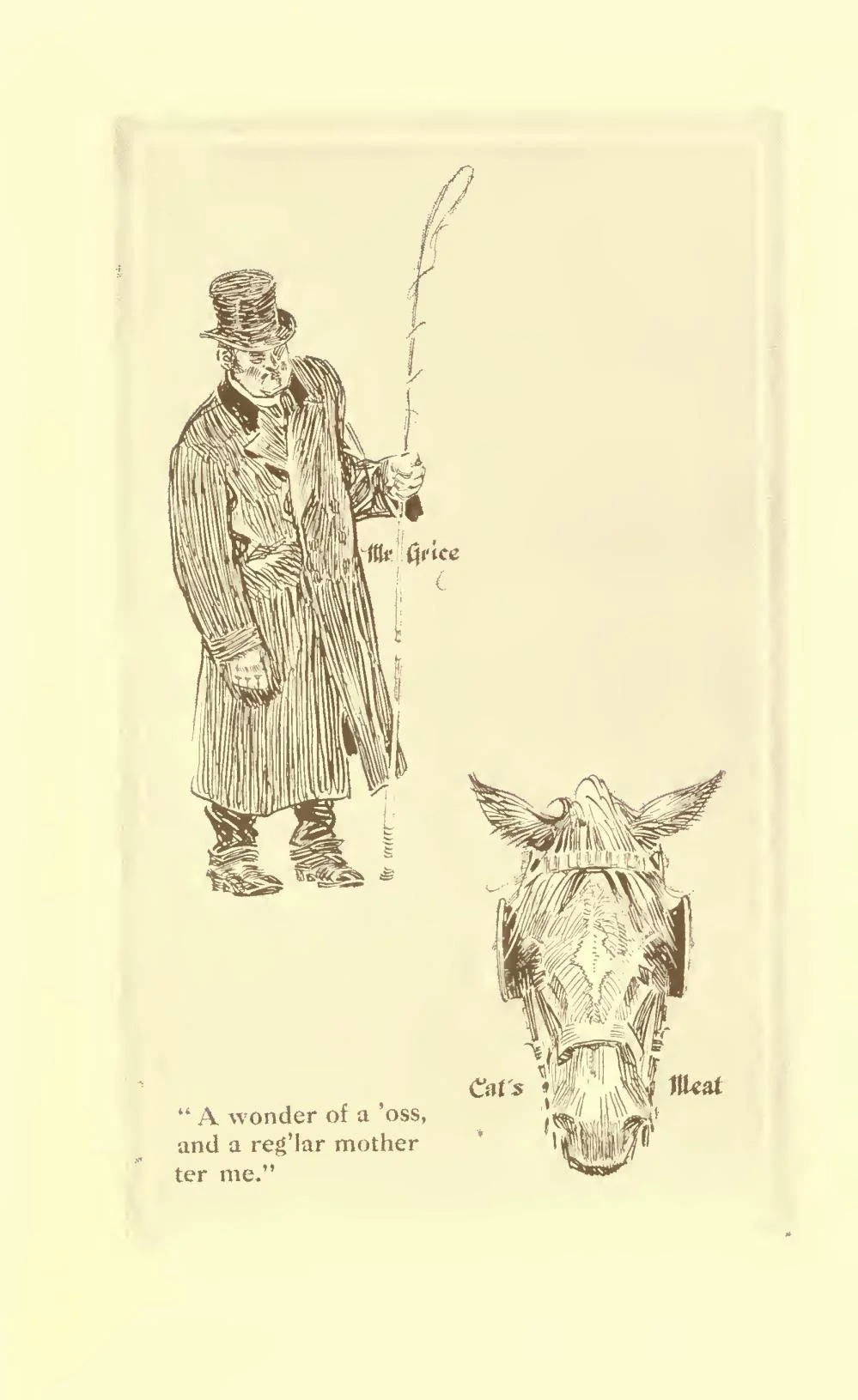

The revelers melted into the night down the shuttered street, leaving Mr. Grace with the disregarded hat of money, the dead horse sprawled across the broken shafts and a gentleman, from whose hand a pair of white spats dangled, contemplating the ruin disconsolately.
CHAPTER XLI—TREE-TOPS
Tree-Tops stood half-way up the hill, looking out across a terraced garden. At the foot of the hill lay a plain, where hamlets nestled beneath the wings of trees, and meadows washed about the shores of yellow wheat-lands like green rivers in flood. In blue pastures, beyond the edge of the horizon, white clouds wandered like browsing sheep.
The windows of Tree-Tops were latticed. The roof was thatched. It was no more than a converted cottage. It blinked at you as though it wore spectacles.
Behind it ran a Roman road, buried deep in the leaves of centuries. On the brow of the hill was a legionaries’ camp. To show where the road ended a white cross had been cut, by turning back the sod from the underlying chalk. Gathered about the camp in a half-circle, spreading back for miles through uplands, was a beech-forest whose leaves fluttered like green butterflies crucified on boughs of silver. Clouds trailed slowly over it, or hung snared in its topmost branches.
Over the shoulder of the hill, immediately behind the Faun Man’s house, lay a golf-course with vivid squares of close-cropped turf from which red flags waved angrily as poppies. Across the valley shone fields of mustard, like sunlight falling in sudden patches.
The Faun Man puzzled Curious Corner. The village might have been named in prophecy of his advent, with such extraordinary oddness did he conduct his household. Like birds hopping in and out of a hedge, his visitors came and went without knocking. Nobody tried to explain anybody; no one at Tree-Tops thought explanation necessary.
The women were young and dashing; certainly they were not married to the men. If they were wicked—which was never proved—they were decidedly light-hearted.
By day they played golf and rode horseback. By night they sat in the terraced garden, where fragrances wandered like old, sweet memories; there, to the tinkling of banjos and mandolins, they sang till dusk had brimmed the valleys and the moon sailed solitary. When their laughter had grown tired, a light would spring up in a room beneath the thatch where the Faun Man worked. Sometimes it would outstay the dawn. The villagers watched these doings from a distance. They wagged their heads.
But if Tree-Tops had the reputation for being wild, there could be no doubt that its master had money. He drove a four-in-hand from Oxford to London. He rode a horse called Satan, which no one could manage; it had killed two men already. And the money! He coined it with his pen—so it was reported.
But the inhabitants of Curious Corner never guessed the motive of all this frivolity: that the Faun Man wasn’t really living—was only distracting himself, till a woman with golden hair should nod, when life would commence.
And the golden woman! Peter saw her often: in Oxford; when he cycled out with Harry to Tree-Tops; during his vacations in London. He couldn’t believe what Harry told him—that she was cold and selfish. Everything that she did was tender, from the caressing way she had of speaking to the childish frankness with which she slipped her hand into his own when she was happy. She made everyone love her and everyone forgive her—everyone except Harry and Cherry. She had studied the art of appearing adorable, so that what in others were faults in her took on the glamour of attractions. She was so fond of the Faun Man—why didn’t she marry him? Peter didn’t know. He gave it up—shrugged his shoulders. Somewhere underground, as in his own life, the body of love lay buried. In the stillness, did he listen, he could hear jealousy gnawing—gnawing like a rat in the coffin of a dead princess. Once, in reading one of the Faun Man’s books, he came across a jotting in the margin, the thought of which had no bearing on the text. It was as though thwarted longing had cried aloud, suddenly becoming aware of its own tragedy. The sentence read: “Life is slipping away from us. I have tried to make you love me. And yet——.”
The bond of sympathy which existed between himself and the golden woman increased in strength and knowledge. He could talk to her of so many things concerning which he was silent to other people. Being in love, he had to talk to someone. She was so wise in the advice she gave him. By the patience with which she listened, she seemed to tell him that she herself had endured the same indifference. How that could be he did not understand. She encouraged him to make confession. It became a habit. Perhaps the trust which he placed in her flattered her. It may have been that his capacity for being so sheerly young tantalized her—she desired above all things to be always young herself. Without doubt his implicit faith in her goodness helped to silence her self-despisings.
But she was not above using their friendship as a means of provoking the Faun Man. She would slip her arm about Peter’s neck and say, “No chance for you now, Lorie.”
Her lover’s eyes would rest on her broodingly and film over, hiding his thoughts, “Oh, well, I have Cherry.” Even though Cherry knew that it was said in pretence, her face would grow radiant. It hurt Peter. He would willingly have given the best years of his life to make her care for him like that. It was then that he listened, and heard within himself the gnawing of the rat of jealousy.
Cherry—he made no progress with her. She seemed to like him, and she held him off. She avoided being left alone with him. In company there were times when she treated him with intimacy—times when she ignored him. While all his actions told her plainly that in his life she was the supreme interest, she seemed to go out of her way to inform him, without words, that in hers he was secondary. Then, when he had grown tired and had almost determined to cure himself, she would do something unexpected and considerate which kept him hoping. Only at parting did she allow herself to appear glad of him. She had the power of chilling him with her graciousness, while with her gray eyes she allured him. Cherry! Cherry! Her name set all his world to music.
One day he found her alone at Tree-Tops. She had fallen asleep in the bay-window, which looked out over the plain where the meadows flowed smoothly and the wheat-fields ripened. The others had left her—had gone over the shoulder of the hill to play golf. He had cycled out from Oxford without warning. Climbing through the steep garden, busy with the stir of birds and insects, he espied her curled up like a kitten among the cushions, her eyes fast shut and her breath coming softly. He stooped over her, tempted by the redness of her mouth. Her eyes opened. She showed no embarrassment—made no attempt to brush away her sleepiness. She did not move, but lay there meeting his gaze quietly.
He broke the silence. “Cherry, why do you always avoid touching me? We’re farther apart now than we were—were when we first met. I can’t surprise you any longer by telling you that I love you. And yet—and yet to me it’s still wonderful. Why do you always treat me as though I were nothing?”
“Do I? I don’t mean to.”
He sat down beside her and took her hand. “Shall I go away? If I went away you might learn to miss me.”
She turned toward him gently. “Please, please, Peter, don’t do that.”
“Then you do want me—you would miss me? I never know what you think of me. You never tell me—never betray yourself.”
She let her fingers nestle in his hand. “There’s only one Peter. Of course I’d miss you. I don’t need to tell you that. I like you very much, Peter.”
He looked away across the unheeding country. “Like! Yes, but liking isn’t loving.”
Voices were heard and footsteps approaching. She sat up hurriedly, smoothing out her dress. “I’d so much rather be friends. I’d be such a good little friend to you, Peter, if you’d only be content with that.”
Content with that! He shook his head.
“Cherry, I couldn’t.”
The Faun Man and the golden woman entered. They were laughing. “You always treat me in public as if we were alone together. Really, Lorie, I wish you——.”
Then she saw Peter seated close to Cherry. Her eyes saddened.
CHAPTER XLII—THE COACH-RIDE TO LONDON
I wonder why he doesn’t come!”
Peter stepped out of the college-lodge, gazing up and down the cobbled street.
Harry, always undisturbed and good-natured, laughed. “One can never be sure of Lorie. Looks as though it was going to rain. P’raps he’s put it off because of that.”
“If he had,” said Peter, “he’d have sent us word.”
For two hours they’d been inventing excuses for the Faun Man. He had told them to invite a party of their friends and he’d drive them to London. To go to London without permission was against all rules; but to ask permission would be useless, since most of the men, like Peter and Harry, were sitting for their Finals within the next fortnight. That they were taking a sporting chance of discovery lent a touch of daring to the excursion.
All of them had risen early and had been ready for the start since nine. It was nearly eleven. If the Faun Man didn’t turn up shortly they wouldn’t have time to cover the sixty odd miles to London and to catch the last train back. That last train back was very necessary. If they weren’t in college or their lodgings by midnight when doors were locked, there was no telling what would happen. Probably they’d get sent down, which would mean that they’d miss their Finals, and would either lose their degrees or have to wait a year before they were examined.
They were getting fidgety, pulling out and consulting their watches. Some of them were already saying that it was too late to risk it. A horn sounded. Peter glanced back from the road into the lodge and shouted, “Hi, you fellows! Here he comes.”
Round the corner swung the chestnut leaders, tossing their heads and jingling their bridles. As the wheelers followed and the coach drew into sight, an exclamation went up, “Why, he isn’t——”
They looked again to make certain. No, he wasn’t. Instead, a woman sat on the box, erect and lonely, perched high up, governing the reins with her small, thin hands. Her trim figure was clad in a dark blue suit, close-fitting as a riding-habit, with pale blue facings. Her hair was caught back into a loose knot against her neck and dressed so smoothly that it shone like metal. The effort of controlling the horses had brought a flush to her cheeks. Her eyes sparkled with mischief at the sensation she was creating. She reined in against the pavement, glancing down provocatively at the group of young men. She looked a goddess, and had the sense to know it. “Given up hoping for me,” she cried cheerfully; “is that it?”
Peter nodded. “Pretty nearly. But where’s the Faun Man and Cherry? Why are you driving?”
She shrugged her shoulders. “I’ll tell you later. Scramble up.”
They scrambled up, filling the roof and joking, all their high spirits and anticipation recovered.
“Ready.”
The guard sprang away from the leaders’ heads and clambered up behind as the coach started forward.
It was a gray day, with patches of blue gleaming through it, like light through holes in the roof of a tent. As they passed over Magdalen Bridge the willows shuddered and stooped above the water, prophesying that rain was coming. The moisture in the air made colors stand out sudden and separate. Even sounds seemed accentuated. From farmlands, near and far, live things called plaintively. Cocks bugled shrill alarms. Cattle waded restlessly knee-deep in summer meadows. Birds fluttered out of hedges, as if setting out on journeys; then thought better of it and hastily returned. Fields lay hushed. In contrast, the sky was torn and rutted. Clouds lurched forward, black and sullen, like artillery taking up positions. Detached wisps of mist hurried hither and thither, like isolated bands of cavalry. Through the brooding stillness the coach swayed onward. The horses’ hoofs rattled as castanet accompaniment to the laughter of conversation.
At the long, white inn of The Three Pigeons they changed horses, getting ready for the climb out of the valley past Ashton Rowant. The golden woman called to Peter to come and sit on the box beside her. She was a pleased child, patting his hand and smiling down at him side-long as he took his place. She treated him in public with the same affection that she used to him in private; she had complained of the Faun Man for treating her like that. Peter wondered.—Her eyes were immensely blue and wide this morning. She seemed no older than on that first day when he had seen her in the white room of the Happy Cottage. He watched her now, as she leant out with her whip to catch the reins which the ostler tossed up. How graceful she was, how determinedly young and buoyant!
He touched her. “You were going to tell me why Cherry and the Faun Man didn’t——.”
She broke in upon him. “Was I? Perhaps later. Can’t you forget Cherry just for once? I’m here and—and won’t you be content with only me for a little while, Peter?”
She spoke lightly, with a pretence at wounded feelings, and yet——. He had piqued her pride. He had noticed it before, especially of late—the same flippancy of tone and quick turning away of the head when Cherry’s name was mentioned. Harry explained it by saying that she was envious of any affection given to another woman.
The new team was full of fire—it took all her attention. “So, girl! So! Steady there. Steady!”
Peter knew these grays; he had heard the Faun Man speak of them, “Nervous as cats. Take a devil of a lot of holding.” She handled them like a veteran.
“Golden woman, you’re wonderful.”
She shrugged her shoulders coquettishly, raising her brows and laughing silently. Her eyes were between the leaders’ ears on the road in front of her. “I know. Can’t help it, Peter. It’s the way I was made.” And then, “But what an awfully long while you’ve taken to discover it.”
“I haven’t. But where was the good of my telling you? The Faun Man let’s you know it every day of your life.”
She pouted. “He does. But—but that isn’t the same.” Green pasture-lands of the valley were falling away behind. As they rose higher, woods sprang up, standing tiptoe, drinking in the clouds. The atmosphere grew more heavy and thunderous. The horses were walking now, scrambling for a foothold and zigzagging from side to side as they took the steep ascent. The men dropped off the coach to lighten it and went ahead.
Harry caught hold of Peter’s arm. “Where’s Lorie? Did she tell you?”
“No. When I ask her, she says, ‘Later, perhaps.’ Can’t get another word out of her.”
Then Harry saw a great light. “I bet you I’ve guessed. Something happened at the last minute to delay him. He’s coming over from Tree-Tops to join us at High Wycombe. He’ll be there with Cherry for lunch. It’s because of Cherry, to give you a surprise, that she won’t tell you.” At the top of the hill Peter took his place again beside the golden woman. He understood her air of mystery now and played up to it. In an instant all his world had changed. He was going to see Cherry. A new sparkle came into his eyes. The golden woman noticed it. “Hulloa! Wakened? What’s happened?”
“You’ve happened,” he said. “You’re a topper. You don’t mind my saying it, do you? You’re most awfully kind.”
She looked at him curiously. “Am I? What makes you say that?”
“I know what’s happened to the Faun Man and Cherry. You can keep your secret; but I had to thank you.”
“Thank me!” She fell silent.
He talked on in high spirits; it must have been the horses that suggested Mr. Grace. “He hasn’t been so bloomin’ prosp’rous lately—that’s his way of putting it—not since Cat’s Meat died. He has to hire his horse and cab now, and doesn’t seem to make much profit out of it. ‘Bloodsuckers!’ he says. ‘I ‘as ter give ‘em back all I earns—and that’s wot they calls ‘iring. Bloodsuckers!’”
As they came down the hill by Dashwood’s into High Wycombe, he ceased talking, casting his eyes ahead. He thought it just possible that Cherry and the Faun Man might have walked out to meet them. The guard was sounding his horn in long flourishes. They were in the town now, passing by the Market-place. Now the coach was drawing up before the hotel. No one was there to watch them descend except the ostler and some idlers. He hung about while the horses were taken out; every now and then he stepped into the road, trying to make himself believe that, if he waited long enough, he would see the girl with the red lips and gray eyes hurrying down the street toward him.
Harry came out. “Guessed wrong that time, didn’t I? Come along in. We’re having lunch.”
It was absurd, this anxiety that he felt—all out of proportion. And yet it was always like that when he was going to meet her—it was always like the first time. He never lost the thrill of choking gladness and surprise. Each time he discovered something new in her of sweetness, leaving him amazed at his former blindness.
Harry was speaking to the golden woman. “So they’re not coming?”
She crouched her chin against her shoulder, gazing at him innocently and wide-eyed. “Who?”
“Why, my brother and Cherry. What’s the secret? Look here, Eve, you ought to tell us. I’m certain he sent a message—some sort of an explanation.”
“Are you?” She gave him a tantalizing smile; then turned to Peter. “Peter shall know; perhaps before we reach London.”
There was a low rumble, followed by a crash. The rain came smashing against the panes. They pushed back their chairs and ran to look out. In an incredibly short time streets were flooded; gutters were turbulent with muddy rivers. Rain thudded against the pavement and sprayed up in little fountains.
“Doesn’t look to me,” said Harry, “as though we’ll ever get as far as London.”
“Got to,” said the golden woman.
The deluge commenced to slacken, but the storm still hung above the valley, moaning and grumbling. Rain swept like smoke across the house-tops.
Harry laughed. “Got to! You can’t drive a four-inhand to London through that. May as well make the best of it. We’ve to be back in Oxford before midnight, or else——. Perhaps there’s still time to do it. We’ll give it a chance.”
Some of the party burst into the room. “I say, you chaps, we’ve discovered a regular circus. Such a rum old cock! Come out and talk to him!”
The golden woman raised her head. “Why not bring him in here?”
“But we didn’t think you’d———.”
She lifted her hands and let them fall despairingly. “You men! How selfish you are, keeping everything that’s vulgar to yourselves!”
Scuffling sounded in the passage and a voice booming protests, “Not like this! It ain’t fitting. Not before a lady.”
A red-faced sailor, in the loose blouse and baggy trousers of the Royal Navy, was pushed through the doorway. In a deep bass voice he immediately commenced to excuse himself. “Not my fault, miss.” He tugged at an imaginary lock on his forehead. “I’m Mr. Taylor, I am—‘ome on a ‘oliday, tryin’ to find a nice gal wot’ll appreciate my h’un-doubted fine qualities.”
The golden woman stretched back her neck, half-closed her eyes and chuckled. “Are you sure you have any, Mr. Taylor?”
The man fumbled at his cap. “Used to ‘ave—used to sing terrible.”
“Sing terribly for me now, won’t you?”
He struck an attitude, flattered by the request, and hitched up his trousers. It was a ballad of betrayed maidenhood that he sang, solemn as a dirge and intended to be hugely affecting. It told of the home-coming, with her two babies, of a girl whose sweetheart had deserted her. It had a chorus in which, with an unhappy wag of his head, the sailorman signed to his audience to join:
“Go ring those village bells,
Let all the people know,
It was on a dark and stormy night,
One, two, three—perished in the snow.”
When they came to the enumerating of precisely how many perished, they stuck out their fingers three times. But some of them weren’t content with only three deaths in one family; they wanted to go on counting. Then the sailorman would stop singing and reprove them gently, “You know, young gen’lemen, that ain’t right. It ain’t fitting to joke on death.”
At last it occurred to him that something was amiss. “I’m afraid I’m a-makin’ a fool of meself.”
“Don’t mention it, Mr. Taylor,” they shouted.
Their answer didn’t reassure him, though they hurled it at him in varying keys many times. He insisted on leaving, making his exit backward because he had heard that a gentleman must always keep his face toward a lady.
The rain was over. The sky had a sorry look for having been petulant. The sun, though he still refused to come out, hung golden ladders from the clouds. They stepped into the street, gazing up and feeling the air with their hands.
“What about it?” asked Harry.
“Why, of course we’re going,” said the golden woman. Her eyes met Peter’s; they seemed to beg him not to call off, but to accompany her. Why was she so insistent about getting him to London? Who was waiting there? Why wouldn’t she tell him anything about the Faun Man or Cherry? He calculated how long the drive would take. They were not quite half-way. If they continued the journey they’d barely catch that last train back. Again he recognized the appeal in her eyes.
“What about it? What do you say, Peter?”
“I? Why, I’m game. I’m going.”
Some of the men refused. The party was reduced to six when they started.
What a wet clean world they entered! It had all been made new and, somehow, tender. The spray of rain was still in the air; it swept against their faces coolly, vanished unexplained, and touched them again without warning. In meadows and tree-tops there was a continual muffled patter, as of little unseen people treading softly. From the back seats came bursts of laughter and snatches of song, mimicking Mr. Taylor’s impressive chorus:
“It was on a dark and stormy night,
One, two, three—perished in the snow.”
The golden woman bent her head aside, “Tryin’ to find a nice gal wot’ll appreciate my undoubted fine qualities! That’s what all you men are doing.”
“Oh, I don’t know.”
“Yes, you are, from the minute you put on long trousers to the last moment when you step into the grave. Men don’t find her often; when they do, as likely as not she doesn’t want them.”
“I know a little about that,” said Peter; “so does Lorie. Women aren’t very kind to the men who love them.”
“Oh, aren’t they!” She flicked at the leaders so that they leapt like stags. “You’re young; you need civilizing. You don’t know nothin’, as that sailorman would say. How many marriages are made for love? They’re made because women are kind. Many a woman marries because she can listen to a man talking all about himself without letting him see that she is bored by it. Happiness is the only reality; and love—love’s almost, almost a delusion.”
Peter looked at her quietly. She could say jaded things like that when she was made so beautifully—when everyone turned to look after her—when the finest man in the world would give his life to save her from pain! What had God done with the years of her life? She never looked any older. And she wasn’t grateful. Perhaps, after all, Harry was right—all her goodness had been put into the perfection of her body, and her soul had suffered.
She was aware that his eyes rested on her in judgment. She tried to refrain from the impulse. Turning, she flashed on him a sudden smile. “Too bad to say things like that to you—you who hope for so much from life! What’s the trouble?”
“I was thinking.”
“Thinking?”
He spoke slowly, “That love only seems a delusion to people who refuse to be loving.”
A common-land sprang up; geese wandered across it. Evening was falling early, washing colors from the landscape, blurring everything with its watery light. The sky stooped near to earth, threatening to tumble, monstrous with bulging clouds.
They drew up at the inn at Gerrard’s Cross. Peter climbed down to stretch his legs while the horses were being changed. He found his friends gathered about a timetable, peering over the shoulders of the man who held it.
“We’re not going to manage it,” one was saying. “There’s another storm brewing. Besides, we’re not making haste—going as leisurely as if we had all the day before us. Nothing for it, we’ll have to drop off and go back by train.”
“There’s a train leaving here in half an hour,” said the man who held the time-table. “I’m going to catch it. Getting sent down just before your Finals isn’t good enough.” Harry interrupted. “Before we decide anything, we’d better go out and speak to her.”
The case was explained to the golden woman. They were most awfully sorry. It wasn’t very gallant conduct on their part; but what other choice had they? Wouldn’t she leave the horses and the guard at the inn, and come back with them to Oxford? Or could they see her on the train to Paddington? Having told the guard to go on with the harnessing, she listened to them quietly. When they had finished she said, “Peter and I are going to drive to London. You’re willing to take a chance, aren’t you, Peter?”
He broke into his boyish laugh. “It’ll be sport. I’ll chance it.”
As the coach moved off he turned and waved to the others, who stood watching from the common. The guard from his back seat, raising the horn, gave them a farewell flourish. In his heart of hearts Peter wished that he were among them. But——. Well, the golden woman had a secret. She was going to tell it to him. It had something to do with Cherry. And it wouldn’t have been decent to have left her to finish the drive alone to London. He’d get the last train back from Paddington, barring accidents.
She was speaking to him. “That’s better. At last we’re alone together.”
“Do you think we’ll do it?” he asked. .
“Do what?”
“Get there in time.”
She drew her brows together. “Peter, Peter, what does it matter? You take life so seriously.”
They laughed.
“What are you going to do with it?” she asked. He looked puzzled. “With life, I mean,” she added.
“Don’t know. It depends.”
“On what?”
“People,” he answered vaguely, taking care to avoid mentioning Cherry. “I may travel for a year. Perhaps Kay will come with me. After that I’m going into my father’s business.”
The golden woman’s face became grave; beneath its gravity was a flame of excitement. Her voice trembled and reached him softly. “That’s not what I meant. That’s not doing anything with life. Those things are incidents—externals. I meant, are you going to live life, or are you going to miss everything? Life’s an ocean, full of enduring, dotted with a few islands. Are you going to be an explorer—or are you going to miss everything?”
Odd that she, of all persons, should have asked him that! He remembered how Harry had said that she was a ship, always setting sail for new lands and never coming to anchor.
“An explorer! I’ll first see the islands.”
A strand of her hair broke loose and fluttered about her eyes. “I can’t put it back,” she said. “I wish you’d do it.” Her hands were occupied with the reins. He leant across her. As his face came under hers, she held her breath. To him it was nothing. The horses, feeling her hands go slack, broke into a gallop; for a moment she lost control of them. When she had quieted them, she turned to him impulsively, “Peter, you’re a darling.” Her eyes held his with an expression of appeal and challenge; then faltered, as though they were afraid to look at him.
Her excitement communicated itself. He was embarrassed. He didn’t understand. He guessed that she was in trouble and was asking for his kindness. “Golden woman, how easily you and I say things like that. If Cherry had said it to me, or if you had said it to the Faun Man, how much more——.”
She cut him short. “Don’t.”
They had traveled half a mile in silence, when she whispered, “It wasn’t easily said.”
In the west, behind them, the sky began to burn. Little tongues of flame licked the edges of black clouds. Mists writhed and drove across the sinking sun. Peter stood up in his seat, looking back; it was a glimpse of hell. He glanced ahead—everything over there was blackness. Trees looked blasted; they bowed their heads. Roads and fields were empty. There was no life, no color in the meadows.
“We’re in for it,” he said.
Rain began to patter, softly at first. Wind was getting up and breathed across the country in a long sigh. He spread a coat across the golden woman’s shoulders. She didn’t thank him. Gathering the reins more firmly in her hands, she whipped up the horses.
Their heads were bent together. Behind them, out of ear-shot on the back-seat, the guard huddled. She spoke. “We’re going to be late. I intended we should be late. I wanted to get rid of the others. I knew that you’d stick by me.”
And again she said, “You were talking of women not being kind.—— Men aren’t kind to the women who love them.”
She had changed. Her face had sharpened out of its contentment. Usually its expression was lazy and laughing, but now——. Pain had come into it. It was intense and thin with purpose; it was purpose she had always lacked. He tried to find a word for the new thing that he found in her. Was it only the distortion that the storm was working? A flash of lightning slit the heavens; it ripped the clouds like a red-hot blade. A shattering crash! The dynamite of the gods exploding! Darkness came down. Another flash! Trees leant forward, like fugitives with arms extended. And she—her face was white and dominant. It looked beautiful and Medusa-like—snakes of loosened hair blew about it. She no longer crouched her head. She sat tall and defiant, the rain splashing down on her. What strength she had in her hands! She held in the quivering horses, speaking to them now harshly, now caressingly. They pricked up their ears, listening for her voice. He found the word for the new thing that had come to her. It was passion.
“Come nearer. What did you mean when you told me you had guessed my secret?”
“The Faun Man——”
She took him up. “Yes, Lorie—he and I had our first quarrel this morning. We’ve both wasted our lives, waiting for something—something that could never happen.”
“Why never?”
“Because I can’t bring myself to—not in his way. He told me this morning——. It doesn’t matter what he told me. It hurt me to hear him speak like that, so strongly and quietly and sadly. Lorie and I, we’ve drifted—let life slip by. We’ve wakened; we’re tired.” Then, like a child, appealing against injustice. “He said I hadn’t a heart—that I was made of stone, not like other women. It’s not true that I’m different—is it, Peter?” And again, “Is it, Peter?” And then, “It hurt to be blamed for not giving—giving what would be his to take, if he were the right man.”
“The right man! That’s what Cherry says. How does a woman know who is the right man?”
She avoided a direct answer. “The right man is always born too late or too early; or else he’s wasting himself on someone who doesn’t want him.”
It was a city of the dead that they were entering. Rain swept the streets in sudden and vindictive volleys. Lamps shone weakly; some were extinguished. Few people were about. At Ealing they halted for their last change.
“Won’t be goin’ any further?” the guard suggested.
When he was informed to the contrary, he glanced up at the drenched faces. He seemed to see a thing that startled him. “Blime!” While he hurried the ostlers with the harnessing, he tried not to look at those white patches in the dusk; his eyes returned to them, unwillingly fascinated. When he had released the leaders’ heads, he stepped back and swung himself up behind as the coach lunged into the storm.
There was barely time to reach Paddington. Peter calculated. If he missed the train, the consequences would be grave. He asked the golden woman to hurry. She listened, but made no attempt to quicken their pace. She didn’t seem at all disturbed by his dilemma. He almost suspected her of holding in the horses. Too late to leave her now! As they trotted through the premature night, he began to ask himself questions. Why had she been so determined to finish the journey? Why had she shown such eagerness to be alone with him?
He leant forward. “Where’s Lorie?”
“In London.”
“And Cherry?”
She tossed her head impatiently, “With you, it’s always Cherry.”
“Well then, Lorie—is he going to meet us?”
“If he does, what difference will it make?”
“To me? Not much. But to you—you’ll know then, and you’ll be happy.”
“Shall I?”
Her indifference spurred him into earnestness. From differing points of view, the golden woman and Cherry used the same arguments. If he could convince her, he could perhaps convince Cherry. In fighting for the Faun Man, it was his own battle he was fighting.
“You don’t know yourself, golden woman—you don’t know his value. He’s become a habit—you’ll miss him terribly. He’s been too extravagant in the giving of himself. He’s made you selfish. If you were to lose him, if suddenly from giving you everything, he were to give you nothing——-”
Her voice reached him bitterly. “That’s what he threatens—to starve me after giving me everything. He didn’t say it in those words, but——. What do I care?”
“You do care. You’re caring now. All day long you’ve been caring. If he isn’t there to meet us——.”
“I shall be glad.”
“You won’t.” He spoke eagerly. “You won’t. To-night you may think you’ll be glad, but to-morrow—to-morrow you’ll be without him. Just think, you’ve kept him marking time all these years. He’s expected and expected. You’ve banked on him—felt safe because of him. You’re foolish. You can’t cheat at the game of life—you can’t even cheat yourself; in the end you’re bound to play fair.”
She didn’t answer.
“You won’t be glad if he’s not there.”
Silence.
“Is he going to meet us?”
“If he doesn’t—— She went no further.
“Will Cherry be there?”
Her face flashed down on him, white and stabbing. “Again. Always Cherry.”
Later she whispered, “Forgive me, Peter.”
Without a word, they passed through tunnels of muted houses. The sky closed down on them. The rain drew a curtain about them. The slap of the horses’ hoofs upon the paving started echoes. Traffic slipped by them spectrelike, as if moving in another world. Now it was between shuttered shops of Regent Street that they trotted. At last Trafalgar Square, vast and chaotic, a pagan temple from which the roof had fallen!
They strained forward from the box, searching through the darkness. From the entrance to The MÃÆétropole light streamed across the pavement. It was the end of their journey. As the horn sounded, a man stepped out from shelter. For a moment—but no; he had only been sent to take the coach to the stables. As they clattered to a standstill, several guests came out on to the steps of the hotel to watch them. The guard climbed down and ran to the leaders’ heads. No one was there to greet them—no one who was familiar.
She laughed high up, excitedly, “What did I tell you?”
“Not there,” he agreed reluctantly; “neither of them.” She touched his hand and caught her breath. “As I said—neither of them care. You and I—we’re still alone.” He was sorry for her, guessing her disappointment. Had Lorie been there it would have spelt forgiveness. Big Ben boomed ten. He started. “Hulloa! I’m dished. I can’t get back.”
“You’re not going back? You don’t want to leave me? Say you don’t.”
He was embarrassed. He didn’t know what to make of her. She was on his hands; he ought to be in Oxford. Evidently she had been harder hit than she acknowledged. He tried to speak cheerfully. “Look here, it’s time we became sensible. That chap’s waiting for us to scramble down—he wants to take the horses. Let’s go into the hotel. I’ll engage a room for you—high time you got those wet things off. Nice little mess we’ve made of it! When I’ve seen you settled, I’ll toddle off to Topbury and spend the night with my people.”
“Will you?”
She glanced at him slantingly. To his immense surprise, she brought the whip down smartly across the horses. As the leaders darted forward the guard, taken unaware, was thrown off his balance. As Peter looked back through the steaming mist, he saw him picking himself up from the pavement, waving his arms and shouting.
Utterly bewildered by her shifting moods, he turned to her, “You’ve left that chap behind.—— I wish you’d tell me what the game is. I don’t want you to drive me to Topbury and, anyhow, the Embankment’s all out of the direction.”
“I’m not driving you to Topbury, stupid.”
He spoke more sternly, “Seriously, you must tell me. You’ve brought me to London and—by Jove, I almost believe you tried to make me miss my train. It isn’t sporting. Why don’t you turn back to The MÃÆétropole. I’ll get you a room and——.”
“Too many people to see us,” she said shortly.
He had only one means of stopping her—to catch hold of the reins. Too risky! He gazed about him, wondering what to do. They were traversing the Embankment—it was empty save for outcasts huddled on benches like corpses. The night looked sodden. The river gleamed murkily. Lights on bridges, hanging like chains, shone obscurely.
She was mocking him in low caressing tones. “You don’t want to leave me? Say you don’t.”
The odd repetition of the question struck him. He had missed its first significance. It couldn’t be! He pressed nearer, peering into her face. He caught the hungry pleading in her eyes—the mad defiance. “You mean——? You never meant——. Eve, you’re too good a woman.”
She halted the horses, and gazed down on him smilingly. She shook her head slowly, denying his assertion of her goodness. “You hadn’t guessed?”
“Guessed!” He drew himself upright. The passion in her voice appalled him.
Her arms went about him; cold wet lips were pressing his mouth. “You dear boy-man! You dear boy-man!”
He thrust her from him. He was choking. Her lips—they scorched him. He had seen in all women’s faces the likeness to his mother’s and Kay’s. But now——.
A bedraggled creature, in tattered finery, with a broken plume nodding evilly across her forehead, struggled from a bench, shuffled across the pavement and whined up at him. He took no notice. He tried not to believe what had been meant. Through their nervous silence trees shuddered; the muffled skirmish of the rain thudded.
The golden woman was watching him. A gleam of hatred in her eyes at first—the reflection of his own loathing. Then, as pity replaced his loathing, a look of horror spread. She sank her face in her hands; her fingers locked and twisted. She looked like one who had become sane, and remembered her madness. “What am I? What have I done?” She whispered the questions over and over; the storm beat down upon her shoulders. He sat like one turned to stone, not daring to touch her, powerless to put his pity into words.—— And of this the bedraggled street-walker, whining up from the pavement, was sole witness.
A policeman tramped heavy-footed out of the distance. “‘Ere you, none o’ that. ‘Urry along.” This to the streetwalker. To the golden woman, “H’anything the matter with the ‘osses, me lady?”
She came to herself. The street-walker was limping into the shadows. Her eyes followed her with fascination. She felt for her purse; not finding it, she commenced unfastening the brooch that was at her neck. Seeing her intention, Peter put his hand in his pocket. She stayed him with an impatient gesture.
Calling to the woman, she leant down from the box and said something.
The policeman waited stolidly. He repeated his question, “H’anything the matter with the ‘osses, me lady?”
“No.”
She swung the coach round. There was no explanation.
Of that wild drive back through the night Peter saved but a blurred remembrance. Scarcely a word was spoken—there was nothing that could be said. After they had struck the open country, they went at a gallop most of the journey. Every now and then they drew up at a darkened inn. He climbed down from the box and hammered on a closed door. A window opened. A rapid explanation. Grumbling. Sleepy men appeared, only partly dressed, carrying lanterns. Horses were taken out and a fresh team harnessed. As the dawn came up, pale and haggard, he saw her face; it was hard-lipped and ashen. He would never forget it. Every year showed. The golden hair had broken loose; it was the only young thing left. She was no longer the golden woman; he drove that night beside the figure of repentance.
Hills taken cruelly at a gallop! Cocks crowing! Unawakened towns! The waking country! He pieced her into his experience. What was it that women wanted? To be married and not to be married? To accept the flattery of being loved and not to return it? Riska, his Aunt Jehane, Glory, Cherry—all the women he had known—they passed before him. He tried to read their eyes. Their heads were bowed; all that he could learn of them was the pathetic frailty of their bodies.
Marching through the meadows came Oxford, its spires indomitably pointed against the clouds. Now they were traveling the austere length of High Street. At Carfax they turned. On Folly Bridge they drew up.
She had brought him back. He wanted to say something generous.
“Lorie, he loves you. If he asks you again——”
She nodded. “If he asks me,” she said brokenly.
He walked along the edge of the river, golden in the early summer’s morning, silver with mists curling from off it. He plunged in at a point opposite the Calvary barge. As he swam, he looked back. From the coach, high on the arch of the bridge, her eyes followed him. Just before he landed, she raised the whip; the horses strained forward.
Running through the meadows, he came to the wall which went about Calvary, found a foothold and dropped safely over. After he had undressed, he hid his dripping clothing. He was in bed and sleeping soundly, when later in the morning his scout came to wake him.
CHAPTER XLIII—AN UNFINISHED POEM
Strong sunlight streamed across the foot of his bed. Below, in the quad, he could hear the clatter of breakfast-dishes being cleared away. Fumbling beneath his pillow, he pulled out his watch. Ten o’clock! Time he dressed and got to work! Less than a fortnight till his Finals, and he’d lost a day already!
A sound of running on the stairs! Someone was entering his outer room.
“Hulloa! I’m still in bed. Who is it?”
The bedroom door flew open. Harry stood panting on the threshold, holding a London paper in his hand. For all his haste, he didn’t say a word. He simply stared—stared rather weakly and stupidly, as though he’d forgotten what he’d come about. His lips quivered. The twitching of his fingers made the paper crackle.
Peter raised himself on his elbow. “Got back all right, old man. Why—.” He saw Harry’s face clearly; it was drawn and ghastly. “Don’t look like that. What is it? For God’s sake, tell me.”
“Dead.”
“Dead?”
He threw back the clothes, leapt out and snatched the paper. Standing in the sunlight he caught the head-line, TO SAVE OTHERS. His eyes skipped the matter below it, gathering the sense: “At the crowded hour—in Hyde Park yesterday afternoon—lost control of his horse, Satan—bolted to where children were playing—swerved aside—rode purposely into an iron fence—thrown and broke his neck.”
The paper fell from his hand. He picked it up and reread it. Some mistake! He wouldn’t believe it. The Faun Man dead! He’d been so brimming with life. Never again to hear his mandolin strumming! Never again to hear his gallant laughter! To walk through the roses at Tree-Tops—and he would not be there!
Peter sat down on the edge of the bed, clenching his forehead in his hands. The voice, the gestures, everything—everything that had been so essentially the Faun Man he wanted to recall before he could forget.
“If yer gal ain’t all yer thought ‘er
And for everyfing yer’ve bought ‘er
She don’t seem to care——-”
He could see him bending over the strings slyly smiling. He had been of such high courage that he could coin humor, out of his own unhappiness.
Then, like a minor air played softly, “Lorie, he loves you. If he asks you again—-” and the golden woman’s broken assent, “If he asks me.”
She had kept him waiting too long. He had asked her for the last time that morning. He couldn’t ask her again, however much she desired it—couldn’t. She’d blamed him for his first neglect of her—had made it an excuse for her own unfaithfulness. He hadn’t met her. His neglect of her had been simply that he was dead.
Word came two days later—they had brought him home to Tree-Tops. That evening Peter gained leave of absence.
Whitesheaves! The name was embroidered in geraniums on the velvet of the close-cut turf. The train halted long enough for him to alight, then pulled out puffing laboriously. It seemed an affront that people should be journeying when across the fields the Faun Man lay, his journey forever at an end. Only one other passenger got out—a young chap, in flannels and a straw-hat, who was instantly embraced by a radiant-faced girl. They sauntered arm-inarm to where a dog-cart was standing and drove away into the evening stillness, their heads bent together, their laughter floating back in snatches.
Peter set out reluctantly by a short-cut through wheat-fields. He didn’t want to prove to himself that it had happened. He was trying to imagine that he had come on one of his surprise visits. He would find the Faun Man dreaming, sprawled like a lean hound in the twilight of the terraced garden.
The sun hung large and low in the west. A breeze swept the country with a contented humming, bowing the heads of the corn. In the distance, above Curious Corner, chiseled in the greenness of the hill the white cross glistened. Through trees a spire shot up. Beneath boughs thatched roofs of the village showed faintly. He rounded a bend; the house to which he was going gazed down on him. It hadn’t the look of a house of death. Its windows shone valiantly above the pallor of the rose-garden, out-staring the splendor of the fading west.
He climbed the red-tiled path—came to the threshold. The door was hospitably open. Like birds hopping in and out of a hedge, the breeze and the fragrance of flowers came and went. He knocked. No one answered. He tiptoed in. A breathless silence! Mounting the stairs, he came to the door with the iron latch, which gave entrance to the Faun Man’s bedroom.
Flowers! He had always loved flowers. They were strewn on a bed unnaturally white and unruffled. An unnatural peace was everywhere. The sheet was turned back from the face; the brown slight hands stretched straightly down. Each was held by a woman who knelt beside him with her head bowed. The attitude of the women was tragic with jealousy.
How long and graceful he looked in death! How gaunt and tired! All the striving, the brave pretending, the famished yearning which he had disguised showed plainly now. A smile hung about the corners of his mouth—a little mocking perhaps, yet tender. A bruise was on his forehead. He had the look of one who, having been puzzled, understood life at last and was content.
Peter felt that he had intruded. He had no right to stay there. Those bowed heads reproached him. He felt what men often feel when death is present: the body had been put out to usury; at the end of the trafficking it belonged to women, as it had belonged to a woman before the trafficking commenced.
He wandered out into the garden. Twilight weakened into darkness. His feet were always coming back to the window; he stood beneath it, looking up to where she knelt. If it were only for a moment, surely she would come to him. Again he entered. No stir of life in the house. He peered into the bedroom. She had not moved since he left.
Beyond her was the door which led into the Faun Man’s study. Noiselessly he stole across to it and raised the latch.
The room was in darkness. Set against the open window was a desk. Moonlight drifted in on it. A chair was pushed back from it. A pen lay carelessly on the blotting-pad, waiting for the master to return. Here it was possible to believe that the mind still lived and worked.
A movement! He stretched out his hand. Someone rose. Into the shaft of moonlight came the face of a man. “Oh—oh, it’s you, Harry!”
He struck a match and lit the lamp. They talked softly, in short whispered sentences. On the floor, on tables, on chairs, books and manuscripts lay scattered. The breeze blowing in at the window turned pages, as though an invisible person were searching. A sheet of paper, lying uppermost on the desk, fluttered across the room to where Harry sat. He stooped, picked it up, ran his eye over it and handed it to Peter. “The last thing he wrote. Thinking of her to the end.”
Peter took it and read,
“She came to me and the world was glad—
‘Twas winter, but hedges leapt white with May;
With snow of flowers my fields were clad,
Madly and merrily passed each day,
And next day and next day—
While all around
By others naught but the ice was found.
‘O ungrateful heart, were you ever sad?
She was coming to you from the first,’ I said.
She turned to me her eager head,
Clutching at what my thoughts did say.
“She went from me and the world was sad—
‘Twas spring-time and hedges were all a-sway;
With snow of winter my fields were clad,
Darkly and drearily passed each day,
And next day and next day—
While all around
By others naught but spring-buds were found.
‘O foolish heart, were you ever glad?
She was going from you from the first,’ I said.
She turned to me her eager head,
Clutching at what my thoughts did say.”
“Like his life—an unfinished poem.” Peter leant out to return it to Harry, but found that he had fallen asleep in his chair.
The lamp burnt itself out. The chill of dawn was in the air. Through the window the sky was gathering color, like life coming back to the cheeks of the dead. The door opened slowly. Stiff with long sitting he staggered to his feet. “Cherry!”
Pressing her finger against her lips, she motioned him to be silent. Glancing at Harry she whispered, “The first sleep in two days, poor fellow.”
As he followed her across the dusk of the bed-chamber, a pool of gold caught his attention; it glittered on the pillow by the face of the Faun Man. The golden woman lay crouched like a pantheress beside the body, her eyes half-shut and heavy with watching.
In the pallor of the rose-garden Cherry halted. She gave him both her hands. “We can never be more to one another. Since this—I’m quite certain now. I always wanted to be only friends.”
The heart of the waking world stopped beating. His hope was ended. Clasping her hands against his breast, he drew her to him. She gave him her cold lips. “For the last time.” She turned. He heard her slow feet trailing up the stairs.
As he walked to the station through rustling wheat-fields the sun lifted up his scarlet head, shaking free his hair, like a diver coming to the surface at the end of a long plunge. Birds rose singing out of corn and hedges, proclaiming that another summer’s day had commenced. But Peter—he heard nothing, saw nothing of the gladness. He saw only the final jest—the smile, half-mocking, half-tender, that hung about the Faun Man’s mouth; and he heard Cherry’s words, “I always wanted to be only friends.”
CHAPTER XLIV—IN SEARCH OF YOUNGNESS
To you I owns h’up; I ‘as me little failin’s, especially since Cat’s Meat———He could never mention Cat’s Meat without wiping his eyes. “But if I ‘as me little failin’s, that ain’t no reason for callin’ me Judas His Chariot and h’other scripture nimes. She’s a dustpot, that’s wot she is, my darter Grice.”
“A what?” asked Peter.
Mr. Grice was surprised that a man just down from Oxford shouldn’t know the word; he was flattered to find himself in a position to explain.
“A dustpot,” he repeated. “That means a child wot sits on ‘er father’s ‘ead.”
“Oh, a despot!”
Mr. Grace had learnt to be patient under correction. “Now, Master Peter, ain’t that wot I said? I sez, ‘She’s a dustpot’; then you sez, ‘Oh, a dustpot!’ ‘Owever yer calls it, that’s wot I calls ‘er.”
They were sitting in an empty cab in the stable from which Mr. Grice hired his conveyance. Peter touched the old man’s hand affectionately. “I’ve been wondering—thinking about you. You know, I’m going traveling with Kay. My friend, the Faun Man, left me a thousand pounds to buy what he called ‘a year of youngness.’ He was great on youngness, was the Faun Man.”
Mr. Grace nodded. His eyes twinkled. “Remember that night, Peter, and the song ‘e made h’up about yer?
‘Oh, Peter wuz ‘is nime,
So Peterish wuz ‘e,
‘E wept the sun’s h’eye back agen,
Lest ‘e should never see.‘=
H’I orften ‘um it ter the ‘osses when h’I’m a-groomin’ of ‘em. Sorter soothes ‘em—maikes ‘em stand quiet.”
“I remember,” said Peter; “but here’s what I was going to say: you hav’n’t had an awful lot of youngness in your life and yet you’re—how old, Mr. Grace? Seventy? I should have guessed sixty. Well, it doesn’t seem fair that I——.”
“Nar then, Master Peter! H’it’s fair enough. Don’t you go a-wastin’ o’ yer h’imagination. I don’t need no pityin’.”
“But it doesn’t seem fair, really; so I’m going to make you an offer—a very queer offer. How’d you like to live in the country and get away from Grace?”
“‘Ow’d I like it? ‘Ow’d a fly like ter git h’out o’ the treacle? ‘Ow’d a dawg like ter find ‘isself rid o’ fleas? ‘Ow’d a——? Gawd bless me soul—meanin’ no prefanity —wot a bloomin’ silly quesching!” He paused reflectively. “But a dawg, Master Peter, gits sorter useter ‘is fleas, and a fly might kinder miss the treacle. H’I’d like it well enough; but if there warn’t nothink ter taik me thoughts h’orf o’ meself, I’d feel lonesome wivout ‘er naggin’.”
Peter laughed. “I’ll give you something to do with your thoughts. My Uncle Ocky——.”
Mr. Grace woke up, turned ponderously and surveyed Peter. “That’s h’it, is h’it? That awright. Rum old card, yer uncle! H’I never fancied as h’I’d let h’anyone taik the plaice wot Cat’s Meat ‘eld in me h’affections. ‘E ‘as. Tells me h’all ‘is troubles, ‘e does. Life’s gone ‘ard wiv ‘im since Mr. Widder sent ‘im packin.’ My fault—I’m not denyin’ h’it. We ‘as our glass tergether and we both ‘ates wimmen—or sez we does. ‘E borrers a bit from me nar and then. Mr. Waffles and me is good pals—we ‘as lots in common. You, for h’instance.”
Peter inquired from Mr. Grace where he would be likeliest to find his uncle.
“Likeliest! H’if yer puts it that waie, h’I should saie yer’d be likeliest ter find ‘im in a pub.”
Out of the tail of his eye Ocky saw Peter entering.
“Horrid stuff,” he said loudly; then in a whisper to the barmaid, “Give me another three penn’orth.—— Why, hulloa, old son!”
Peter led him into a private room and said he’d pay for it. “D’you remember that night at the Trocadero—you know, when Glory was with us. I told you what I’d do for you if I ever had money. Suppose I could give you a chance to pull straight, what would you do with it?”
Tears came into Ocky’s eyes; he’d grown unused to kindness. “Is it the truth you’re wanting, Peter?—— If you gave me the chance to pull straight, I’d do what I’ve always done—mess it.”
Peter shook his head incredulously and smiled. “Don’t believe you. You’d pull straight fast enough if you knew that anyone cared for you.”
“No one does, except you, Peter.”
“Oh yes, there’s someone—someone whom you and I, yes, and I believe all of us, are always forgetting.”
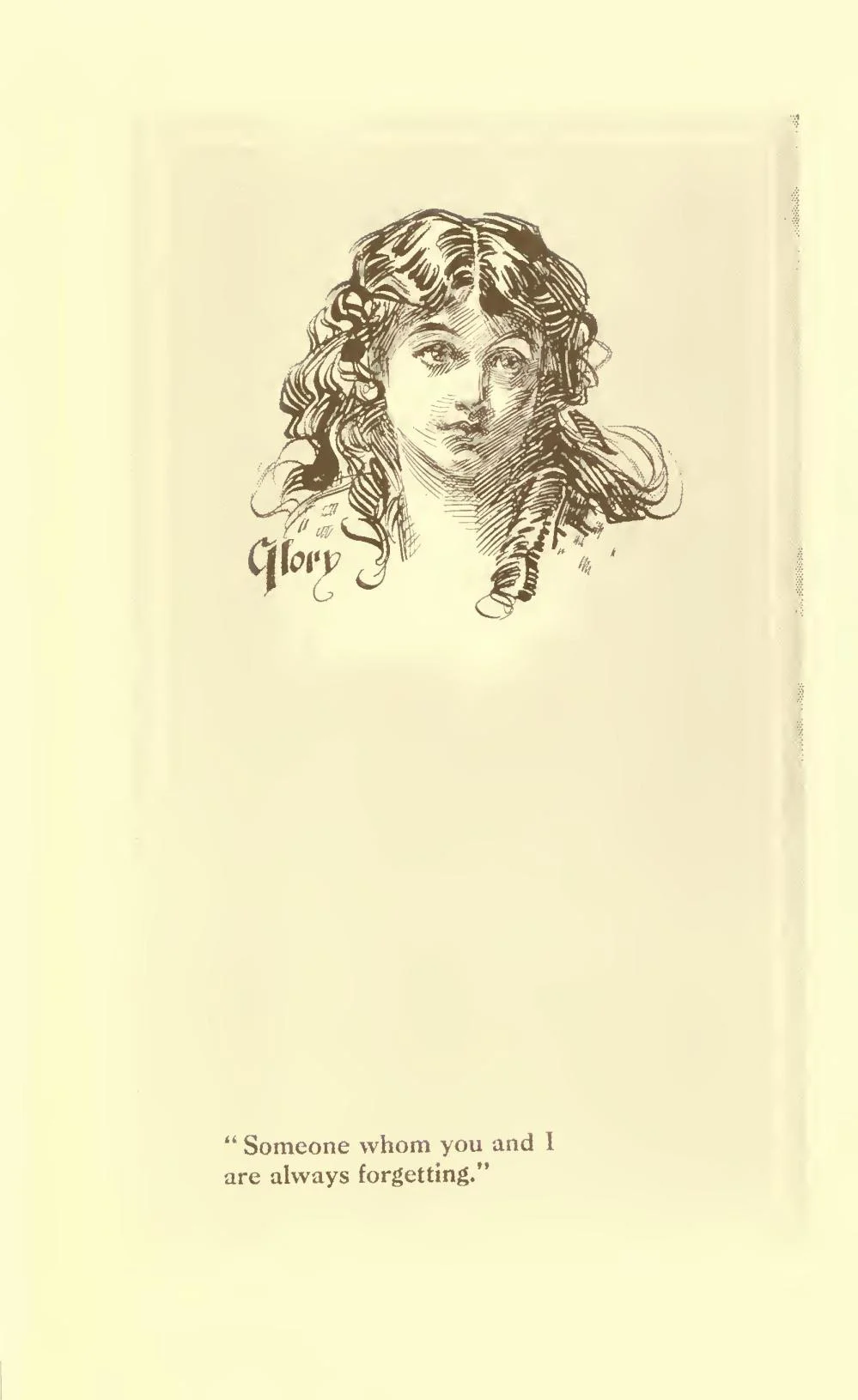

Ocky looked up slowly. “You mean Glory.” He leant across the table, tapping with his trembling fingers. “Know why I went to hell?—it sounds weak to say it. I went to hell because I had no woman to hold me back with love. If I could have Glory—-. But she’ll be thinking of marrying. I’ve spoilt her chances enough already.”
“If you could have Glory,” Peter insisted, “and if you were to have, say, five hundred pounds, what would you do then?”
“The truth again?”
“Nothing else would be of any use, would it?”
“If I had five hundred pounds and Glory, I’d move into the country and buy a pub. I’ve lived to be over fifty, I’ve learnt only one bit of knowledge from life.”
“What is it?”
Ocky flushed. “To you I’m ashamed to say it.”
“Never mind. Say it.”
Ocky twirled his mustaches, covering his confusion, “To know good beer when I taste it.”
Peter leant back laughing, “That’s something to start on, isn’t it?”
Next day he told Glory, “They’re willing—both of ‘em.”
In searching the papers for advertisements, he came upon an announcement.
Near Henley, The Winged Thrush. Comfortable riverside hostelry; pleasantly situated; suitable for artist or poet, desirous of combining lucrative business with pleasure, etc. A bargain. Reason for selling, going to Australia.
He remembered—that last night of the regatta, the sun-swept morning, the glittering river, and the breakfast in the arbor with Cherry.
The purchase was arranged. Ocky, Glory and Mr. Grace went down to see the place. Mr. Grace was to look after the ‘osses—if there were any; if there weren’t, he was to help in serving customers. For a reason which he would not explain, Peter refused to accompany them on their tour of inspection.
During those last days, before he and Kay set out on their year of youngness, he saw Glory often. From her he learnt of Riska and her many love-affairs; how they always fell short of marriage because she carried on two at once or because of the deceit concerning her father. She was getting desperate; she had been taught that the sole purpose of her being was to catch a man—so far she had failed. She still had hope—there was Hardcastle. In a sly way, she saw a good deal of him. Exactly how and where, she had pledged Glory not to divulge.
And Peter learnt of Eustace. Eustace had gone to Canada, to take up farming with money lent by Barrington. Jehane, with her tragic knack of hanging her expectations on loosened nails, boasted that Eustace was to be her salvation. Perhaps he was careless, perhaps he had gained a distaste for the atmosphere of falsity which had formed his home environment; in any case, he wrote more and more rarely, and showed less and less desire for his mother to join him as the period of his absence lengthened. Jehane, as she had done with his father before him, invented good news when good news was lacking, bolstering her pride in public. Her children, despite her sacrifices for them, watched her with judging eyes and, directly they arrived at a reasoning age, began to detect her hollowness. Eustace was gone. Glory was going. Riska, failing another accident, would soon be married to Hardcastle. Only Moggs, Ma’s Left Over as they had called her because of her tininess, remained. She was a child of twelve, submissive in her ways, colorless in character and with Ocky’s weak affectionateness of temperament.
It was the morning of Kay’s and Peter’s departure. During breakfast, the last meal together, Barrington had sat looking at the landscape by Cuyp, as he always did in moments of crisis. The cab was at the door; the luggage had been carried out. The adventure in search of youngness had all but begun. The door bell rang and the knocker sounded. A telegram was handed in. Barrington opened it—glanced at the signature. “Ah, from Jehane!”
As he read it, his face grew grave. He passed it to Nan and led Peter aside. “Don’t tell Kay. It’s about Riska. She’s run off with that fellow Hardcastle. Whether she’s married to him or——. It doesn’t say.”
His own rendering of the situation was plain—“Ripe fruit, ready to fall to the ground.”
They entered the cab, driving into the great worldwideness. And Riska, with her impatient mouth and pretty face, she also, in her stormy way, had gone in quest of youngness.
CHAPTER XLV—LOVE KNOCKS AT KAY’S DOOR
The castle stood like a gleaming skull, balancing on the edge of a precipice. The centuries had picked it clean. Through empty sockets, about which moss gathered, it watched white wings of shipping flit mothlike across the blue waters of the Gulf of Spezia. It had been the terror of sailors once—a stronghold of pirates, Saracens and Genoese, fierce men who had built the hunchback town that huddled against the rocks behind it. Now it was nothing but a crumbling shell, picturesque and meaningless save to tourists and artists. The tourists came because Byron had written The Corsair in its shadow, and the artists——.
One of them had left his canvas on an easel in a broken archway. Kay tripped across and looked at it—a wild piece of composition, all white and green and orange, splashed in with vigor, with the fierce Italian sky above it. It interpreted the spirit of the place—its loneliness, its lawless past, its brooding sense of unsatisfied passion. She turned away, awed by its power, a little frightened by its intensity. It made her feel that, from behind tumbled mastery, eyes were gazing at her. Climbing the splintered tower, she watched the sunset. In the great stillness she could hear stones dropping down the sheer cliff into the racing tide beneath.
She had forgotten how time was passing. That low bass humming! It was the voice of the sea; it seemed as though the sun’s voice spoke to her. Across the blue of the Mediterranean a golden track led up to the horizon. At its end a fiery disc hung, like a gong against which the waves tapped gently.
It had been a tumultuous day—a day of excited fears, winged hopes and strategies. Harry was coming. Peter had received the astounding telegram that morning.
“Queer chap! This was sent off from Genoa. He’s almost here by now. Why on earth didn’t he let us know earlier?”
Why hadn’t he? Kay knew—because, if he had, there would have been still time for her to turn him back. The persistent mouth-organ boy, he was always quite certain that he had only to make up his mind and he’d get his desire. She didn’t like him any the less for that, but——.
No, she wouldn’t be there to meet him. She had excused herself to Peter and had accompanied him to the sun-baked pier, at which the steamer called on its way from Lerici to Spezia. She had waved and waved till he was nearly out of sight—then she had fled.
Why? She couldn’t say—couldn’t say exactly, but very nearly. She had forbidden her mouth-organ boy to come—and he was coming. She was secretly elated to find herself defied. After all, she didn’t own Italy, and——. But Harry wasn’t making the journey to see Italy, nor to see Peter. She was well aware of that—Peter wasn’t.
So she had persuaded one of her fishermen friends to sail her across the gulf to Porto Venere. Down there in the sleepy harbor he was waiting, his brown eyes lazily watching, his ear-rings glittering, his fingers rolling cigarettes, not at all perturbed but wondering, with a shrug of his shoulders, why she so long delayed.
And Harry, he too would be wondering, thinking her unkind. Peter had probably brought him back to San Terenzo by now. They would have been on the lookout for her directly the steamer rounded the cypressed headland. When they hadn’t found her on the pier, they would have made haste to the yellow villa in which they lived, which had been Shelley’s. And again, they hadn’t found her. She could imagine it all—just what had happened: Peter’s discreet apologies, and Harry’s amused suspicion that he was being punished. His laughter—she could imagine that as well; he always laughed when he was hurt or annoyed.
Kay clasped her hands. It was rotten of her not to go to him. All day she had wanted to be with him. He had traveled all the way from London to get a glimpse of her. And yet, knowing that, she sat on in the ruined castle, while the reluctant day, like a naughty child at bed-time, saffron skirts held high, stepped lingeringly down the purple hills, keeping the sun waiting.
She was trying to arrive at a conclusion. To Peter she was everything—more than ever this past year had taught her that. He made no plans for the future in which she was not to share. It was just as it had been when they were girl and boy—he seemed to take it for granted that they were always to live together. The thought that she should marry never entered his head. Save for the mouth-organ boy, it would not have entered hers.
But the mouth-organ boy! Long ago, when she couldn’t see him, she had heard him playing in the tree-tops. It was something like that now. Since she had left England, his letters had followed her. Sometimes she hadn’t answered them. Sometimes she had answered them casually. Sometimes she had had fits of contrition and had written him volumes—compact histories of her thoughts and doings. It made no difference whether she was punctual or neglectful; like a familiar friend in unfamiliar places, his handwriting was always ahead of her travels, waiting to greet her.
“What does he say?” Peter would ask her.
Then she would read him carefully edited extracts—nice polite information, entirely innocuous. Peter hadn’t guessed. He mustn’t.
How preposterous it had seemed when Harry had first written her that he loved her! She hadn’t regarded him in the aspect of a lover—didn’t want to. It had seemed almost treachery to Peter. But now——. Now it didn’t seem at all preposterous—only wonderful, and true, and puzzling.
How long ago was it? Eight months since he had told her. She had been a child then—seventeen, with cornflower eyes and blowy daffodil hair. The knowledge that she was loved had startled her into womanhood.
She ought to be getting back. But Peter, Peter from whom she had no secrets, didn’t know. She dared not tell him—and Harry was there. Peter had given her so much—this year of romance; and yet, with all his giving——.
He might give her his whole life; he couldn’t give her this different thing that Harry offered.
She rose to go. Her attention was arrested. It couldn’t be! Gazing sheer down, she leant out across the broken parapet. In the racing tide, through its treacherous whirlpools, a man was swimming. She could see his reddish hair and beard shine as they caught the sunset. As he lunged forward, they sank beneath the surface. She held her breath.
He was keeping near in to the rocks—so near that, had she dropped a stone, it would have struck him. With all his fighting, he was making little progress. It was too far to the town to run for help—moreover, none of the fishing-boats ever ventured there. She wanted to cry out encouragement; she feared to distract him from his effort. Now, in rounding a bend, he was lost to sight. Ah! There he was again. She saw where he was going—to the weather-beaten steps which wound down the precipice. He stretched out his hand and pulled himself up, dragging his body across the rocks like a fly which had been all but drowned. He stood up, white and magnificent, squeezing the water from his beard and hair. As he commenced to climb the stair in the cliff-front, he vanished.
She couldn’t go now. Her curiosity was roused. What kind of a man could be so foolhardy as to do a thing like that? Drawing back into the shadow of the tower, she waited.
Whistling—faint at first! It was a gay little Neapolitan air. Singing for a stave or two! It broke off—the whistling took up the air. Gulls flew up, circling and screaming. Above the moldering ramparts, red and gold against the red and gold of the sunset, came the valiant head of a man who might have been the last of the pirates. His eyes shone like blue fire. The wind was in his beard and hair. When he had lifted himself on to the wall, he stood there, on the very edge, looking back perilously. He was of extraordinary height and strength. The teeth, through which he whistled, were strong and white—everything about him was powerful, his hands, his shoulders, his courageous face. He seemed a survival of ancient deity—a sea-god who, thinking himself unobserved, had landed at the spot where, centuries ago, Venus had been worshiped by a forgotten world. He looked solitary and irresponsible—a law to himself. Because of his size and the remoteness of the place, Kay was filled with lonely terror.
He walked slowly over to the easel in the broken archway. He was bare-armed and bare-footed; his shirt was collarless and turned back at the neck. Still whistling, he picked up the palette, pushed his thumb through it, glanced across his shoulder seaward and commenced touching in streaks of color. He worked carelessly, yet with rapid intensity. Sometimes he left ofif whistling, stepped back from the canvas, his head on one side, and surveyed his handiwork. The light was failings Kay prayed that he had finished—but no. Driven to desperation, she thought she could creep by him. Harry and Peter would be getting nervous.
She had drawn level with him. A stone turned beneath her foot. His head twisted sharply. She commenced to run. Glancing back, she saw his eyes following—he was laying down his brushes and palette. In her panic, she had chosen the wrong direction; a wall rose in front, blocking her exit. He was coming—she could hear his bare feet overtaking her. She climbed the wall; below lay the sea, now orange, now sullen in patches. There was no way of escape; she looked down. The space made her dizzy; she groped with her hands as if to push back the distance. She felt like a bird with its wings folded, falling, falling. Everything had gone black.
For a moment she was held out above the sea, her flight arrested. Blue eyes bent over her laughing. She was swung back. She found herself lying on the sun-scorched turf. The man was kneeling beside her, chafing her hands and forehead. Her faintness left her. As she gazed up at him, he smiled and said something in an unintelligible language. She sat up bewildered, trying to appear brave. “I’m—I’m all right, thank you. I’ll go now.”
“Ah, a little English girl!” His voice was deep and pleasant.
She surveyed him with growing confidence. How concerned and gentle he was for so large a creature! She scrambled to her feet. He was quick to take her hand, but she withdrew it from him. “I’m really all right. It was only dizziness. Good-by, Mr.—Mr. Neptune.”
“Mr. Neptune!” He plucked at his red beard and planted himself in front of her. His eyes twinkled. “Strange little English girl, why do you call me that?”
“Because you came out of the sea. And d’you know, before I go I want to tell you—I was awfully afraid you’d get drowned. Do you always swim when you come to the castle?”
Mr. Neptune placed his hands on her slight shoulders. They were large and masterful hands, barbaric with vivid smudges of the colors he had been using. She was conscious that, in his artist’s way, he was looking not so much at her as at her body.
“Always swim to the castle! No. It was the first time. Your poet, Byron, was the last to do it. Thought I’d try just for sport, as you English call it.”
“I wouldn’t do it again,” she said wisely; “and now I must really go.”
He didn’t budge from her path. She waited. He regarded her with amusement. “Going! Not till you’ve promised to let me paint your portrait.”
Kay was astounded and—yes, and flattered. He might be a great artist; he had the air of a man who was important. But she was more frightened than flattered: he looked so huge standing there in the yellow twilight.
“Please, please,” she said, “you must let me go. My brother’s waiting for me and he’ll be nervous.”
He made no sign that he had heard, but gazed down at her intently with his bare arms folded. She hesitated. A sob rose in her throat. “Why—why should you want to paint me?”
“Because,” he said, “you are beautiful. What is beautiful dies, but I—I make it last for always.” Then, in a gentler voice, “Because, little English girl, if I don’t paint you, we may never meet again.”
It was the way in which he said it—the thrilling sadness of his tone. She felt that she was flushing, and laughed to disguise her embarrassment. “But, Mr. Neptune, I’ve thanked you and—and it was your fault that we met—and isn’t it rather rude of you to prevent me from——?”
“No,” he spoke deliberately, “not rude. You’re adorable—too good to die. I want to make you live forever. If I were Mr. Neptune, d’you know what I’d do? I’d swim off with you, earth-maiden.”
Her words came quickly; she was afraid of what he might say or do. “I promise. You shall paint me.”
She tried to pass him. He put his arm before her as a barrier. His eyes flashed down on her, gladly and gravely. “When the English promise anything, they shake hands on it. Is that not so?”
She slipped her small hand into his great one. She heard a footstep behind; it was her fisherman who had at last come in search of her. She nodded to let him know that she was coming. Now that she was not alone, she lost her fear of the giant. She became interested in him. She almost liked him.
“Where will you paint me?” she asked.
“Here, against the sky. It’s the color of your eyes. We’re going to be friends—is it so?” He stepped aside. “Then, little English girl, good-night.”
As she passed under the broken archway, she turned and waved. His blue eyes still followed her through the yellow twilight.
Down through the hunchback town she went. Its streets were deformed, steeply descending, scarcely more than a yard wide. It was eloquent with memories of unrecorded fights, in which a handful had held Porto Venere against armies. Beneath its close-packed roofs it was already night. Before little shrines in the walls candles glistened. Sailor-men, with gaudy sashes round their waists, bowed their heads and crossed themselves reverently as they passed. In crooked doorways mothers sat suckling their babies—madonnas with the oval faces and kind eyes that Raphael loved to paint. To them the mystery of love was divulged; many of them no older than Kay.
After her great fear she was strangely elated. She had seen admiration in a man’s eyes. “Why should you want to paint me?” She could hear his deep voice replying, “Because you are beautiful.” Then came the wistful knowledge of life’s brevity, “What is beautiful dies.” She had never thought of that—that she and Harry and Peter, and all this world which was hers to-day must die. The old town with its defaced magnificence, its battered heraldry, its generations of lover-adventurers who had left not even their names behind them—everything reminded her, “What is beautiful dies.” She was consumed with a desire she had never known before—to experience the rage of life.
Why was it? What had made her waken? Was it contact with a primitive and virile personality? She had gained a new understanding of manhood. Would Harry be like that, if he lived to-day as though it were a thousand years ago?
She stepped into the boat, curling herself in the prow among nets where she would be out of the way of the sail. Darkness was stealing across the sky, a monstrous shadow-bird whose wings roofed in the gulf from shore to shore. The sail began to bulge; the boat lay over on its side. Outlines of wooded hills grew vague. To the north Spezia lay, a blazing jewel. At the mast-heads of anchored men-of-war lanterns twinkled faintly. She trailed her hand, watching how the water ran phosphorescent through her fingers. A fisher-boat crept out of the dusk. A guitar was being played. A man’s voice and a girl’s, singing full-throatedly! They faded voluptuously into silence.
“Because you are beautiful.” Her young heart beat flutteringly. Had others thought it and been afraid to tell her? She leant back her head; stars gazed down on her, approvingly and placid-eyed. All sounds and sights were touched with poetry. The whole of life before her! Peter and Harry waiting! So much of youth to spend; so many choices! Yet, only one choice—Peter.
A voice hailed her. “Hulloa! Is that you, Kay?”
So soon! She sat up. San Terenzo with its golden eyes! On the crazy quay she made out two blurs of white.
“Yes, Peter, it’s Kay. Is Harry with you?”
Before the boat had stopped, as it nosed its way along the side, Harry leapt in. “At last! It’s you.”
His voice was strained and impetuous. For eight months he had waited; he had been kept waiting an extra day—the longest of them all.
“Hush!” she whispered. “Peter—— I’ve told him nothing. You shouldn’t have come, Harry; you really shouldn’t.”
She took a hand of each as they helped her to land. Walking back to the villa, she gave them laughing glimpses of her adventure, “So it’s not such a bad day’s work; he’s going to make me live forever in a portrait.”
Good-nights had been said. From her window Kay had seen the lights blown out in other bedrooms. The fishing-village, fringing the shore, had been in darkness for two hours. She leant out, gazing across the bay to where the headland of Lerici curved in like a horn. Life—that was what she thought about. It was in this very room that Shelley had wakened and recognized the cowled figure of his soul, and had heard it question, “Art thou satisfied?” It was the same question that she asked herself.
A knock upon the door! She started from the window and looked back. It came again, so lightly that it seemed to say, “Only you and I are meant to hear me.”
She threw a wrapper about her; her long bright hair fell shining across her shoulders. It might be Peter. Again it came.
On the threshold Harry was standing.
“Let me speak to you.”
She hesitated.
“You gave me no chance to say anything. Am I to stay or—or to go to-morrow?”
He ought to go. She knew that. And yet——.
“I can wait, Kay. Though you send me away, I shall wait forever for you.”
She was sorry for him—and more than sorry. This pleading of the living voice was different—so different from the pleading of letters. Dimly she heard within herself the echo of his clamor stirring.
“Dear Harry, I want you to stay—but to stay just as you were always.”
He caught his breath. It was almost as though he laughed in the darkness. “It was always as it is now. You didn’t know; it began that first day when I fought Peter, showing off like a boy. So if it’s to be as it was always——-.”
He looked so lonely standing there. He oughtn’t to be sad with her—it hurt; they’d always been glad together. She took his hands tremblingly, “Stay and be—be the mouth-organ boy. We’ll have such good times, Harry, we three together. Don’t be my—anything else. I’m too young for that, and——
“And?”
“Peter hasn’t learnt to do without me. Lorie was the same with you—you understand. So Harry, promise me that you won’t let Peter know—won’t do anything to make him know, or to make him unhappy.”
He put his arms about the narrow shoulders, stooping his head. “Trust me.”
She leant her face aside sharply. “Not on my lips. They’re for the man I marry.”
“But one day I——.”
She freed herself from him gently. “Neither of us can tell.”
In the days that followed, when they walked and swam and sailed together, Harry recognized what Kay had meant when she said that Peter hadn’t learnt to do without her. With the end of his hope of Cherry, all his affections had flown homeward and had concentrated on the love of his sister. It seemed as though he made an effort to find her sufficient for his heart’s cravings. To all other women his eyes were blind. The thought that any other woman should come into his life seemed never to occur to him.
Glory—she wrote to him, as Harry had written to Kay, with conscientious regularity. But he read her letters aloud, obviously without editing; they were serious letters like her eyes, searching and quiet, with a hint of need behind them, and with bursts of fun when she told of the struggles of her stepfather and Mr. Grace to run The Winged Thrust both genially and for profit.
And the man who lived to-day as though it were a thousand years ago—a week after Kay had first met him, they sailed across the gulf to discover him. They found him in the castle painting.
“Ha! The little English girl!”
He threw down his brushes and came toward her with his arms extended. He gathered her hands together into his own and bent over her intently with his eyes of blue fire, “I thought I’d lost my earth-maiden.”
That was all. So long as Harry and Peter were present he was no more than a shaggy artist, a little self-important, a little shy. When they had walked off to explore the town it was different.
He picked her up as though she were a child, and sat her on the broken wall, where the blue sea swept behind her shoulders and the white clouds raced through her corn-colored hair. For a while he was utterly silent, touching in sketches of her, testing various poses. The smell of wild thyme mingled with that of flowers, fermenting in the sunshine. From far below the wash of waves rose coolly.
Presently he spoke. “You stopped a long while away. Every day I’ve been here watching for you. I don’t often watch for anybody. If people don’t come——,” he snapped his fingers, “I begin again. I begin with someone who won’t keep me waiting.”
His egotism seemed not conceit, but justified consciousness of power. Kay was beginning to explain; he cut in upon her. “It’s all right. For you I’d wait till—oh, till there wasn’t any castle—till it was all swept into the sea by rain. But only for you—for other people life’s too short.” He stopped sketching and looked up at her. “Little English girl, life is very short. Phew!” He blew out his cheeks. “Like that, and you are old. All the lovers are gone. No one cares whether you live or die. With us men it’s the same, only we—we search for the great secret. You have it in your face. There’s so much to do; it’s not kind to keep us waiting.”
“The great secret! What is it?”
He appeared to take no notice of her question. Picking up his pencil, he went back to his sketching. Then, while he worked, glancing occasionally to her face where the radiance of the sunshine fell against her profile, “The great secret! It’s hard to say. It’s why we’re here, and from where we come, and where we go. It’s the knowledge of life and the meaning of death; it’s everything that we call beauty. I see it in your face. I paint it. How it came there, neither you nor I can say.”
Next day he set to work on canvas. The picture grew. It wasn’t for the picture that Kay went to him; it was for the things he said in the loneliness, lifted high between the waste of tossing sea and restless sky. He set her thinking; he made life more glad, more eager and, because of its mystery, more poignant. The great secret! He didn’t hope to find it; but he told her of the men who had sought.
In telling her, he brought the soul into her eyes and set it down on canvas. A young girl with blowy hair, perched among things ancient, her white hands folded, patient for the future, with the pain of joy in her wide child’s eyes! That was what he painted.
And she—she was stirred by him. He gave her the freedom of his mind. He treated her as a woman, teaching her knowledge and the sorrow of knowledge—from all suspicion of which she had been guarded. She was as much repelled as attracted by him; through him she learnt to love Harry. She began to understand the suffering of love that is kept hungry. She began to understand its urgency. At last she understood that such love as Harry brought her must always stand first, sacrificing every other affection. It was this that gave pain to her joy.
One day in early June, the man laid aside his brushes. “The last touch. It’s finished.”
He lifted her down very gently and watched her as she stood before it. Clasping and unclasping her hands, she gazed at her own reflection with an odd mixture of wonder and ecstacy. “But—but it’s beautiful.”
He put his arm about her shoulder, speaking softly, “And so are you.”
“But not so beautiful.”
“More. I couldn’t paint your voice.”
She stretched out her hands toward it. “Oh, I wish—I wish I could have it.”
He tilted up her face. “Little English girl, it’s yours. I did it for you. You’ll know now how you looked when your beauty dies.”
Tears came. It was like the world complaining against God’s injustice. “But I don’t want it to die.”
He drew her head against him. “Kay—what an English name! Little Kay, one thing will keep it alive.” She waited. “The great secret,” he whispered; “it lies behind all life. For other people your beauty will have vanished; a man who loves you will always see it.”
Before she was aware, he had touched her lips. If was as though he had stained her purity.
On the sail back to San Terenzo, as the darkness drew about them, she crept closer to Harry. He felt her hand groping for his own. “Kiddy, you’re burning—as hot as a coal. What is it? A touch of fever?”
She spoke chokingly. “Harry, my lips. They’re yours.”
CHAPTER XLVI—THE ANGEL WHISTLES
It was the longest day in June. The room was stifling, filled with greenish light which fell in stripes through the slats of the closed shutters. On the tiled floor water had been sprinkled. Walls were stripped bare. A sheet, dipped in disinfectants, was pinned across the open door. On the other side sat the nun who had come to act as nurse. She sympathized with the jealousy that kept them always at the bedside and only intruded when she was sent for, or to give the medicines. This desperate clinging of flesh to flesh while the soul was outgrowing the body—how often she had watched it! She could not speak their language—didn’t understand anything but the quivering tenderness of what was said. She was a little in awe of these two young Englishmen who seemed so angry with God, and who sat day and night guarding the dying girl lest, in an unheeded moment, God should snatch her from them. Reckless of contagion, they bent above the pillow where the flushed face tossed between the plaits of daffodil hair.
The fight was unequal; it couldn’t last much longer. It had been going on for a week. Had they known in time that it was typhoid——. By the time they knew it was too late for her to be removed. The fishing-village had none of the necessities of nursing; the doctor had to come from Spezia.
Someone had to go for him at this moment; she had had a relapse. Harry looked at Peter. “I’ll go.” He spoke quietly, knowing that she might not be there when he returned.
Peter touched Kay’s hand, attempting the cheerfulness which they had feigned from the first, hoping that it might deceive even Death.
“Kitten Kay.”
She opened her eyes. She had gone back years as her strength had failed. She spoke as she looked, like a slight child-girl far distant from womanhood.
“Belovedest?”
They had been crowding the gentleness of a full life into the words exchanged in those few days.
He started to speak; choked and had to start afresh.
“Harry’s off to Spezia to fetch the doctor—the man who’s going to make you well.”
“Well!”
It was uttered deliberately, with a wise disbelieving smile.
“Harry! Harry!”
Her face grew troubled as she tried to recollect a name that was familiar.
Harry’s eyes filled with tears. He went on his knees beside her, pressing her hand to his lips.
“Kay, don’t you know me—your mouth-organ boy?”
The puzzled look melted. A low laugh came to her parched lips. “My dear, dear mouth-organ boy!”
At the door he gazed back longingly. Peter caught him by the arm. It was the struggle not to be selfish—it had been going on through seven days.
“You stay. Let me go.”
Harry shook his head. “She was yours before she was mine.”
He slipped out. His footsteps faded down the stairs.
In the house there was no sound—only her weary sighing. Everything was hushed and shuttered. Outside waves dragged against the sand and broke in long sparkling ripples. A pulley creaked as a fisherman hoisted sail. Across the bay came the panting of the steamer from Lerici. It drew in against the pier; boys’ laughter sounded and splashing as they dived for money. Again the panting, wandering off into the distance. It rounded the headland.
Comments (0)